


When Can Babies Eat Eggs? Introducing Eggs to Infants
September 25, 2026
Jordyn Koveleski Gorman

Last Updated on September 25, 2026 by Jordyn Koveleski Gorman
Eggs are one of the most common allergenic foods, which makes them an important (and sometimes stressful) part of starting solids with infants. The approach to introducing allergenic foods to babies has changed drastically across the last several decades, and with that rapid change, confusion and misinformation about allergens has also increased.
For parents wondering when their baby can eat eggs (known as a big 9 allergen), finding clear guidance can be difficult.
There’s good news, though: breakthrough research on allergen introduction has made it clear that introducing allergens early and often is the safest, most beneficial approach to preventing food allergies.
When can babies eat eggs?
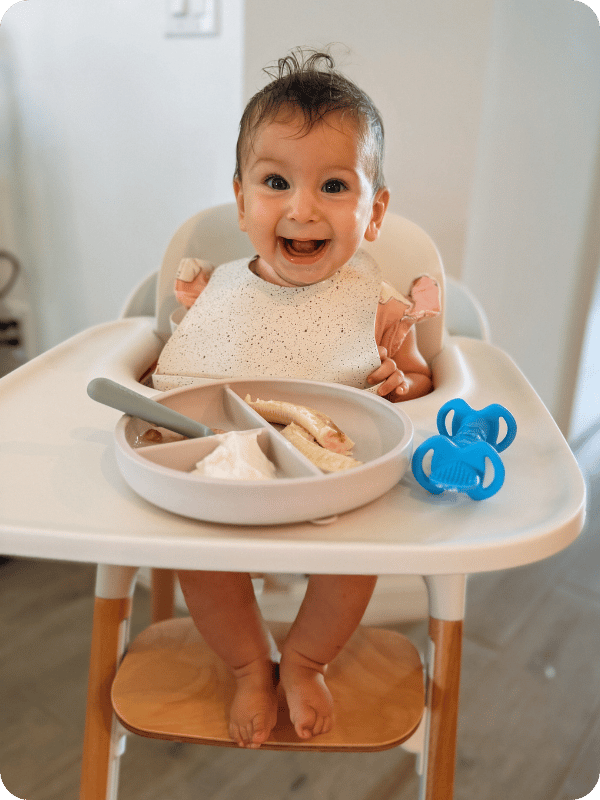
Babies can eat eggs as soon as they start solids, around 6 months of age. In fact, eggs can be one of the best “first foods” for littles as they begin exploring texture!
Fear of food allergies is a common reason that parents delay offering allergens to their babies. One study found that 34% of parents reported avoiding introducing some foods out of fear of a potential allergy or hypersensitivity. (1) Awareness of the latest research can help reduce anxiety about introducing allergens at the beginning of starting solids.
Egg allergy in babies
There is ample evidence to support early introduction of eggs, typically between 4–6 months. (2) Since most infants are not ready to begin solids until around 6 months, once sitting is well-established, it’s important to note that introduction earlier than 6 months is not usually necessary. For infants with moderate to severe eczema, consultation with an allergist and/or immunologist before introducing allergens is recommended.
One clinical trial introduced 6 allergens—peanuts, eggs, milk, white fish, sesame, and wheat—to infants between 3–6 months of age until they turned 3. The results: a 67% reduction in egg allergies and 100% reduction in peanut allergies in children who consumed sufficient amounts of each. (3) Researchers also concluded that early introduction of the studied allergens was safe. (3)
This study is one that parents often hear about, and it leads them to believe that allergens should be introduced before 6 months of age, but that’s not necessarily true. Early introduction doesn’t exclusively mean prior to 6 months old. See the next study below, and read more about when to introduce allergens here.
For egg allergies specifically, one study fed cooked egg powder in gradually increasing doses to infants being treated for eczema from 4–10 months of age. Results found that early egg exposure reduced the risk of egg allergy by 79%. (5)
“Early and often” guidelines have also been linked to a drastic decrease in peanut allergies in the US. Prevalence of peanut allergies has fallen by more than 40% since 2017 and the adoption of new guidelines. (4)
So, it may be scary or overwhelming at first, but the research supports offering eggs as soon as baby shows all the readiness signs for solids!
How to introduce eggs to baby
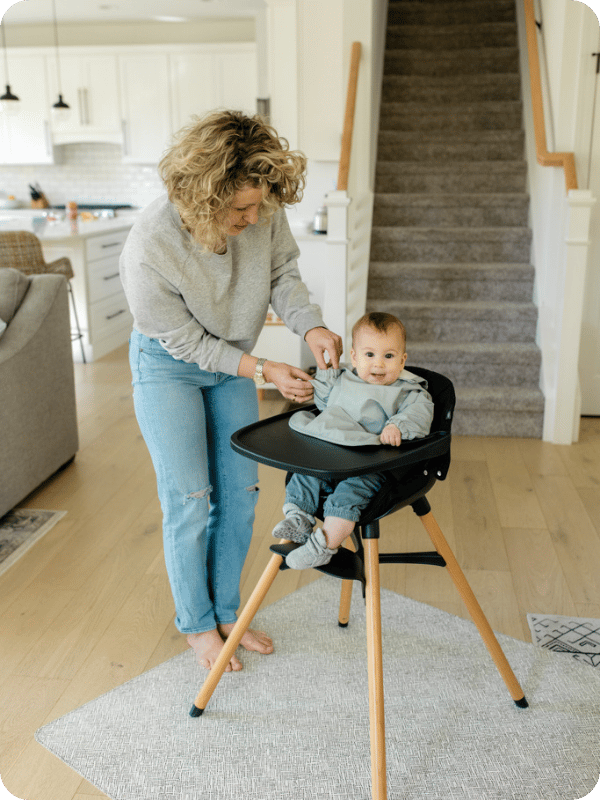
Whether you plan to offer baby purees or do baby-led weaning, there are ways to serve eggs to your little one. Cooked eggs are generally a soft solid, which most infants can navigate early in their journey with complementary foods.
Keep in mind that it’s normal and expected that baby will frequently miss their mouth, spit out food, or even gag sometimes when starting solids. Serving foods in developmentally appropriate ways not only reduces the risk of choking, but also encourages infants to explore new flavors, textures, smells, and experiences with food. It’s okay if baby mostly plays with food when first starting solids!
By around 9–10 months, we expect to see baby begin to chew foods. Before then, baby may simply move food around on their tongue until it falls out of their mouth or they swallow. And that’s okay!
Our two favorite ways to prepare eggs for starting solids are below.
Option 1:
Fry an egg! If you are cooking it in butter, make sure milk protein has already been introduced. Break the yolk while cooking so that it spreads throughout the egg, then cook until egg white and yolk are fully cooked. Cut into strips about the width and length of 1–2 fingers and offer them to baby.
Option 2:
Make a hard boiled egg. First, focus on the yolk. Scoop it out and mash it up with breastmilk, formula, or cow’s milk (if already introduced). You can also offer the egg white in strips for baby to hold and mash down. Both of these are great opportunities to practice self-feeding, as you can give baby a pre-loaded spoon or hand them a slice of the white part of the egg and let them take it from there.
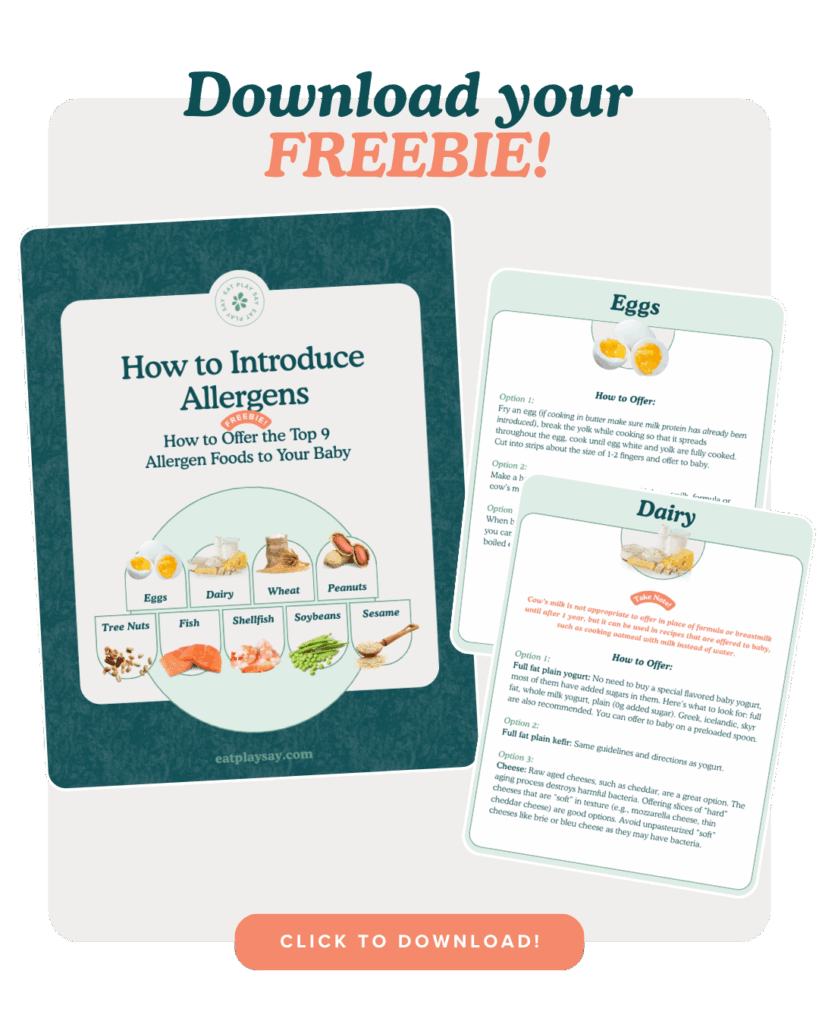
Wondering how to prepare and serve other allergens, such as peanuts, dairy, wheat, shellfish, and more? Download our FREE guide on Introducing Allergens below!
Introducing one allergen at a time
When introducing common allergens, you can serve them with other “safe” foods that have already been established with your baby. However, it’s best to avoid serving multiple allergens at the same time unless they have all been introduced several times.
This doesn’t mean that you need to space allergens out by weeks or months! Instead, try offering an allergen a few times over the course of 3–4 days before moving on to the next one. For example, butter and cow’s milk (mentioned above) should be avoided when first preparing eggs if dairy has not yet been introduced. This helps ensure that potential allergies or sensitivities are correctly associated with the allergen responsible for reactions.
More infant feeding support
Starting solids doesn’t have to be the scariest thing you’ve ever done! With the right tools and resources in your pocket, you can support baby on every step of their feeding journey.
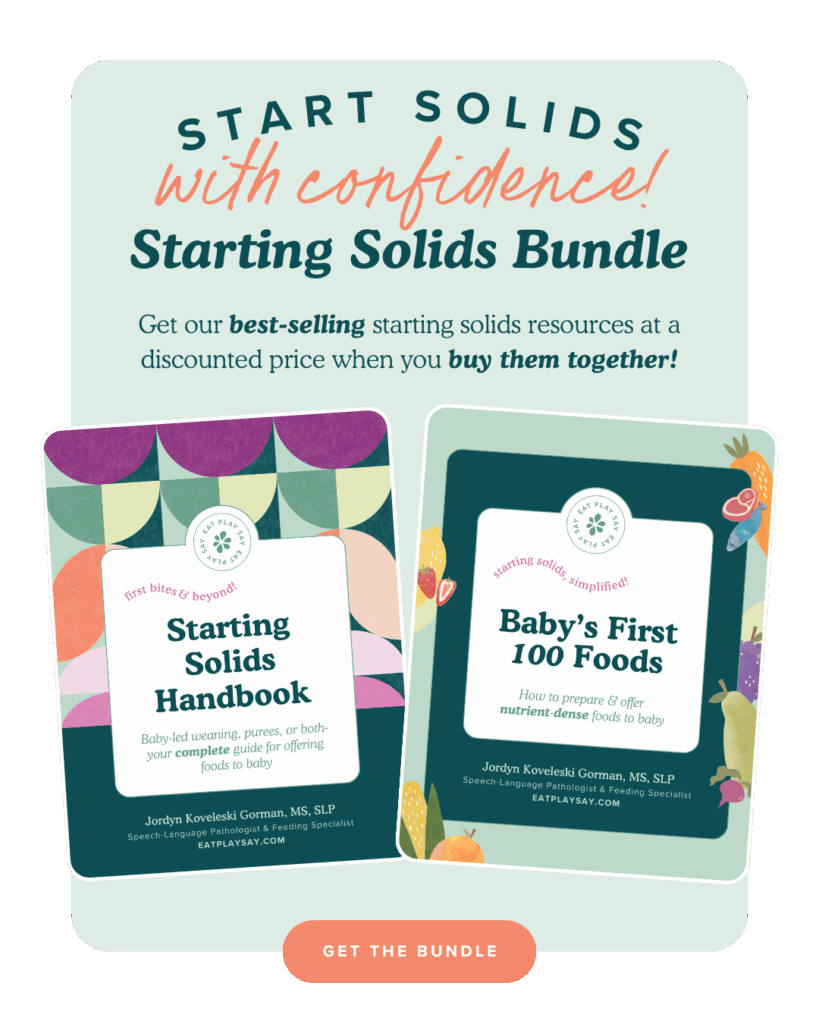
The Starting Solids Handbook and Baby’s First 100 Foods bundle is our most in-depth resource for feeding your little one from 6 months and beyond! Packed with 200+ pages of evidence-backed tips, tricks, and recipes for serving foods, the Starting Solids Bundle will answer every question you have about starting solids.
For more free educational content, check out our blog:
- More about starting solids
- Breast and bottle feeding
- Infant & toddler development
- Play activities that support your little’s skills
- Speech and language resources
Sources
- Holmberg Fagerlund B, Helseth S, Andersen LF, Småstuen MC, Glavin K. Parental concerns of allergy or hypersensitivity and the infant’s diet. Nurs Open. 2018 Aug 19;6(1):136-143. doi: 10.1002/nop2.195. PMID: 30534403; PMCID: PMC6279714.
- Trogen B, Jacobs S, Nowak-Wegrzyn A. Early Introduction of Allergenic Foods and the Prevention of Food Allergy. Nutrients. 2022 Jun 21;14(13):2565. doi: 10.3390/nu14132565. PMID: 35807745; PMCID: PMC9268235.
- Perkin MR, Logan K, Tseng A, Raji B, Ayis S, Peacock J, Brough H, Marrs T, Radulovic S, Craven J, Flohr C, Lack G; EAT Study Team. Randomized Trial of Introduction of Allergenic Foods in Breast-Fed Infants. N Engl J Med. 2016 May 5;374(18):1733-43. doi: 10.1056/NEJMoa1514210. Epub 2016 Mar 4. PMID: 26943128.
- Stanislaw J. Gabryszewski, Jesse Dudley, Jennifer A. Faerber, Robert W. Grundmeier, Alexander G. Fiks, Jonathan M. Spergel, David A. Hill; Guidelines for Early Food Introduction and Patterns of Food Allergy. Pediatrics November 2025; 156 (5): e2024070516. 10.1542/peds.2024-070516
- Natsume O, Kabashima S, Nakazato J et al. Two-step egg introduction for prevention of egg allergy in high-risk infants with eczema (PETIT): a randomised, double-blind, placebo-controlled trial. The Lancet, 2016; 389, 276-286
Leave a Reply
OTHER POSTS YOU MAY LIKE:



MS, SLP
Founder of Eat Play Say, Speech-Language Pathologist, Feeding Specialist, Play Expert, Mom of 3
Jordyn Koveleski Gorman
SPECIALIZES IN: Infant and toddler speech-language, play, and feeding development, and curating a team that provides expert help that feels like a reassuring text from that one mom friend
EDUCATION: Jordyn received her BS in Speech-Language Pathology from Bloomsburg University and her MS in Speech-Language Pathology from Towson University
FAVE PARENTING FIRST: “The first true smile, it’s the sweetest!”

MS, CCC-SLP, CBS, IBCLC
Speech-Language Pathologist & Feeding Specialist, Certified Breastfeeding Specialist, International Board Certified Lactation Consultant
Jessica Nicholson Cocca
SPECIALIZES IN: Breast and bottle feeding, tongue ties, oral motor dysfunction, starting solids, infant and toddler speech, treating oral motor disorders
EDUCATION: Jessica received her BS in Communication Sciences and Disorders from Pennsylvania State University in 2015 and her MS in Speech-Language Pathology from Towson University in 2017
FAVE PARENTING FIRST: “Baby’s first wave! What a fun first communication gesture!”

MA, CCC-SLP, CLC
Speech-Language Pathologist, Certified Lactation Counselor
Jennifer McFarlin
SPECIALIZES IN: Breast and bottle feeding, tongue ties, starting solids, infant and toddler speech development
EDUCATION: She received her BS in Speech-Language Pathology from Ball State in 2014 and a MA in Speech-Language Pathology from Ball State in 2016.
FAVE PARENTING FIRST: “My favorite baby’s first is their first true smile that just warms your soul knowing they are smiling at you. My other favorite is their first word. I love watching their language explode!”

MS, CCC-SLP
Bilingual Speech-Language Pathologist
Nicole La Petina Kelly
SPECIALIZES IN: Bilingual development (Spanish-English), supporting multilingual families, infant and toddler speech
EDUCATION: She received her BA in Communication Sciences and Disorders and in Spanish from the University of Wisconsin-Madison in 2014 and her MS in Speech-Language Pathology with an English-Spanish Specialization from Marquette University in 2016.
FAVE PARENTING FIRST: “It’s the first slobbery kisses for me!”

RDN, LD
Licensed Registered Dietitian
Kimberly Vede
SPECIALIZES IN: Infant and pediatric nutrition including breastfeeding, formula feeding, and starting solids. She also specializes in prenatal and postpartum nutrition.
EDUCATION: She received her BSc in Biology in 2014 from Life University, and her BSc in Dietetics from Life University in 2019.
FAVE PARENTING FIRST: ”The first time they say ‘mama!’”


This checklist was created with input from a Speech-Language Pathologist, Occupational Therapist and Physical Therapist and has been downloaded over 20,000 times by parents worldwide. Learn the important milestones to pay attention to, and keep it in your digital back pocket during the baby + toddler years!
Comprehensive Milestone Checklist for gross motor, fine motor, and speech-language milestones for 0-36 months,
DOWNLOAD FOR FREE


