


Baby Led Weaning vs. Purees: Pros & Cons
February 13, 2025
Jordyn Koveleski Gorman

Last Updated on July 16, 2026 by Jordyn Koveleski Gorman
As a pediatric feeding specialist, I’m often asked to choose which is better in a battle: baby led weaning vs. purees. Parents want to know if it’s better to start with purees for a while and then move up to chewable foods, or if they should skip the purees all together and go right to chewable foods.
The answer: it’s really not as black and white as you’d think! Personally, I have taken both approaches to feeding with my (very different) babies, and let me tell you, both approaches led to “good” eaters down the road. Let’s break down the pros and cons of baby led weaning vs. purees together!
What is baby led weaning (BLW)?
Just as there are conflicting opinions about BLW, there are different definitions, too.
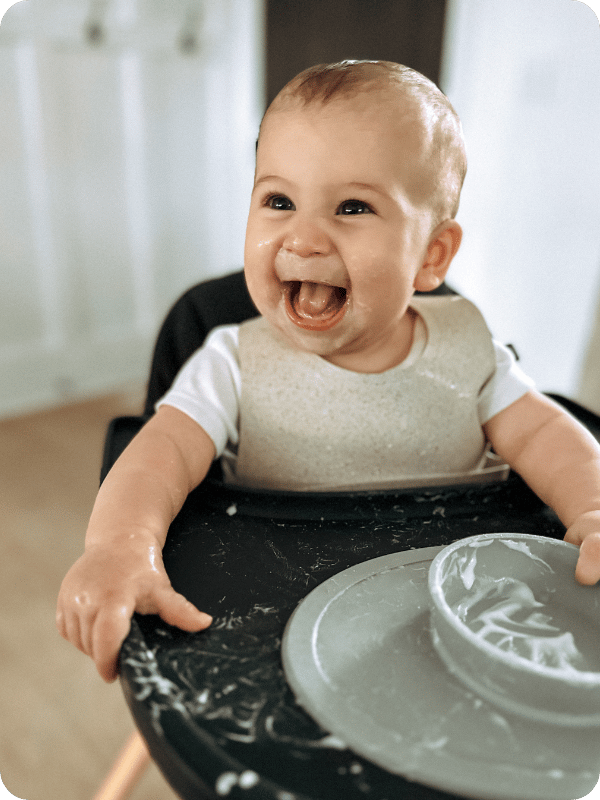
For example, Solid Starts defines BLW as, “A method of starting solids that skips spoon feeding and ‘stages’ of baby food. Instead, baby is offered a variety of food textures from the start and allowed to practice feeding themselves.” (1)
In recent years, other food specialists have defined BLW a little less specifically. One definition is a method of introducing foods where baby self-feeds all or the majority of bites and the caregiver does not offer bites to baby.
There are two elements that most definitions of baby led weaning have in common. First, that the focus is on offering naturally occurring foods. And, secondly, having baby bring bites to their own mouth rather than be assisted by a caregiver. Additionally, BLW focuses on starting solids around 6 months, or once baby can sit up unassisted and shows readiness signs for eating.
What are baby purees?
The counter approach to BLW is starting with a puree on a spoon, such as previously recommended rice cereal or a pureed fruit/vegetable. Generally, with this approach, the caregiver offers the food to the baby instead of baby self-feeding.
These purees may be introduced around 6 months, but they are commonly introduced earlier, around 4–5 months of age. However, earlier introduction is not recommended until baby shows all signs of readiness.
Parents are sometimes told by professionals that baby doesn’t need to be able to sit unsupported to eat purees, but unsupported sitting should be a prerequisite for any and all food textures.
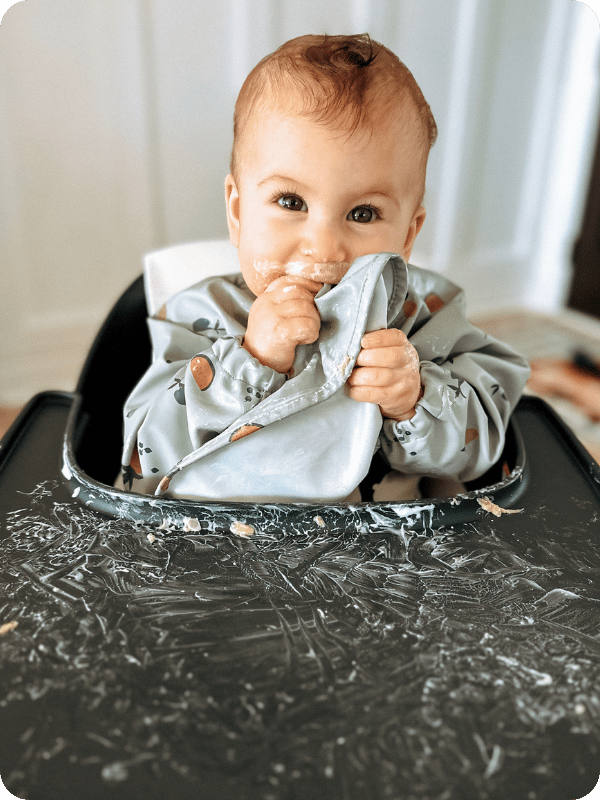
Baby led weaning vs. purees: The pros & cons of both
Knowing the pros and cons of both approaches can help you make a decision that’s best for your baby.
Baby led weaning
BLW is considered a “feeding fad” to some and a “feeding lifestyle” to others. This approach has some good underlying principles, but also some limitations.
BLW Pros:
- Encourages independence, self-feeding, and hand-to-mouth experience with foods.
- Encourages baby to use gestures to communicate when they want to eat food and when they are finished eating.
- Allows baby to take the lead with eating and listen to hunger cues as they are more in control of their bites.
- Provides baby with exposure to individual foods as opposed to blended purees of multiple foods.
- Gets baby chewing early! Babies who are chewing before 10 months of age are less likely to be labeled “picky” by their parents in toddlerhood. And chewing is excellent for jaw development and for speech production, too! (2)
- Usually starts closer to 6 months. Baby’s gross motor skills are more developed (e.g., greater trunk stability and neck control), which is important for a good eating experience.
BLW Cons:
- BLW can be strict. Some BLW professionals promote saying no to spoons, no purees, etc. This can pressure parents to feel the need to be restrictive to littles.
- Baby does not usually get exposure to a spoon. This can impact their speech-language skills, as spoon feeding supports bilabial sounds like “ma” and “ba” and provides input to the mouth.
- Some BLW professionals discount purees as a texture, but purees naturally occur in the world. Hummus, yogurt, applesauce, sour cream, and soup are all examples of purees. It’s not a good idea to skip over any texture, as exposure to all textures is what makes a well-rounded eater.
- Babies might not be ready right at 6 months. Looking at skills is more important than looking at age. (This means that yes, it’s okay to wait until 6.5 or 7 months.)
- Some parents expect babies to self-feed at 6 months of age, when their baby may not yet be developmentally ready. This can place unfair expectations on the baby and lead to negative eating experiences.
- Sometimes parents offer baby foods that are not developmentally appropriate for their skill level. This can cause a negative experience with food, like excessive gagging or a choking episode. Just because soft solids can be offered doesn’t mean that baby will do well with them right off the bat!
Purees
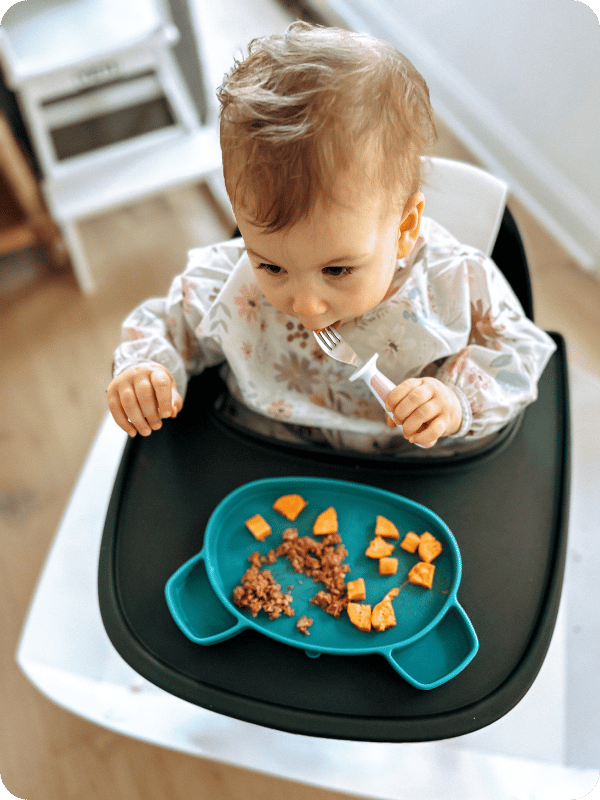
Spoon feeding purees is considered the “traditional feeding approach.” Regardless of its long history, spoon feeding purees also has pros and cons.
Puree Pros:
- Purees are usually most developmentally appropriate for babies who are able to sit in the high chair. Babies are less likely to have a negative experience with this texture because it’s smooth, easy to manage, and easy to offer.
- Spoon feeding supports speech-language skills. When babies use a spoon, they tend to find their lips, which then leads to producing more sounds like “ma, ba,” and raspberries.
- Purees help teach baby how to mash food. Then, they learn how to manage other solid foods as they are introduced (e.g., banana, avocado, peanut butter).
Puree Cons:
- Parents sometimes end up “doing all the work” and scraping the spoon of puree on the baby’s upper lip. As a result, baby tends to be a less active participant in eating and might wait for the caregiver to initiate.
- Purees provide baby with less opportunities to self-feed. The utensil use can be harder to achieve than grasping food in the hand and bringing it to the mouth. With purees, parents are also doing most of the feeding, so baby may not look to self-feed as often or at all.
- Parents may take longer to expose their child to higher textures, like lumpy or mashed solids. Parents sometimes continue to feed baby purees because it is “easier,” and that can delay their oral motor skill progression.
- Some parents get in the habit of hiding foods in a puree food combination. Hiding foods in purees doesn’t allow baby to taste each food individually and can lead to later refusal of foods.
Can you combine baby led weaning and purees?
Developmentally, it is most appropriate for one of baby’s first foods to be a puree on the spoon. The good news is that the feeding approach you take doesn’t have to be all or nothing. (And if anyone tries to tell you otherwise, that’s an excellent sign to look elsewhere for advice.)
If future pickiness is a concern, let this comfort you: research has indicated that, in general, neither purees nor BLW lead to a marked difference in picky eating later on. (3) Every child is unique, and that means every feeding journey should be, too.
The foundational principles of BLW are solid! Encouraging sensory and food exploration with baby’s hands as soon as they start sitting in the high chair is important and good.
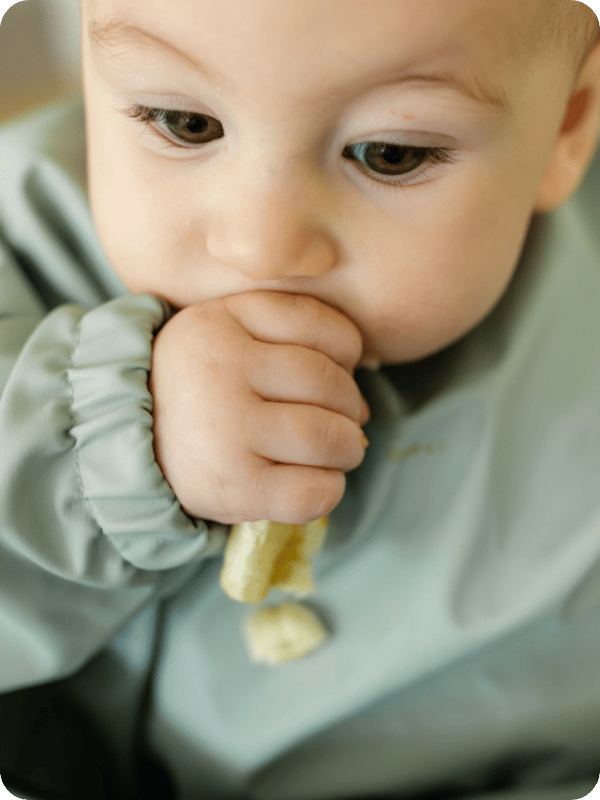
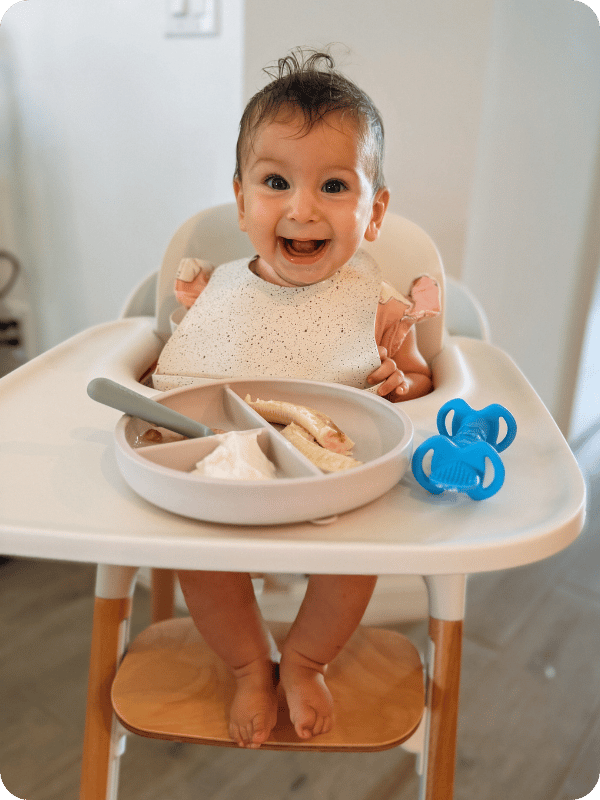
From a speech-language and feeding specialist’s perspective, I recommend a blended approach. For instance, while spoon feeding a puree or mashed food, offer the same soft solid food on the tray as well (e.g., mashed down banana with a slice of banana). With this method, baby learns the skill of spoon feeding and has the opportunity to bring hands to mouth.
Baby can learn independence and self-feeding skills! And baby can also learn how to eat from a spoon and support speech-language skills.
After baby’s oral motor skills mature with spoon feeding, you can slowly replace purees with more solid foods, helping baby self-feed as needed. You can still take a baby-led approach with purees, as long as you are letting baby be an active participant in eating.
More starting solids support
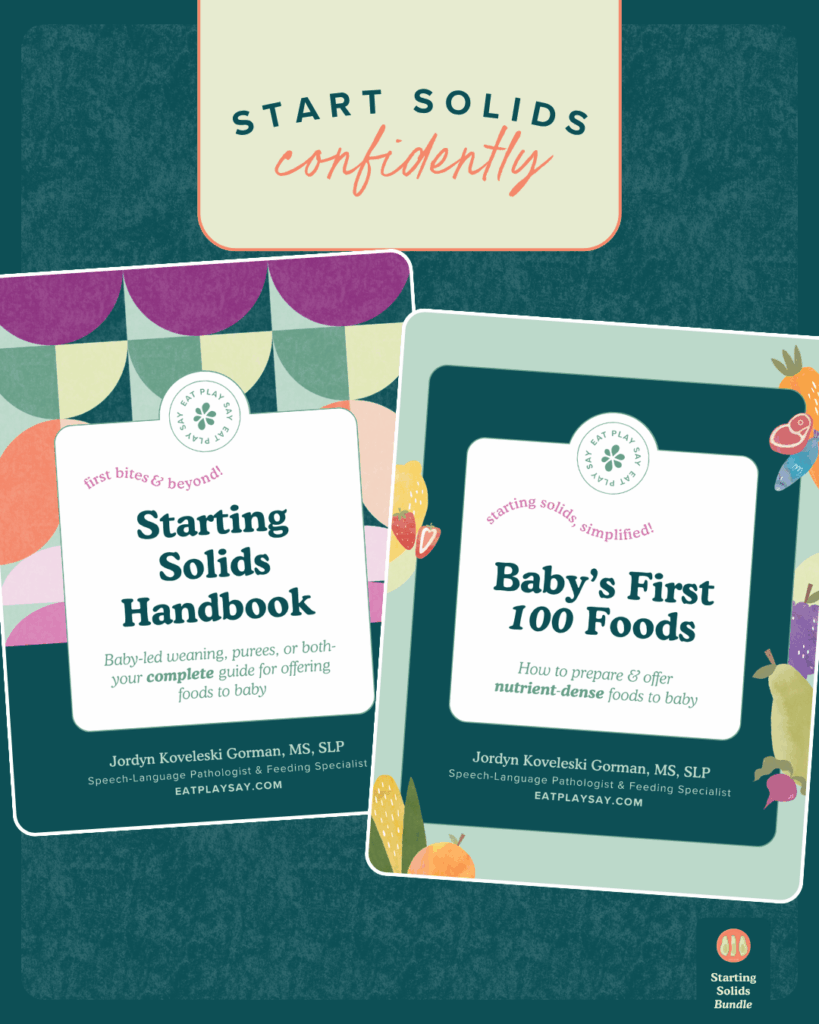
Starting solids is a big milestone, but it doesn’t have to keep you up at night! Our team of child development specialists created the Starting Solids Handbook and Baby’s First 100 Foods guide for this exact reason.
This all-hands-on-deck handbook bundle has more than 200 pages of research-backed tips, tricks, and education to help you feel empowered to tackle solids with your little one! And our balanced, blended approach gives you space to make the decisions that feel best for your family while also reducing those late-night Google searches. Grab your bundle below!
Sources
- Solid Starts, “What is Baby-Led Weaning?” Accessed June 2026. Solid Starts Blog.
- Emmett PM, Taylor CM. Being inspired: What we have learned about picky eating in childhood from using questionnaires on feeding practices and behaviors in a longitudinal birth cohort. Curr Res Psychiatry. 2021;1(4):48-51. PMID: 35419570; PMCID: PMC7612611.
- Białek-Dratwa A, Kowalski O. Infant Complementary Feeding Methods and Subsequent Occurrence of Food Neophobia-A Cross-Sectional Study of Polish Children Aged 2-7 Years. Nutrients. 2023 Oct 28;15(21):4590. doi: 10.3390/nu15214590. PMID: 37960243; PMCID: PMC10648584.
OTHER POSTS YOU MAY LIKE:


MS, SLP
Founder of Eat Play Say, Speech-Language Pathologist, Feeding Specialist, Play Expert, Mom of 3
Jordyn Koveleski Gorman
SPECIALIZES IN: Infant and toddler speech-language, play, and feeding development, and curating a team that provides expert help that feels like a reassuring text from that one mom friend
EDUCATION: Jordyn received her BS in Speech-Language Pathology from Bloomsburg University and her MS in Speech-Language Pathology from Towson University
FAVE PARENTING FIRST: “The first true smile, it’s the sweetest!”

MS, CCC-SLP, CBS, IBCLC
Speech-Language Pathologist & Feeding Specialist, Certified Breastfeeding Specialist, International Board Certified Lactation Consultant
Jessica Nicholson Cocca
SPECIALIZES IN: Breast and bottle feeding, tongue ties, oral motor dysfunction, starting solids, infant and toddler speech, treating oral motor disorders
EDUCATION: Jessica received her BS in Communication Sciences and Disorders from Pennsylvania State University in 2015 and her MS in Speech-Language Pathology from Towson University in 2017
FAVE PARENTING FIRST: “Baby’s first wave! What a fun first communication gesture!”

MA, CCC-SLP, CLC
Speech-Language Pathologist, Certified Lactation Counselor
Jennifer McFarlin
SPECIALIZES IN: Breast and bottle feeding, tongue ties, starting solids, infant and toddler speech development
EDUCATION: She received her BS in Speech-Language Pathology from Ball State in 2014 and a MA in Speech-Language Pathology from Ball State in 2016.
FAVE PARENTING FIRST: “My favorite baby’s first is their first true smile that just warms your soul knowing they are smiling at you. My other favorite is their first word. I love watching their language explode!”

MS, CCC-SLP
Bilingual Speech-Language Pathologist
Nicole La Petina Kelly
SPECIALIZES IN: Bilingual development (Spanish-English), supporting multilingual families, infant and toddler speech
EDUCATION: She received her BA in Communication Sciences and Disorders and in Spanish from the University of Wisconsin-Madison in 2014 and her MS in Speech-Language Pathology with an English-Spanish Specialization from Marquette University in 2016.
FAVE PARENTING FIRST: “It’s the first slobbery kisses for me!”

RDN, LD
Licensed Registered Dietitian
Kimberly Vede
SPECIALIZES IN: Infant and pediatric nutrition including breastfeeding, formula feeding, and starting solids. She also specializes in prenatal and postpartum nutrition.
EDUCATION: She received her BSc in Biology in 2014 from Life University, and her BSc in Dietetics from Life University in 2019.
FAVE PARENTING FIRST: ”The first time they say ‘mama!’”


This checklist was created with input from a Speech-Language Pathologist, Occupational Therapist and Physical Therapist and has been downloaded over 20,000 times by parents worldwide. Learn the important milestones to pay attention to, and keep it in your digital back pocket during the baby + toddler years!
Comprehensive Milestone Checklist for gross motor, fine motor, and speech-language milestones for 0-36 months,
DOWNLOAD FOR FREE


