


The Link Between Infants Sitting Up & Starting Solids
June 2, 2024
Jordyn Koveleski Gorman

Last Updated on September 10, 2026 by Jordyn Koveleski Gorman
This page contains affiliate links. We will receive a commission on qualifying purchases using these links.
Is your 4–5 month old staring you down during dinner, so much so that you think they’re ready for their first tastes of solids? This can be such an exciting, yet daunting milestone to reach! But, we want to proceed with caution here. Possibly more than any other developmental milestone, parents often start solids before baby is developmentally ready.
You might be thinking, “Well, my child’s pediatrician told us to start solids at baby’s 4 month well visit, so they must be ready!” But did you know that the American Academy of Pediatrics explicitly recommends waiting until ~6 months to introduce solid foods, including purees? (1)
There are many reasons why it’s not recommended to start solids before 6 months. Another major milestone plays a role in why it’s best to wait: sitting! For most babies, sitting without support occurs around 6 months, perfectly aligned with the recommendation for starting solids! Waiting until baby can sit unsupported for several minutes is the safest, most developmentally appropriate approach to starting solids.
Rest assured, it’s a great sign if your little one isn’t quite ready to sit on their own but is showing interest in solid foods. But interest alone does not mean you have to start before your baby’s physical development matches up! Let’s break down the connection between independent sitting and starting solids from the perspective of a feeding specialist.
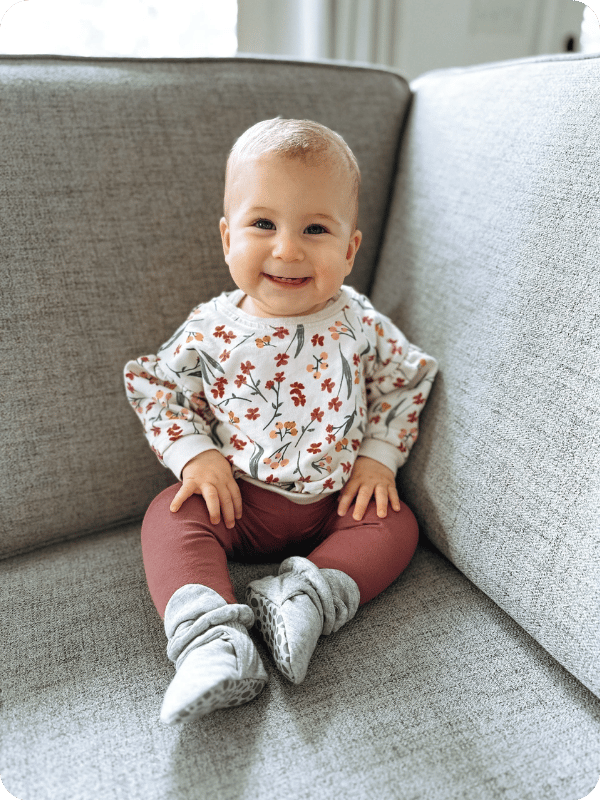
Postural support is important for all feeding skills
During bottle or breast feeding, caregivers are taught to make sure that baby’s ears, shoulders, and hips are aligned. When baby’s body is aligned at midline (their spine is aligned and supported), feedings tend to be calmer and more efficient. Feeding is a whole-body process using many muscles, and the mouth is the beginning of the digestive system. This is true whether baby is taking in milk or eating solid foods.
Sitting upright is the best posture to chew and swallow solid foods, including purees. There is even research suggesting that food tastes better when a person is seated! (2) Sitting up with strong head and neck control ensures that baby will be able to move food in, out, and around their mouth safely. Learn more about the risks of starting solids early on our blog.
Sitting up helps infants eat solids
Gross motor skill development supports fine motor skill development, with gross motor skills typically developing slightly ahead of fine motor skills. (3) That means that big body movements support smaller, fine-tuned body movements. When baby is working on gross motor skills like rolling, sitting, or crawling, it’s quite noticeable!
Some other important gross motor skills that improve core strength include: lifting their head while laying on their tummy, pushing up on their palms while on their tummy, rolling symmetrically to both sides, and weight shifting on their hands (like when reaching for an object on their belly).
All of these skills work the core muscles and help increase stability and strength, which will give baby the confidence and ability to bring food, cups, and utensils to and away from their mouth with one or both hands. Without stability and strength, baby may not feel as secure, eager, and confident to explore foods.
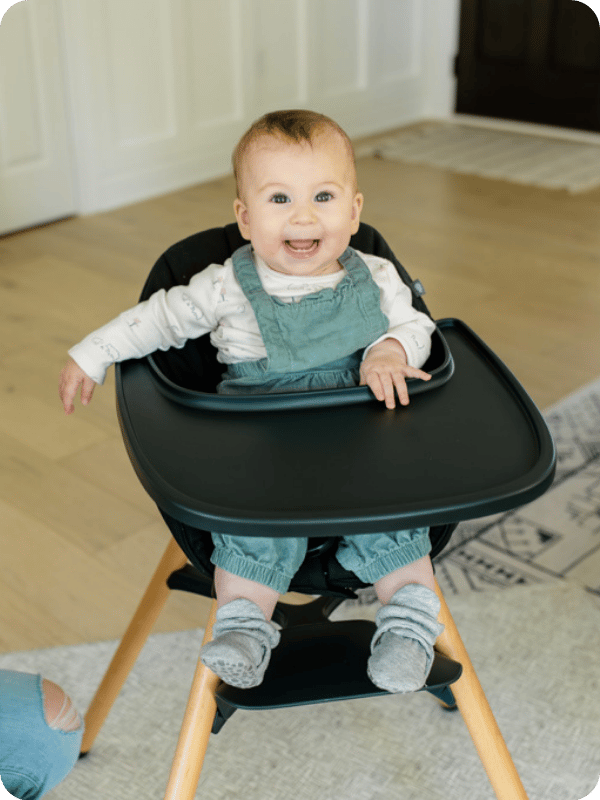
Sitting up helps baby self-feed
The important movements involved during eating are considered fine motor skills. They occur sequentially, just like gross motor skills do.
These feeding skills and the order they typically occur in are: bringing hands to mouth, picking up food, moving food in and out of the mouth, spitting food out, bringing a spoon to the side of the mouth to chew/lick, moving food side-to-side, and chewing food. (1)
Most of these skills are expected to happen once baby is strong enough to sit unsupported. If they aren’t yet sitting well when starting solids, baby will likely not have many of the skills needed to manage foods. They may struggle with lack of coordination or have difficulty attempting these skills, which puts them at risk for unsafe swallowing and can lead to negative experiences in the high chair.
Starting solids soon? Don’t do it alone! Download our FREE Starting Solids Cheat Sheet for tips, tricks, and evidence-backed guidance from our team of pediatric feeding experts!
When will my baby sit independently?
Independent sitting is expected to occur between 5–7 months of age, with most babies meeting this milestone by the end of the sixth month. (1) By 7 months, most babies are sitting up independently (alone, on the floor with nothing propping them up) and playing with toys and teethers while seated.
If your baby was born early (before 37 weeks gestation), make sure to use their adjusted age when considering solid readiness.
Around 5 months is usually a good time to practice sitting in the high chair. Instead of offering foods, begin with toys they like at mealtimes. This way, parents can observe baby’s endurance, comfort level, core strength, and fine motor skills as they near starting solids. Check the fit of your high chair (and troubleshoot discomfort) here.
If baby can sit comfortably for 5–10 minutes upright in the high chair without slouching, leaning or slumping over, they may be ready to start solids! Sitting unsupported on the floor for 3–5 minutes is another indicator that baby is likely ready to start solids soon. With these skills mastered, they will likely be able to easily pick up spoons and foods, explore a mess on their tray, and begin to bring utensils and food to their mouth. Read more about the signs of readiness for starting solids here.
Examples of babies sitting upright by themselves
Not sure if your baby is truly sitting upright by themselves in the high chair? Let’s look at some examples of leaning vs. self-supported high chair positioning.
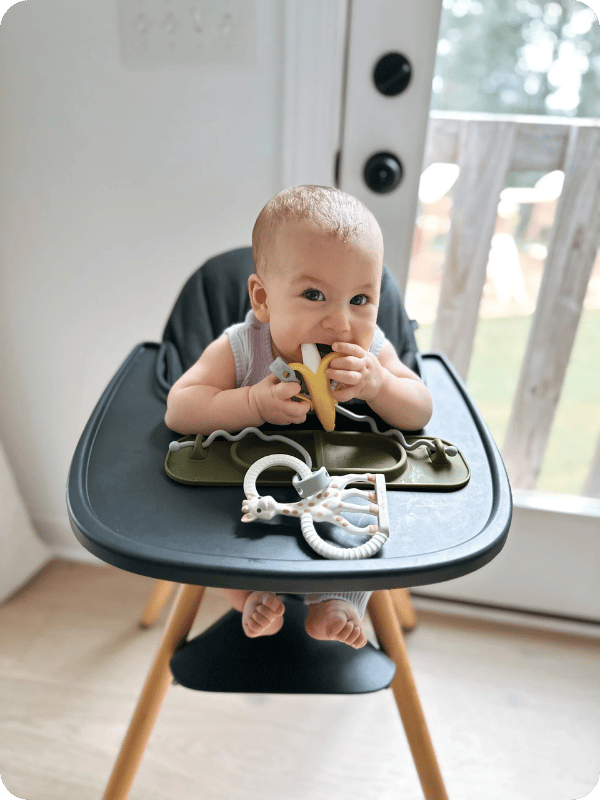
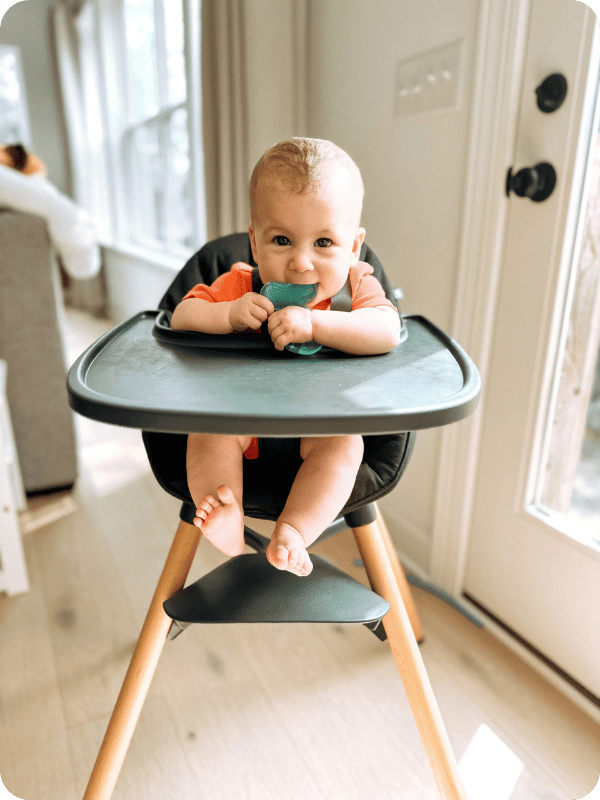
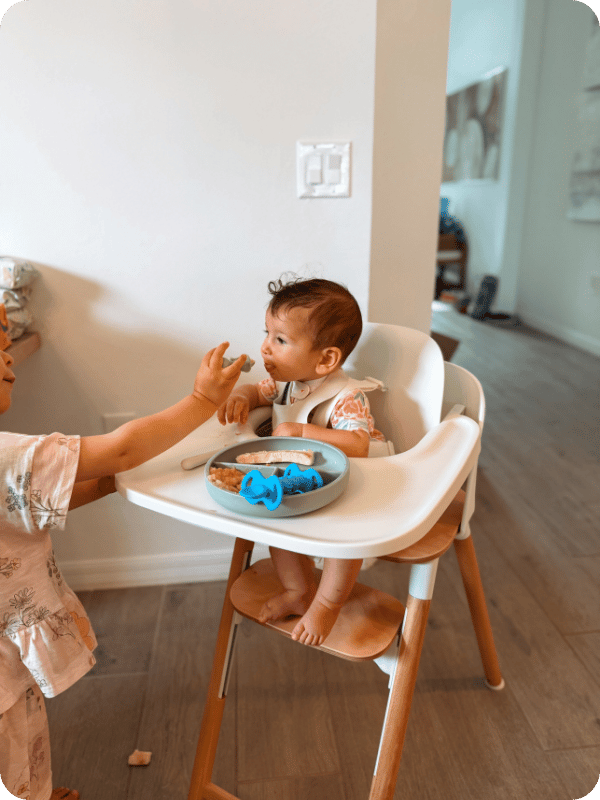
The baby above has not hit the milestone of sitting independently on the floor, and is not showing signs of solids readiness. This baby is hunching over in the high chair. She is using her elbows to help keep her body upright, which indicates that she does not have enough core strength to sit fully upright and bring her hands to her mouth. Here, she is bringing her body to her hands, instead, to compensate for that lack of core strength.
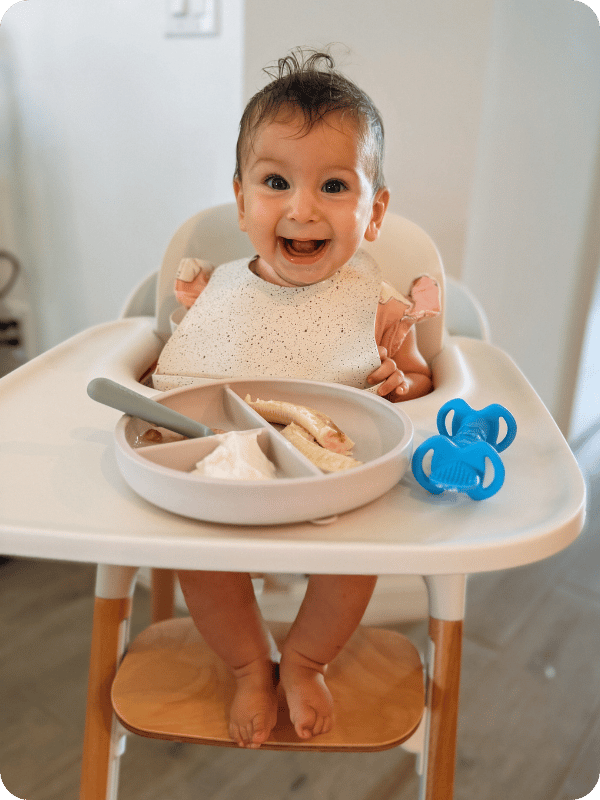
By contrast, the baby below has hit the milestone of sitting independently on the floor and is showing signs of solids readiness. This baby is 6 months old and sitting independently on the floor for 3–5 minutes. See how upright she is in the high chair, with her body in the middle of the chair and no leaning.
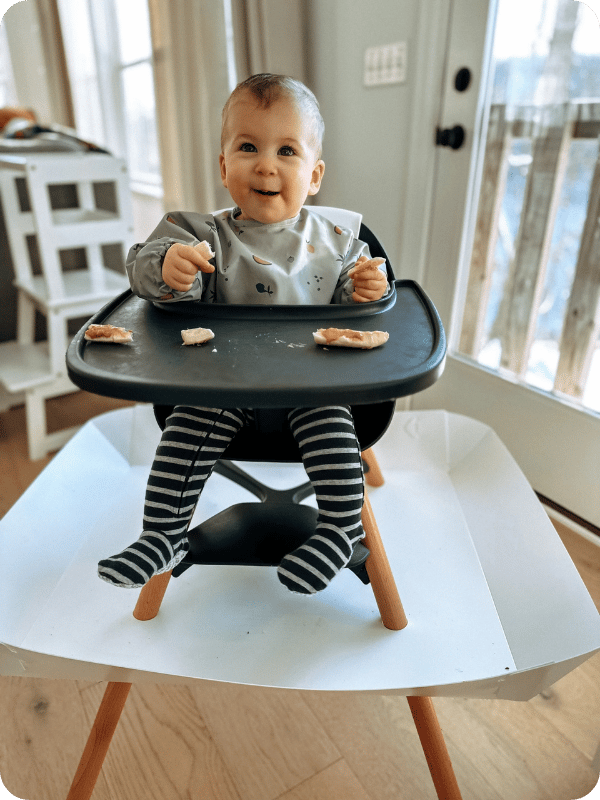

These pictures show the same high chair and the same baby with about a month’s time in between. In just a few short weeks, this baby went from not being ready to start solids, to being ready! If your little one is approaching 7 months of age and is not sitting up well with or without support, reaching out to a physical therapist near you is recommended. Or you can book a consultation with one of our professionals to learn more.
More infant support
Starting solids can feel daunting! But having all the information you need to tackle solids in a way that feels right for your family can turn this overwhelming task into something exciting. That’s why we created our collection of Handbooks!
Written by our team of pediatric development specialists, every guide cuts through the chaos to deliver exactly what you need. No expert jargon, just real-life guidance to empower parents! The Starting Solids bundle has everything you need to start solids with confidence!
Sources
- Jennifer M. Zubler, Lisa D. Wiggins, Michelle M. Macias, Toni M. Whitaker, Judith S. Shaw, Jane K. Squires, Julie A. Pajek, Rebecca B. Wolf, Karnesha S. Slaughter, Amber S. Broughton, Krysta L. Gerndt, Bethany J. Mlodoch, Paul H. Lipkin; Evidence-Informed Milestones for Developmental Surveillance Tools. Pediatrics March 2022; 149 (3): e2021052138. 10.1542/peds.2021-052138
- Dipayan Biswas, Courtney Szocs, Annika Abell, Extending the Boundaries of Sensory Marketing and Examining the Sixth Sensory System: Effects of Vestibular Sensations for Sitting versus Standing Postures on Food Taste Perception, Journal of Consumer Research, Volume 46, Issue 4, December 2019, Pages 708–724, https://doi.org/10.1093/jcr/ucz018
- Sutapa P, Pratama KW, Rosly MM, Ali SKS, Karakauki M. Improving Motor Skills in Early Childhood through Goal-Oriented Play Activity. Children (Basel). 2021 Nov 2;8(11):994. doi: 10.3390/children8110994. PMID: 34828707; PMCID: PMC8625902.
OTHER POSTS YOU MAY LIKE:


MS, SLP
Founder of Eat Play Say, Speech-Language Pathologist, Feeding Specialist, Play Expert, Mom of 3
Jordyn Koveleski Gorman
SPECIALIZES IN: Infant and toddler speech-language, play, and feeding development, and curating a team that provides expert help that feels like a reassuring text from that one mom friend
EDUCATION: Jordyn received her BS in Speech-Language Pathology from Bloomsburg University and her MS in Speech-Language Pathology from Towson University
FAVE PARENTING FIRST: “The first true smile, it’s the sweetest!”

MS, CCC-SLP, CBS, IBCLC
Speech-Language Pathologist & Feeding Specialist, Certified Breastfeeding Specialist, International Board Certified Lactation Consultant
Jessica Nicholson Cocca
SPECIALIZES IN: Breast and bottle feeding, tongue ties, oral motor dysfunction, starting solids, infant and toddler speech, treating oral motor disorders
EDUCATION: Jessica received her BS in Communication Sciences and Disorders from Pennsylvania State University in 2015 and her MS in Speech-Language Pathology from Towson University in 2017
FAVE PARENTING FIRST: “Baby’s first wave! What a fun first communication gesture!”

MA, CCC-SLP, CLC
Speech-Language Pathologist, Certified Lactation Counselor
Jennifer McFarlin
SPECIALIZES IN: Breast and bottle feeding, tongue ties, starting solids, infant and toddler speech development
EDUCATION: She received her BS in Speech-Language Pathology from Ball State in 2014 and a MA in Speech-Language Pathology from Ball State in 2016.
FAVE PARENTING FIRST: “My favorite baby’s first is their first true smile that just warms your soul knowing they are smiling at you. My other favorite is their first word. I love watching their language explode!”

MS, CCC-SLP
Bilingual Speech-Language Pathologist
Nicole La Petina Kelly
SPECIALIZES IN: Bilingual development (Spanish-English), supporting multilingual families, infant and toddler speech
EDUCATION: She received her BA in Communication Sciences and Disorders and in Spanish from the University of Wisconsin-Madison in 2014 and her MS in Speech-Language Pathology with an English-Spanish Specialization from Marquette University in 2016.
FAVE PARENTING FIRST: “It’s the first slobbery kisses for me!”

RDN, LD
Licensed Registered Dietitian
Kimberly Vede
SPECIALIZES IN: Infant and pediatric nutrition including breastfeeding, formula feeding, and starting solids. She also specializes in prenatal and postpartum nutrition.
EDUCATION: She received her BSc in Biology in 2014 from Life University, and her BSc in Dietetics from Life University in 2019.
FAVE PARENTING FIRST: ”The first time they say ‘mama!’”


This checklist was created with input from a Speech-Language Pathologist, Occupational Therapist and Physical Therapist and has been downloaded over 20,000 times by parents worldwide. Learn the important milestones to pay attention to, and keep it in your digital back pocket during the baby + toddler years!
Comprehensive Milestone Checklist for gross motor, fine motor, and speech-language milestones for 0-36 months,
DOWNLOAD FOR FREE


