


When Can Baby Sit in the High Chair to Start Solids?
July 1, 2024
Jordyn Koveleski Gorman

Last Updated on September 10, 2026 by Jordyn Koveleski Gorman
This page contains affiliate links. We will receive a commission on qualifying purchases using these links.
Is it about time to bust out the high chair and start solids? What an exciting (and a little bit messy) journey ahead! Ensuring that baby can sit safely in the high chair when starting solids is an important prerequisite to offering those first bites of food, including purees.
High chair and feeding safety can sometimes be unintentionally overlooked, especially when parents receive outdated advice about the right time to start solids. Our team of feeding specialists created this guide to help you feel confident in your baby’s positioning and prepare for those first bites.
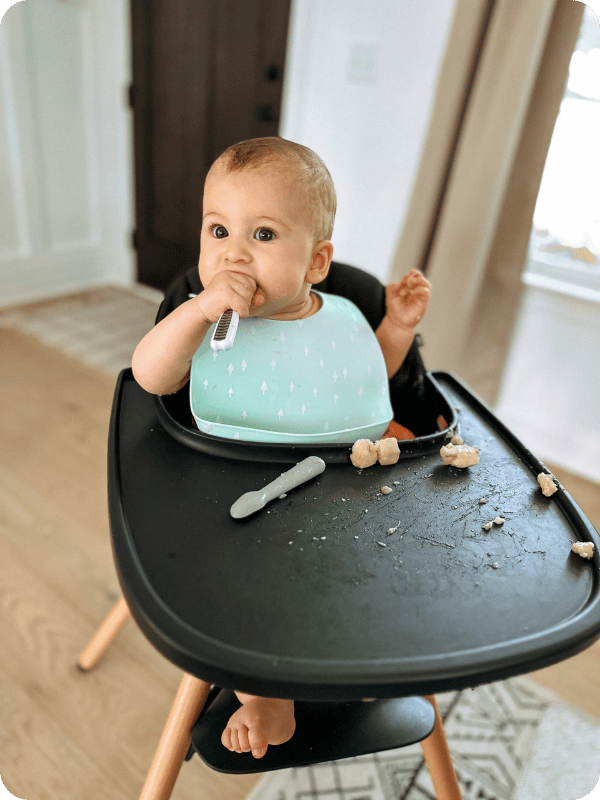
Proper high chair fit and positioning for baby
There are endless high chair options, so when choosing a new one or setting up what you have at home, it’s important to know why certain features matter.
When your baby is seated in the high chair for solids, it’s important to pay attention to the following:
- Baby’s body should be fully upright, not reclined or leaning.
- Their elbows should rest on the tray easily, with the tray hitting at the stomach instead of the chest.
- Baby’s feet need to have somewhere to rest. Depending on your high chair, their feet may not hit a footrest yet. We can show you what to do if so!
You may be thinking that surely none of these factors make a huge difference in baby’s feeding experience. But, actually, making sure that baby meets the 3 criteria above can help keep baby safe by preventing possible choking hazards and promoting active participation in feeds.
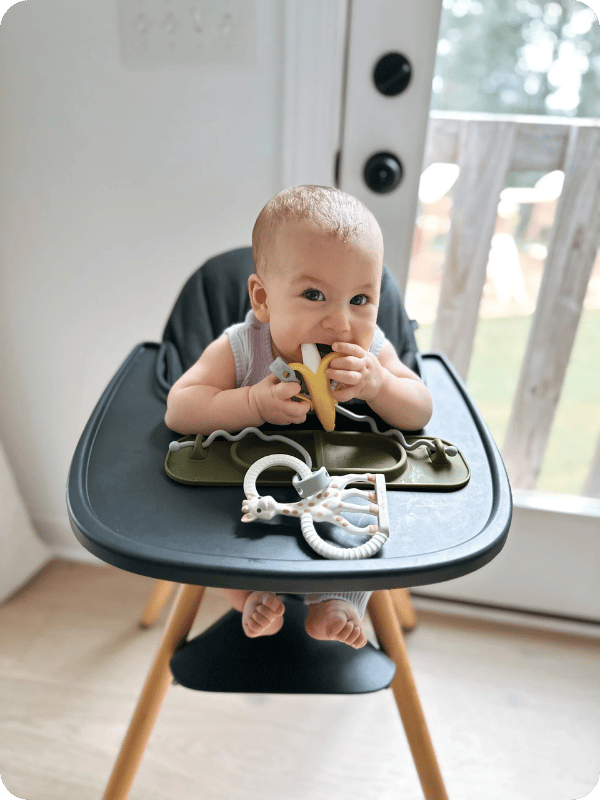
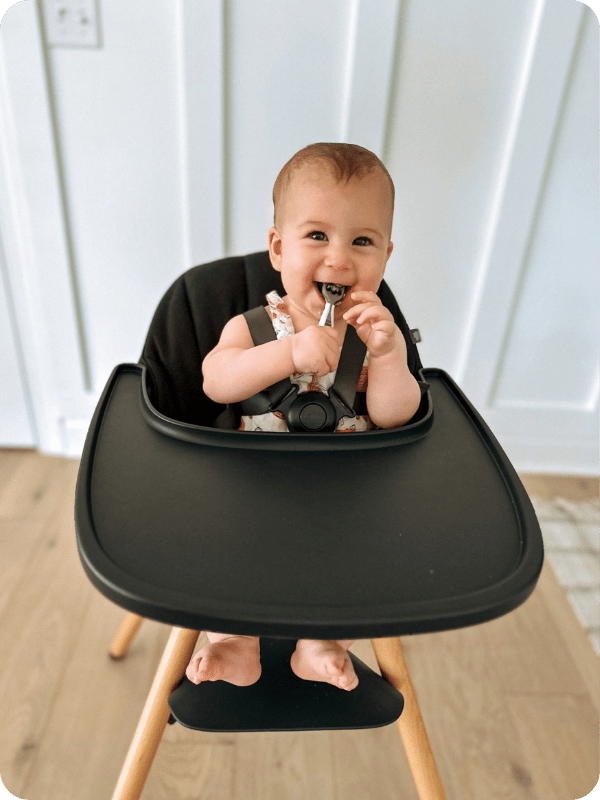
Hunching over in the high chair
The baby in the first photo is hunching in the high chair. This is not an optimal position for baby, as they cannot fully extend their arms to reach the food on the tray and they will likely fatigue during a meal.
By contrast, the baby in the second photo is sitting upright. This is a much more optimal position for baby, as they can reach all of the food and utensils on the tray and it’s much safer for swallowing!
Sitting baby in a 90-90-90 position in the high chair
Checking that baby is in a “90-90-90” position promotes safe feeding, but what does this mean? Basically, this is when baby’s body is supported at the hips, knees, and ankles with their elbows resting on the tray or table, allowing their joints to bend at a 90 degree angle. (1) As feeding specialists, we often refer to this positioning when working with littles because it stabilizes the core and neck well, which also supports the airway.
Giving babies this support in those areas also frees them to practice their fine motor skills to explore and eat foods. While some chairs have a reclining feature (which is often marketed as an up-sell or highly coveted feature), this does not ensure safe feeding with solids. Feeding baby in a reclined position is not recommended.
Parents are often told to start solids before their little one has the trunk and head control necessary to sit upright, and some might think reclining baby back is the answer. It’s not. Upright positioning allows for airway protection while eating food.
Think of how you eat meals and snacks most of the time. You’re probably upright! Have you ever tried to pop a handful of snacks in your mouth when laying on the couch and found it difficult to swallow? It’s the same concept for baby as they begin to explore textures thicker than breast milk or formula. The ability to sit upright to eat is one of many reasons why it is not advised to start solids before ~6 months of age. (2)
Learn more about why sitting up matters for starting solids here. Not sure if your baby has the proper strength to sit upright in the high chair? Review the signs of readiness for starting solids here.
Start solids with confidence! Download our FREE Starting Solids Cheat Sheet for tips, tricks & evidence-backed guidance from our team of pediatric feeding experts!
Baby’s high chair should have a footrest
Parents often don’t realize how important the footrest is for offering support. (1) Think about your own experience at high top tables at restaurants: do you find yourself looking for a ledge to rest your feet? Or if there isn’t one, are you constantly shifting your weight or crossing and uncrossing your legs? Leaning on the table top? This is your brain’s way of naturally seeking stability.
This is why a footrest is so important! When starting solids, babies are developing trunk and core muscles, and they need as much stability as they can get. This is also why using a travel high chair that clips to the counter is not recommended for frequent use when starting solids. We want to limit dangling feet if we can! (Note that there are actually some travel high chairs with a foot rest!)
If your high chair is supportive at the hips and baby’s feet don’t yet bend at the knee to dangle down, that can be okay. Although feet planted on a footrest is the most optimal position, that doesn’t mean you have to get a new high chair if your current high chair’s footrest isn’t so functional yet. If your little one is well supported at the hips and their legs go straight out (so that their body makes an “L” shape) when starting solids, I wouldn’t be as concerned. Being fully upright and not leaning is the most important factor for stability.
What if baby leans in the high chair?
If you sit baby in the high chair and they hunch over or lean, it’s important to check their gross motor skills combined with the high chair set up. Sometimes this can be an issue with the high chair rather than core strength development. If your baby is sitting up independently on the floor but is leaning in the high chair, it’s time to investigate. Baby is likely not supported well in the bucket of the seat, resulting in them leaning for stability.
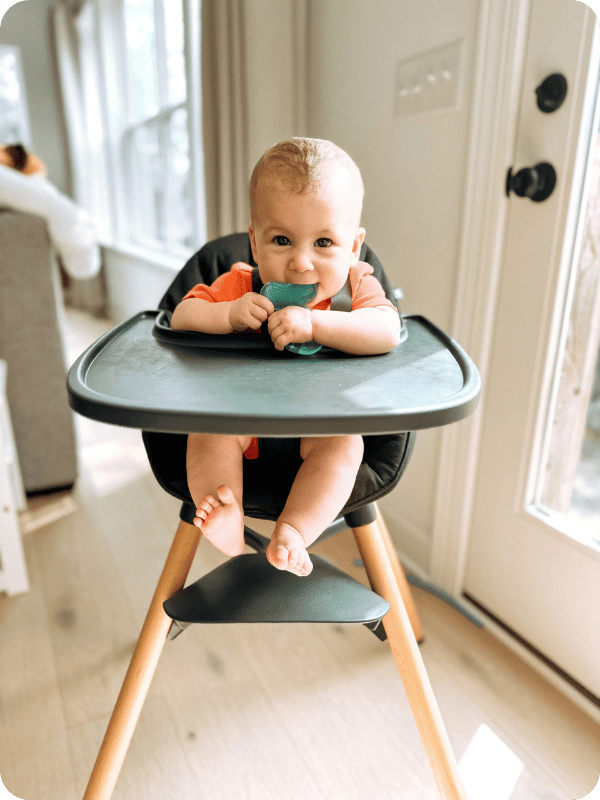
The baby above is leaning in the high chair. However, this baby also hasn’t mastered sitting independently yet, so she isn’t ready to start eating solids. This leaning is a concern that should give parents pause before offering solids to baby.
If baby is hunching forward or leaning over and food is presented to them, they are not in the safest position for moving food in their mouth and swallowing. It is common for babies in this posture to tell us that they don’t feel supported by showing minimal interest in eating, crying, or fussing in the high chair. We can read their disinterest as a possible cue of needing more support. It’s okay to wait a few more weeks for baby’s gross motor skills to improve if that is the underlying reason for leaning in the high chair!
Making your high chair more supportive
There are some modifications you can implement if baby is not getting the proper support from the high chair you already own.
If your baby is reclined too far in their high chair, so that they have to work extra to sit up and engage with food on the tray, try adding a cushion to the high chair or a folded towel behind their back. These are great to use when baby is smaller and needs more support, because they can be easily taken off as baby grows! It also increases the lifespan of your high chair.
If baby’s feet are dangling, try these steps:
- Purchase a foot rest compatible with your high chair
- Move the existing foot rest up
- Add a resistance band for them to rest their feet on
- Try to pull a chair up to the high chair for baby to rest their feet
- Or attach a box or book on the footrest if it cannot be raised higher (1)
If baby is leaning to one side while seated upright, you can add rolled up towels to each side or one side, or insert a cushion that gives more side support.
What high chair to use when traveling or at home
Most travel high chairs are not supportive enough for a little one beginning solids. Testing your chair out before traveling can help you see where baby might need support, whether at their hips or feet.
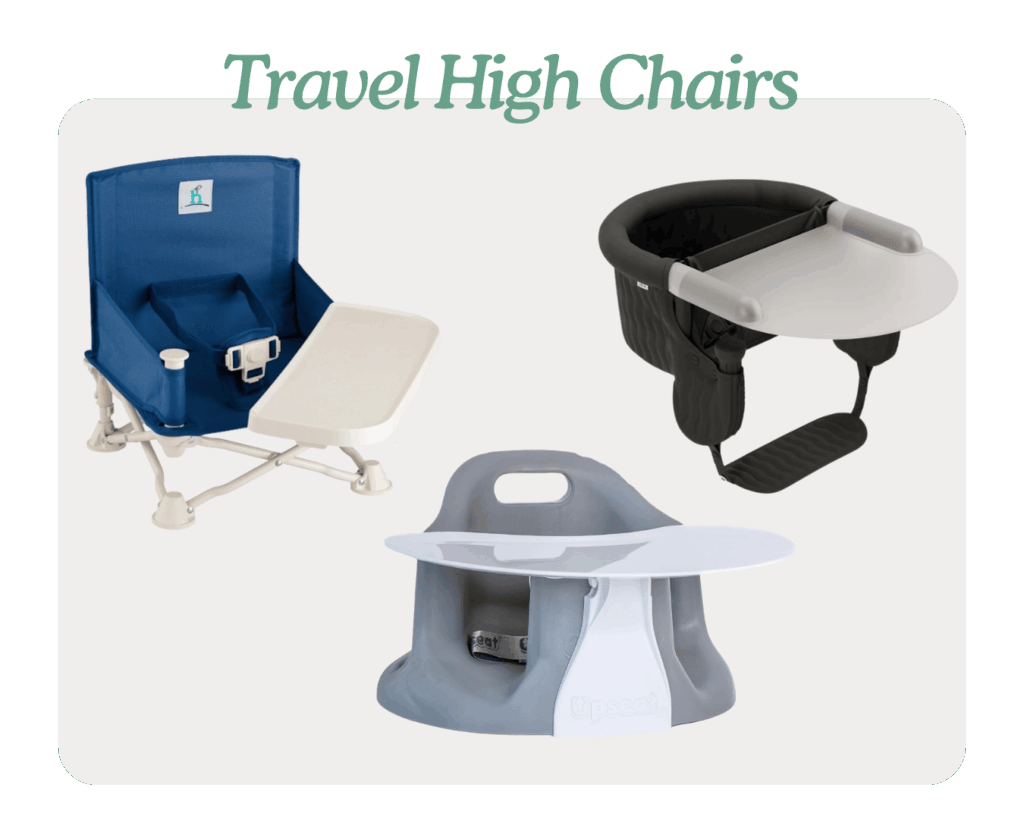
This travel chair is our favorite because you can put it on the floor, which provides a natural foot rest. Roll up towels on either side of baby if they need more support. This chair will last until toddlerhood, and it collapses down into a bag for on-the-go.
Another fan favorite from our team’s occupational therapist and physical therapist is the UpSeat! It doesn’t collapse down, but it may be small enough to travel with you in the trunk. And honorable mention: this hook-on chair has a footrest!
In general, use travel high chairs with caution and only for short-term use. These are great for on-the-go, but due to their minimally supportive nature, we don’t recommend them for consistent daily use. Instead, for everyday use, we recommend one like this high chair from Lalo, which is not only incredibly supportive for baby, but easy to clean for caregivers.
More infant feeding resources
Now that you know how to properly fit your little one in their high chair, you’re ready to take on solids. And you’re going to knock it out of the park! If starting solids is still feeling overwhelming, that’s okay! Our resources are written by child development specialists to help parents feel confident along the way.
The Starting Solids Bundle has the answers to all of your most-asked questions about introducing food to baby! Whether you plan to start with purees or dive into BLW, this guide gives you all the tools you need to feed your baby the way you want! (Psssst: plus a handy printable list for tracking baby’s first 100 foods and more!)
Read more blogs about starting solids here. Or search the blog for posts about infant & toddler development, breast & bottle feeding, and ways to play with your child at every stage of development!
Sources
- Fernando, N., & Potock, M. (2022). Raising a healthy, happy eater: A parent’s handbook (2nd ed.). The Experiment.
- Jennifer M. Zubler, Lisa D. Wiggins, Michelle M. Macias, Toni M. Whitaker, Judith S. Shaw, Jane K. Squires, Julie A. Pajek, Rebecca B. Wolf, Karnesha S. Slaughter, Amber S. Broughton, Krysta L. Gerndt, Bethany J. Mlodoch, Paul H. Lipkin; Evidence-Informed Milestones for Developmental Surveillance Tools. Pediatrics March 2022; 149 (3): e2021052138. 10.1542/peds.2021-052138
OTHER POSTS YOU MAY LIKE:


MS, SLP
Founder of Eat Play Say, Speech-Language Pathologist, Feeding Specialist, Play Expert, Mom of 3
Jordyn Koveleski Gorman
SPECIALIZES IN: Infant and toddler speech-language, play, and feeding development, and curating a team that provides expert help that feels like a reassuring text from that one mom friend
EDUCATION: Jordyn received her BS in Speech-Language Pathology from Bloomsburg University and her MS in Speech-Language Pathology from Towson University
FAVE PARENTING FIRST: “The first true smile, it’s the sweetest!”

MS, CCC-SLP, CBS, IBCLC
Speech-Language Pathologist & Feeding Specialist, Certified Breastfeeding Specialist, International Board Certified Lactation Consultant
Jessica Nicholson Cocca
SPECIALIZES IN: Breast and bottle feeding, tongue ties, oral motor dysfunction, starting solids, infant and toddler speech, treating oral motor disorders
EDUCATION: Jessica received her BS in Communication Sciences and Disorders from Pennsylvania State University in 2015 and her MS in Speech-Language Pathology from Towson University in 2017
FAVE PARENTING FIRST: “Baby’s first wave! What a fun first communication gesture!”

MA, CCC-SLP, CLC
Speech-Language Pathologist, Certified Lactation Counselor
Jennifer McFarlin
SPECIALIZES IN: Breast and bottle feeding, tongue ties, starting solids, infant and toddler speech development
EDUCATION: She received her BS in Speech-Language Pathology from Ball State in 2014 and a MA in Speech-Language Pathology from Ball State in 2016.
FAVE PARENTING FIRST: “My favorite baby’s first is their first true smile that just warms your soul knowing they are smiling at you. My other favorite is their first word. I love watching their language explode!”

MS, CCC-SLP
Bilingual Speech-Language Pathologist
Nicole La Petina Kelly
SPECIALIZES IN: Bilingual development (Spanish-English), supporting multilingual families, infant and toddler speech
EDUCATION: She received her BA in Communication Sciences and Disorders and in Spanish from the University of Wisconsin-Madison in 2014 and her MS in Speech-Language Pathology with an English-Spanish Specialization from Marquette University in 2016.
FAVE PARENTING FIRST: “It’s the first slobbery kisses for me!”

RDN, LD
Licensed Registered Dietitian
Kimberly Vede
SPECIALIZES IN: Infant and pediatric nutrition including breastfeeding, formula feeding, and starting solids. She also specializes in prenatal and postpartum nutrition.
EDUCATION: She received her BSc in Biology in 2014 from Life University, and her BSc in Dietetics from Life University in 2019.
FAVE PARENTING FIRST: ”The first time they say ‘mama!’”


This checklist was created with input from a Speech-Language Pathologist, Occupational Therapist and Physical Therapist and has been downloaded over 20,000 times by parents worldwide. Learn the important milestones to pay attention to, and keep it in your digital back pocket during the baby + toddler years!
Comprehensive Milestone Checklist for gross motor, fine motor, and speech-language milestones for 0-36 months,
DOWNLOAD FOR FREE


