


When & How To Introduce Meat Baby Food
October 19, 2026
Jordyn Koveleski Gorman

Last Updated on October 19, 2026 by Jordyn Koveleski Gorman
This page contains affiliate links. We will receive a commission on qualifying purchases using these links.
Introducing meat to baby often comes with questions about the best way to serve it, which to offer first, and how to know that baby is ready to try meat.
As a “harder” textured food, introducing meat early can be intimidating. Whether you approach solids by offering purees, follow baby-led weaning, or you fall somewhere in between, there are developmentally appropriate ways to offer your little one meat!
Our team’s registered dietitian joined me for this post to break down why meat is an important part of starting solids, as well as a few different ways you can introduce it to your baby.
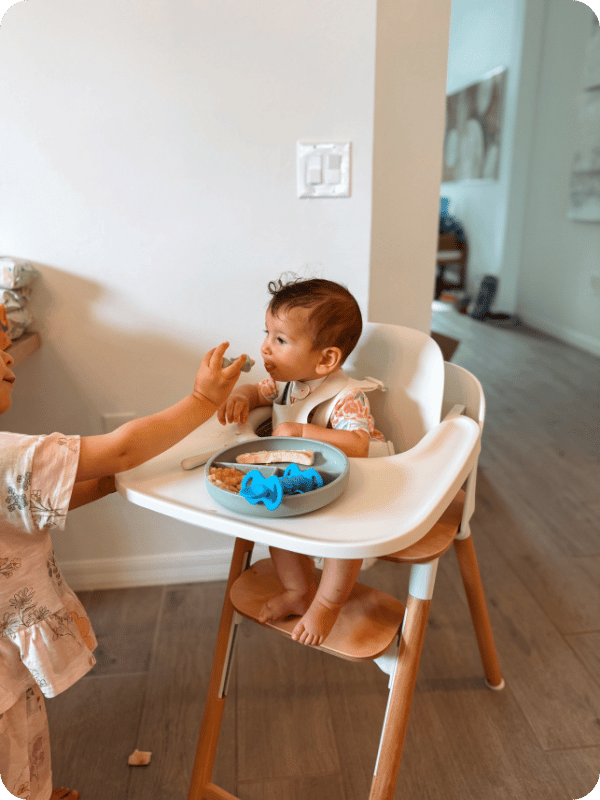
Why meat is important for babies
Starting solids at 6 months isn’t just about having fun (although that’s a huge part of it!), exploring textures, or learning how to use a spoon and fork. In fact, one of the main reasons for starting solids is that your little one’s nutritional needs begin to change and expand around this time.
Offering well-balanced meals to your little one consists of macronutrients (fat, protein, and carbs) and micronutrients (vitamins and minerals). The most nutritionally complete way to offer these things is by focusing on offering whole foods, as opposed to processed foods, whenever possible.
Since infants only eat a small amount of food when starting out, every bite counts. Making sure those bites are filled with the most wholesome ingredients is important. Plus, when starting solids, you may only be offering one food per day or one food at each meal, and that is okay! It can feel like there’s pressure to mark off baby’s first 100 foods in just a couple of weeks, but that’s not necessary.
Iron and starting solids
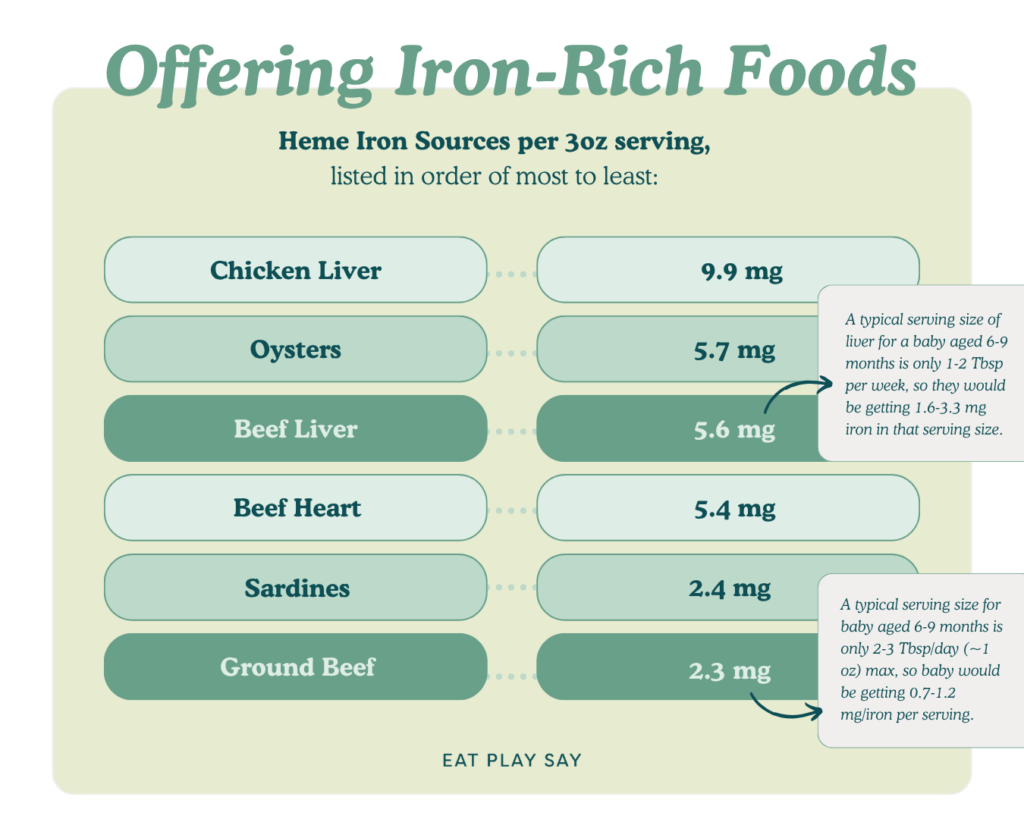
Meat is a great food to offer baby because it provides a good mix of macro- and micronutrients. Many parents think about meat as a great source of protein, which is true, but many meats also provide a much needed micronutrient that infants and toddlers need in high volume. That nutrient is iron, which is necessary for growth, development, sleep, and oxygenation. Babies are born with iron stores from their mother, and those stores become depleted around 6 months. (1) This is a huge reason for starting solids around 6 months!
Iron-rich foods are especially important for breastfed babies, as breastmilk does not contain enough iron to fill the gap after baby’s iron stores are depleted. Formula-fed babies are likely to receive enough iron from their formula in the first 12 months of life, although it is still important to introduce iron-rich foods so baby can have a well-balanced diet after weaning from formula.
Animal products, including meat, have a form of iron known as heme iron, which is easier for the body to absorb than iron from plant-based products (called non-heme iron). (2) That means just a small amount of meat can go a long way nutritionally for your little one. Learn more about the importance of iron when starting solids here.
How to introduce meat baby food
Below are our recommendations for introducing meat to baby, either as a puree, mash, or as a solid! Consider your little one’s age and readiness for different textures when deciding the safest way to offer baby food.
Serving beef to baby
Many cuts of beef are hard to manage for little ones, so be mindful of bite sizes and your child’s ability to chew. Try to pair beef with “wetter” purees and mashed foods during meals to balance out food textures.
Puree: Use a blender or food processor and blend cooked ground beef/steak with water, bone broth, formula or breastmilk until desired consistency. Add seasonings if desired.
Mashed: Add cooked meat of choice to a blender or food processor. Use the “pulse” setting with water, bone broth, formula or breastmilk added, and blend until it is thick and clumpy. Add liquid to make it smoother. Adding mashed potatoes or other mashed food consistency can help moisten.
Soft solid: When offered as a patty, ground beef can be a soft solid. Very thin slices of roast beef may also be soft enough to offer. Cut in age-appropriate pieces and make sure beef can be squished between your fingers easily. Just a reminder to try and avoid processed meats like lunchmeat, as they typically have a lot of sodium and other additives.
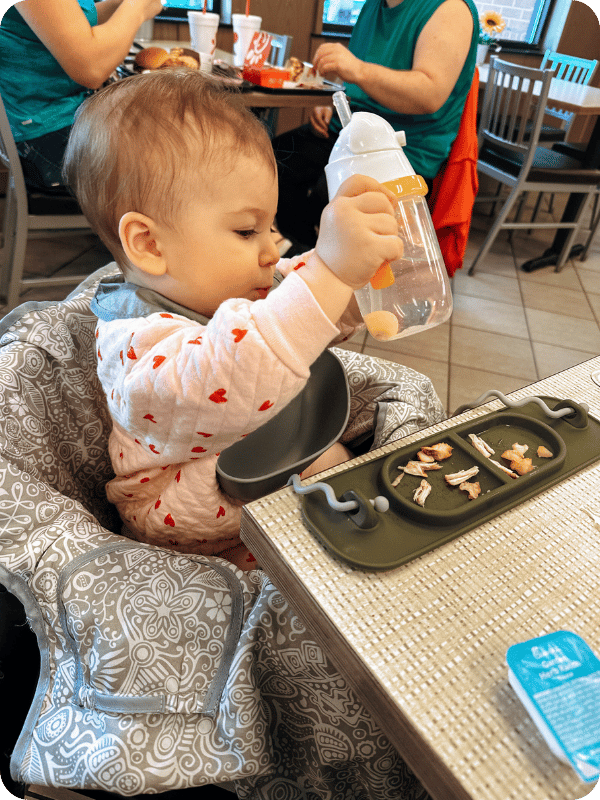
Serving chicken to baby
Puree: Place chicken breast or thighs into a pot of boiling water and immediately cover and remove from heat. Poach the chicken for about 10-20 minutes until an internal temperature of 165 degrees F is reached. Use a blender or food processor and blend cooked chicken with water, bone broth, formula or breastmilk until desired consistency. Add seasonings if desired.
Mashed: Poach chicken to an internal temperature of 165 degrees F, as instructed above. Use a blender or food processor on the “pulse” setting with a water, bone broth, formula or breastmilk added, until it is thick and clumpy. Mayonnaise, butter or other oil can help moisten and soften the mashed chicken.
Soft solid: Bake or poach chicken breast or thighs until internal temperature reaches 165 degrees F. Shred finely and combine with a dressing or wetter texture (e.g., mashed potatoes).
Alternatively, offer an entire baked chicken drumstick (no skin) for baby to hold or long thin strips of chicken thighs that can be squished.
Serving chicken or beef liver to baby
Liver is an excellent choice as a first food for baby because of its high nutrient density. It is high in iron, bioavailable vitamin A (retinol), and is packed with B vitamins and minerals. It’s also a great source of protein. Only a little bit is needed to offer a big nutrient benefit.
Puree: Saute livers in a skillet with a small amount of oil for about 3 minutes per side until temperature of 165 degrees F (chicken) or 145 F (beef) is reached. Use a blender or food processor and blend cooked liver with bone broth, formula or breastmilk until desired consistency. To achieve a mashed consistency instead, simply blend for less time using the “pulse” setting.
Soft solid: Saute livers in a skillet with a small amount of oil for about 3 minutes per side until temperature of 165 degrees F (chicken) or 145 (beef) is reached. Liver can be harder to manage, so dicing very small and putting in a pasta sauce or mashed potato consistency is best.
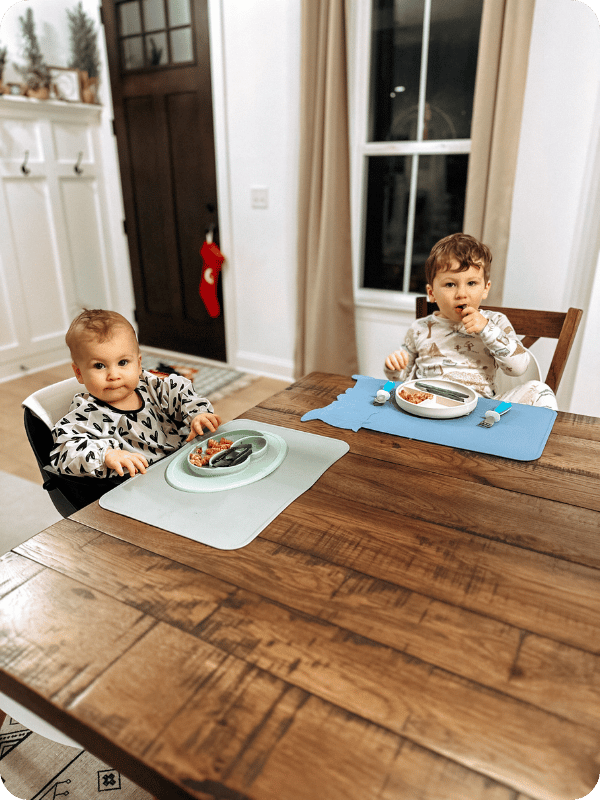
Serving white fish to baby
Introducing allergens to baby early and often is well supported by research. Many fish products, including white fish, salmon, and sardines, are high in iron, as well as other macro- and micronutrients your little one needs! Learn more about introducing allergens to baby here.
Puree: Bake white fish in a ceramic or glass baking dish at 350 F until soft and flakey, or use canned white fish. Use a blender or food processor and blend cooked white fish with water, bone broth, formula or breastmilk until desired consistency. For a mashed consistency, use the “pulse” setting instead.
Soft solid: Bake white fish in a ceramic or glass baking dish at 350 F until soft and flakey, or use canned white fish. Offer diced pieces on a preloaded fork or as finger food depending on age. White fish is very soft and squishy, so it is hard to offer larger pieces to baby. They may grasp and self-feed clumps of cooked fish.
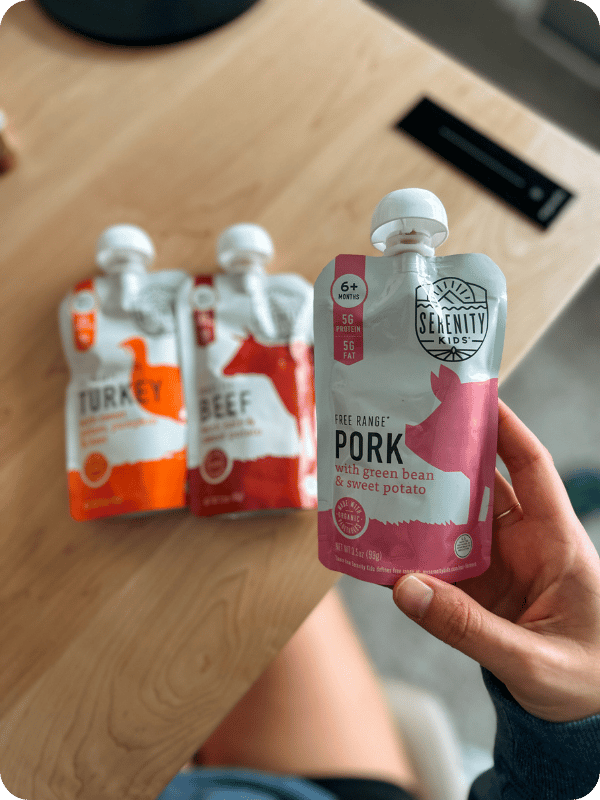
Pureed meats for infants vs. baby-led weaning
Equipped with recipes, you can see that serving meat to baby can be manageable no matter your approach to starting solids. As your little one’s chewing pattern matures and they become a confident eater, you will spend less time prepping and cleaning up after meals, and more time enjoying them with your little one. And remember, if your little one mostly just plays with their food at first, that’s okay, too!
If you want to serve baby pureed meats and need an alternative while on the go, we also use Serenity Kids pouches! They independently test and publicize results for heavy metals in their products (which is required by law in some places), and they ethically source high-quality ingredients for their recipes. (Pssst: code JORDYN saves 20%)
More infant resources
For more guidance like you found in this blog, search our Handbooks!
The Starting Solids Handbook and Baby’s First 100 Foods bundle is our most in-depth resource for feeding your little one from 6 months and beyond! Packed with 200+ pages of evidence-backed tips, tricks, and recipes for serving foods, the Starting Solids Bundle will answer every question you have about starting solids.
For more free educational content, check out our blog:
- More about starting solids
- Breast and bottle feeding
- Infant & toddler development
- Play activities that support your little’s skills
- Speech and language resources
Sources
- Ziegler EE, Nelson SE, Jeter JM. Iron stores of breastfed infants during the first year of life. Nutrients. 2014 May 21;6(5):2023-34. doi: 10.3390/nu6052023. PMID: 24853888; PMCID: PMC4042569.
- Monsen ER. Iron nutrition and absorption: dietary factors which impact iron bioavailability. J Am Diet Assoc. 1988 Jul;88(7):786-90. PMID: 3290310.
Leave a Reply
OTHER POSTS YOU MAY LIKE:




MS, SLP
Founder of Eat Play Say, Speech-Language Pathologist, Feeding Specialist, Play Expert, Mom of 3
Jordyn Koveleski Gorman
SPECIALIZES IN: Infant and toddler speech-language, play, and feeding development, and curating a team that provides expert help that feels like a reassuring text from that one mom friend
EDUCATION: Jordyn received her BS in Speech-Language Pathology from Bloomsburg University and her MS in Speech-Language Pathology from Towson University
FAVE PARENTING FIRST: “The first true smile, it’s the sweetest!”

MS, CCC-SLP, CBS, IBCLC
Speech-Language Pathologist & Feeding Specialist, Certified Breastfeeding Specialist, International Board Certified Lactation Consultant
Jessica Nicholson Cocca
SPECIALIZES IN: Breast and bottle feeding, tongue ties, oral motor dysfunction, starting solids, infant and toddler speech, treating oral motor disorders
EDUCATION: Jessica received her BS in Communication Sciences and Disorders from Pennsylvania State University in 2015 and her MS in Speech-Language Pathology from Towson University in 2017
FAVE PARENTING FIRST: “Baby’s first wave! What a fun first communication gesture!”

MA, CCC-SLP, CLC
Speech-Language Pathologist, Certified Lactation Counselor
Jennifer McFarlin
SPECIALIZES IN: Breast and bottle feeding, tongue ties, starting solids, infant and toddler speech development
EDUCATION: She received her BS in Speech-Language Pathology from Ball State in 2014 and a MA in Speech-Language Pathology from Ball State in 2016.
FAVE PARENTING FIRST: “My favorite baby’s first is their first true smile that just warms your soul knowing they are smiling at you. My other favorite is their first word. I love watching their language explode!”

MS, CCC-SLP
Bilingual Speech-Language Pathologist
Nicole La Petina Kelly
SPECIALIZES IN: Bilingual development (Spanish-English), supporting multilingual families, infant and toddler speech
EDUCATION: She received her BA in Communication Sciences and Disorders and in Spanish from the University of Wisconsin-Madison in 2014 and her MS in Speech-Language Pathology with an English-Spanish Specialization from Marquette University in 2016.
FAVE PARENTING FIRST: “It’s the first slobbery kisses for me!”

RDN, LD
Licensed Registered Dietitian
Kimberly Vede
SPECIALIZES IN: Infant and pediatric nutrition including breastfeeding, formula feeding, and starting solids. She also specializes in prenatal and postpartum nutrition.
EDUCATION: She received her BSc in Biology in 2014 from Life University, and her BSc in Dietetics from Life University in 2019.
FAVE PARENTING FIRST: ”The first time they say ‘mama!’”


This checklist was created with input from a Speech-Language Pathologist, Occupational Therapist and Physical Therapist and has been downloaded over 20,000 times by parents worldwide. Learn the important milestones to pay attention to, and keep it in your digital back pocket during the baby + toddler years!
Comprehensive Milestone Checklist for gross motor, fine motor, and speech-language milestones for 0-36 months,
DOWNLOAD FOR FREE


