


When to Introduce the Big 9 Allergens to Baby
May 8, 2024
Jordyn Koveleski Gorman

Last Updated on July 18, 2026 by Jordyn Koveleski Gorman
Advice on introducing allergens like peanuts, eggs, dairy, and wheat to babies has shifted drastically through the years. For many years, it was recommended to delay allergen introduction when starting solids. But in the last several years, advice has done a 180: now, parents are told to introduce allergens early and often.
Frustratingly, parents still often receive outdated information about food allergens. It can be confusing when healthcare professionals recommend different things and family members offer their own tips from the 1970s. Sorting through it all could be a full time job!
But maybe parents don’t need to sort through it all to figure out when to give baby their first lick of peanut butter or bite of scrambled egg. The latest research on allergen introduction is actually quite clear that early introduction is the best approach we have to reducing food allergies. But how early is early and how often is often? Let’s talk about it!
What are the big 9 allergens?
The “big 9 allergens” refers to a group of foods that are most likely to be allergenic. Some lists will include fewer allergens, but most will look the same or very similar.
The big 9 allergens are:
- Eggs
- Dairy
- Wheat
- Peanuts
- Tree nuts
- Fish
- Shellfish
- Soybeans
- Sesame
The difficulty, of course, is that some of these allergens are in many food items. For those with allergies, it can be hard to avoid them in day-to-day life. And things like dairy, tree nuts, and shellfish are umbrella terms for wide categories of foods. For parents who aren’t sure how and when to introduce allergens to baby, this list can feel daunting. But it doesn’t have to be that way.
What research says about the big 9 allergens
In 2015, a landmark study, called Learning Early About Peanuts (LEAP), published the first large-scale clinical trial on early peanut introduction. Researchers found that sustained peanut consumption in high-risk infants starting between 4–11 months and continuing until age 5 reduced the rate of peanut allergy by more than 80%. (1)
This was huge news primarily because prior to this research, peanut allergies had more than tripled in the United States from 1997–2008. (2) Even with the publication of this groundbreaking research, adopting a new approach to allergens has faced some difficulty. Lack of confidence in recommendations and confusion about implementation from clinicians are barriers parents have faced when seeking advice about allergen introduction from their children’s medical team. (3)
Still, even with these challenges, allergy rates began to fall after new guidelines were published. Peanut allergies have fallen drastically in the US since those guidelines were adopted, by more than 40% since 2017. (4)
But what about the rest of the big 9 allergens?
Another clinical trial included 1,300 breastfed babies with no risk factors who were given 6 allergens (peanut, egg, milk, white fish, sesame, and wheat) from 3–6 months of age until age 3. Results revealed a 67% reduction in egg allergy and a 100% reduction in peanut allergy in children who consumed sufficient amounts of these foods, and there was some positive data linking early introduction to lower incidence of milk and sesame allergies, too. (5)
Although data was not statistically groundbreaking for most allergens in this study, researchers concluded that early introduction across all 6 allergens was safe. (5)
Another study of 147 infants with eczema who were fed cooked egg powder in gradually increasing doses from 4–10 months, while also undergoing aggressive eczema treatment, showed early egg exposure reduced the risk of egg allergy by 79%. (6)
Based on these major studies, guidelines around the globe have changed to recommend introducing peanuts, tree nuts, and other common allergens once an infant is ready for solid food.

When to introduce the big 9 allergens
So you know that it is generally considered safe to introduce allergens early and often, but knowing that and actually putting it into practice are two different things! It is always recommended to discuss medical concerns with your child’s pediatrician. However, having a game plan to approach allergen introduction can help ease anxieties and reduce pressure surrounding it.
It’s worth noting that in addition to research supporting early introduction, there is also research that indicates avoiding allergens in the first year of life can drastically increase the likelihood of sensitization or allergies later on. (7) Finding the “sweet spot” of when to introduce these foods can be pretty simple in most cases.
Across all major allergens, the recommendation is to start them as early as 4–6 months (depending on risk level) for the best chance of decreasing the risk for food allergies. But, that doesn’t mean that all infants should start eating top allergen foods at 4 months. In fact, starting solids (including offering allergens) is recommended closer to 6 months, as there are more factors to consider than just allergen introduction.
There are a few criteria that infants should meet before introducing allergens, known as “signs of readiness” for starting solids. The graphic below includes a handy checklist to review! Read more about signs of readiness for starting solids here.
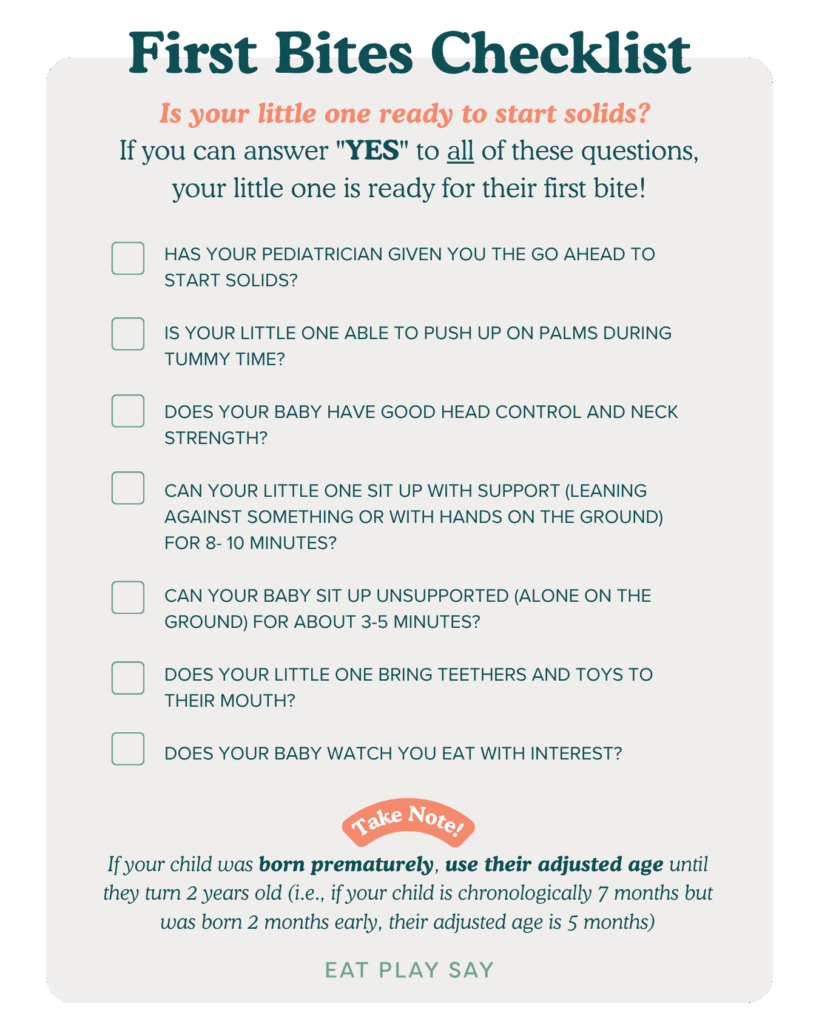
From a gross motor development standpoint, most infants are ready to start solids around 6 months of age. This recommendation also aligns with the AAP, WHO, and other health organizations’ guidelines for introducing complementary foods. This is where parents must weigh the risks and benefits in conversation with their child’s medical team, balancing readiness with risk factors for allergies.
For instance, if your little one experiences severe eczema, consulting an allergist may be helpful in determining when to introduce allergens. A medical team may recommend offering allergens before 6 months of age for certain cases. For babies with low risk factors, it is generally recommended to begin introducing allergens once baby shows all the signs of readiness for solids (around 6 months of age), and there is generally no need to start solids early in these cases.
How to introduce peanut butter and other allergens to baby
Every baby is different, and introducing allergens will be unique to every child, even amongst siblings. And that’s okay!
When starting solids, it is safe to offer new non-allergenic foods to baby daily. However, it is recommended to wait a few days between offering new allergenic foods to observe for any reactions. Offering one new allergenic food weekly is a good goal to strive for and is usually attainable.
When offering a new allergenic food, try to offer it 2–4 times over 1–2 days and wait a few days to observe for any reactions. (5) Offering new allergens earlier in the day is preferable to better track potential reactions. If baby usually naps in a different room, it can be helpful to avoid feeding a new allergen right before naptime, too. That doesn’t mean you have to keep your baby awake all day! Rather, try to avoid introducing a new allergen and then putting baby down for a nap 10–15 minutes later.
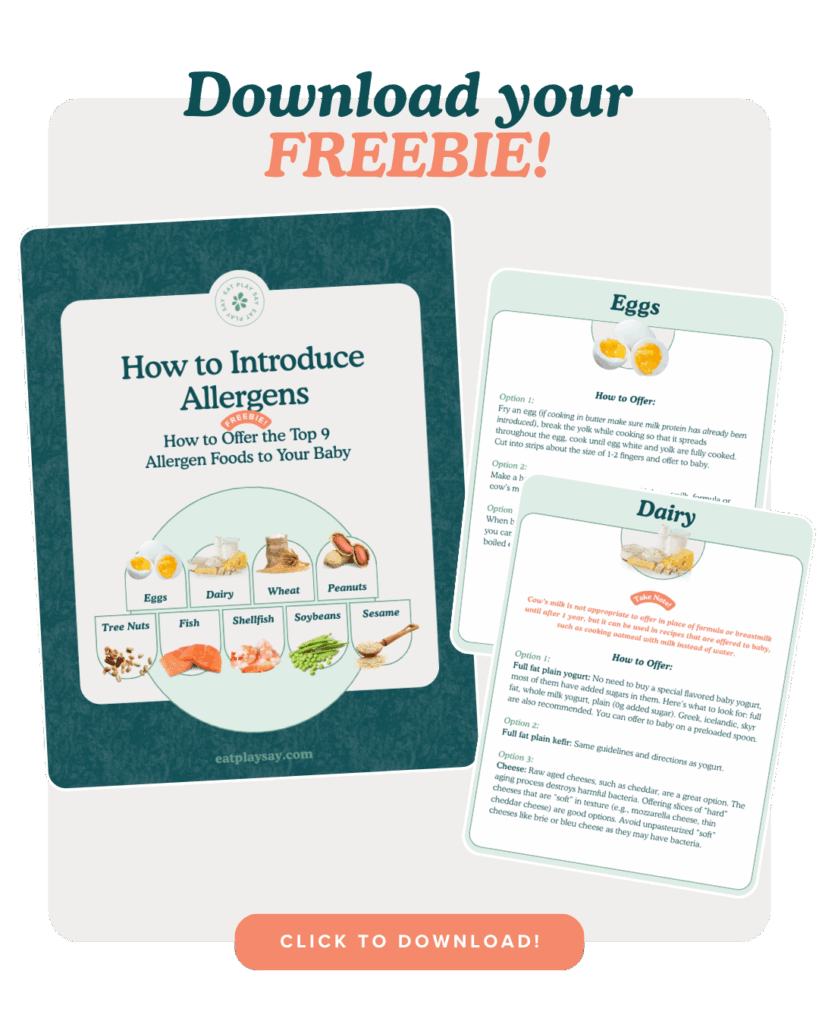
If you’re not sure how to serve allergenic foods to baby when starting out, our free guide can help! Download your copy of How to Introduce Allergens to get a free printable allergen checklist and recipes for 3 ways to serve all of the big 9 allergens!
More infant and toddler support
Fore more parenting resources just like this one, check out our blog to:
- Get help with starting solids
- Feed toddlers quick, real-food meals and snacks
- Learn more about infant and toddler development
- Get support with breast and bottle feeding
Sources
- Du Toit G, Roberts G, Sayre PH, Bahnson HT, Radulovic S, Santos AF, Brough HA, Phippard D, Basting M, Feeney M, Turcanu V, Sever ML, Gomez Lorenzo M, Plaut M, Lack G; LEAP Study Team. Randomized trial of peanut consumption in infants at risk for peanut allergy. N Engl J Med. 2015 Feb 26;372(9):803-13. doi: 10.1056/NEJMoa1414850. Epub 2015 Feb 23. Erratum in: N Engl J Med. 2016 Jul 28;375(4):398. doi: 10.1056/NEJMx150044. PMID: 25705822; PMCID: PMC4416404.
- Mount Sinai. Rate of Childhood Peanut Allergies More than Tripled Between 1997 and 2008. Accessed July 2026.
- Ruchi S. Gupta, Lucy A. Bilaver, Alkis Togias; Encouraging Trends in Peanut Allergy Prevention: Real-World Impact of Prevention Guidelines. Pediatrics November 2025; 156 (5): e2025072593. 10.1542/peds.2025-072593
- Stanislaw J. Gabryszewski, Jesse Dudley, Jennifer A. Faerber, Robert W. Grundmeier, Alexander G. Fiks, Jonathan M. Spergel, David A. Hill; Guidelines for Early Food Introduction and Patterns of Food Allergy. Pediatrics November 2025; 156 (5): e2024070516. 10.1542/peds.2024-070516
- Perkin MR, Logan K, Tseng A, Raji B, Ayis S, Peacock J, Brough H, Marrs T, Radulovic S, Craven J, Flohr C, Lack G; EAT Study Team. Randomized Trial of Introduction of Allergenic Foods in Breast-Fed Infants. N Engl J Med. 2016 May 5;374(18):1733-43. doi: 10.1056/NEJMoa1514210. Epub 2016 Mar 4. PMID: 26943128.
- Natsume O, Kabashima S, Nakazato J et al. Two-step egg introduction for prevention of egg allergy in high-risk infants with eczema (PETIT): a randomised, double-blind, placebo-controlled trial. The Lancet, 2016; 389, 276-286
- Tran MM, Lefebvre DL, Dai D, et al. Timing of food introduction and development of food sensitization in a prospective birth cohort. Pediatr Allergy Immunol. 2017; 28: 471–477. https://doi.org/10.1111/pai.12739
OTHER POSTS YOU MAY LIKE:




MS, SLP
Founder of Eat Play Say, Speech-Language Pathologist, Feeding Specialist, Play Expert, Mom of 3
Jordyn Koveleski Gorman
SPECIALIZES IN: Infant and toddler speech-language, play, and feeding development, and curating a team that provides expert help that feels like a reassuring text from that one mom friend
EDUCATION: Jordyn received her BS in Speech-Language Pathology from Bloomsburg University and her MS in Speech-Language Pathology from Towson University
FAVE PARENTING FIRST: “The first true smile, it’s the sweetest!”

MS, CCC-SLP, CBS, IBCLC
Speech-Language Pathologist & Feeding Specialist, Certified Breastfeeding Specialist, International Board Certified Lactation Consultant
Jessica Nicholson Cocca
SPECIALIZES IN: Breast and bottle feeding, tongue ties, oral motor dysfunction, starting solids, infant and toddler speech, treating oral motor disorders
EDUCATION: Jessica received her BS in Communication Sciences and Disorders from Pennsylvania State University in 2015 and her MS in Speech-Language Pathology from Towson University in 2017
FAVE PARENTING FIRST: “Baby’s first wave! What a fun first communication gesture!”

MA, CCC-SLP, CLC
Speech-Language Pathologist, Certified Lactation Counselor
Jennifer McFarlin
SPECIALIZES IN: Breast and bottle feeding, tongue ties, starting solids, infant and toddler speech development
EDUCATION: She received her BS in Speech-Language Pathology from Ball State in 2014 and a MA in Speech-Language Pathology from Ball State in 2016.
FAVE PARENTING FIRST: “My favorite baby’s first is their first true smile that just warms your soul knowing they are smiling at you. My other favorite is their first word. I love watching their language explode!”

MS, CCC-SLP
Bilingual Speech-Language Pathologist
Nicole La Petina Kelly
SPECIALIZES IN: Bilingual development (Spanish-English), supporting multilingual families, infant and toddler speech
EDUCATION: She received her BA in Communication Sciences and Disorders and in Spanish from the University of Wisconsin-Madison in 2014 and her MS in Speech-Language Pathology with an English-Spanish Specialization from Marquette University in 2016.
FAVE PARENTING FIRST: “It’s the first slobbery kisses for me!”

RDN, LD
Licensed Registered Dietitian
Kimberly Vede
SPECIALIZES IN: Infant and pediatric nutrition including breastfeeding, formula feeding, and starting solids. She also specializes in prenatal and postpartum nutrition.
EDUCATION: She received her BSc in Biology in 2014 from Life University, and her BSc in Dietetics from Life University in 2019.
FAVE PARENTING FIRST: ”The first time they say ‘mama!’”


This checklist was created with input from a Speech-Language Pathologist, Occupational Therapist and Physical Therapist and has been downloaded over 20,000 times by parents worldwide. Learn the important milestones to pay attention to, and keep it in your digital back pocket during the baby + toddler years!
Comprehensive Milestone Checklist for gross motor, fine motor, and speech-language milestones for 0-36 months,
DOWNLOAD FOR FREE


