


When Do Babies Start Smiling?
November 4, 2026
Jordyn Koveleski Gorman

Last Updated on November 4, 2026 by Jordyn Koveleski Gorman
This page contains affiliate links. We will receive a commission on qualifying purchases using these links.
Your baby’s first smile is one of the sweetest, most heartwarming milestones. In the early newborn days, your little one may “smile” while sleeping, stretching, or even while pooping. As sweet as those glimmers are, they may leave you wondering when you can expect your baby to smile at you on purpose.
So, let’s talk about baby smiles: when to expect it, what it means, and how you can encourage your little one to start smiling!
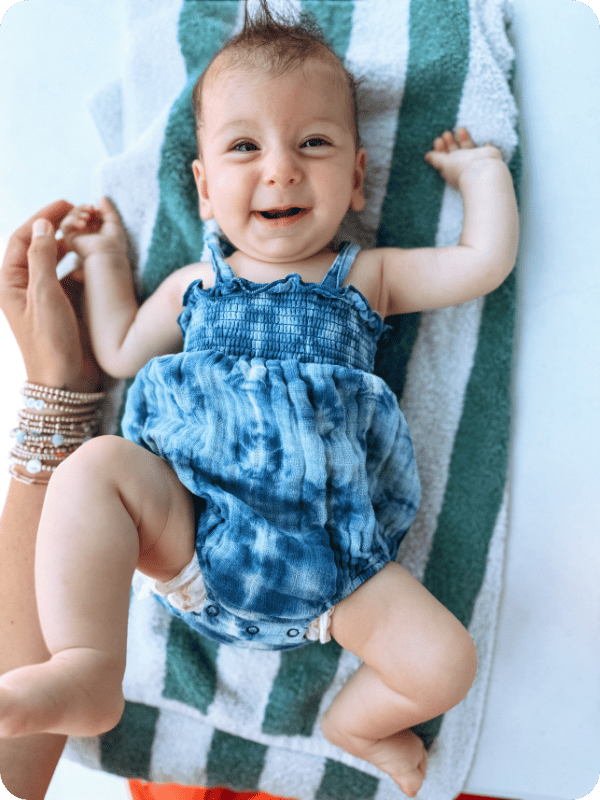
When do babies start smiling?
Social smiling is one of the first methods of nonverbal communication that your little one will learn. This is different from those reflexive smiles that occur from birth, as social smiling is an intentional action your little one will use to communicate rather than an unintended response to stimuli, such as during sleep or when stretching.
Most milestone checklists include smiling intentionally at a caregiver as a 3 month milestone. Generally, though, newborns often begin to smile even earlier, around 6–8 weeks of age. (1) So, if you’ve been asking yourself, “Wait, is she smiling??” She might be!
Infants smile for the same reasons that other children and adults smile: to express happiness, joy, excitement, or even that they think something is funny! Your little one’s first smiles are a great opportunity to connect and bond. And, after a long few weeks of little sleep, baby’s smile may feel like confirmation that you’re doing a good job. (And you are!)
What if baby isn’t smiling yet?
If baby hasn’t started smiling yet, they may simply need a little more time to figure things out! Newborns are growing and changing so rapidly that it’s possible for there to be no “signs” that your little one is learning to smile until, suddenly, they are smiling at you! Your little one could start smiling at the most random time or in response to something unexpected.
Generally, if baby isn’t smiling by 8 weeks of age, but is meeting other milestones, there is likely nothing to be concerned about. Likely, your little one’s first smile is just days away.
If baby is behind on several milestones or you have concerns about their development, it’s recommended to speak to their pediatrician and/or a specialist, such as a lactation consultant for feeding concerns or a physical therapist for neck and body tension. Additionally, if baby hasn’t started smiling intentionally by ~12 weeks, it’s time to mention it to their pediatrician.
Some other milestones we look to emerge around the same time as smiling, around 2–3 months, include:
- Looking at a caregiver’s face
- Seeming happy when a caregiver approaches
- Cooing (vowel sounds in the back of the throat)
- Reacting to loud noises
- Looks at a toy for a few seconds
- Ability to hold their head up when on their tummy (the duration varies week by week)
- Briefly opening their hands (1)
You can help support your baby’s development by monitoring how they’re growing. Download your FREE Milestone Checklist for 0–36 months, and join 40,000+ other parents to “check and see” where baby is developmentally!
How to encourage your infant to start smiling
Playing with your baby is the best way to encourage them to practice skills like smiling! As a newborn, wake windows are short and often spent mostly feeding. Just a few minutes per wake window spent playing with your little one can make a big impact.
Our favorite activities to encourage smiling in your little one are also incredibly simple. Try them out!
Talk to and smile at your baby
Research shows that infants often smile when gazing at their mother’s face, and those smiles are also associated with stronger positive emotions. (2) So, stare at those sweet baby cheeks and know that every moment a caregiver spends interacting face-to-face with baby is benefiting their development!
Talking to your little one doesn’t have to be constant narration. In fact, saying a few simple words to your newborn and then pausing to let them process can provide more benefits for baby’s speech development.
Learn more about pausing when talking to baby here.
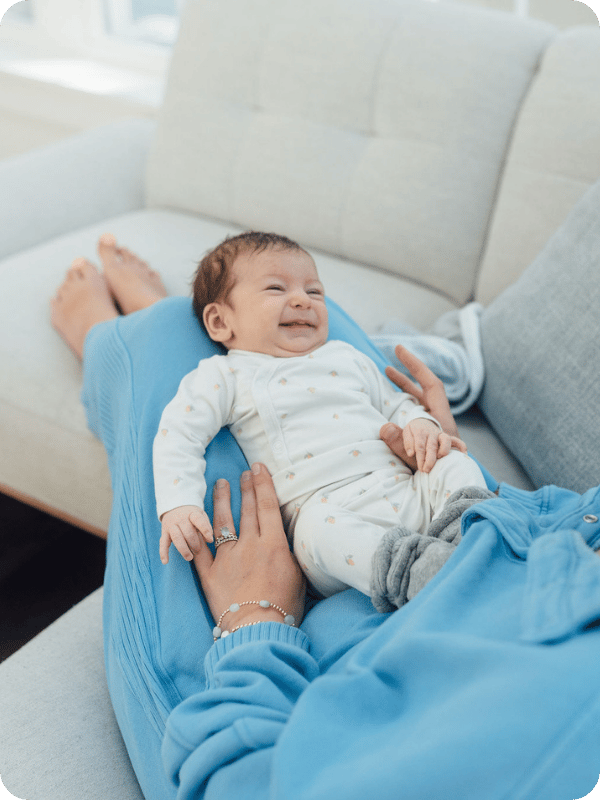
Smiling when baby coos back to you, or as they look at your face, is the perfect way to encourage them to smile on their own!
Read books together
There are so many benefits to reading to your baby, even as a newborn! Our favorite books for newborns are engaging without being overwhelming. And many of them double as toys and even teethers, too!
Reading to your newborn provides opportunities to make silly sounds and facial expressions that can encourage baby to smile. Reading a silly book about a farm? Model animal sounds or the chugga-chugga-chug of a tractor!
Play peekaboo
The biggest, brightest smiles, where you can see baby’s gums and their eyes crinkle in excitement, are associated with a few things: gazing at their mother, being tickled, and other rough play. (2) Rough play is not recommended for newborns, of course, but there is an excellent alternative for young infants! Playing peekaboo has also been shown to lead to a “stronger” smile in infants. (2)
More infant development support
Looking for more support with your little one’s growth and development? We’ve got your back!
Eat Play Say’s most in-depth resources feature hundreds of pages of expert-written, research-backed guidance. From baby’s first coos to play ideas that help them build skills, we have a Handbook for you!
For more posts like this one, check out our blog:
- Support with starting solids
- Breast and bottle feeding
- Infant & toddler development
- Play activities that support your child’s development
- More speech and language resources
Sources
- Jennifer M. Zubler, Lisa D. Wiggins, Michelle M. Macias, Toni M. Whitaker, Judith S. Shaw, Jane K. Squires, Julie A. Pajek, Rebecca B. Wolf, Karnesha S. Slaughter, Amber S. Broughton, Krysta L. Gerndt, Bethany J. Mlodoch, Paul H. Lipkin; Evidence-Informed Milestones for Developmental Surveillance Tools. Pediatrics March 2022; 149 (3): e2021052138. 10.1542/peds.2021-052138
- Messinger DS, Cassel TD, Acosta SI, Ambadar Z, Cohn JF. Infant Smiling Dynamics and Perceived Positive Emotion. J Nonverbal Behav. 2008 Sep 1;32(3):133-155. doi: 10.1007/s10919-008-0048-8. PMID: 19421336; PMCID: PMC2676856.
Leave a Reply
OTHER POSTS YOU MAY LIKE:


MS, SLP
Founder of Eat Play Say, Speech-Language Pathologist, Feeding Specialist, Play Expert, Mom of 3
Jordyn Koveleski Gorman
SPECIALIZES IN: Infant and toddler speech-language, play, and feeding development, and curating a team that provides expert help that feels like a reassuring text from that one mom friend
EDUCATION: Jordyn received her BS in Speech-Language Pathology from Bloomsburg University and her MS in Speech-Language Pathology from Towson University
FAVE PARENTING FIRST: “The first true smile, it’s the sweetest!”

MS, CCC-SLP, CBS, IBCLC
Speech-Language Pathologist & Feeding Specialist, Certified Breastfeeding Specialist, International Board Certified Lactation Consultant
Jessica Nicholson Cocca
SPECIALIZES IN: Breast and bottle feeding, tongue ties, oral motor dysfunction, starting solids, infant and toddler speech, treating oral motor disorders
EDUCATION: Jessica received her BS in Communication Sciences and Disorders from Pennsylvania State University in 2015 and her MS in Speech-Language Pathology from Towson University in 2017
FAVE PARENTING FIRST: “Baby’s first wave! What a fun first communication gesture!”

MA, CCC-SLP, CLC
Speech-Language Pathologist, Certified Lactation Counselor
Jennifer McFarlin
SPECIALIZES IN: Breast and bottle feeding, tongue ties, starting solids, infant and toddler speech development
EDUCATION: She received her BS in Speech-Language Pathology from Ball State in 2014 and a MA in Speech-Language Pathology from Ball State in 2016.
FAVE PARENTING FIRST: “My favorite baby’s first is their first true smile that just warms your soul knowing they are smiling at you. My other favorite is their first word. I love watching their language explode!”

MS, CCC-SLP
Bilingual Speech-Language Pathologist
Nicole La Petina Kelly
SPECIALIZES IN: Bilingual development (Spanish-English), supporting multilingual families, infant and toddler speech
EDUCATION: She received her BA in Communication Sciences and Disorders and in Spanish from the University of Wisconsin-Madison in 2014 and her MS in Speech-Language Pathology with an English-Spanish Specialization from Marquette University in 2016.
FAVE PARENTING FIRST: “It’s the first slobbery kisses for me!”

RDN, LD
Licensed Registered Dietitian
Kimberly Vede
SPECIALIZES IN: Infant and pediatric nutrition including breastfeeding, formula feeding, and starting solids. She also specializes in prenatal and postpartum nutrition.
EDUCATION: She received her BSc in Biology in 2014 from Life University, and her BSc in Dietetics from Life University in 2019.
FAVE PARENTING FIRST: ”The first time they say ‘mama!’”


This checklist was created with input from a Speech-Language Pathologist, Occupational Therapist and Physical Therapist and has been downloaded over 20,000 times by parents worldwide. Learn the important milestones to pay attention to, and keep it in your digital back pocket during the baby + toddler years!
Comprehensive Milestone Checklist for gross motor, fine motor, and speech-language milestones for 0-36 months,
DOWNLOAD FOR FREE


