


How “Pausing” Can Positively Impact When Babies Talk
May 30, 2024
Jordyn Koveleski Gorman

Last Updated on August 17, 2026 by Jordyn Koveleski Gorman
This page contains affiliate links. We will receive a commission on qualifying purchases using these links.
Did you know that you might be talking to your baby too much? It’s true!
In a well-meaning attempt to help babies learn, parents often incorrectly think that they need to fill every silent moment of the day with talking. The problem with this approach is that parents don’t pause to let baby process and respond to what they’re hearing.
As a speech-language pathologist, let me relieve some pressure: you don’t have to talk nonstop! Quiet moments in between talking aren’t a bad thing. Silence is not only allowed, but encouraged! When used at the right time, pausing can actually help baby’s speech-language skill development!
Let’s talk about the art of pausing and how it helps your little one!
When do babies talk?
Babies aren’t expected to say their first intentional word until ~12 months. (1) Some babies may say their first word sooner, and others will be a little later. There is a range of normal and a multitude of factors at play.
Speech-language milestones often cause parents to worry for a variety of reasons, but it’s important to note that the likelihood of any one child having a speech-language delay is fairly low, only about 2.5%. (2) Some factors, such as family members experiencing speech-language delays or other medical diagnoses, can increase potential. So, if a child is progressing well overall in meeting milestones, they are likely okay!
Even before your little one develops spoken language, communication skills are being built upon every day from birth onward. In fact, the skills that baby develops in the first few months of life can be predictors of future language development. (3) Essentially, the way you speak to your baby can help them develop spoken words later on!
Babies as young as just a few weeks old can actually imitate things like coos, vocalizations, facial expressions, and raspberries. (1) But they can only imitate these sounds if we let them have the chance. How can parents do that? By pausing (for way longer than you think!).
Pausing when talking to baby
Infants and toddlers don’t yet have the ability to process information at adult speeds. They need more time to make connections and react to their environment.
Research has shown that in the first 6 months, infants are “tuned in” to the sounds of all languages. From 6–12 months, their brains focus more specifically on the native language spoken around them. (4) This isn’t a conscious decision your little one makes; it’s innate to their development!
Parents can help baby’s brain process language by slowing down and waiting for baby to respond. Sometimes, you may have to wait as long as 5–10+ seconds before baby is ready to continue the conversation! Want to see this in action? Watch this video.
Pausing after labeling items or providing a direction, and even after smiling or looking at a child, can do so much. It provides an awkward silence that a child is more likely to fill with either a body movement, facial expression, or maybe even a sound or word. You can start pausing when talking to your child from the day they arrive into this world.
Pausing allows your little one to respond and, more importantly, imitate you. Developmentally, imitation comes before independent words and language emerge. Imitation increases baby’s ability to communicate. See how pausing helps with imitation in this video.
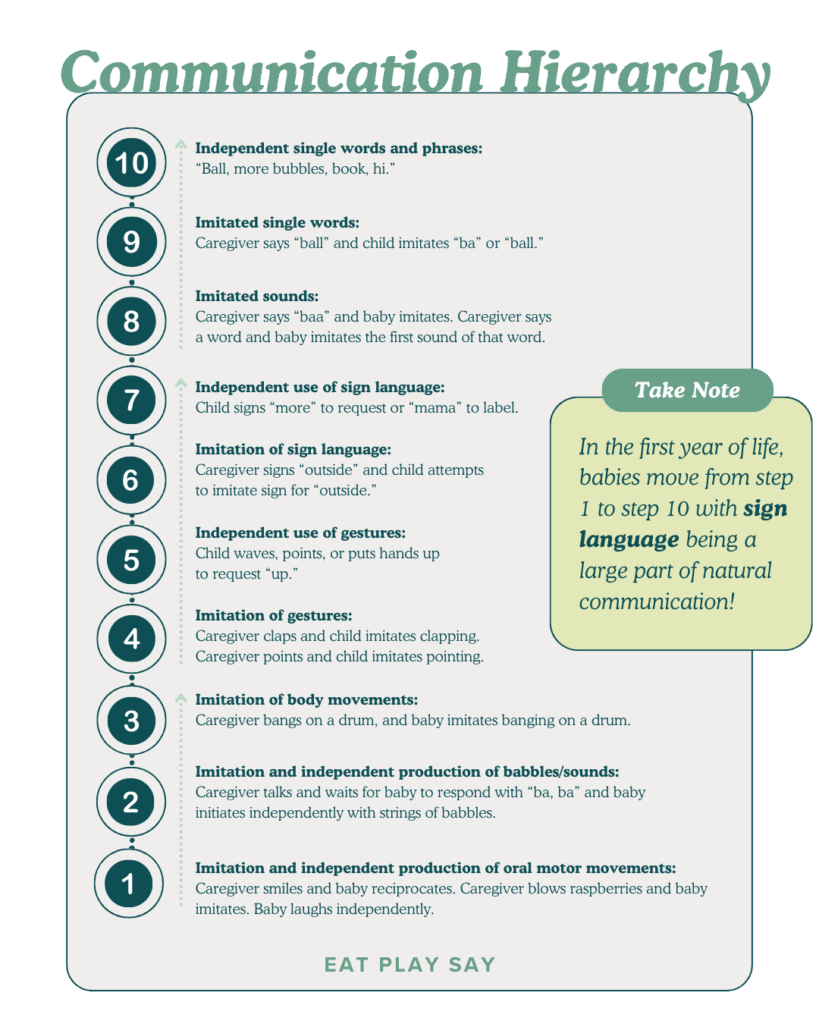
The Communication Hierarchy below shows all the steps babies must take when learning to communicate from birth through spoken words. Notice that half of the steps involve imitation! Remember that pausing encourages imitation, an important skill for baby to develop before their first word.
How to “pause” to help baby talk
Pausing can look different depending on your child’s age. Try these age-appropriate communication tips with your little one!
Newborns (0-3 Months):
- Make facial expressions and pause to wait for a reaction.
- Look at baby without making any sounds and see if they will initiate vocally first.
- Cover your face with your hands and count to 5, then take your hands off and make a face or say a sound like “boo” and wait for their reaction.
- Hold a picture or preferred toy just within reach and wait for a body movement like reaching.
3-6 Months:
- Make vowel sounds like “aaaaa” and “oooo” when looking at them and pause.
- Blow raspberries or make other funny face sounds and pause.
- Sing a song and stop after every verse to see if they respond vocally or try to sing along.
- Model touching crinkly toys or banging on a drum and pause for imitation.
6-9 Months:
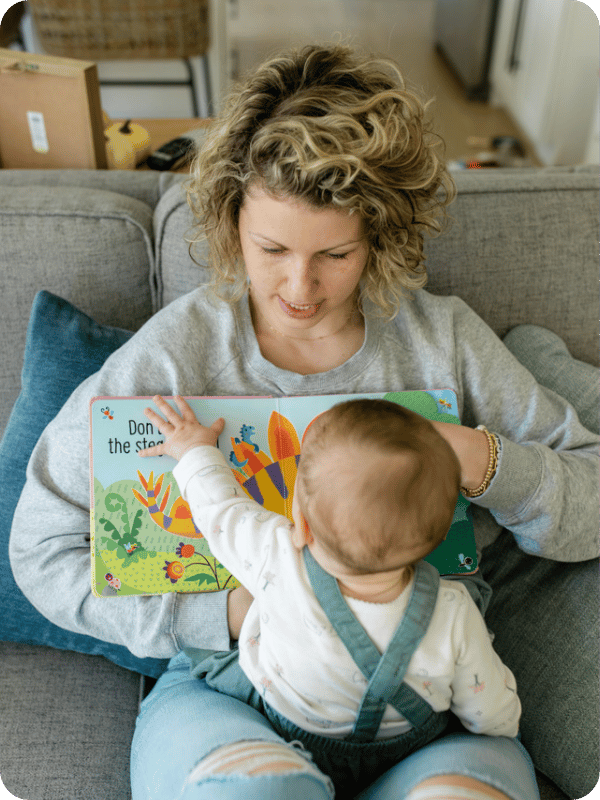
- Model turning pages in the book and pause for them to make a sound or reach for the book.
- Make consonant sounds like “ma, ba” when looking at them and pause.
- Look at them and smile without making a sound and pause for imitation or a response.
- Sing repetitive songs and leave off the last word of the verse to see if they will vocalize it.
- Play with cause and effect toys, and when the toy stops pause for them to initiate another turn with their body or vocally.
9-12 Months:
- Label items with single words and pause for them to imitate vocally or with their body.
- Sing songs and stop mid-way and pause, when they indicate that they want to hear more of the song, model “more” and sign it.
- Give routine directions like “close the door” and “up” and pause to wait for a response. Remember: wait a long time, 5–10 seconds or more!
- Play with toys that require body movements and mimic daily routines, wait for them to initiate playing first so you can imitate them.
12-18 Months:
- Give new directions one time and model what to do (e.g., “Throw it in the trash!”) and pause for 5–10 seconds so they can imitate you.
- Model single-word and two-word phrases and pause, looking at them expectantly to answer.
- Engage in pretend play routines and stop mid-way in the routine (e.g., change the doll’s diaper and only take it off, don’t put it back on) and pause for your little one to tell you or show you that it’s not finished.
- Play with toys that have many play options (e.g., pretend making coffee and drinking it and cleaning it up, or fake food you can cut and pretend to eat and serve). Model the different ways to play and allow for your little one to imitate you.
So when do babies talk? It’s different for everyone!
Remember that babies develop on their own unique timeline, and it’s okay if your baby doesn’t say their first word as quickly as your best friend’s baby or a stranger’s on the sidewalk. It’s even okay if your own children learn to talk at different speeds!
Helping your baby develop spoken words and build their understanding of language doesn’t have to be complicated. Modeling things for them, providing simple language for day-to-day life, and pausing to give them time to process is a great start. When possible, spending just a few minutes a day reading to your baby can make a big impact too! Just keep the idea of pausing in mind, as it gives your baby the best opportunity to answer you back.
If you are concerned about baby’s milestones, you can self-refer to Early Intervention for a free evaluation in the US. It can take a while to get an evaluation, and finding a private practice or hospital-based provider can be faster (but may require a referral). Our team is available for virtual consultations in a matter of days.
More infant resources
You’re doing an amazing job with your little one, and your baby is so lucky to have you! Parenting is hard work, and no parent should have to do it alone. That’s why we’re here! Our Handbooks are written by our team of pediatric specialists, helping parents like you feel empowered to tackle every challenge.
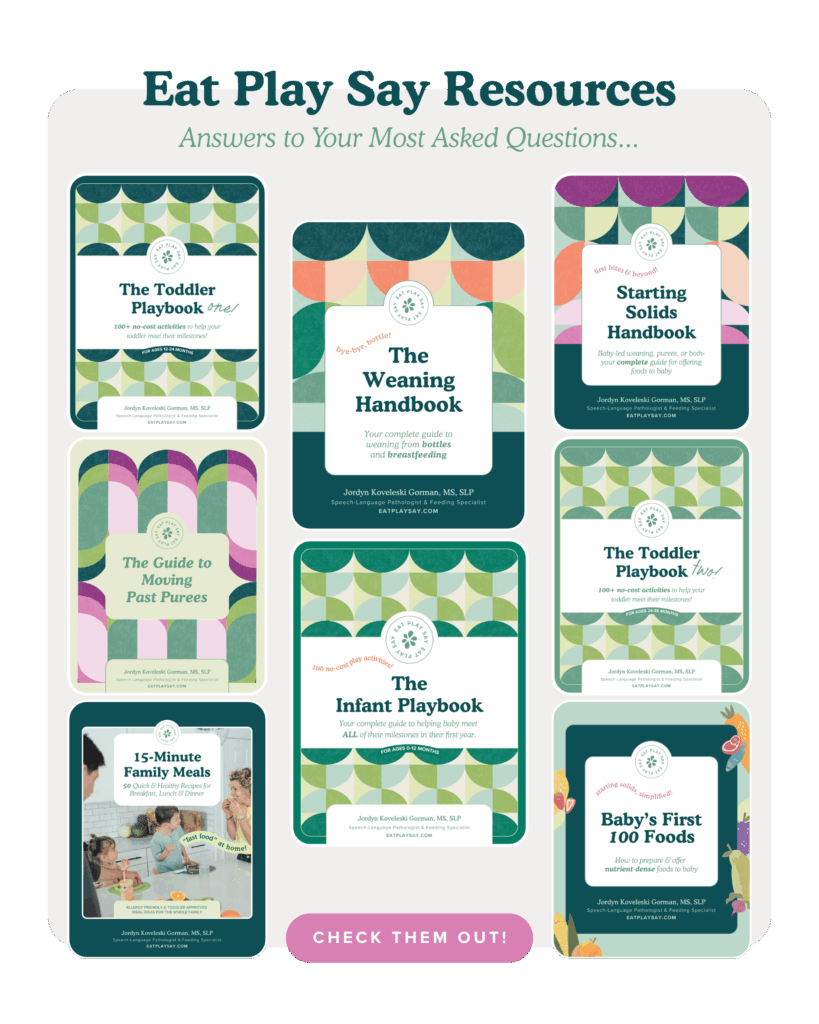
Find more infant, toddler, and preschool resources on our website:
- Speech & language resources
- Get help with starting solids
- Breast & bottle feeding support
- Learn more about infant and toddler development
- Find ways to play with littles from birth
- Get recipes and nutrition support for toddlers
Sources
- Jennifer M. Zubler, Lisa D. Wiggins, Michelle M. Macias, Toni M. Whitaker, Judith S. Shaw, Jane K. Squires, Julie A. Pajek, Rebecca B. Wolf, Karnesha S. Slaughter, Amber S. Broughton, Krysta L. Gerndt, Bethany J. Mlodoch, Paul H. Lipkin; Evidence-Informed Milestones for Developmental Surveillance Tools. Pediatrics March 2022; 149 (3): e2021052138. 10.1542/peds.2021-052138
- Sunderajan T, Kanhere SV. Speech and language delay in children: Prevalence and risk factors. J Family Med Prim Care. 2019 May;8(5):1642-1646. doi: 10.4103/jfmpc.jfmpc_162_19. PMID: 31198730; PMCID: PMC6559061.
- McGillion M, Herbert JS, Pine J, Vihman M, dePaolis R, Keren-Portnoy T, Matthews D. What Paves the Way to Conventional Language? The Predictive Value of Babble, Pointing, and Socioeconomic Status. Child Dev. 2017 Jan;88(1):156-166. doi: 10.1111/cdev.12671. Epub 2016 Nov 10. PMID: 27859008.
- Tierney AL, Nelson CA 3rd. Brain Development and the Role of Experience in the Early Years. Zero Three. 2009 Nov 1;30(2):9-13. PMID: 23894221; PMCID: PMC3722610.
OTHER POSTS YOU MAY LIKE:


MS, SLP
Founder of Eat Play Say, Speech-Language Pathologist, Feeding Specialist, Play Expert, Mom of 3
Jordyn Koveleski Gorman
SPECIALIZES IN: Infant and toddler speech-language, play, and feeding development, and curating a team that provides expert help that feels like a reassuring text from that one mom friend
EDUCATION: Jordyn received her BS in Speech-Language Pathology from Bloomsburg University and her MS in Speech-Language Pathology from Towson University
FAVE PARENTING FIRST: “The first true smile, it’s the sweetest!”

MS, CCC-SLP, CBS, IBCLC
Speech-Language Pathologist & Feeding Specialist, Certified Breastfeeding Specialist, International Board Certified Lactation Consultant
Jessica Nicholson Cocca
SPECIALIZES IN: Breast and bottle feeding, tongue ties, oral motor dysfunction, starting solids, infant and toddler speech, treating oral motor disorders
EDUCATION: Jessica received her BS in Communication Sciences and Disorders from Pennsylvania State University in 2015 and her MS in Speech-Language Pathology from Towson University in 2017
FAVE PARENTING FIRST: “Baby’s first wave! What a fun first communication gesture!”

MA, CCC-SLP, CLC
Speech-Language Pathologist, Certified Lactation Counselor
Jennifer McFarlin
SPECIALIZES IN: Breast and bottle feeding, tongue ties, starting solids, infant and toddler speech development
EDUCATION: She received her BS in Speech-Language Pathology from Ball State in 2014 and a MA in Speech-Language Pathology from Ball State in 2016.
FAVE PARENTING FIRST: “My favorite baby’s first is their first true smile that just warms your soul knowing they are smiling at you. My other favorite is their first word. I love watching their language explode!”

MS, CCC-SLP
Bilingual Speech-Language Pathologist
Nicole La Petina Kelly
SPECIALIZES IN: Bilingual development (Spanish-English), supporting multilingual families, infant and toddler speech
EDUCATION: She received her BA in Communication Sciences and Disorders and in Spanish from the University of Wisconsin-Madison in 2014 and her MS in Speech-Language Pathology with an English-Spanish Specialization from Marquette University in 2016.
FAVE PARENTING FIRST: “It’s the first slobbery kisses for me!”

RDN, LD
Licensed Registered Dietitian
Kimberly Vede
SPECIALIZES IN: Infant and pediatric nutrition including breastfeeding, formula feeding, and starting solids. She also specializes in prenatal and postpartum nutrition.
EDUCATION: She received her BSc in Biology in 2014 from Life University, and her BSc in Dietetics from Life University in 2019.
FAVE PARENTING FIRST: ”The first time they say ‘mama!’”


This checklist was created with input from a Speech-Language Pathologist, Occupational Therapist and Physical Therapist and has been downloaded over 20,000 times by parents worldwide. Learn the important milestones to pay attention to, and keep it in your digital back pocket during the baby + toddler years!
Comprehensive Milestone Checklist for gross motor, fine motor, and speech-language milestones for 0-36 months,
DOWNLOAD FOR FREE


