


When Do Babies Say Their First Word?
April 30, 2024
Jordyn Koveleski Gorman

Last Updated on August 19, 2026 by Jordyn Koveleski Gorman
This page contains affiliate links. We will receive a commission on qualifying purchases using these links.
As your little one inches closer and closer to their first birthday, you’re probably anxiously awaiting that first true word. And you might be hoping that word sounds something like “mama” or even “dada.” Good news: that first word is likely coming soon!
Understanding the developmental process of speech-language milestones can help parents support their little one as they get ready to say their first words. Let’s talk about when to expect baby’s first word, and how you can help them get there!
What age do babies start talking
Developmentally, a first, true, independent word is expected by the end of 12 months of age. (1) But what counts as a word?
A true word will have a few specific features, such as:
- Any sound or sound combination that is consistently produced to represent something
- Said unprompted and independently, like “ba” for “ball” or “wa” for “water”
- Animal sounds (“neigh, moo”) and environmental sounds (“vroom, beep”) also count if said independently
- Approximations count; perfect pronunciation does not matter
To be consistent and independently produced means that the word is said without you instructing baby to “say ball!” and without you prompting them to imitate you. Essentially, the word has to come from them organically. When they see an object or person and they initiate verbally by trying to say a word, that’s it!
5 ways to help baby say their first word
You can help baby work on their first words well before your little one turns a year old.
Consider the Communication Hierarchy below. Notice that baby’s language skills are being developed long before those first words! Every interaction teaches baby something new, even if it will be months until you can see that skill play out.
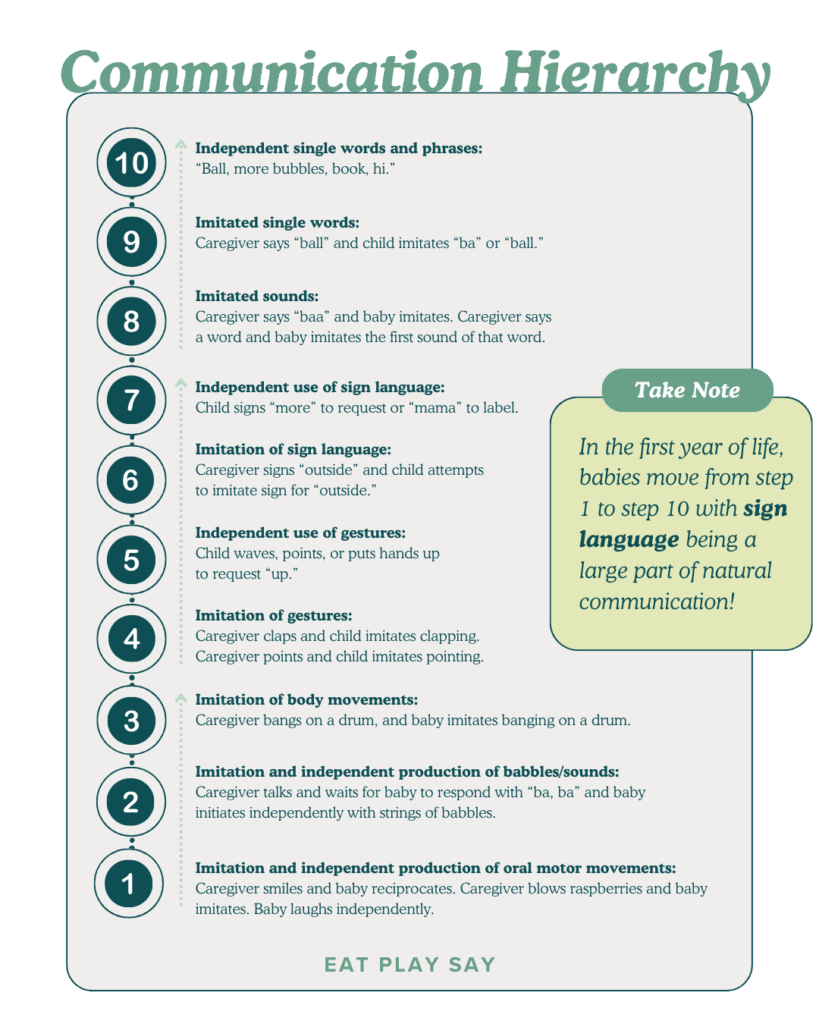
Wondering what practical things you can do to help baby get ready for their first word? Below are 5 easy things you can start today to help baby get to their first true word!
1. Imitate everything they do
Respond to your 3 month old’s cooing by cooing back. Imitate every smile you get. If your 5 month old is laying on the ground playing with toys and lets out a sound, imitate that sound back to them! If they bang a toy with their hand, imitate their movements and keep the back-and-forth game going!
Essentially, imitation of body movements leads to imitation of sounds, and those build on each other until baby imitates gestures and signs, and then words! Keeping in mind that imitation is the goal, look for different ways that you can get baby to imitate your sounds or movements!
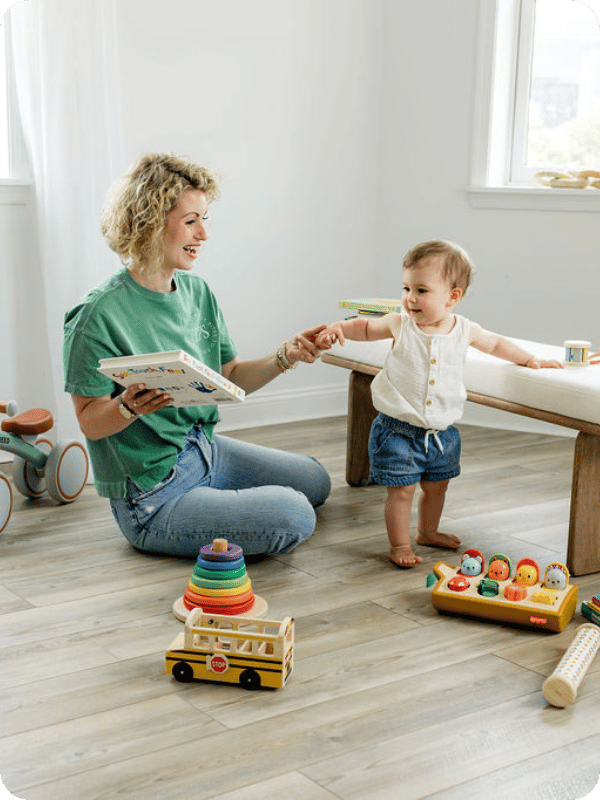
Picking toys that help you model functional words for your little one is important. These toys encourage imitation for littles about 6–18 months of age, and some toddlers will continue to play with these too! In addition to encouraging imitation of motor movements, these toys also pair with functional words like “up, down, bang, boom!”
Additionally, toys for 9–12 months should focus on repetitive movements that leave baby asking for more, looking to imitate both how you play and what you say!
2. Sing lots and lots of songs
Music helps with language learning as it involves the other side of your little one’s brain! Sing routine songs repeatedly and build anticipation for what comes next. Stop songs in the middle and wait for your child to react before finishing the song. Even before 6 months old, babies can try to imitate your intonation pattern with vocalizations.
Classic nursery rhymes like Twinkle Twinkle or Itsy Bitsy Spider are great options! You can also sing your own made up songs to your little one.
3. Introduce sign language
Sign language is a natural part of learning how to communicate (notice it in the Communication Hierarchy above).
Try modeling signs during routines like diaper changes, feedings, play, or bathtime. Littles are more likely to imitate body movements, gestures, and signs before they imitate words. The earlier that signs are introduced, the better. But there’s still value even if you didn’t start before 6 months! Research tells us that signs lead to spoken language, so don’t overlook the power of signing to/with your little one!
4. Read lots of books
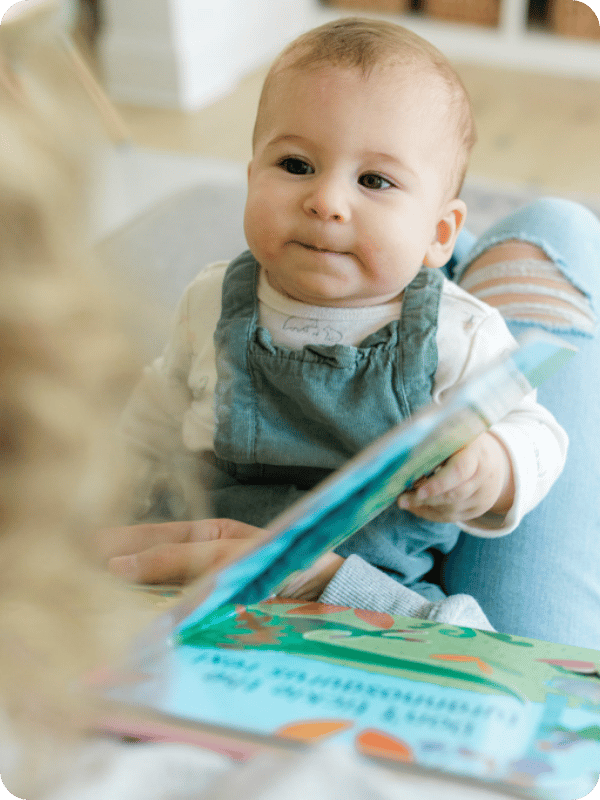
The connection between book reading and language skills is undeniable. Get your little one’s hands on books early, and make them part of everyday routines. Focus on books that make noise, have texture, and motivate baby to imitate body movements and vocally. These are our favorite books for infants.
5. Pause
This is the most important thing you can do! And this language-learning skill can be started from birth. If you say something to baby or make a gesture, make sure you pause to give them time to respond!
Babies often try to respond or say something back (like a sweet newborn coo or a squealy babble) but just weren’t given enough time! If your little one is imitating you a lot, pause before talking to see if baby will try to make a sound or say a word first. Pausing is one of the most effective tools for helping littles start saying words independently. Learn more about the benefits of pausing here.
Tips to help baby say their first word
If your little one is approaching a year of age and isn’t very vocal or imitating verbally, try not to worry. There are many things you can do to help support them on their journey to their first word.
Here are some things to keep in mind:
- Talk slowly and simply to baby.
- Say repetitive phrases and pause for them to fill in the blank. Try phrases like, “Baa baa black sheep, have you any _____?”
- Pair words with gestures constantly, such as “up, down, dance, yay!”
- Limit distractions during play, such as background noise or the TV.
- Introduce signs early to help bridge to spoken language.
- Include your little one in daily repetitive tasks (e.g., laundry) and say the same words during those tasks.
- Wait for them to interact with you first and then imitate them.
Here are some things to avoid:
- Do not talk constantly. Instead, allow baby to explore their environment. It’s okay to be quiet and see if they will say some sounds on their own!
- Avoid prompting baby with statements like, “Say ball! Tell me ball! Say hi!” Reducing the pressure to speak can help baby explore and practice on their own. Simply modeling and pausing is enough of a prompt! If there is a ball, simply show the ball to baby and name it, “ball!” and then wait for baby to respond.
- Don’t ask baby, “What’s this? What’s that?” Just like above, reducing pressure is key. For instance, parents often feel the need to quiz littles on colors or shapes. Instead of asking baby, “What color is that car?” you can simply say, “The car is red.” They are more likely to imitate a comment you make than answer a question you ask.
Milestones and baby’s first words
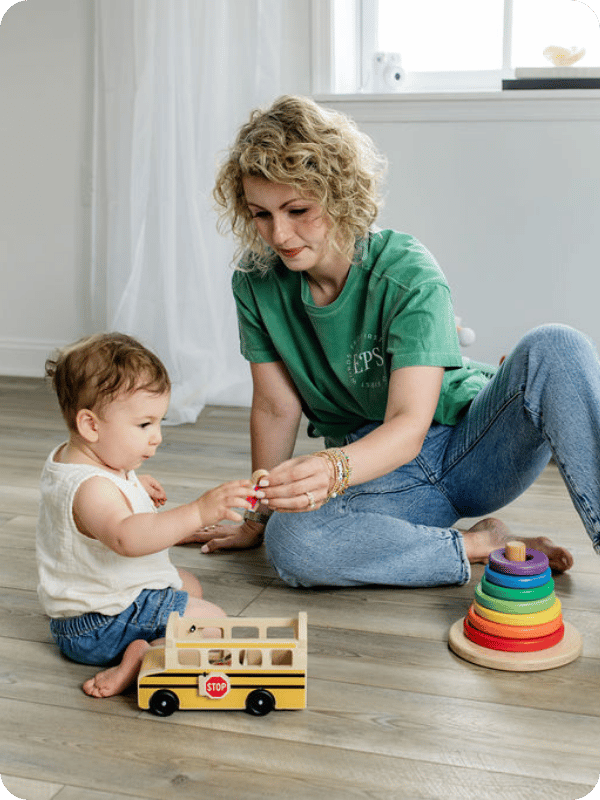
After baby’s first birthday, introduce pretend play toys and keep modeling functional nouns and verbs. Baby will continue to practice imitation and will soon say words independently!
The AAP and CDC expect 3–5 unique words by 18 months. (1) As a speech-language pathologist, this number is not quite aligned with what we see clinically, and it’s not a guideline we recommend parents use. Instead, by 18 months, 10 individual words or approximations (including signs and animal sounds) is expected. About 50% of littles will be saying 50 words by 18 months! (2)
Although the exact number may vary from source to source, the general idea is that by 18 months old, littles should have gained a few new words in addition to their first word we see around 12 months. Your little one doesn’t need to speak in full sentences by 1.5 years old, or even by age 2! New words may be added slowly at first, and that’s okay. Overall growth and progress is what we look for.
Parents often worry that if their child isn’t hitting milestones early or even right on time, that it means something is wrong. There is research supporting that although delays in talking at 12–18 months can be linked to continued speech delays closer to age 3, it does not guarantee that a child will still be delayed by age 3. (3)
Littles often catch up quickly, but that doesn’t mean you have to wait and see without providing extra support. Remember that there is a range of normal and no two babies are alike. But if you feel like your little one might not be where they should be, it’s good to act early and seek support!
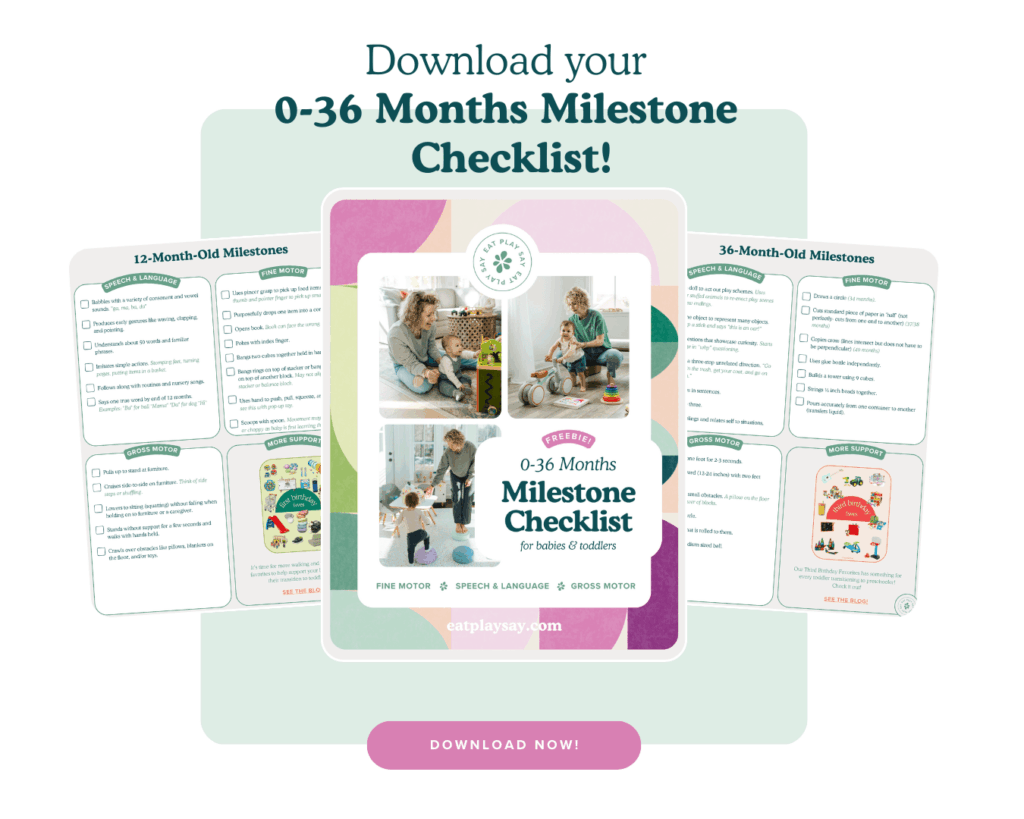
To “check and see” where baby is at with developmental milestones, download our FREE Milestone Checklist. Join 40,000+ parents doing the same!
Getting help for baby’s first words
If your child doesn’t have a true word by the end of 12 months of age, and you’ve tried all the things in this blog, it’s time to talk to a professional! The earlier you can get support, the better. Trust your gut. You know your little one best!
You can self-refer to Early Intervention for a free evaluation in the US. It can take a while to be seen, so some families may choose to find a private practice or hospital-based provider for a sooner appointment. You can also schedule a virtual consultation with our team of pediatric professionals in a matter of days!
More infant & toddler resources
Parents shouldn’t have to be overwhelmed by 2 a.m. Google searches or feel alone trying to support their little ones. That’s why Eat Play Say is here!
For more in-depth, research-backed support, check out our Handbooks! With answers to your most asked questions on topics like starting solids, weaning, and even how to play with infants and toddlers, we’ve got your back!
Looking for more blogs like this one? Check out our other posts here.
Sources
- Jennifer M. Zubler, Lisa D. Wiggins, Michelle M. Macias, Toni M. Whitaker, Judith S. Shaw, Jane K. Squires, Julie A. Pajek, Rebecca B. Wolf, Karnesha S. Slaughter, Amber S. Broughton, Krysta L. Gerndt, Bethany J. Mlodoch, Paul H. Lipkin; Evidence-Informed Milestones for Developmental Surveillance Tools. Pediatrics March 2022; 149 (3): e2021052138. 10.1542/peds.2021-052138
- Mayo Clinic. Language Development: Speech Milestones for Babies. Published 19 February 2025. Accessed August 2026.
- Fernald A, Marchman VA. Individual differences in lexical processing at 18 months predict vocabulary growth in typically developing and late-talking toddlers. Child Dev. 2012 Jan-Feb;83(1):203-22. doi: 10.1111/j.1467-8624.2011.01692.x. Epub 2011 Dec 16. PMID: 22172209; PMCID: PMC3266972.
OTHER POSTS YOU MAY LIKE:


MS, SLP
Founder of Eat Play Say, Speech-Language Pathologist, Feeding Specialist, Play Expert, Mom of 3
Jordyn Koveleski Gorman
SPECIALIZES IN: Infant and toddler speech-language, play, and feeding development, and curating a team that provides expert help that feels like a reassuring text from that one mom friend
EDUCATION: Jordyn received her BS in Speech-Language Pathology from Bloomsburg University and her MS in Speech-Language Pathology from Towson University
FAVE PARENTING FIRST: “The first true smile, it’s the sweetest!”

MS, CCC-SLP, CBS, IBCLC
Speech-Language Pathologist & Feeding Specialist, Certified Breastfeeding Specialist, International Board Certified Lactation Consultant
Jessica Nicholson Cocca
SPECIALIZES IN: Breast and bottle feeding, tongue ties, oral motor dysfunction, starting solids, infant and toddler speech, treating oral motor disorders
EDUCATION: Jessica received her BS in Communication Sciences and Disorders from Pennsylvania State University in 2015 and her MS in Speech-Language Pathology from Towson University in 2017
FAVE PARENTING FIRST: “Baby’s first wave! What a fun first communication gesture!”

MA, CCC-SLP, CLC
Speech-Language Pathologist, Certified Lactation Counselor
Jennifer McFarlin
SPECIALIZES IN: Breast and bottle feeding, tongue ties, starting solids, infant and toddler speech development
EDUCATION: She received her BS in Speech-Language Pathology from Ball State in 2014 and a MA in Speech-Language Pathology from Ball State in 2016.
FAVE PARENTING FIRST: “My favorite baby’s first is their first true smile that just warms your soul knowing they are smiling at you. My other favorite is their first word. I love watching their language explode!”

MS, CCC-SLP
Bilingual Speech-Language Pathologist
Nicole La Petina Kelly
SPECIALIZES IN: Bilingual development (Spanish-English), supporting multilingual families, infant and toddler speech
EDUCATION: She received her BA in Communication Sciences and Disorders and in Spanish from the University of Wisconsin-Madison in 2014 and her MS in Speech-Language Pathology with an English-Spanish Specialization from Marquette University in 2016.
FAVE PARENTING FIRST: “It’s the first slobbery kisses for me!”

RDN, LD
Licensed Registered Dietitian
Kimberly Vede
SPECIALIZES IN: Infant and pediatric nutrition including breastfeeding, formula feeding, and starting solids. She also specializes in prenatal and postpartum nutrition.
EDUCATION: She received her BSc in Biology in 2014 from Life University, and her BSc in Dietetics from Life University in 2019.
FAVE PARENTING FIRST: ”The first time they say ‘mama!’”


This checklist was created with input from a Speech-Language Pathologist, Occupational Therapist and Physical Therapist and has been downloaded over 20,000 times by parents worldwide. Learn the important milestones to pay attention to, and keep it in your digital back pocket during the baby + toddler years!
Comprehensive Milestone Checklist for gross motor, fine motor, and speech-language milestones for 0-36 months,
DOWNLOAD FOR FREE


