


When Do Babies Start Babbling? And What to Do if They Stop
November 1, 2023
Jordyn Koveleski Gorman

Last Updated on August 12, 2026 by Jordyn Koveleski Gorman
This page contains affiliate links. We will receive a commission on qualifying purchases using these links.
Although your baby’s first “real” word isn’t expected until they are around 12 months old, that doesn’t mean your baby can’t communicate before then.
For instance, newborns cry to tell us they have a need, and then they learn to coo when looking at their caregiver. Or you might have seen the way a 6 month old screeches at the top of their lungs to get your attention. These are precursors to spoken language! Babbling is another important precursor to your little one’s first word.
But when do babies start babbling? And what if baby suddenly stops babbling? Let’s break it down!
When do babies start babbling?
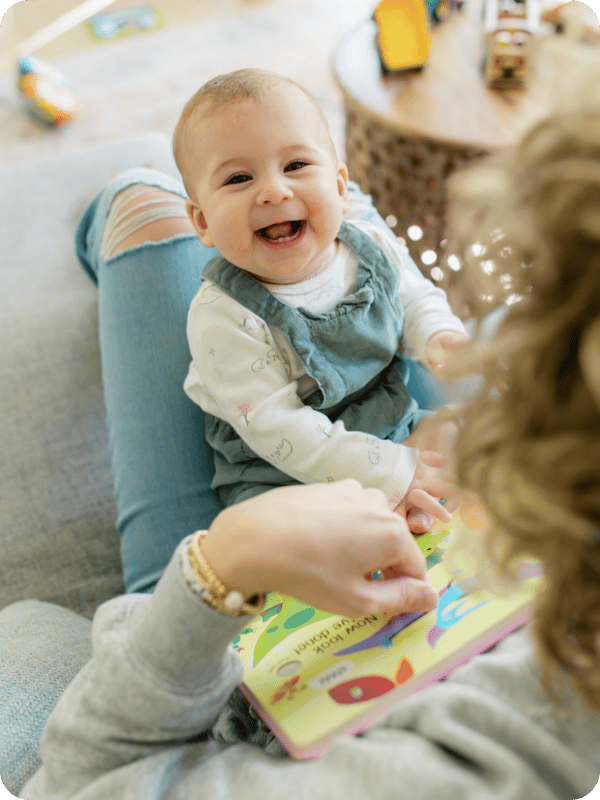
Babbling usually begins anywhere from 4–6 months. The AAP and CDC list babbling as a 9 month milestone, but include elements of babbling (like taking turns making sounds with a caregiver) as 4 and 6 month milestones. (1) As speech-language pathologists, we can make these milestones a bit clearer for you.
There is a range of normal for many developmental milestones for infants and toddlers. Speech and language skills are especially broad, as a baby may produce their first “ba” sound when they are 4 or 5 months old but might not consistently repeat it until they are 8 months old. Babbling is a skill that is somewhat subjective, and caregivers may perceive babbling differently than a pediatrician or another parent.
In general, the goal is for baby to produce some consonant sounds (e.g., ba, ma, pa, da, ga) in babbles by the time they are 6 months of age. It does not need to be consistent, nor does it need to be the same consonants. The goal is for baby to turn those vowel-like coos into consonants by their half birthday.
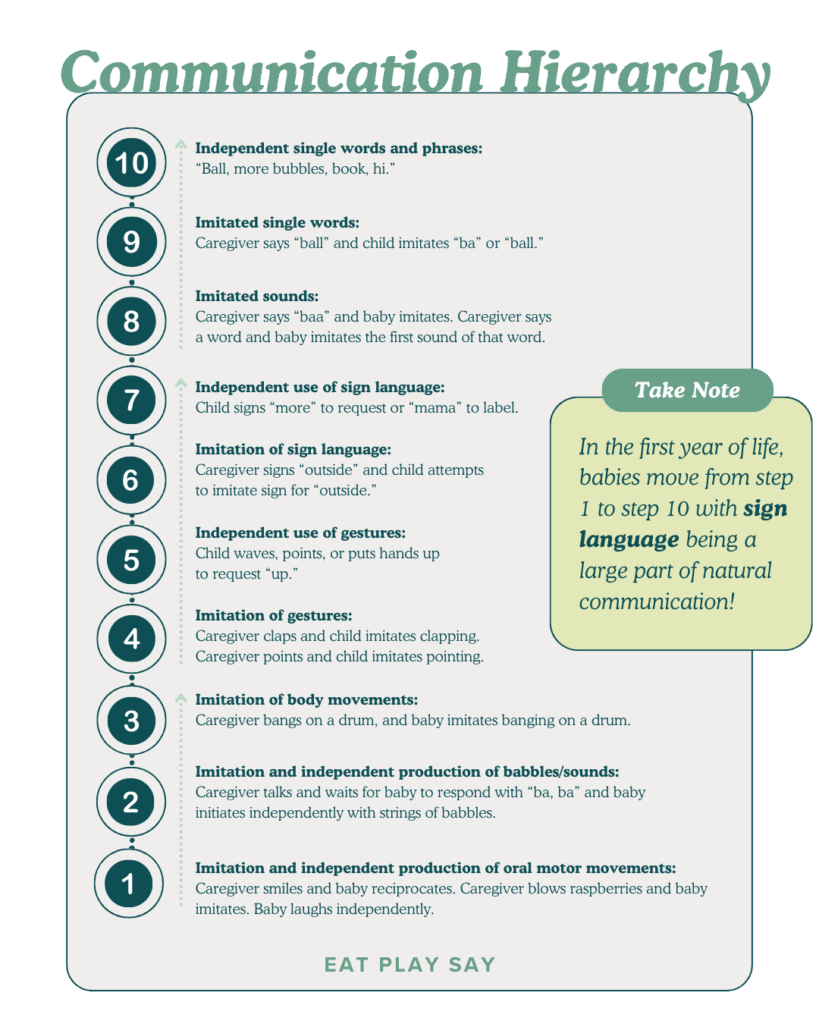
Check out the Communication Hierarchy below for an overview of speech-language development. Breaking these skills down in this way can be helpful for seeing the bigger picture and understanding that your little one is communicating every day!
What is babbling and why does it matter?
Babbling is a broad term that refers to an early form of verbal communication before the development of spoken words. It usually involves forming consonant-vowel syllable shapes, such as /b, m, p/ sounds spontaneously. These will sound like, “ba, ma, pa.”
Babbling is different than when your little one coos (such as making “oooh” or “ga” sounds from the back of their throat). Cooing can begin as early as a few weeks of age! When baby begins babbling, there will likely be longer strings of consonant-vowel sounds together. You can have a conversation with baby, taking turns as they babble in response!
Research has shown that contrary to previous thoughts, babbling is not a random collection of sounds. In fact, baby’s first words can actually be linked to the sounds they produce when babbling. (2) Even after babies say their first words, they continue to babble.
Over time, you’ll notice that their babbles begin to sound more and more like real words and sentences. This is backed by research, too! (2) In a long string of silly, nonsensical sounds, babies and toddlers will throw in a word or words that they know. So if you listen closely, you might just hear them talking about “mama,” “dada,” or their favorite “ba.” And rest assured, they meant to do that!
Additionally, the number of different babbled sounds babies produce at 10 months can be used to predict language skills 5 months later. (3) Another study found that the age that a baby begins babbling is a strong predictor of the age a baby will be when producing their first intentional word. (4)
Babbling may sound silly or even unnecessary, but it’s a vital piece of developing speech-language skills for your little one!
What if baby suddenly stops babbling?
First of all, the overall likelihood of any one child having a speech or language delay is low, only about 2.5%. (5) But this is understandably a common concern for parents, especially when skills seem to disappear suddenly.
Maybe your 4 month old was making a ton of sounds, and now it seems like they’ve reverted back to only crying. Or your 5 month old was imitating blowing raspberries every day and now they won’t do it. Parents want to know if these skills suddenly disappearing is normal or cause for concern.
There are a few things to consider when experiencing a sudden “regression” in skills from your baby. This is true for more than just babbling!
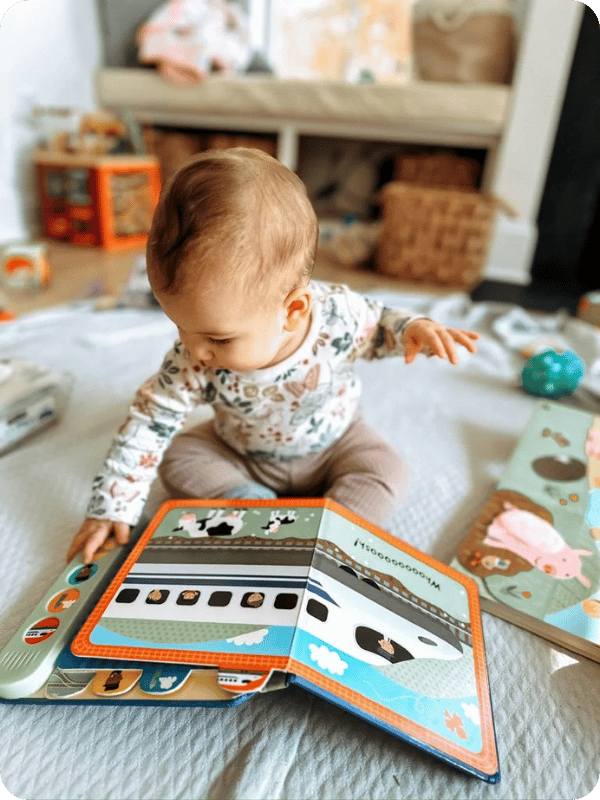
Babies aren’t robots.
Just like you might not say or do the same things two days in a row, babies may focus on something else from one day to the next! If baby has consistently shown a skill over a period of days or weeks and then it seems to go away out of the blue, it is highly possible that they are simply focused on something else. In the example of blowing raspberries, consider that baby might have noticed your hair moving when you leaned forward or they saw your smile and it distracted them. That’s okay!
Look for other new skills.
Instead of focusing on what your baby has stopped doing, take notice of any other new things that they are doing. Perhaps your baby started babbling a new sound just a week after they stopped imitating raspberries, or maybe they just learned to roll over. If your baby is moving forward with milestones and development overall, there is likely nothing to worry about. Sometimes skills “pause” while others are pressing “play.” Monitor for the skill that has stopped to come back into “play mode” in the coming weeks.
“Check and see” their milestone development.
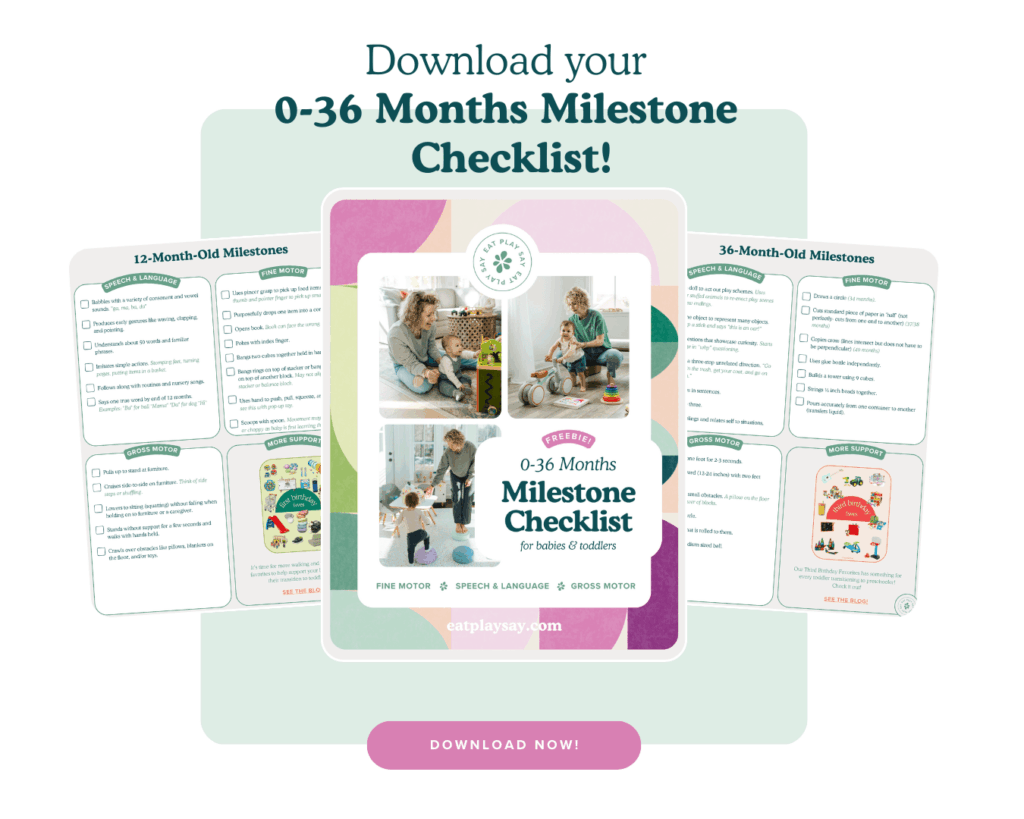
If you are concerned that your baby is behind, a milestone checklist can help put your mind at ease and give you ideas of how to play with your baby. If baby hasn’t checked off all of the boxes for their age range, spend a week or two trying to elicit those skills. Baby may be able to do it with some time and support. If baby is on track overall, there is likely nothing to worry about! It’s important to note that chances of a delay are increased if there is a family history of speech-language delays or presence of an underlying medical diagnosis.
Download our free Milestone Checklist and join 40,000+ parents who decided to “check and see” their baby’s development!
You can help baby babble
Studies have recently begun making connections between babbling, social development, and later speech formation. One study noted that a mother’s responsiveness to her child’s babbles was correlated to advanced consonant-vowel vocalizations later on. (6)
Here are some easy ways to help support baby’s babbling:
- Give your baby lots of opportunities to “chat” face-to-face with you or another caregiver.
- Read books to baby! The more books, the better. You can find our favorite books for baby here.
- Remember to “pause” when talking to baby, so they have the chance to respond.
- Model language throughout the day. Narrating your movements, sound effects, and activities for even just a few minutes every day can be beneficial!
What if babbling doesn’t return after a few weeks?
Even though the likelihood of this happening is very slim, it may be a sign of a developmental delay or other underlying developmental diagnosis.
First, talk to your pediatrician about your concerns.
Next, remember that you don’t need a referral from a physician to schedule an evaluation with your local Early Intervention Program. Evaluations for children under 3 years of age are free in the United States and therapy services (if needed) are either no cost or low cost for families. Getting your little one help early is key.
Our team of pediatric specialists offers virtual consultations for parents who have questions and want answers now. Waiting for an evaluation or speech therapy can take several months, while we schedule to meet with you virtually in just days. Meet the professionals behind Eat Play Say!
More infant resources
Your little one is growing, and you’re doing an amazing job supporting them along the way! You should be so proud.
Looking for more support with your little one? Check out our expert-written Handbooks! Whether you need help finding the best developmentally appropriate play activities for your little one or need a boost starting solids, we’ve got you covered!
For more support raising little ones, check out our blog!
- Get help starting solids
- Learn more about infant and toddler development
- Find ways to play with your little one
- Get more speech & language support
Sources
- Jennifer M. Zubler, Lisa D. Wiggins, Michelle M. Macias, Toni M. Whitaker, Judith S. Shaw, Jane K. Squires, Julie A. Pajek, Rebecca B. Wolf, Karnesha S. Slaughter, Amber S. Broughton, Krysta L. Gerndt, Bethany J. Mlodoch, Paul H. Lipkin; Evidence-Informed Milestones for Developmental Surveillance Tools. Pediatrics March 2022; 149 (3): e2021052138. 10.1542/peds.2021-052138
- Laing C, Bergelson E. From babble to words: Infants’ early productions match words and objects in their environment. Cogn Psychol. 2020 Nov;122:101308. doi: 10.1016/j.cogpsych.2020.101308. Epub 2020 Jun 3. PMID: 32504852; PMCID: PMC7572567.
- Wu, Z., & Gros-Louis, J. (2014). Infants’ prelinguistic communicative acts and maternal responses: Relations to linguistic development. First Language, 34(1), 72-90.
- McGillion M, Herbert JS, Pine J, Vihman M, dePaolis R, Keren-Portnoy T, Matthews D. What Paves the Way to Conventional Language? The Predictive Value of Babble, Pointing, and Socioeconomic Status. Child Dev. 2017 Jan;88(1):156-166. doi: 10.1111/cdev.12671. Epub 2016 Nov 10. PMID: 27859008.
- Sunderajan T, Kanhere SV. Speech and language delay in children: Prevalence and risk factors. J Family Med Prim Care. 2019 May;8(5):1642-1646. doi: 10.4103/jfmpc.jfmpc_162_19. PMID: 31198730; PMCID: PMC6559061.
- Gros-Louis, J. Maternal responsiveness and the development of directed vocalizing in social interactions. https://doi.org/10.1111/INFA.12054
OTHER POSTS YOU MAY LIKE:


MS, SLP
Founder of Eat Play Say, Speech-Language Pathologist, Feeding Specialist, Play Expert, Mom of 3
Jordyn Koveleski Gorman
SPECIALIZES IN: Infant and toddler speech-language, play, and feeding development, and curating a team that provides expert help that feels like a reassuring text from that one mom friend
EDUCATION: Jordyn received her BS in Speech-Language Pathology from Bloomsburg University and her MS in Speech-Language Pathology from Towson University
FAVE PARENTING FIRST: “The first true smile, it’s the sweetest!”

MS, CCC-SLP, CBS, IBCLC
Speech-Language Pathologist & Feeding Specialist, Certified Breastfeeding Specialist, International Board Certified Lactation Consultant
Jessica Nicholson Cocca
SPECIALIZES IN: Breast and bottle feeding, tongue ties, oral motor dysfunction, starting solids, infant and toddler speech, treating oral motor disorders
EDUCATION: Jessica received her BS in Communication Sciences and Disorders from Pennsylvania State University in 2015 and her MS in Speech-Language Pathology from Towson University in 2017
FAVE PARENTING FIRST: “Baby’s first wave! What a fun first communication gesture!”

MA, CCC-SLP, CLC
Speech-Language Pathologist, Certified Lactation Counselor
Jennifer McFarlin
SPECIALIZES IN: Breast and bottle feeding, tongue ties, starting solids, infant and toddler speech development
EDUCATION: She received her BS in Speech-Language Pathology from Ball State in 2014 and a MA in Speech-Language Pathology from Ball State in 2016.
FAVE PARENTING FIRST: “My favorite baby’s first is their first true smile that just warms your soul knowing they are smiling at you. My other favorite is their first word. I love watching their language explode!”

MS, CCC-SLP
Bilingual Speech-Language Pathologist
Nicole La Petina Kelly
SPECIALIZES IN: Bilingual development (Spanish-English), supporting multilingual families, infant and toddler speech
EDUCATION: She received her BA in Communication Sciences and Disorders and in Spanish from the University of Wisconsin-Madison in 2014 and her MS in Speech-Language Pathology with an English-Spanish Specialization from Marquette University in 2016.
FAVE PARENTING FIRST: “It’s the first slobbery kisses for me!”

RDN, LD
Licensed Registered Dietitian
Kimberly Vede
SPECIALIZES IN: Infant and pediatric nutrition including breastfeeding, formula feeding, and starting solids. She also specializes in prenatal and postpartum nutrition.
EDUCATION: She received her BSc in Biology in 2014 from Life University, and her BSc in Dietetics from Life University in 2019.
FAVE PARENTING FIRST: ”The first time they say ‘mama!’”


This checklist was created with input from a Speech-Language Pathologist, Occupational Therapist and Physical Therapist and has been downloaded over 20,000 times by parents worldwide. Learn the important milestones to pay attention to, and keep it in your digital back pocket during the baby + toddler years!
Comprehensive Milestone Checklist for gross motor, fine motor, and speech-language milestones for 0-36 months,
DOWNLOAD FOR FREE


