


Infant Activities that Support Speech-Language Development
March 4, 2025
Jordyn Koveleski Gorman

Last Updated on August 26, 2026 by Jordyn Koveleski Gorman
New moms and dads are often told that “narrating their day” is one of the best infant activities for speech-language development. It’s on posters in pediatrician’s offices, online, and in nearly every parenting guide. Unfortunately, without context and clarity, this advice can go from being a helpful tip to overwhelming and exhausting really quickly.
Many people think that narrating the day means to talk nonstop throughout their infant’s wake windows. And if they don’t manage to talk for 45 minutes or 2 hours straight, they start to feel guilty or like they’ve somehow failed. But that’s not the case!
As a pediatric speech-language pathologist, talking to babies is literally my specialty. Although it’s important for parents to talk to their little one, there’s no need to speak constantly. In fact, talking too much can actually keep baby from expressing their own coos and babbles!
There are many ways to support your little one’s speech-language development, including narrating your day. Like with all things, though, there are effective ways to approach it and less effective ways. Learning how to talk to your baby in a way that helps their development can be simple and rewarding! Let’s talk about speech-development infant activities that can easily be incorporated into your daily routine.
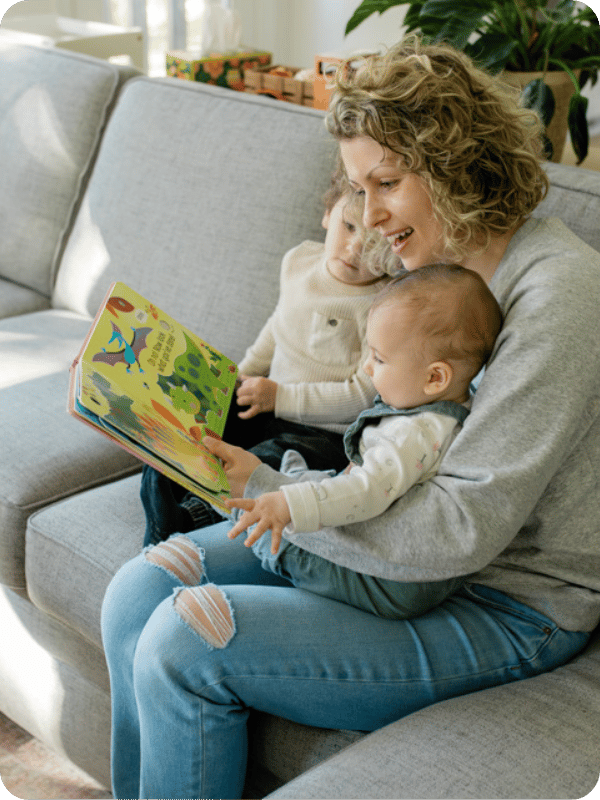
Infant activities: Narrating the day do’s and don’ts
First, here are a few examples of things to avoid and what to try instead when narrating your day.
Instead of:
“Okay baby, let’s go change your diaper. First, we are going to walk up the stairs one by one and go into your room. Now, I’m going to lay you down on the changing mat and undo your onesie. And now, I’m going to grab some wipes and cover you so you don’t pee on me! Okay, time to wrap up your dirty diaper, throw it in the trash, and put your clothes back on!”
Try:
“Stinky stinky! Diaper change time! [Long pause.] This is why we change your diaper, change your diaper, change your diaper…[Pause again.] Okay, 5, 4, 3, 2, 1 all done!”
Notice that the second option allows for several pauses for baby to respond to the caregiver, and it focuses on functional words, which are words and short phrases that communicate needs and wants. (1) When baby hears these words repeatedly during their routines, they will be more likely to anticipate what happens next, as well as imitate verbally.
Instead of:
“Let’s read this book about cars! Beep beep! The car is driving on the road, here is the road. They go vroom vroom, so fast!”
Try:
“Wow, cars! [Pause.] Beeeeeeeeep! [Pause.] Drive the car! [Pause.] Look out, beep beep!”
Pausing is important when talking to baby. It teaches baby the flow of a conversation and gives their brains time to process the information you’re giving to baby. Learn more about the importance of pausing here.
Additionally, focusing on functional words helps babies and toddlers learn to communicate. It is easier to process and respond to, “Beep beep car!” than it is to respond to, “The car drives on the road and it says ‘beep beep, vroom vroom!’ Do you see the car? Wow!”
Functional words are often (but not always) verbs, or a simple noun–verb pair. (1) From above, “change diaper” is a functional pair. Words like “eat,” “no,” “uh oh,” and “milk” are all functional words because they help communicate a request or need.

Infant speech development activities
Try these simple activities to help support your little one’s speech development. You can do these as part of normal play time while still incorporating other “conversations” throughout the day!
London Bridge
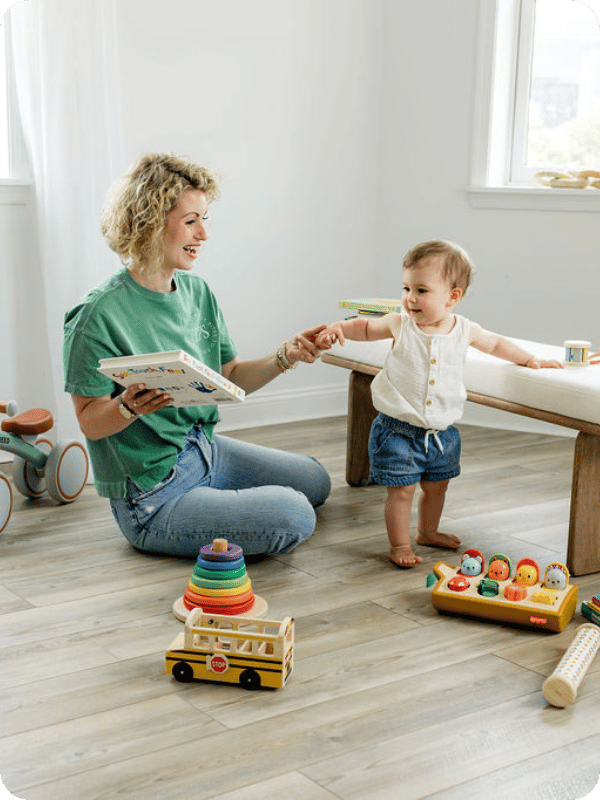
Lay baby on the floor, and grab a blanket or towel. Sing London Bridge is Falling Down and when you say “down,” place the blanket over their body. Wait a second and then say, “Where’s [baby’s name]?!” Wait another second and lift up the blanket and say, “There’s [baby’s name]!” Do the same thing with Peek-a-Boo or another nursery rhyme, and look for baby to coo, smile, or move their body in response! Older infants will start to pull the blanket off on their own, too.
Introduce Sign Language
Some early gestures begin to emerge between 6–9 months, so you can start using sign language during your routines as early as a few months old! Sign “milk,” “play,” and “all done” during feedings, playing, and transitions. Add in more functional signs as you feel comfortable. This video shows examples of our favorite signs! Learn more about the benefits of sign language here.
Telephone Time
As baby gets a little older (9 months or so), this game gets more interactive and so fun! Grab anything that resembles a phone (toy banana, an old phone, a rectangular piece of cardboard) and take turns answering the phone with baby. “Hello? Oh, it’s for you!” and hand it to them. They may imitate the action and attempt to vocalize back to you. This is great for turn-taking, imitation, and working towards first words!
Tips for talking to baby
Talking to your baby doesn’t have to feel like rocket science! Keep these tips in mind, and rest assured that your baby is learning so much from you!
Remember these main tips when talking to baby:
- Pausing between short phrases allows baby to process information, and even respond back through cooing, babbling, gesturing, and eventually talking!
- Repeating the same words throughout a play routine, book, or during an exchange helps baby learn that word. (2) The more they hear it, the more likely they are to eventually imitate it and use it!
- Aim to only talk 50% of the time when you are playing with baby. This allows baby time to respond the other 50% of the time. Remember that even conversations with infants have back-and-forth. Try not to go on a monologue when talking to baby. Give them time to participate too.
- Silence can be good for baby. Remember that their little minds take a long time to process things! Silence helps them process, learn, and apply what they know. We have to be quiet to allow baby time to do this.
- As long as you are engaging with your little one, you are doing a good job. There is no set amount of time that you need to talk to baby. When they are awake, if you are there to play and interact with them, then you are doing what you need to do to help them learn!
More infant resources
Raising little ones is hard work, and no parent should feel alone! That’s why Eat Play Say is here, to support parents along the way. Our resources are written by licensed pediatric specialists to help parents feel supported and empowered at every new milestone!
For more activities that support your little one’s speech, fine motor, and gross motor development (like the ones in this blog), download our Infant Playbook or make it a bundle!
For more free articles just like this one, check out our blog:
- More speech & language help
- Starting solids tips
- Breast & bottle feeding support
- Play activities for littles
- Infant & toddler development
- Get help feeding toddlers
Sources
- Byrne K, Sterrett K, Lord C. Examining the Transition from Single Words to Phrase Speech in Children with ASD: A Systematic Review. Clin Child Fam Psychol Rev. 2024 Dec;27(4):1031-1053. doi: 10.1007/s10567-024-00507-1. Epub 2024 Nov 16. PMID: 39550470; PMCID: PMC11609125.
- Schwab JF, Lew-Williams C. Repetition across successive sentences facilitates young children’s word learning. Dev Psychol. 2016 Jun;52(6):879-86. doi: 10.1037/dev0000125. Epub 2016 May 5. PMID: 27148781; PMCID: PMC5651173.
OTHER POSTS YOU MAY LIKE:


MS, SLP
Founder of Eat Play Say, Speech-Language Pathologist, Feeding Specialist, Play Expert, Mom of 3
Jordyn Koveleski Gorman
SPECIALIZES IN: Infant and toddler speech-language, play, and feeding development, and curating a team that provides expert help that feels like a reassuring text from that one mom friend
EDUCATION: Jordyn received her BS in Speech-Language Pathology from Bloomsburg University and her MS in Speech-Language Pathology from Towson University
FAVE PARENTING FIRST: “The first true smile, it’s the sweetest!”

MS, CCC-SLP, CBS, IBCLC
Speech-Language Pathologist & Feeding Specialist, Certified Breastfeeding Specialist, International Board Certified Lactation Consultant
Jessica Nicholson Cocca
SPECIALIZES IN: Breast and bottle feeding, tongue ties, oral motor dysfunction, starting solids, infant and toddler speech, treating oral motor disorders
EDUCATION: Jessica received her BS in Communication Sciences and Disorders from Pennsylvania State University in 2015 and her MS in Speech-Language Pathology from Towson University in 2017
FAVE PARENTING FIRST: “Baby’s first wave! What a fun first communication gesture!”

MA, CCC-SLP, CLC
Speech-Language Pathologist, Certified Lactation Counselor
Jennifer McFarlin
SPECIALIZES IN: Breast and bottle feeding, tongue ties, starting solids, infant and toddler speech development
EDUCATION: She received her BS in Speech-Language Pathology from Ball State in 2014 and a MA in Speech-Language Pathology from Ball State in 2016.
FAVE PARENTING FIRST: “My favorite baby’s first is their first true smile that just warms your soul knowing they are smiling at you. My other favorite is their first word. I love watching their language explode!”

MS, CCC-SLP
Bilingual Speech-Language Pathologist
Nicole La Petina Kelly
SPECIALIZES IN: Bilingual development (Spanish-English), supporting multilingual families, infant and toddler speech
EDUCATION: She received her BA in Communication Sciences and Disorders and in Spanish from the University of Wisconsin-Madison in 2014 and her MS in Speech-Language Pathology with an English-Spanish Specialization from Marquette University in 2016.
FAVE PARENTING FIRST: “It’s the first slobbery kisses for me!”

RDN, LD
Licensed Registered Dietitian
Kimberly Vede
SPECIALIZES IN: Infant and pediatric nutrition including breastfeeding, formula feeding, and starting solids. She also specializes in prenatal and postpartum nutrition.
EDUCATION: She received her BSc in Biology in 2014 from Life University, and her BSc in Dietetics from Life University in 2019.
FAVE PARENTING FIRST: ”The first time they say ‘mama!’”


This checklist was created with input from a Speech-Language Pathologist, Occupational Therapist and Physical Therapist and has been downloaded over 20,000 times by parents worldwide. Learn the important milestones to pay attention to, and keep it in your digital back pocket during the baby + toddler years!
Comprehensive Milestone Checklist for gross motor, fine motor, and speech-language milestones for 0-36 months,
DOWNLOAD FOR FREE


