


Should Parents Wait & See with Developmental Milestones?
February 28, 2025
Jordyn Koveleski Gorman

Last Updated on May 26, 2026 by Jordyn Koveleski Gorman
Watching your little one grow and develop is one of the greatest gifts in life. And when you’re not sure if something your child is doing (or not doing) is “normal,” it’s natural to seek out answers and guidance from experts like your child’s pediatrician. But, unfortunately, sometimes asking questions can lead to a deflating, disappointing, and anxiety-inducing response: “Let’s just wait and see.”
If you’re feeling alone, know that you aren’t. In fact, this “wait and see” approach became so prevalent in healthcare that the AAP and CDC did an entire study to figure out how to reduce the use of this approach with children. (1) This is important because multiple studies have shown that the earlier intervention takes place, the better the outcomes long-term. (2)
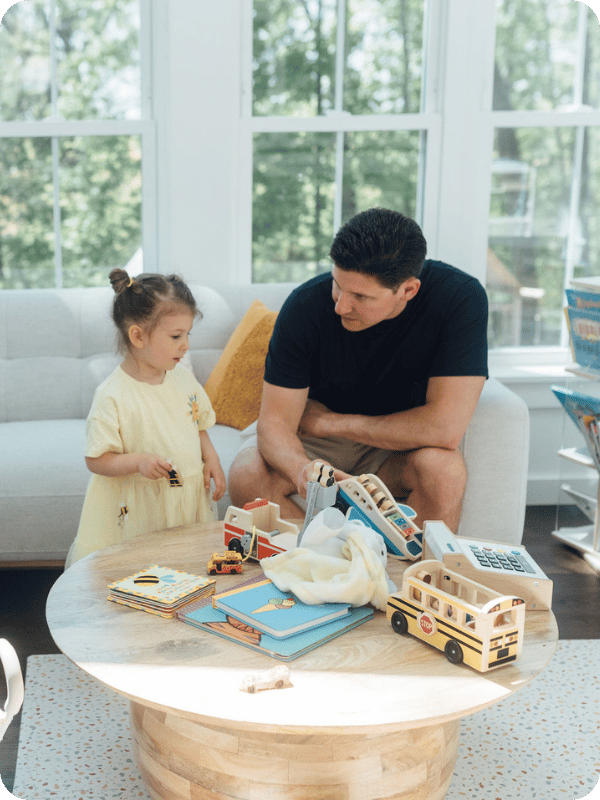
Should parents wait and see with developmental milestones?
Let’s start here: pediatricians are amazing, and they work hard to make sure that our kids are safe, healthy, and happy. They spend years of their life in school and receive thorough, exhaustive training in medicine. And also, they are pediatric medical experts, not developmental specialists.
When it comes to developmental milestones, it is best to get that information from a group of specialists who are trained to understand and respond to questions and concerns about development. This group includes physical therapists, occupational therapists, speech-language pathologists and feeding specialists (that’s me!), and others.
Although pediatricians are aware of milestones and often serve as the first step for intervention, they should not be expected to serve as specialists in these areas. If they were, there wouldn’t be a need for the other fields of study! Just like you wouldn’t ask a cardiologist to perform foot surgery, you wouldn’t expect a pediatrician to know specifics about speech-language, gross motor, or fine motor development.
The term “wait and see” comes from the common occurrence in the pediatrician’s office where a parent brings up a valid concern about development and their pediatrician replies, “Let’s wait and see where she is at our next appointment.” Well, the next visit might not be for 6 months.
So, should parents “wait and see” when they have concerns about their child’s development? The answer is a resounding NO! Let’s talk about what to do instead.

What are developmental milestones?
That landmark study from the CDC and AAP in 2022 led to an updated list of developmental milestones and criteria at each age. It was controversial for a few reasons, one of which being that several milestones were removed (like crawling), and the thresholds for considering a milestone were changed. (1) As a result of this study, you will likely encounter differing lists and definitions of what qualifies as a milestone.
You’re probably thinking, “Great, now I’m even more confused.” But rest assured, even though there may be some variation between sources: milestone trackers are generally still consistent and useful. You don’t have to panic about which one is most accurate, because they all have the same goal—ensuring that children are supported through development.
Our team of specialists consider milestones as the age at which 90% of children achieve a particular skill, while some place the benchmark at 75% (CDC) or even 50%. (1)
In general, if a little one isn’t hitting a milestone on time or isn’t close to hitting it, it’s something to look into rather than “wait and see.”
How did “wait and see” happen with developmental milestones?
Lots of milestones have historically been stated in ranges, which in theory should provide peace of mind that not every child develops at the same rate.
For example:
- Your baby should make cooing noises by 2–4 months
- Babbling of consonants is expected by 5–6 months
- Typically, crawling develops by 9–10 months
- Baby’s first word should come between 11–14 months
But the downside of these ranges? Sometimes, when expressing concern that your child has not yet met a milestone, the response is, “Well, let’s wait and see. Maybe they just need a little more time.”
The conversation usually stops at that point, right? A lot of times, there are few or no follow-up questions and no other resources are given. This is where parents and littles are let down. In the same scenario, a developmental specialist would know to ask additional questions and look for more information that may reveal if an evaluation is truly warranted.
Pediatricians don’t always know what to ask next or what resources to give, and until recently, “wait and see” was considered an appropriate medical response. However, instead of the passive “wait and see,” we recommend you “check and see” where baby is at to ensure they are given the right support when they need it!
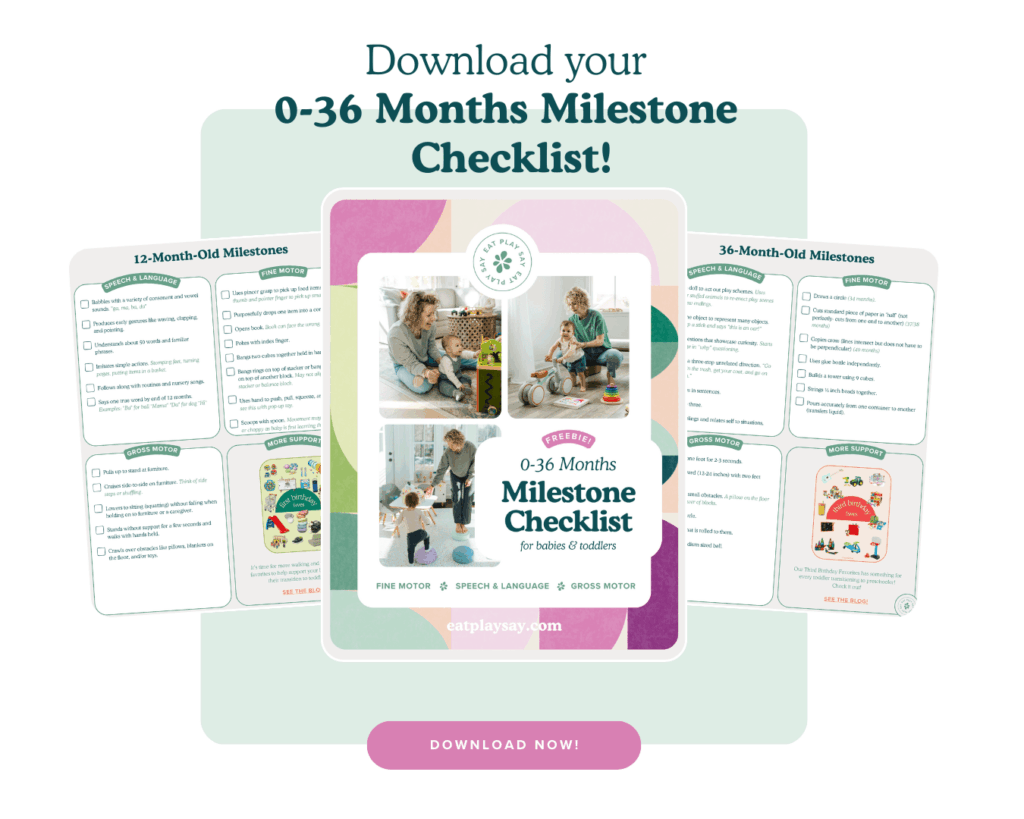
We created a Free Milestone Checklist to help you “check and see” easily! Grab your copy below, and join 30,000+ other parents who are checking and seeing!
What to do when you’re told to “wait and see”
If your child’s doctor says, “Let’s wait and see,” and your gut is telling you that doesn’t feel right, there are a few ways you can respond. Advocating for your little one can be hard and overwhelming, but you know your baby best! If something feels off in your gut and you feel dismissed, you are allowed to keep asking questions.
Approaches you can take when met with the phrase “wait and see.”
1. “Do you have any research to support that waiting and seeing is the right approach with children the same age as my son/daughter?”
Perhaps your little one has hit all the other milestones right on time and still has time to be within the average range of meeting this particular milestone. Your pediatrician may say that it’s early to have that milestone met, and that another month or two won’t hurt to wait considering that your child has been on track prior to this point. However, if they can’t really answer this question, or your child has been a little late to hit other milestones, it might be a good idea to follow up with one of the other options below.
2. “I don’t feel comfortable waiting and seeing. I would like information to contact the local Infants and Toddlers/Birth to 3/Early Intervention Program.”
If you want to take matters into your own hands and receive a free evaluation from a local program, your pediatrician should have a phone number or website for you to contact the right person in your area. This is a smart move to do early, since the wait times for evaluations and treatment can be lengthy due to state regulations. You can call right after your appointment and should be able to get an evaluation on the schedule.
And if your pediatrician doesn’t have the information on hand, you can also self-refer to your state’s Early Intervention program.

3. “I don’t feel comfortable waiting until our next visit to see if my child has made progress. Do you have a list of local [speech-language, occupational therapy, physical therapy] providers that I could contact?”
If you want a faster answer as to if your child is meeting age-based expectations or not, a private practice or private specialist can perform either a screening/consultation or an evaluation generally much faster than a state-funded program. Most pediatrician offices have a list of local providers, or you could do a quick Google search. Our team of development specialists can meet virtually in a matter of days!
As a follow-up to question 3, consider asking:
4. “I am going to have my child evaluated by a specialist just to make sure there isn’t something that we can do now. Could I please have a referral to [Occupational Therapist, Physical Therapist, Speech-Language Pathologist] before I leave today?”
Some insurance plans require a physician referral for a private evaluation to be covered. If a pediatrician doesn’t give you a referral that day because they need a specific clinic/practice to send it to, you can call and ask for one once you’ve made your appointment for the evaluation. They can fax the referral directly to the specialty clinic before your evaluation.

You are helping your little one grow
The voice that matters most in your child’s life is yours. Although your child’s doctor is a helpful resource, you are always permitted to ask more questions and make your own decisions about your child’s care.
Trust your gut. If you don’t think waiting and seeing is a good idea, there is nothing wrong with getting an evaluation! And if your child is developmentally on track, then you’ll know for sure and hopefully have peace about it.
Early intervention is key, so the earlier you get the ball rolling, the better off your little one will be! Trust your gut. Ask questions. Advocate for your child. You’ve got this!
More infant and toddler resources
Eat Play Say is here to help you feel empowered and supported through parenthood.
For more resources, check out our blog archives:
- Support with breast & bottle feeding
- Getting started on solid foods
- More posts about development
- Learn how to play with your child at every age
Our most in-depth resources that you can carry in your pocket are our Handbooks! Built by our team of specialists, each one features hundreds of evidence-backed tips, tricks, and knowledge that can help you make informed decisions for your family!
Sources
- Jennifer M. Zubler, Lisa D. Wiggins, Michelle M. Macias, Toni M. Whitaker, Judith S. Shaw, Jane K. Squires, Julie A. Pajek, Rebecca B. Wolf, Karnesha S. Slaughter, Amber S. Broughton, Krysta L. Gerndt, Bethany J. Mlodoch, Paul H. Lipkin; Evidence-Informed Milestones for Developmental Surveillance Tools. Pediatrics March 2022; 149 (3): e2021052138. 10.1542/peds.2021-052138
- Hebbeler, Early Intervention for Infants and Toddlers with Disabilities and Their Families.
OTHER POSTS YOU MAY LIKE:




MS, SLP
Founder of Eat Play Say, Speech-Language Pathologist, Feeding Specialist, Play Expert, Mom of 3
Jordyn Koveleski Gorman
SPECIALIZES IN: Infant and toddler speech-language, play, and feeding development, and curating a team that provides expert help that feels like a reassuring text from that one mom friend
EDUCATION: Jordyn received her BS in Speech-Language Pathology from Bloomsburg University and her MS in Speech-Language Pathology from Towson University
FAVE PARENTING FIRST: “The first true smile, it’s the sweetest!”

MS, CCC-SLP, CBS, IBCLC
Speech-Language Pathologist & Feeding Specialist, Certified Breastfeeding Specialist, International Board Certified Lactation Consultant
Jessica Nicholson Cocca
SPECIALIZES IN: Breast and bottle feeding, tongue ties, oral motor dysfunction, starting solids, infant and toddler speech, treating oral motor disorders
EDUCATION: Jessica received her BS in Communication Sciences and Disorders from Pennsylvania State University in 2015 and her MS in Speech-Language Pathology from Towson University in 2017
FAVE PARENTING FIRST: “Baby’s first wave! What a fun first communication gesture!”

MA, CCC-SLP, CLC
Speech-Language Pathologist, Certified Lactation Counselor
Jennifer McFarlin
SPECIALIZES IN: Breast and bottle feeding, tongue ties, starting solids, infant and toddler speech development
EDUCATION: She received her BS in Speech-Language Pathology from Ball State in 2014 and a MA in Speech-Language Pathology from Ball State in 2016.
FAVE PARENTING FIRST: “My favorite baby’s first is their first true smile that just warms your soul knowing they are smiling at you. My other favorite is their first word. I love watching their language explode!”

MS, CCC-SLP
Bilingual Speech-Language Pathologist
Nicole La Petina Kelly
SPECIALIZES IN: Bilingual development (Spanish-English), supporting multilingual families, infant and toddler speech
EDUCATION: She received her BA in Communication Sciences and Disorders and in Spanish from the University of Wisconsin-Madison in 2014 and her MS in Speech-Language Pathology with an English-Spanish Specialization from Marquette University in 2016.
FAVE PARENTING FIRST: “It’s the first slobbery kisses for me!”

RDN, LD
Licensed Registered Dietitian
Kimberly Vede
SPECIALIZES IN: Infant and pediatric nutrition including breastfeeding, formula feeding, and starting solids. She also specializes in prenatal and postpartum nutrition.
EDUCATION: She received her BSc in Biology in 2014 from Life University, and her BSc in Dietetics from Life University in 2019.
FAVE PARENTING FIRST: ”The first time they say ‘mama!’”


This checklist was created with input from a Speech-Language Pathologist, Occupational Therapist and Physical Therapist and has been downloaded over 20,000 times by parents worldwide. Learn the important milestones to pay attention to, and keep it in your digital back pocket during the baby + toddler years!
Comprehensive Milestone Checklist for gross motor, fine motor, and speech-language milestones for 0-36 months,
DOWNLOAD FOR FREE


