


Feeding Skills Impact Infant Speech Development
February 14, 2025
Jordyn Koveleski Gorman

Last Updated on July 30, 2026 by Jordyn Koveleski Gorman
Infant speech development is closely linked to feeding skills, yet many parents are never educated on the connections or why it matters. Instead, these areas of development are often viewed as distinct from one another, which leads to incomplete support when little ones need a hand.
Bringing feeding and speech-language skills into view together can be helpful for providing early intervention, as feeding difficulties often present more visibly at first than speech and language issues. As a speech-language pathologist and feeding specialist, it’s my job to provide education to parents as well as equip them with the tools to best support their little one’s development. Let’s dive in!

Children’s speech and feeding
First, and most obviously, speech-language and feeding skills are connected because the same part of the body is involved in both skills. More than just involving the mouth, the same muscles and structures we eat with are vital to speech. So, naturally, if one area is impacted, then the other is likely impacted, too.
Feeding skills may be more visible in those first few months of life, but that doesn’t mean infants aren’t also building speech and language skills! In fact, research has shown that face-to-face interaction in the first 3 months of life is correlated to improved speech-language skills at 18–30 months. (1) Foundational skill development is occurring long before baby says their first word.
Starting solids sets the foundation for first words
Babies typically don’t say their first word until around 12 months, but all of the feeding skills that occur before then significantly impact a child’s speech production skills.
Feeding development is a dynamic process with multiple internal and external factors. (2) Changes in jaw, lip, and tongue positioning are pieces of that puzzle, each requiring increasing strength, coordination, and efficiency. (3) The motor movements babies use when starting solids are actually the first physical step to forming words!
For example, in order for a child to produce sounds clearly and correctly, they need to retract their tongue and anchor it in place in the back of the mouth. Once the tongue is anchored, the tongue tip can move around the mouth and make all of the sounds. What is one way baby practices how to do this? By moving food around in their mouth!
There are many ways that feeding concerns could interfere with the ability to retract the tongue properly. For instance, what if baby struggled with spoon feeding as a 5–6 month old and didn’t master tongue retraction? Additionally, if baby struggled with straw drinking or drinking from an open cup, they may not have practiced the skill of tongue retraction with those tasks either. Or if baby gagged a lot with solids and didn’t master chewing before 10–12 months of age. Fast forward 2–3 years, that same child may struggle with sound production as a toddler and may require speech-language therapy for articulation later.
It may seem scary or overwhelming to hear that a 5–6 month old baby showing signs of feeding difficulties could need speech therapy later. But there’s good news: the earlier parents are made aware of these connections, the sooner baby can receive the support they need! Early intervention is the key.
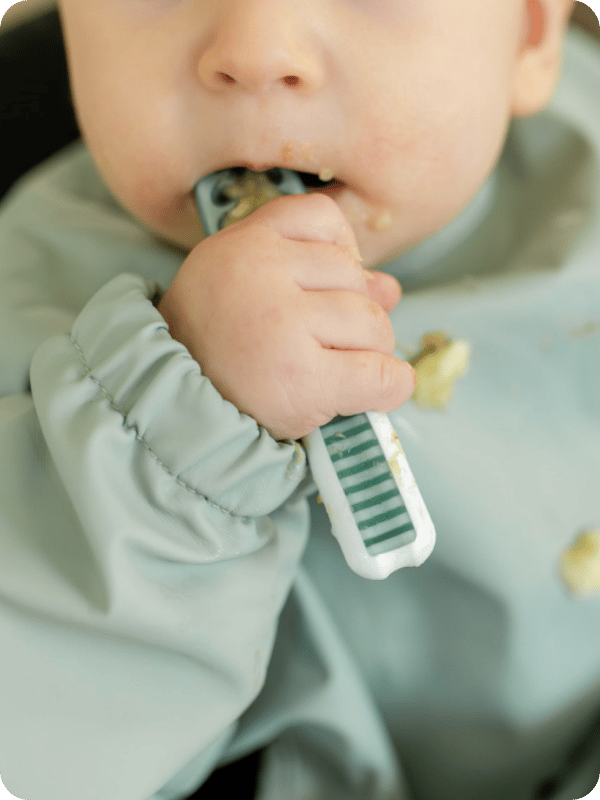
Speech development and feeding difficulties
Oral-motor control, which involves the use and coordination of the mouth and its muscles, is profoundly linked to speech and language. (4)
Clinically, parents often report during speech-language consultations that their child struggled with moving through the hierarchy of textures as an infant. Although it often surprises parents to know that it is related to speech issues, texture difficulties give specialists an important hint about potential causes.
The jaw is the foundation or core of the mouth; therefore, it needs to be strong. Think of it like your abdominal muscles! Without your abs, you would be floppy and unable to do pretty much anything. Your abs support and power the rest of your body, giving your legs and hands the support needed to complete their jobs.
This is the jaw’s job inside the mouth. The tongue does all of the intricate, fine motor work inside the mouth, like moving food around and making sounds. But without a strong jaw foundation, the tongue cannot do its job.
Building jaw strength for infant speech development
Babies who mouth objects and interact with different teethers build jaw strength little by little. That’s why we recommend offering baby teethers right around 3 months of age! Then, when solids are introduced around the 6 month mark, they have a strong foundation and are better equipped to manage the foods.
Baby’s jaw continues to get stronger as they engage with open cups, manage mashed foods, and eventually manipulate chewable foods. With a strong jaw, baby’s tongue will be able to do its job when it’s time to make sounds.
Babies who are not imitating oral motor movements, like blowing raspberries or making lip popping sounds, are less likely to imitate sounds and words, as those skills happen first in the communication hierarchy. Similarly, babies who cannot imitate the chewing motion when watching a caregiver may also struggle to imitate more complex sounds in the mouth, like “da” or “ga.” Oral motor imitation oftentimes directly relates to speech sound imitation!
As these skills develop, baby also begins to chew food around 9 months (at least, that’s the developmental goal). Practicing with teethers and mouthing objects also supports this new skill. It’s all intertwined!
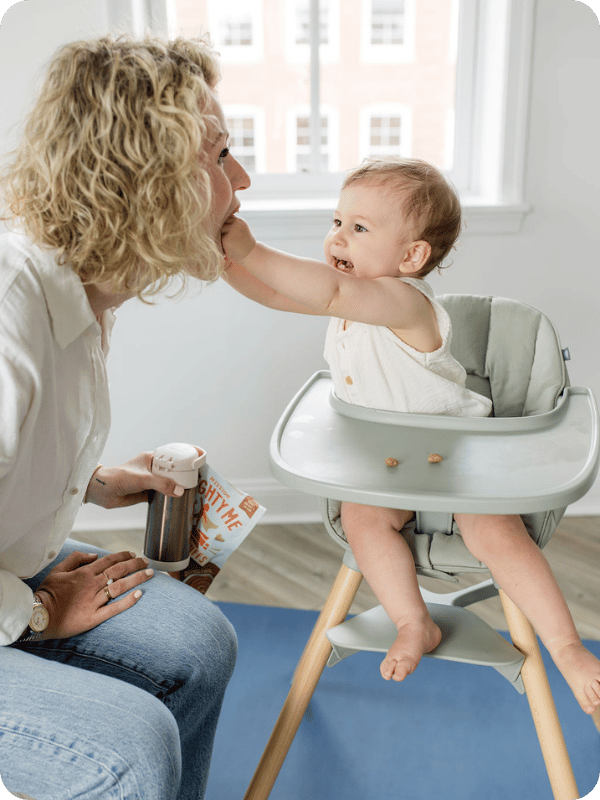
How to help support infant speech development & feeding skills
The takeaway? If your baby is struggling with feeding, it’s important to spot the struggles early and get support.
As always, speak to your child’s pediatrician about any medical concerns. Feeding and other oral-motor concerns should be evaluated by a specialist, such as a lactation consultant, speech-language pathologist, and/or feeding specialist. You can self-refer to Early Intervention for a free evaluation in the US, or speak to one of our specialists virtually.
Remember that helping your baby develop doesn’t have to be complicated. You can meet your little one right where they are. Simple activities (like playing with teethers) can go a long way when it comes to your child’s development! And if they need a little extra help, that’s okay too! You’re doing a great job, and your baby is lucky to have you!
More infant resources
Looking for more guidance on your starting solids journey? Our Handbooks are the place to start! We created the Starting Solids Bundle as a complete guide to offering foods to baby without overcomplicating things!

You can find our best product recommendations for starting solids here, or browse the blog for more starting solids articles!
Sources
- Yaara Endevelt-Shapira, Alexis N. Bosseler, Julia C. Mizrahi, Andrew N. Meltzoff, Patricia K. Kuhl, Mother–infant social and language interactions at 3 months are associated with infants’ productive language development in the third year of life, Infant Behavior and Development, Volume 75, 2024, 101929, ISSN 0163-6383, https://doi.org/10.1016/j.infbeh.2024.101929.
- Hahn Arkenberg, Rachel; Malandraki, Georgia A; Seidl, Amanda; Hustad, Katherine C.; Moding, Kameron; Delaney, Amy L.; et al. (2024). FEEDING DEVELOPMENT IN THE CONTEXT OF INFANT VOCALIZATIONS & CAREGIVER FEEDING RESPONSIVENESS. Purdue University Graduate School. Thesis. https://doi.org/10.25394/PGS.25631754.v1
- Delaney AL, Flatt A, Koepp H, Fial AV, Hustad KC. A Scoping Review of Oral Feeding Skill Development in Typically Developing Children Part II: Exploring Variability in Oral Feeding Skill Descriptions. Am J Speech Lang Pathol. 2025 Nov 6;34(6):3513-3530. doi: 10.1044/2025_AJSLP-25-00066. Epub 2025 Oct 20. PMID: 41115258; PMCID: PMC12611411.
- Alcock K. The development of oral motor control and language. Downs Syndr Res Pract. 2006 Aug;11(1):1-8. doi: 10.3104/reports.310. PMID: 17048804.
OTHER POSTS YOU MAY LIKE:


MS, SLP
Founder of Eat Play Say, Speech-Language Pathologist, Feeding Specialist, Play Expert, Mom of 3
Jordyn Koveleski Gorman
SPECIALIZES IN: Infant and toddler speech-language, play, and feeding development, and curating a team that provides expert help that feels like a reassuring text from that one mom friend
EDUCATION: Jordyn received her BS in Speech-Language Pathology from Bloomsburg University and her MS in Speech-Language Pathology from Towson University
FAVE PARENTING FIRST: “The first true smile, it’s the sweetest!”

MS, CCC-SLP, CBS, IBCLC
Speech-Language Pathologist & Feeding Specialist, Certified Breastfeeding Specialist, International Board Certified Lactation Consultant
Jessica Nicholson Cocca
SPECIALIZES IN: Breast and bottle feeding, tongue ties, oral motor dysfunction, starting solids, infant and toddler speech, treating oral motor disorders
EDUCATION: Jessica received her BS in Communication Sciences and Disorders from Pennsylvania State University in 2015 and her MS in Speech-Language Pathology from Towson University in 2017
FAVE PARENTING FIRST: “Baby’s first wave! What a fun first communication gesture!”

MA, CCC-SLP, CLC
Speech-Language Pathologist, Certified Lactation Counselor
Jennifer McFarlin
SPECIALIZES IN: Breast and bottle feeding, tongue ties, starting solids, infant and toddler speech development
EDUCATION: She received her BS in Speech-Language Pathology from Ball State in 2014 and a MA in Speech-Language Pathology from Ball State in 2016.
FAVE PARENTING FIRST: “My favorite baby’s first is their first true smile that just warms your soul knowing they are smiling at you. My other favorite is their first word. I love watching their language explode!”

MS, CCC-SLP
Bilingual Speech-Language Pathologist
Nicole La Petina Kelly
SPECIALIZES IN: Bilingual development (Spanish-English), supporting multilingual families, infant and toddler speech
EDUCATION: She received her BA in Communication Sciences and Disorders and in Spanish from the University of Wisconsin-Madison in 2014 and her MS in Speech-Language Pathology with an English-Spanish Specialization from Marquette University in 2016.
FAVE PARENTING FIRST: “It’s the first slobbery kisses for me!”

RDN, LD
Licensed Registered Dietitian
Kimberly Vede
SPECIALIZES IN: Infant and pediatric nutrition including breastfeeding, formula feeding, and starting solids. She also specializes in prenatal and postpartum nutrition.
EDUCATION: She received her BSc in Biology in 2014 from Life University, and her BSc in Dietetics from Life University in 2019.
FAVE PARENTING FIRST: ”The first time they say ‘mama!’”


This checklist was created with input from a Speech-Language Pathologist, Occupational Therapist and Physical Therapist and has been downloaded over 20,000 times by parents worldwide. Learn the important milestones to pay attention to, and keep it in your digital back pocket during the baby + toddler years!
Comprehensive Milestone Checklist for gross motor, fine motor, and speech-language milestones for 0-36 months,
DOWNLOAD FOR FREE


