


Are Sippy Cups Bad?
January 15, 2025
Jordyn Koveleski Gorman

Last Updated on April 15, 2026 by Jordyn Koveleski Gorman
This page contains affiliate links. We will receive a commission on qualifying purchases using these links.
The quick answer: no, sippy cups aren’t “bad.” But they aren’t exactly “good,” either. It’s a bit of a mixed bag, really.
As a pediatric speech-language pathologist and feeding specialist, I get this question a lot. Let’s break it down together and sort through the buzzwords to talk about the good, the bad, and the in-between of sippy cups.
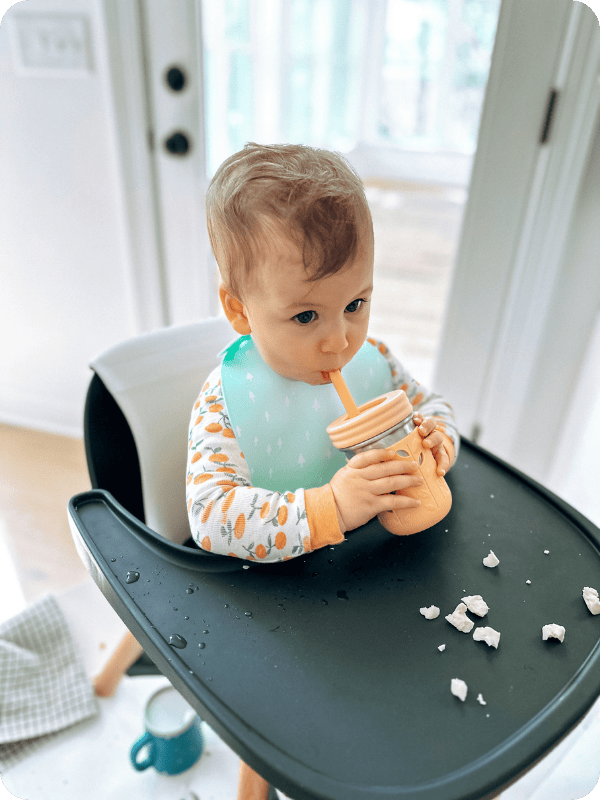
The sippy cup dilemma
Picture this scenario: your baby has been doing great with open cups and straw cups, and now you’re on the hunt for a great travel cup that won’t spill while on the go. Walking through the baby aisle is overwhelming, and the internet is even worse!
You might be asking questions like, “What is the best sippy cup? Wait, what is a spout cup? Or do I want a straw cup? What is a ‘miracle cup’? Do I want one of those?”
Choosing what’s “best” feels impossible, and you’re probably thinking about giving up and going home. Knowing the important elements of a cup and what’s good versus less good can help reduce the decision panic.
First, the science of a cup.
For optimal oral motor development, we want to encourage sucking and swallowing patterns where muscle use (cheeks, lips, jaw, tongue) is balanced, the tongue can learn to elevate and retract while sucking and swallowing, and lips can rest gently on the spout or straw while sucking.
Sippy cups often have a longer, bottle-like spout. They also tend to have a valve that makes it more difficult to suck from, and/or have lids, tops, or spouts that require biting to suck (Munchkin Miracle 360 cups, we’re looking at you!).
What is a sippy cup?
There are a few types of cups we recommend avoiding or limiting use as much as possible. These cups have a spout that sticks out from the top and rests on your little one’s tongue. The graphic below shows a few examples.
Usually, cups like these require some forceful sucking to get liquid out and are marketed heavily as “spill proof.” While these cups aren’t inherently “bad,” they are also not designed with your child’s oral motor skills in mind.
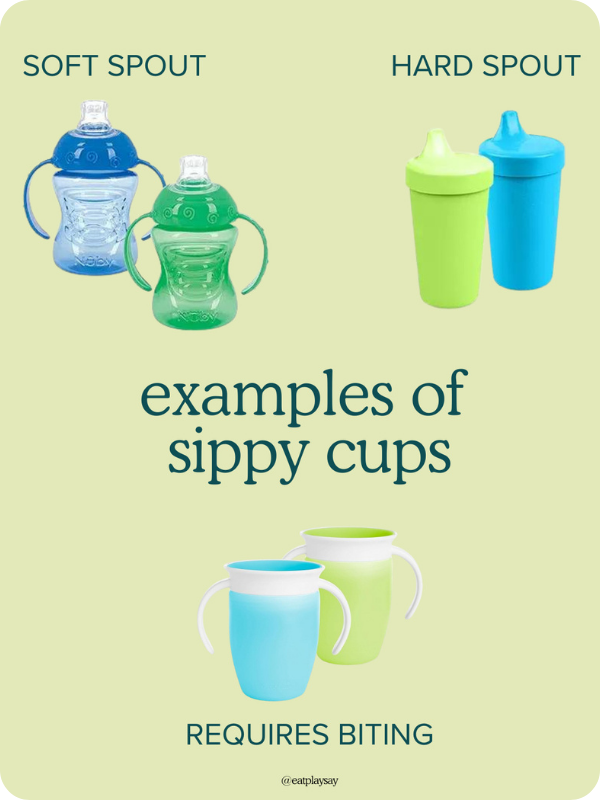
Overall, these are not recommended for frequent, daily use, as they do not support maturing oral development.
While we can’t say that using sippy cups causes speech delays, we also cannot say that they support oral development (more on this in the next section).
If we know that there are cups that aren’t the best for children from an oral development standpoint, limiting their use or avoiding them entirely is a better path.
Why are sippy cups not recommended?
Sippy cups encourage a low and forward tongue position in the mouth, just like a baby bottle.
Straws and open cups are preferred because they require the tongue to be retracted and high in the mouth. This is the optimal position for drinking and eating, but also for speech. The tongue needs to be retracted and elevated to make certain sounds.
For example, say “eeeee” aloud, paying attention to your tongue. Now say “arrrrrrr.” Next, say the “t” sound, then say “guh.” See what we mean? The back of the tongue retracts and anchors in the mouth so that the tip and/or middle of the tongue can land in the mouth to make different sounds.
Without strong retraction and elevation, speech will sound imprecise and slushy. As babies and toddlers learn how to say words and sounds, it’s important for their tongues to be in the right spot. Speech and feeding are very connected!
When to use a sippy cup
Oral motor and feeding specialists often encourage parents to “skip the sippy.” Instead, we recommend sticking to straws and open cups that will encourage better sucking and swallowing. But that doesn’t mean there is never a time and place for a sippy cup.
A sippy cup might be beneficial if:
- Your baby is struggling to use open cups or straws easily
- They are struggling with dehydration from lack of success with open/straw cups
- Constipation is occurring as a result
In this scenario, a more bottle-like cup can help bridge the transition away from a bottle and support appropriate fluid intake. That bottle-like cup is, you guessed it, usually a spouted sippy cup!
Short-term use of a sippy cup may help your child get to straw drinking! In an ideal world, sippy cups would be easy to avoid. But sometimes, it’s not that easy, and short-term use can be beneficial compared to the alternative.
If baby needs a sippy cup
A short, soft-spout sippy cup that doesn’t sit too far back on baby’s tongue is the best bet. The soft spout will have a similar texture to a silicone straw, which is also helpful for the transition.
Parents can also consider using a cup with a longer, soft straw that sits further back on baby’s tongue. This way, they can use a suckling pattern to get the liquid out. Cups like these can help baby get closer to drinking from a shorter straw!
While utilizing a sippy cup, it’s important to practice with straw and open cups frequently. From an oral motor development standpoint, transitioning from a sippy cup to a straw cup as soon as possible is recommended.
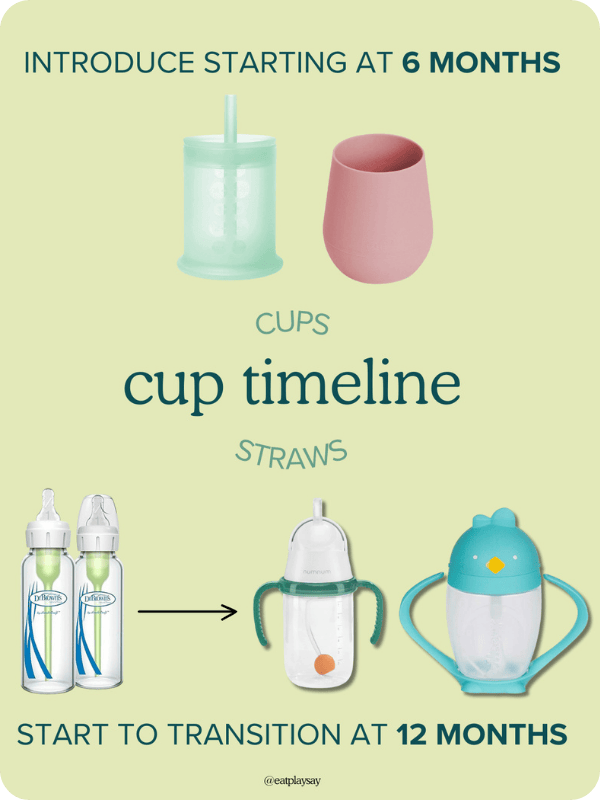
When can you introduce a straw cup?
You can introduce both open cups and straw cups around 6 months of age.
Baby will need a lot of support in the beginning of this process. Squeezable cups can be helpful for teaching a little one how to use a straw. Practicing small sips a few times a day can make a big difference over time.
Remember, too, that baby’s main form of nutrition and hydration in the first 12 months is breastmilk and/or formula from nursing or bottles. Only a couple ounces of water per day is recommended as baby approaches toddlerhood.
What travel cup is best?
There are scenarios where a travel cup that reduces spills is important. Whether you’re on a car ride, doing long-distance air travel, running errands, or heading out for a play date—your first thought may be to go to a sippy cup, but you don’t have to!
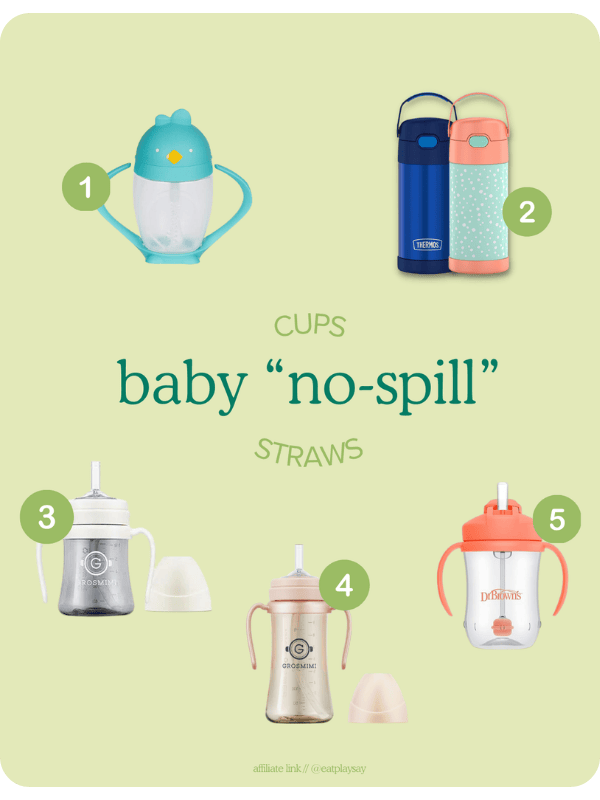
There are some great options that keep both oral motor development and spillage in mind!
We’ve tested and approved these cups ourselves and with babies and toddlers. These cups have short straws (which encourage lips to rest at the edge of the straw) and “weaker” valves (are low or no-spill, require muscles to work more in balance). All of these cups are “no-spill” and support mature oral motor development.
Cup drinking should get easier over time, especially as baby approaches their first birthday. If you’re noticing that your little one is nearing the age of bottle weaning (12-15 months of age) and is not able to transition away from a bottle to a straw cup, reaching out to a feeding specialist for some guidance can be beneficial.
The transition from bottle to straw cup is usually gradual and slow, so give your little one time. Help is out there if you need it!
More infant and toddler resources
Need more support? We’re here to help!
Browse our blog for more help with weaning, starting solids, and developmentally appropriate play activities by age. For more hands-on support, you can schedule a 1:1 virtual consultation with our team of child development experts.
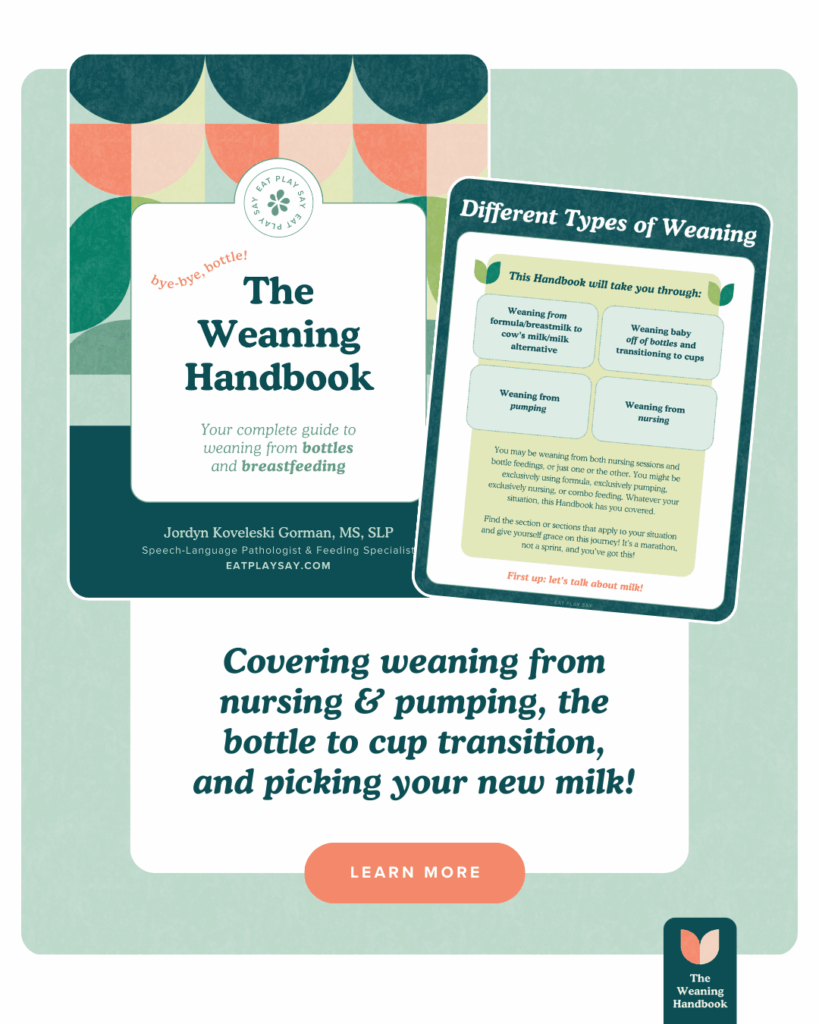
Our Handbooks combine the best of our blog and virtual consultations, with tools and education to empower you through every season of parenthood. They’re yours forever, mobile friendly, and packed with resources! For more help on this topic, check out the Weaning Handbook!
OTHER POSTS YOU MAY LIKE:


MS, SLP
Founder of Eat Play Say, Speech-Language Pathologist, Feeding Specialist, Play Expert, Mom of 3
Jordyn Koveleski Gorman
SPECIALIZES IN: Infant and toddler speech-language, play, and feeding development, and curating a team that provides expert help that feels like a reassuring text from that one mom friend
EDUCATION: Jordyn received her BS in Speech-Language Pathology from Bloomsburg University and her MS in Speech-Language Pathology from Towson University
FAVE PARENTING FIRST: “The first true smile, it’s the sweetest!”

MS, CCC-SLP, CBS, IBCLC
Speech-Language Pathologist & Feeding Specialist, Certified Breastfeeding Specialist, International Board Certified Lactation Consultant
Jessica Nicholson Cocca
SPECIALIZES IN: Breast and bottle feeding, tongue ties, oral motor dysfunction, starting solids, infant and toddler speech, treating oral motor disorders
EDUCATION: Jessica received her BS in Communication Sciences and Disorders from Pennsylvania State University in 2015 and her MS in Speech-Language Pathology from Towson University in 2017
FAVE PARENTING FIRST: “Baby’s first wave! What a fun first communication gesture!”

MA, CCC-SLP, CLC
Speech-Language Pathologist, Certified Lactation Counselor
Jennifer McFarlin
SPECIALIZES IN: Breast and bottle feeding, tongue ties, starting solids, infant and toddler speech development
EDUCATION: She received her BS in Speech-Language Pathology from Ball State in 2014 and a MA in Speech-Language Pathology from Ball State in 2016.
FAVE PARENTING FIRST: “My favorite baby’s first is their first true smile that just warms your soul knowing they are smiling at you. My other favorite is their first word. I love watching their language explode!”

MS, CCC-SLP
Bilingual Speech-Language Pathologist
Nicole La Petina Kelly
SPECIALIZES IN: Bilingual development (Spanish-English), supporting multilingual families, infant and toddler speech
EDUCATION: She received her BA in Communication Sciences and Disorders and in Spanish from the University of Wisconsin-Madison in 2014 and her MS in Speech-Language Pathology with an English-Spanish Specialization from Marquette University in 2016.
FAVE PARENTING FIRST: “It’s the first slobbery kisses for me!”

RDN, LD
Licensed Registered Dietitian
Kimberly Vede
SPECIALIZES IN: Infant and pediatric nutrition including breastfeeding, formula feeding, and starting solids. She also specializes in prenatal and postpartum nutrition.
EDUCATION: She received her BSc in Biology in 2014 from Life University, and her BSc in Dietetics from Life University in 2019.
FAVE PARENTING FIRST: ”The first time they say ‘mama!’”


This checklist was created with input from a Speech-Language Pathologist, Occupational Therapist and Physical Therapist and has been downloaded over 20,000 times by parents worldwide. Learn the important milestones to pay attention to, and keep it in your digital back pocket during the baby + toddler years!
Comprehensive Milestone Checklist for gross motor, fine motor, and speech-language milestones for 0-36 months,
DOWNLOAD FOR FREE


