


How To Choose the Right Baby Bottle
May 24, 2024
Jordyn Koveleski Gorman

Last Updated on April 23, 2026 by Jordyn Koveleski Gorman
This page contains affiliate links. We will receive a commission on qualifying purchases using these links.
Choosing the best bottle to feed your infant is, truly, so overwhelming. The baby aisle is overloaded with choices, and they all promise to be the “best” for your baby. How are you supposed to know which one is the right choice?!
In general, there isn’t exactly a “bad” bottle and a “good” bottle out there. As a feeding specialist, there are some factors that make certain bottles more preferred than others. But ultimately, especially if dealing with bottle refusal, the best bottle for your baby is the one that your little one will take!
Whether you’re preparing for your little one to arrive or are struggling with feeds, there are a few things to consider about your baby’s bottle. The good news is that the list of things to consider isn’t very long! Let’s break it down together.
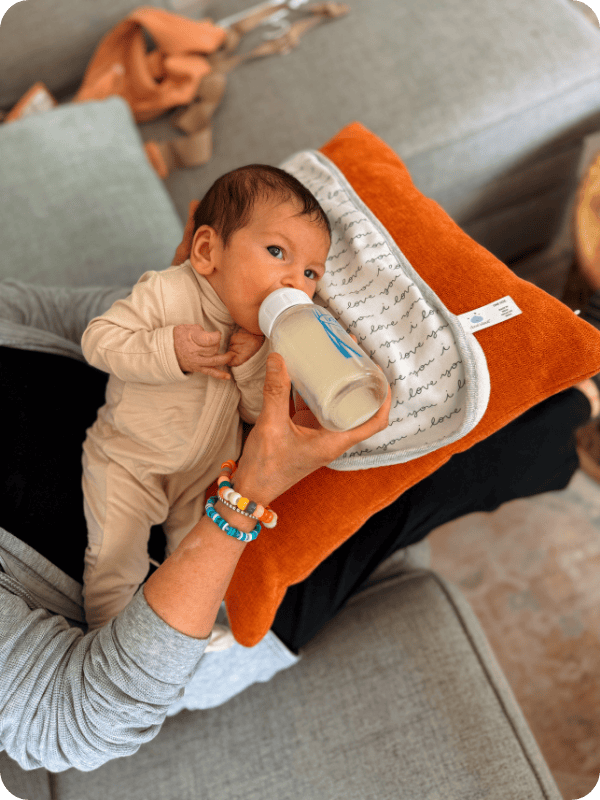
Baby bottle nipple shapes
The most important factor to consider when picking a bottle is nipple shape.
Even if your baby is exclusively bottle fed, let’s think about the physiological aspects of breastfeeding, with an emphasis on what happens to the nipples.
One difference between bottle nipples and nipples on the breast is that mom’s nipples will naturally stretch as baby sucks and expresses milk. This natural function is why bottle nipple shape is so important!
Bottle nipples do not change shape when baby sucks. If the bottle nipple is short and wide before it’s in baby’s mouth, then it will stay short and wide while in their mouth. Therefore, it’s not the optimal shape for feeding.
You might notice a ton of bottles are labeled as “just like mom’s breast” or “as close to breast as you can get.” But…is that true?
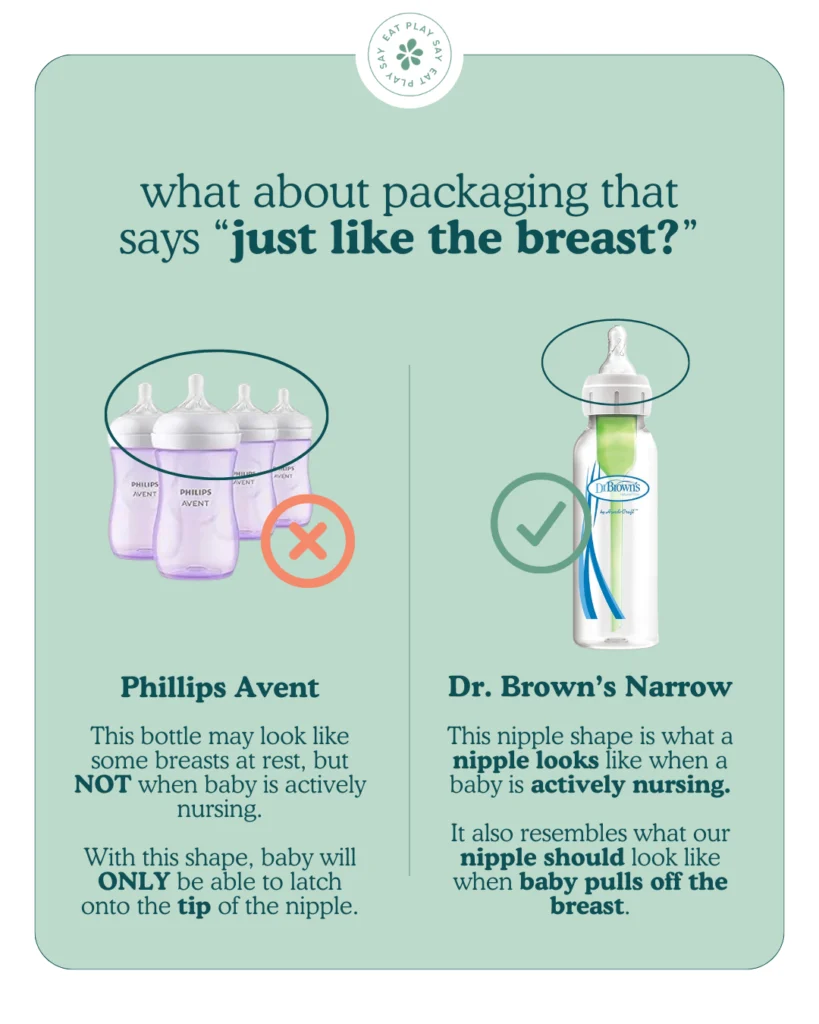
What does our team of Eat Play Say experts say? Beware of marketing! Take notice of the wording and phrases brands use to try to get you to buy their bottles, because it’s all a marketing gimmick!
As parents, we want what is best for our precious babies. Unfortunately, brands know this and use it to their advantage. There are lots of bottles that say “just like the breast” or “natural flow.” Truth be told? Most of the bottles and nipples advertised as resembling a breast are not the best options.
How ironic, right?
Sure, these nipples may look like the breast at rest, but it’s not what the breast looks like when a baby is actively feeding.
What to look for in a baby bottle nipple:
When considering a bottle, look at the nipple and ask yourself the following questions:
- Is it long?
- Does it slope gradually from the tip down to the base, resembling an upside down cone?
- Is the base of the nipple narrow?
If the answers to these questions are yes, you’ve likely found a winner!
A narrow-based nipple with a gradual slope is the best shape for optimal oral function. Additionally, a gradual slope shape allows your baby to cup the nipple with their entire tongue, creating suction that will allow them to remove milk efficiently.
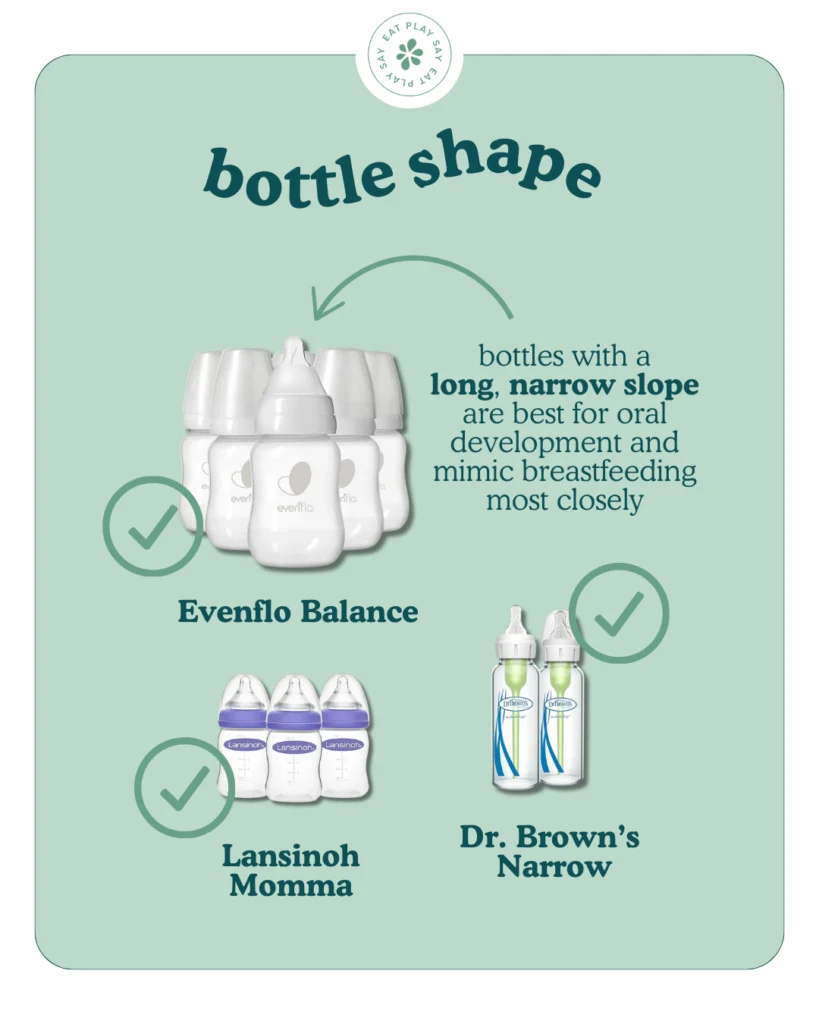
The bottles shown above have a narrow nipple with a long slope, making them the preferred bottle nipple shape! Shop the bottles here!
Baby bottle nipple shapes to avoid:
- Wide-based nipples
- Bottle nipples that are flat
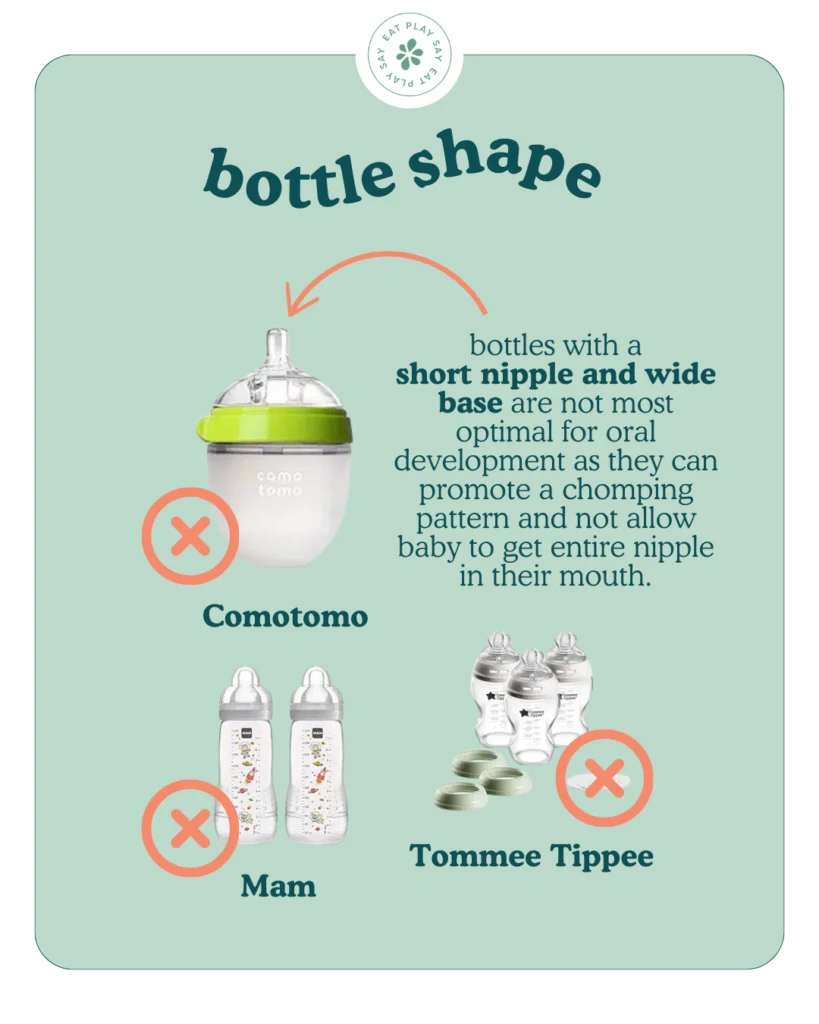
- Bottle nipples that don’t have a gradual slope from tip to base. These promote a chomping pattern because usually the tip of the nipple is the only part resting on the tongue.
The bottles below are wide-based with short nipples. These aren’t great options, but if they are working for your little one, then do what works for your baby and you!
Best bottles for breastfed babies
A common question I get from parents is if breastfed babies require a “special” kind of bottle. The answer? Nope! Bottles that work well for exclusively bottle fed infants are also great options for babies who nurse at the breast, too.
A narrow-sloped nipple on the bottle is still the recommendation for babies who are fed a combination of bottles and nursing at the breast. However, there is one additional consideration: the nipple flow.
Bottle nipple sizes
When your baby is nursing, they are regulating the flow of the milk and are able to start and stop the flow themselves. When selecting a nipple flow or level, you want to pick a slow-flow to mimic that active pattern.
Each bottle system/brand has different ways of identifying these levels. Some brands are labeled with numbers, and others use descriptor words like slow and fast.
For example, if you are using Dr. Brown’s bottle system, you will want to pick a preemie (P), transitional (T) or level 1 (slow-flow) nipple. When in doubt, try not to go up higher than level 1. Faster flow nipples can contribute to refusal at the breast.
You can find more information about nipple sizes and flow rate on our blog.
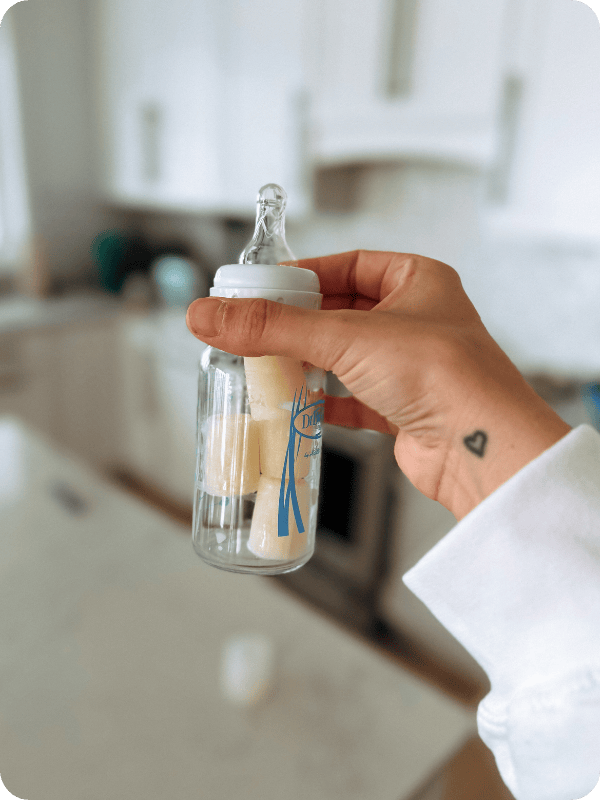
Best feeding bottles for infants
Now you know what to look for when shopping for a new bottle for your little one. Yay! One more parenting task marked off the list. You’re doing the thing, and you should be so proud.
If you are looking for specific bottle recommendations, we wrote about our favorite baby bottles here! These bottles fit the bill and pass the nipple shape test. Some of them also include anti-colic support, which basically translates to it helps reduce air intake during feeds.
More feeding support
If your little one is doing well taking a bottle that doesn’t make our recommended list, and it’s working for your family, that’s great! There is no need to make a switch.
However, if you are trying to breast and bottle-feed and you’re noticing some difficulty going between the two, a bottle change or flow change may be helpful.
For more in-depth guidance on breast or bottle feeding your new baby, you can head to our Breast & Bottle category on the blog! Our team of child development and feeding experts are also available for 1:1 virtual consultations if you’d like more hands-on support.
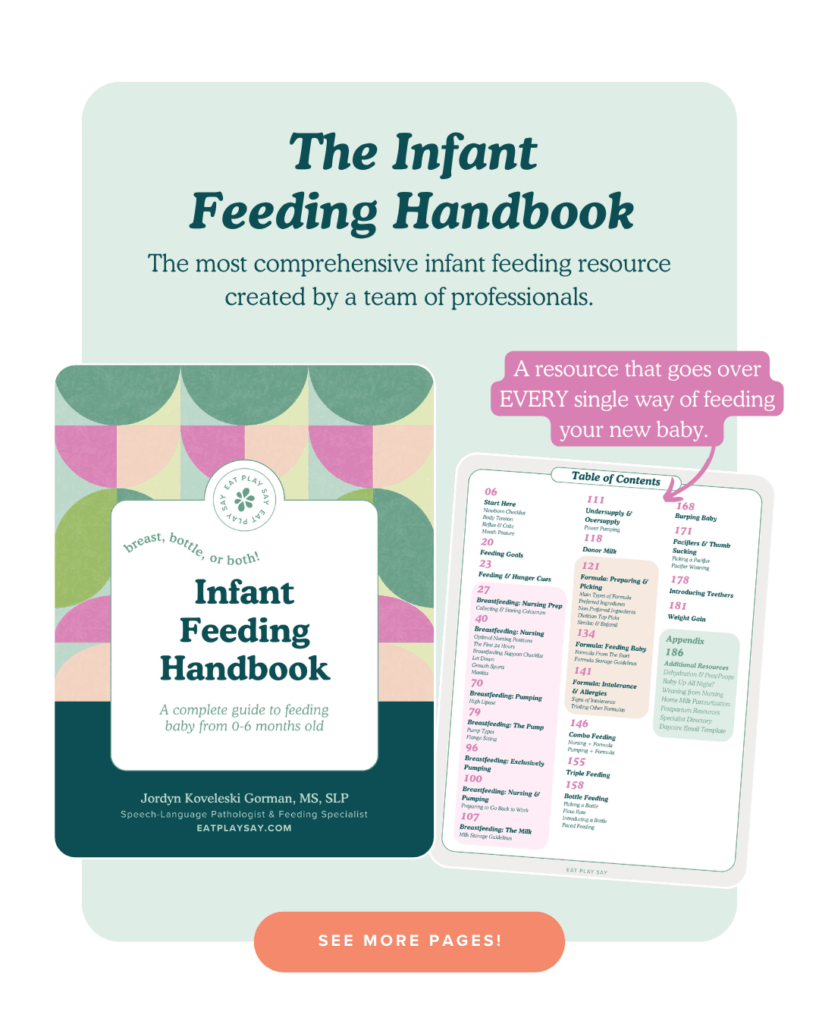
Looking for a resource you can keep in your pocket to turn to for all of your feeding questions? We’ve got you covered! Our Infant Feeding Handbook has almost 200 pages of evidence-based and clinical support beautifully compiled by our team!
OTHER POSTS YOU MAY LIKE:



MS, SLP
Founder of Eat Play Say, Speech-Language Pathologist, Feeding Specialist, Play Expert, Mom of 3
Jordyn Koveleski Gorman
SPECIALIZES IN: Infant and toddler speech-language, play, and feeding development, and curating a team that provides expert help that feels like a reassuring text from that one mom friend
EDUCATION: Jordyn received her BS in Speech-Language Pathology from Bloomsburg University and her MS in Speech-Language Pathology from Towson University
FAVE PARENTING FIRST: “The first true smile, it’s the sweetest!”

MS, CCC-SLP, CBS, IBCLC
Speech-Language Pathologist & Feeding Specialist, Certified Breastfeeding Specialist, International Board Certified Lactation Consultant
Jessica Nicholson Cocca
SPECIALIZES IN: Breast and bottle feeding, tongue ties, oral motor dysfunction, starting solids, infant and toddler speech, treating oral motor disorders
EDUCATION: Jessica received her BS in Communication Sciences and Disorders from Pennsylvania State University in 2015 and her MS in Speech-Language Pathology from Towson University in 2017
FAVE PARENTING FIRST: “Baby’s first wave! What a fun first communication gesture!”

MA, CCC-SLP, CLC
Speech-Language Pathologist, Certified Lactation Counselor
Jennifer McFarlin
SPECIALIZES IN: Breast and bottle feeding, tongue ties, starting solids, infant and toddler speech development
EDUCATION: She received her BS in Speech-Language Pathology from Ball State in 2014 and a MA in Speech-Language Pathology from Ball State in 2016.
FAVE PARENTING FIRST: “My favorite baby’s first is their first true smile that just warms your soul knowing they are smiling at you. My other favorite is their first word. I love watching their language explode!”

MS, CCC-SLP
Bilingual Speech-Language Pathologist
Nicole La Petina Kelly
SPECIALIZES IN: Bilingual development (Spanish-English), supporting multilingual families, infant and toddler speech
EDUCATION: She received her BA in Communication Sciences and Disorders and in Spanish from the University of Wisconsin-Madison in 2014 and her MS in Speech-Language Pathology with an English-Spanish Specialization from Marquette University in 2016.
FAVE PARENTING FIRST: “It’s the first slobbery kisses for me!”

RDN, LD
Licensed Registered Dietitian
Kimberly Vede
SPECIALIZES IN: Infant and pediatric nutrition including breastfeeding, formula feeding, and starting solids. She also specializes in prenatal and postpartum nutrition.
EDUCATION: She received her BSc in Biology in 2014 from Life University, and her BSc in Dietetics from Life University in 2019.
FAVE PARENTING FIRST: ”The first time they say ‘mama!’”


This checklist was created with input from a Speech-Language Pathologist, Occupational Therapist and Physical Therapist and has been downloaded over 20,000 times by parents worldwide. Learn the important milestones to pay attention to, and keep it in your digital back pocket during the baby + toddler years!
Comprehensive Milestone Checklist for gross motor, fine motor, and speech-language milestones for 0-36 months,
DOWNLOAD FOR FREE


