


Pumping Schedule for Exclusively Pumping
April 28, 2026
Jordyn Koveleski Gorman

Last Updated on April 28, 2026 by Jordyn Koveleski Gorman
This page contains affiliate links. We will receive a commission on qualifying purchases using these links.
Trying to create a pumping schedule for exclusively pumping is a hard journey that deserves to be recognized.
Whether your little one has just arrived or you’re a couple months into this new role, feeding a baby is no small feat. And making the right feeding choices for your family and your little one can feel complicated. But you don’t have to do it alone!
As a feeding specialist and a mom of three whose feeding journey has been unique with each baby, let me be the first to tell you: every baby is different, and so is every feeding journey!
There’s a million different reasons that your own feeding journey might lead you to exclusively pumping. Maybe it’s just for a short season, like being separated from your baby or due to illness. For others, it may be related to issues with latching or struggles caused by tongue or lip ties. Moms experiencing low supply might find that pumping can help them feel connected to their little one. For some, exclusively pumping was the plan all along!
No matter your why, know that you’re doing an amazing job caring for and providing for your baby. They are so lucky to have you. And you deserve a round of applause, because pumping is hard work!
To make things a little more simple, I teamed up with the Eat Play Say lactation consultants to create this exclusive pumping schedule. Let’s dig in!
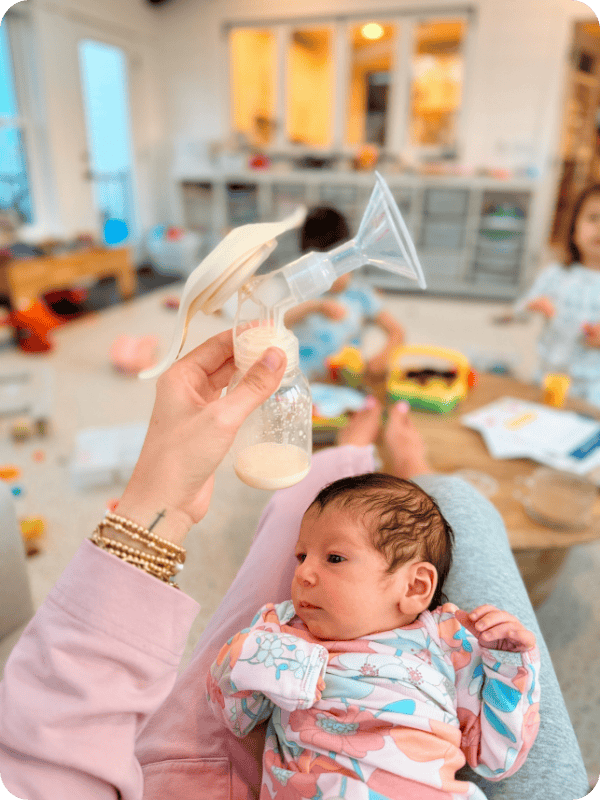
Exclusively pumping schedule
The key to exclusively pumping is consistency. Being consistent is important for both establishing milk supply and maintaining it. Another important element is making sure that you are pumping efficiently, with correct flange sizes and pump settings that work for you.
Early on, it’s recommended to pump at least every 3 hours around the clock to mimic the frequency of baby nursing. So, generally, for exclusively pumping, you should aim for at least 8 pumping sessions every 24 hours. Pumping sessions generally last about 20 minutes, give or take.
It’s important to know, too, that this is every 3 hours from the start of one session to the start of the next. This means that if you start a session at 8 a.m. and complete it at 8:20 a.m., then your next pump will start at 11 a.m., not 11:20.
Removing milk consistently throughout the day is the best way to keep supply and demand even. That said, finding a schedule and routine can take some time. Give yourself grace as you work through this. If the only thing you had to do in a day was pump, maybe it wouldn’t be so hard. But you’re balancing so much! If you have support nearby, it can be incredibly helpful as you navigate this new schedule.
Note, too, that if you’re unable to pump at exactly the 3 hour mark, or if some days your schedule is a little off, that is okay. Remaining consistent is important, but life happens, and sometimes the schedule is off. Think about how many pumping sessions you’re doing in a 24-hour period first. If that 3-hour schedule causes anxiety, counting the total sessions in a day can help ease your mind.
Pumping schedule overnight
In the first few months of life especially, babies wake in the night to feed. Waking to pump is likely necessary to help establish and maintain your supply early on in the pumping journey. However, as baby gets older, this can likely change as sleeping patterns and other routines adapt and change.
Changing your schedule may change your milk supply, too. But that doesn’t mean you can’t try a new schedule for a few days to test it out.
Most likely, changing a single element of your routine for a trial won’t have long term impacts. If you notice a dip in supply when sleeping longer stretches overnight and you’re not ready for that decrease, you can resume your previous schedule!
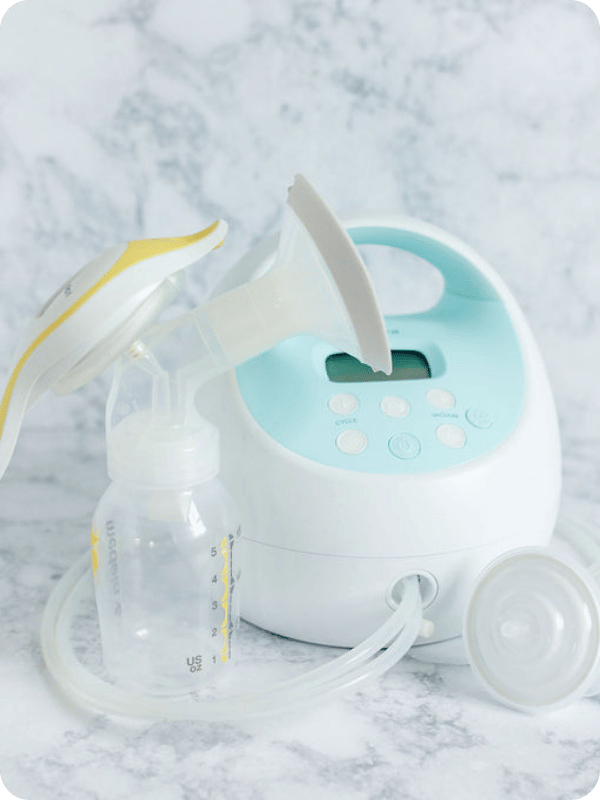
Tips for prioritizing sleep while still maintaining an overnight pump
- Consider having multiple sets of pump parts (flanges, duckbills, etc.). This way, you don’t have to leave your bed in the middle of the night to wash parts. You can also quick rinse your pump parts and leave them in the fridge for up to 24 hours. If you do this method, called the “fridge hack” by some, you can refrigerate the parts overnight, then use them for your first morning pump before washing.
- Try adding a mini fridge to your room to put milk in overnight. This way, you don’t have to get out of bed! You could also use something like the Ceres Chill system to keep pumped milk cold overnight.
Tips for reducing overnight pumping
- Make your last pump of the night a power pump session. Power pumping is a good way to boost your supply if you’re going to try a longer stretch between sessions overnight.
- Push your before-bed session a little later, and wake up earlier in the morning to pump. You can also make your morning pump session a little longer than normal. Prolactin levels are highest in the early morning, so you may be able to pump a larger volume. (1)
Exclusive pumping schedule tips
The logistics of exclusively pumping can be really hard to navigate, especially if you do not have another set of hands to offer support. Common advice is to pump while baby is fed a bottle by someone else, and that can be helpful. But, it’s sometimes not sustainable depending on your situation. And, bluntly put, you deserve to feed your baby, too!
So, when possible and desired, it is helpful to pump while another person feeds baby. But what about the other pump sessions?! You will need to find a schedule and rhythm that works for you, pumping before, during, or after a feeding session. Depending on your pump and your baby, that may look different at each feeding.

A few things that help with pumping:
- Have facetime with baby while you pump. Setting this up can be tricky, but using a Boppy pillow to give baby a different perspective while you sit in front of them to pump can work.
- Be hands-free if possible. Whether that means using a pump that is hands-free or getting pumping bras that help keep your flanges suctioned, having access to your hands is really important! You can find more of our postpartum essentials here.
- Pump during nap time if you’re having a hard time completing a pump session otherwise.
- Let baby have floor time, which is generally safer and better developmentally than using containers. For older babies, or if you need a separate space from other children or pets, a playpen is great, too!
- Consider a schedule that lets you do most of your pumping sessions when another caretaker is present to offer support. This can be tricky if another caretaker is gone for long stretches, but pumping while solo with any number of children can feel overwhelming!
- Stay nourished. Yes, you! Taking care of your own needs is vital to your baby, and you’re worth taking care of. Our Postpartum Meals & Snacks freebie can help!
More pumping schedule and feeding resources
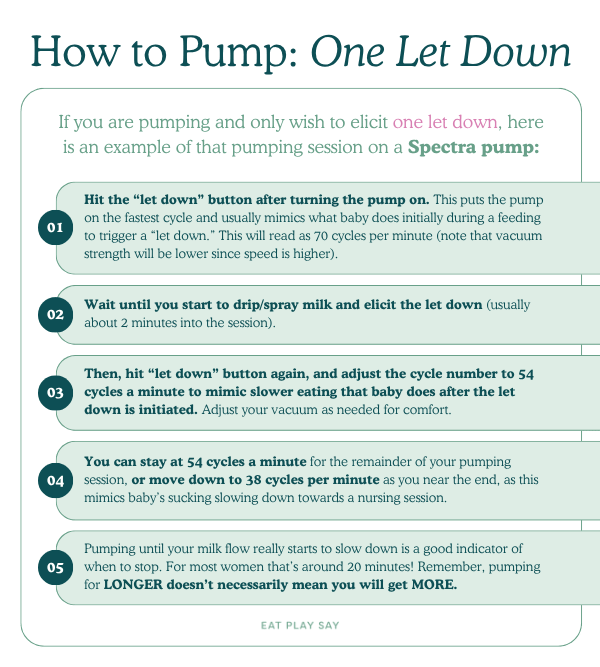
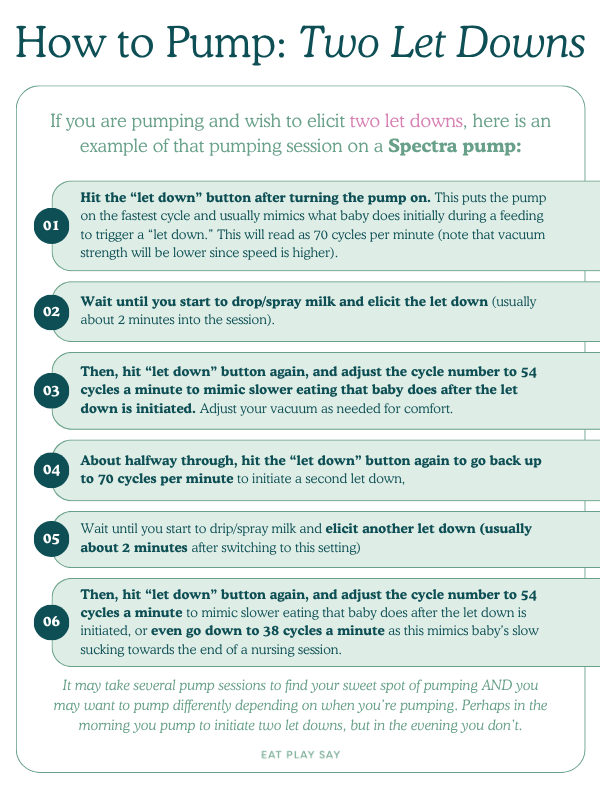
Below are a few graphics adapted from our Infant Feeding Handbook that give an example of a few different ways to pump using a Spectra pump. For more in-depth infant feeding support, grab the handbook for yourself!
If you would like to have one let down during a pump session, try this:
For two let downs during a pump session, try this sequence:
Extra feeding support
You’re doing the thing, and you should be so proud!
You can find more blog posts about feeding your little one in our Breast & Bottle archives. We also have great posts about starting solids and development, including ways to play with your baby from birth through 3 years!
Our team is available for 1:1 consultations for more hands-on support.
Need the kind of support you can carry around everywhere you go? We’ve got you! Our Handbooks include hundreds of pages of research-backed, expert guidance from our team. They’re yours to keep forever and cover so many of the most-asked parent questions!

Sources
- Stern JM, Reichlin S. Prolactin circadian rhythm persists throughout lactation in women. Neuroendocrinology. 1990 Jan;51(1):31-7. doi: 10.1159/000125312. PMID: 2106085.
Leave a Reply
OTHER POSTS YOU MAY LIKE:



MS, SLP
Founder of Eat Play Say, Speech-Language Pathologist, Feeding Specialist, Play Expert, Mom of 3
Jordyn Koveleski Gorman
SPECIALIZES IN: Infant and toddler speech-language, play, and feeding development, and curating a team that provides expert help that feels like a reassuring text from that one mom friend
EDUCATION: Jordyn received her BS in Speech-Language Pathology from Bloomsburg University and her MS in Speech-Language Pathology from Towson University
FAVE PARENTING FIRST: “The first true smile, it’s the sweetest!”

MS, CCC-SLP, CBS, IBCLC
Speech-Language Pathologist & Feeding Specialist, Certified Breastfeeding Specialist, International Board Certified Lactation Consultant
Jessica Nicholson Cocca
SPECIALIZES IN: Breast and bottle feeding, tongue ties, oral motor dysfunction, starting solids, infant and toddler speech, treating oral motor disorders
EDUCATION: Jessica received her BS in Communication Sciences and Disorders from Pennsylvania State University in 2015 and her MS in Speech-Language Pathology from Towson University in 2017
FAVE PARENTING FIRST: “Baby’s first wave! What a fun first communication gesture!”

MA, CCC-SLP, CLC
Speech-Language Pathologist, Certified Lactation Counselor
Jennifer McFarlin
SPECIALIZES IN: Breast and bottle feeding, tongue ties, starting solids, infant and toddler speech development
EDUCATION: She received her BS in Speech-Language Pathology from Ball State in 2014 and a MA in Speech-Language Pathology from Ball State in 2016.
FAVE PARENTING FIRST: “My favorite baby’s first is their first true smile that just warms your soul knowing they are smiling at you. My other favorite is their first word. I love watching their language explode!”

MS, CCC-SLP
Bilingual Speech-Language Pathologist
Nicole La Petina Kelly
SPECIALIZES IN: Bilingual development (Spanish-English), supporting multilingual families, infant and toddler speech
EDUCATION: She received her BA in Communication Sciences and Disorders and in Spanish from the University of Wisconsin-Madison in 2014 and her MS in Speech-Language Pathology with an English-Spanish Specialization from Marquette University in 2016.
FAVE PARENTING FIRST: “It’s the first slobbery kisses for me!”

RDN, LD
Licensed Registered Dietitian
Kimberly Vede
SPECIALIZES IN: Infant and pediatric nutrition including breastfeeding, formula feeding, and starting solids. She also specializes in prenatal and postpartum nutrition.
EDUCATION: She received her BSc in Biology in 2014 from Life University, and her BSc in Dietetics from Life University in 2019.
FAVE PARENTING FIRST: ”The first time they say ‘mama!’”


This checklist was created with input from a Speech-Language Pathologist, Occupational Therapist and Physical Therapist and has been downloaded over 20,000 times by parents worldwide. Learn the important milestones to pay attention to, and keep it in your digital back pocket during the baby + toddler years!
Comprehensive Milestone Checklist for gross motor, fine motor, and speech-language milestones for 0-36 months,
DOWNLOAD FOR FREE


