


How to Stop the Gag Reflex: Choking vs Gagging in Babies
June 9, 2024
Jordyn Koveleski Gorman

Last Updated on July 10, 2026 by Jordyn Koveleski Gorman
This page contains affiliate links. We will receive a commission on qualifying purchases using these links.
First things first: the gag reflex is important for infants, and in most cases, there is actually no need to stop it. Watching your little one gag can be scary, though. It can trigger fears that baby might be choking, and parents often feel helpless when their baby gags.
As a speech-language pathologist and feeding specialist, it’s my job to help parents support their little ones through different challenges and milestones in feeding, including gagging. Understanding the gag reflex in infants is the best way to help your baby through this phase of development while reducing anxiety. Let’s break down what gagging is, why it matters, and what you can do to help your child through this developmental stage.
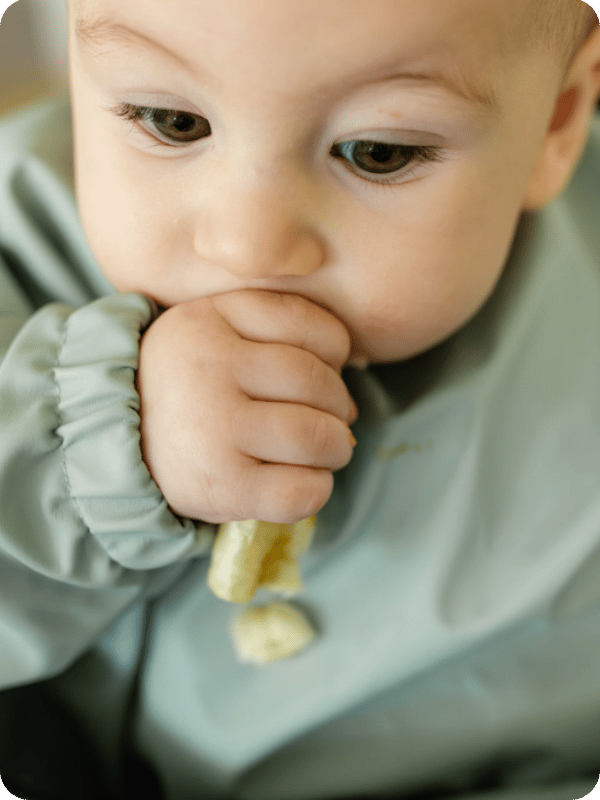
Infant gag reflex
Babies are born with a gag reflex in the first third of their mouth. (1) When something enters their mouth and goes too far back, it will elicit a gag to push it forward. This response is involuntary and controlled by the brain stem. The muscles at the base of the tongue and the pharyngeal wall contract to cause the gag reflex. (2)
You might be wondering why babies gag. It’s actually quite simple: gagging is believed to be an evolutionary response to prevent both choking and swallowing foreign objects. (2) So, gagging is actually a good thing!
If you are bottle feeding your infant, you may occasionally see them gag on the bottle nipple when it enters their mouth. This happens especially if they weren’t quite ready for the bottle or if they bobbed when you weaved to put it in their mouth. Usually, the gag is over quickly, they recover, and drink the bottle without continued gagging.
The gag reflex should decrease over time
By around 6 months of life, the gag reflex starts to move towards the middle of the mouth. (3) This happens naturally but is aided by mouthing toys, chewing on teethers, and eventually, starting solids!
Although the reflex is moving closer to the back of the mouth, you may notice that for a brief time gagging incidents increase in frequency. As baby gets more comfortable mouthing objects and starting solids, baby will push things farther into their mouth. This ramps up gagging and can seem concerning. Rest assured, it’s usually nothing to worry about. With more practice and repetition (usually after several weeks), gagging will decrease with new textures and teethers.
Letting baby put toys in their mouth helps integrate the gag reflex. That’s one reason I recommend using teethers from ~10–12 weeks onward. Several of our favorite teethers can even double as baby’s first spoons. Letting baby “practice” self-feeding with these helps prepare them for solids and begins to work on several speech-language skills!
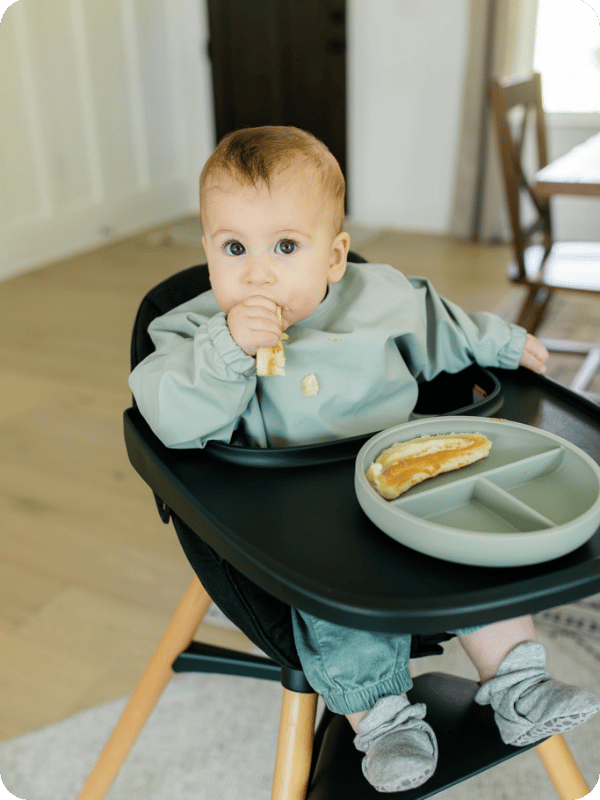
Baby gagging on food? Gag reflex and starting solids
The gag reflex continues to move back as baby starts solids. Around 6–7 months, the part of the brain that controls gagging becomes less sensitive, too, allowing baby to swallow more varieties and textures of foods. (2) By around a year of age, it will settle where the adult gag reflex is: in the back third of the mouth. (3)
What parents should know about gagging and solids:
- The only way to get over gagging is to go through it. Each time your little one gags and recovers, they are moving forward!
- Gagging on a new texture at first (e.g., moving to lumpy purees from purees, to soft solids from dissolvable solids) is normal.
- Persistent gagging after 3–5 bites of a food indicates that your little one may not yet ready for that food. Decrease the texture and try again later.
- If your little one gags to the point of throwing up, or gagging is resulting in food refusal, it’s time to talk to a specialist.
- Gagging is the body’s way of protecting the airway and preventing food from going too far back. The gag can be a good thing!
Spoons making your little one gag?
If your little one is gagging when using spoons, there may be an easy fix. Make sure the spoon’s handle isn’t too long, especially when baby is self-feeding or playing. Spoons with a lip-block (1 and 7 on this list) can help your baby not push the spoon too far back. If you’re seeing consistent gagging when self-feeding, try switching up the utensil. All our favorite infant spoons are here!
Little ones can experience gagging when moving up in texture from purees. That can be normal, but sometimes parents are hesitant to offer higher textures like mashed or soft solids because of gagging. It is important to offer higher textured foods by the time baby is about 9 months of age, as research tells us that if babies are consistently exposed to texture before they turn 10 months of age, they are less likely to experience picky eating in toddlerhood. (4)
Choking vs. gagging in babies
There are several important distinctions between choking and gagging.
First, gagging happens in the mouth, while choking happens in the airway (down the windpipe). Anatomically, gagging is a reflexive muscle contraction, while choking is a partial or complete airway obstruction. Although they may seem similar, they are very different. Choking is a medical emergency. Gagging is actually a built-in prevention system for choking, and it is not an emergency.
Gagging is commonly a noisy, disruptive-sounding event, though not always. Some, but not all, signs of gagging include:
- Simple cough (a short, singular cough or temporary burst of a few mild coughs)
- Tongue protrusion
- Retching movements
- Vomiting (1)
By contrast, choking events are often eerily quiet. When the airway is fully obstructed, there is no way for the vocal chords to make sound, as they rely on air passing through them. (5) This is one reason why infants and toddlers must be monitored closely during meal times. In cases of partial obstruction, producing some sounds may be possible.
Signs of severe (fully obstructed) choking include, but are not limited to:
- Inability to speak, babble, or make noise
- Reaching for the neck or mouth
- Weak or silent coughing
- A high-pitched whistling sound
- Skin or lips turning blue
- Loss of consciousness
- Looking surprised, confused, or panicked (5)
Partial obstruction choking, or mild choking, is something many people recognize as food “going down the wrong pipe.” Symptoms of partial choking include:
- Loud coughing
- Hoarse voice
- Red skin and/or tears in the eyes (5)
Although partial choking may not become an emergency if your child is able to clear their airway through coughing, the signs of an obstructed airway above are always an emergency. Parents should learn how to provide lifesaving first aid, and always call 911 if you suspect someone is choking.
How to stop the gag reflex?
You don’t!
Try not to be scared of the gag. It can be hard to watch your little one make a face and look uncomfortable, but gagging is an essential safety mechanism that helps your baby. Plus, this phase is usually over fairly quickly as baby works to push the reflex further back in their mouth.
More infant feeding resources
Find more feeding resources on our blog, whether you need help with breast & bottlefeeding, starting solids, or even feeding toddlers!
For our most in-depth resources, check out our Handbooks! Written by our multidisciplinary team of pediatric specialists, including PT, OT, lactation consultants, a registered dietitian and SLPs & feeding specialists, we answer all your most asked questions about infants and toddlers. The Starting Solids Bundle has everything you need to jump into solids the way that fits your family best, backed by research and clinical expertise!

Sources
- Arvedson JC. Complementary feeding in the first year of life: choking and gagging; what about nutrition? J Pediatr (Rio J). 2023 Nov-Dec;99(6):534-536. doi: 10.1016/j.jped.2023.08.002. Epub 2023 Sep 9. PMID: 37696494; PMCID: PMC10594011.
- Sivakumar S, Prabhu A. Physiology, Gag Reflex. [Updated 2023 Mar 12]. In: StatPearls [Internet]. Treasure Island (FL): StatPearls Publishing; 2026 Jan-. Available from: https://www.ncbi.nlm.nih.gov/books/NBK554502/
- Ed, Naylor, & Morrow, Ardythe. (2001). Developmental Readiness of Normal Full Term Infants To Progress from Exclusive Breastfeeding to the Introduction of Complementary Foods: Reviews of the Relevant Literature Concerning Infant Immunologic, Gastrointestinal, Oral Motor and Maternal Reproductive and Lactational Development.
- University of Bristol. Should we worry about picky eating? Accessed July 2026.
- Cleveland Clinic. Choking First Aid. Updated 28 March 2025. Accessed July 2026.
OTHER POSTS YOU MAY LIKE:


MS, SLP
Founder of Eat Play Say, Speech-Language Pathologist, Feeding Specialist, Play Expert, Mom of 3
Jordyn Koveleski Gorman
SPECIALIZES IN: Infant and toddler speech-language, play, and feeding development, and curating a team that provides expert help that feels like a reassuring text from that one mom friend
EDUCATION: Jordyn received her BS in Speech-Language Pathology from Bloomsburg University and her MS in Speech-Language Pathology from Towson University
FAVE PARENTING FIRST: “The first true smile, it’s the sweetest!”

MS, CCC-SLP, CBS, IBCLC
Speech-Language Pathologist & Feeding Specialist, Certified Breastfeeding Specialist, International Board Certified Lactation Consultant
Jessica Nicholson Cocca
SPECIALIZES IN: Breast and bottle feeding, tongue ties, oral motor dysfunction, starting solids, infant and toddler speech, treating oral motor disorders
EDUCATION: Jessica received her BS in Communication Sciences and Disorders from Pennsylvania State University in 2015 and her MS in Speech-Language Pathology from Towson University in 2017
FAVE PARENTING FIRST: “Baby’s first wave! What a fun first communication gesture!”

MA, CCC-SLP, CLC
Speech-Language Pathologist, Certified Lactation Counselor
Jennifer McFarlin
SPECIALIZES IN: Breast and bottle feeding, tongue ties, starting solids, infant and toddler speech development
EDUCATION: She received her BS in Speech-Language Pathology from Ball State in 2014 and a MA in Speech-Language Pathology from Ball State in 2016.
FAVE PARENTING FIRST: “My favorite baby’s first is their first true smile that just warms your soul knowing they are smiling at you. My other favorite is their first word. I love watching their language explode!”

MS, CCC-SLP
Bilingual Speech-Language Pathologist
Nicole La Petina Kelly
SPECIALIZES IN: Bilingual development (Spanish-English), supporting multilingual families, infant and toddler speech
EDUCATION: She received her BA in Communication Sciences and Disorders and in Spanish from the University of Wisconsin-Madison in 2014 and her MS in Speech-Language Pathology with an English-Spanish Specialization from Marquette University in 2016.
FAVE PARENTING FIRST: “It’s the first slobbery kisses for me!”

RDN, LD
Licensed Registered Dietitian
Kimberly Vede
SPECIALIZES IN: Infant and pediatric nutrition including breastfeeding, formula feeding, and starting solids. She also specializes in prenatal and postpartum nutrition.
EDUCATION: She received her BSc in Biology in 2014 from Life University, and her BSc in Dietetics from Life University in 2019.
FAVE PARENTING FIRST: ”The first time they say ‘mama!’”


This checklist was created with input from a Speech-Language Pathologist, Occupational Therapist and Physical Therapist and has been downloaded over 20,000 times by parents worldwide. Learn the important milestones to pay attention to, and keep it in your digital back pocket during the baby + toddler years!
Comprehensive Milestone Checklist for gross motor, fine motor, and speech-language milestones for 0-36 months,
DOWNLOAD FOR FREE


