


When Do Babies Start Teething? Signs Baby is Teething
September 25, 2025
Jordyn Koveleski Gorman

Last Updated on June 15, 2026 by Jordyn Koveleski Gorman
This page contains affiliate links. We will receive a commission on qualifying purchases using these links.
Teething has quite the reputation with parents and loved ones of infants. Extra fussy out of the blue? Probably teething. Putting their hands in their mouth a lot lately? Teething, for sure. Poops look a little funny? Also a tooth, probably.
Although it gets the blame for a lot of infant problems, is teething actually causing all of that? As a feeding specialist, teething is a topic I frequently educate about professionally. Let’s dive into the signs of teething and what parents can do to help!
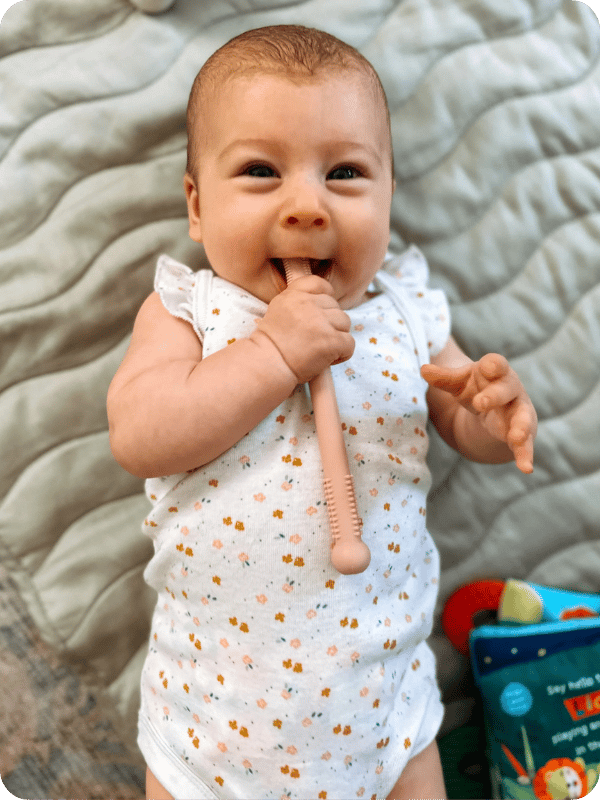
Signs baby is teething
One study found that some symptoms commonly associated with teething do tend to increase in a short-term window before and after tooth eruption. (1) Those symptoms include:
- Increased biting
- Drooling, gum-rubbing, and sucking
- Irritability
- Ear-rubbing
- Facial rash
- Decreased appetite for solid foods
- Mild temperature elevation (1)
The same study also found that a few symptoms sometimes attributed to teething were not good indicators of a new tooth. Those included:
- Congestion
- Sleep disturbance
- Loose stool or an increased stool number
- Decreased appetite for liquids
- Cough
- Rashes other than facial rashes
- Fever over 102 degrees F
- Vomiting (1)
It’s worth noting that even with this research, studies still indicate that there is no predictable indicator that a tooth will erupt soon. Every baby is different, and teething will look unique to each one!
When do babies get teeth?
Parents are usually surprised to find out that common signs of “teething” can begin as early as 10-12 weeks of age. But that doesn’t mean a tooth is coming right away.
For instance, an increase in drooling is a sign of teething, but it’s not always immediately followed by teeth popping through the gums. Developmentally, when babies start to bring their hands to their mouths around 3-4 months, the salivary glands are naturally activated. Baby starts to drool more as a result.
Baby may also chomp on anything and everything when they are preparing for a tooth, but that can also be a normal piece of development not associated with an impending tooth.
These early developmental “mouthing” milestones can make parents believe that teeth are coming as early as 3-4 months. The truth is that it’s normal for babies to get their first tooth anywhere from 5-6 months old to over a year old! So they can be “teething” for quite a while with no teeth actually coming through! This can be frustrating, especially if your little one seems very impacted by teething.
The easiest way to know if a tooth is on the way? Check their gums! Parents can usually see little “bumps” or buds at the gumline indicating that teeth are coming soon. The gumline turns white where teeth are about to pop through. It can be tricky to take a peek, but visualizing their mouth is truly the best way to know.
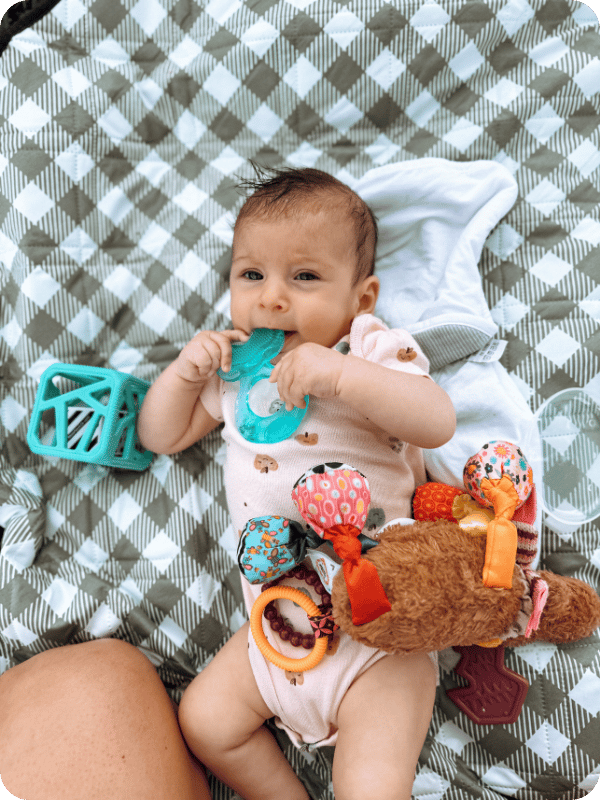
What to do if you think baby is teething
If your baby is chomping on everything, but it feels like you’re waiting forever for a tooth to pop through, don’t worry. All of that chomping and biting is doing your baby good! It strengthens their jaw and prepares them for managing solid foods.
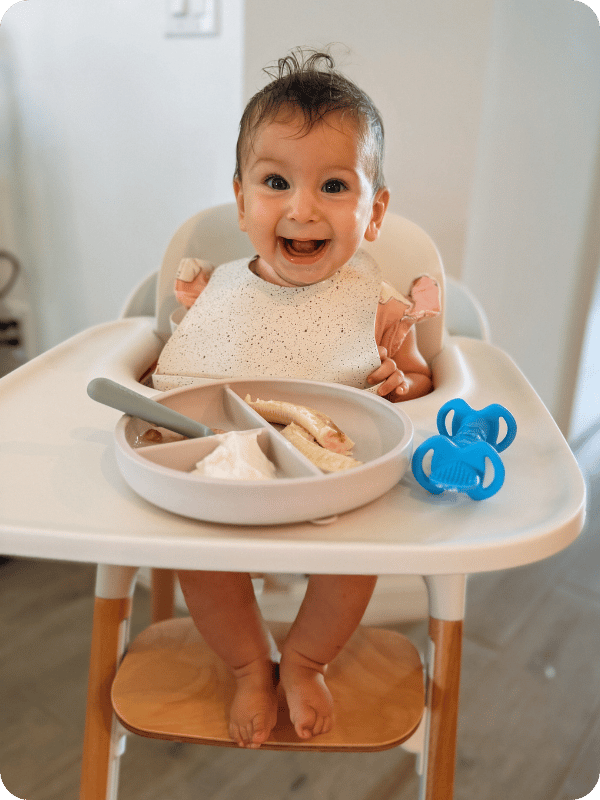
Let them chomp on the silicone ends of toys and books and teethers. If they are eating solids, offer them cool foods like yogurt and cold fruits, as that may relieve some discomfort. You can also offer them chilled teethers by putting them in the fridge. Don’t put them in the freezer though, as extremely cold temperatures can be shocking to baby’s mouth. They may get more upset if the temperature is too cold!
When to use teethers
Teethers are amazing! Their benefits are infinite, and we recommend them way before the first tooth pops through. The best time to introduce is right around 3 months of age. From a developmental standpoint, at 3-4 months baby has likely started reaching and grasping with support. This means they’re ready to start holding onto items and bring them to their mouth!
When babies are born, their mouths are very “unorganized,” which essentially means they lack coordination and sensory regulation. This is why sucking on a pacifier or nursing is soothing. Over time their mouth becomes more organized (coordinated and regulated) through oral exploration.
Babies are meant to put things in their mouth because that is how they explore the world. During the first year, we want baby’s mouth to experience different textures during play and meals to help regulate their oral sensory system. Teethers are an excellent way to do that!
Teethers are especially helpful between 3–6 months of age because they help move the gag reflex back. They also help babies practice the motor plan for chewing and support mature oral motor development. And they are great for baby’s oral-sensory development.
Clinically, we have observed that littles who did not put toys and items in their mouth in infancy are at higher risk for oral sensitivities when starting solids. Essentially, teethers help babies by introducing textures before babies are ready to be introduced to textured foods. Crinkle books with teething corners, silicone rattles, and other soft baby items are also great for mouthing.
Once you start introducing them, keep teethers nearby or even on a pacifier clip. If baby reaches to put things in their mouth, encourage it as long as it is safe and they are supervised! I know that germs can be scary, but remember that mouthing is developmentally normal and should be encouraged.
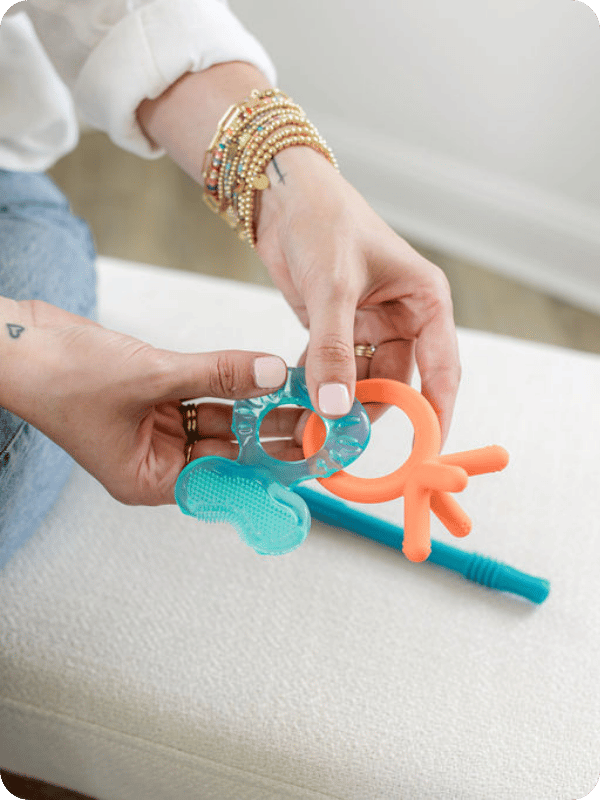
Baby’s First Teether
Start with one that is thick and not too stick-like. Baby’s gag reflex is still very forward in the mouth early on. Some gagging can be expected as baby navigates this new texture.
Baby’s fine motor skills are still developing, so they don’t have the best control of how far to put things in their mouth. Baby will likely need some help with holding the teether and getting it to their mouth. Offer assistance as they need it!
Our favorite first teether is perfect for introducing to baby around 3 months old. You can pop it in the dishwasher or sterilizer, and it has little bristles for some texture. Plus, it can’t go too far back in baby’s mouth and comes in a variety of colors!
Favorite Teethers for infants
Once baby does well with thicker teethers that are easier to hold, moving to stick-like teethers is recommended.
These help move the gag reflex back. They also help baby practice the motor plan of self-feeding. You can even dip them in baby’s favorite food in the high chair when they take their first bites!
You can start with hollow tubes for chomping. Then, move to thicker, more resistive stick-shaped teethers as baby nears 5 months old.
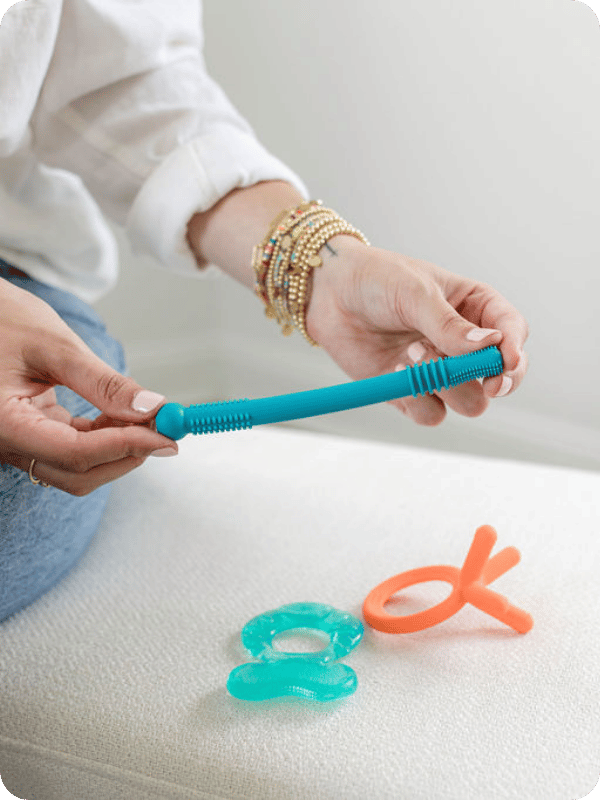
Teethers for 6 Month Olds
When it’s time to start solids, this teether is a great option for littles to practice motor planning for self-feeding and increase jaw strength.
Once they can handle a teether like the Nuby or the hollow sticks, this is a great next step. Still easy to hold, can be put in the dishwasher or sterilizer, and has short sticks so baby doesn’t gag themselves too much!
Teethers for toddlers
Continuing to offer thicker, resistive, and stick-like teethers after 6 months and into toddlerhood is recommended.
Continued use strengthens the jaw, helps move the gag reflex back (which fully moves back around age 1), and can help with pain as baby’s teeth pop through.
Additionally, replacing pacifiers with teethers around the 6 month mark is a great way for baby to continue to receive oral input without prolonging an immature suckling pattern. For information about pacifier weaning or thumb sucking, head to this blog.
Baby’s First Toothbrush
Teethers can also help with toothbrushing. It is important to start brushing those teeth as soon as you see them! Brush in gentle circles with water to start and then add infant toothpaste once they are comfortable with soft bristles in their mouth. It is recommended to see a dentist within 6 months of the first tooth or by their first birthday.
Here is a great training toothbrush that can double as a teether.
More infant resources
You can find a full breakdown of our favorite teethers here. And for more parenting support, our blog is full of information from our team of child specialists!
Here are some more blogs you might like:
- The best feeding utensils for starting solids
- Clean up tips for messy high chair meals
- Baby led weaning vs. purees from a feeding specialist’s perspective
- How and when to burp a baby (and when you can stop)
For our most in-depth resources, check out our Handbooks! With hundreds of pages of research-backed information from our team, we answer all of your most-asked questions in one place, and you get to keep it forever!
Sources
- Macknin ML, Piedmonte M, Jacobs J, Skibinski C. Symptoms associated with infant teething: a prospective study. Pediatrics. 2000 Apr;105(4 Pt 1):747-52. doi: 10.1542/peds.105.4.747. PMID: 10742315.
OTHER POSTS YOU MAY LIKE:


MS, SLP
Founder of Eat Play Say, Speech-Language Pathologist, Feeding Specialist, Play Expert, Mom of 3
Jordyn Koveleski Gorman
SPECIALIZES IN: Infant and toddler speech-language, play, and feeding development, and curating a team that provides expert help that feels like a reassuring text from that one mom friend
EDUCATION: Jordyn received her BS in Speech-Language Pathology from Bloomsburg University and her MS in Speech-Language Pathology from Towson University
FAVE PARENTING FIRST: “The first true smile, it’s the sweetest!”

MS, CCC-SLP, CBS, IBCLC
Speech-Language Pathologist & Feeding Specialist, Certified Breastfeeding Specialist, International Board Certified Lactation Consultant
Jessica Nicholson Cocca
SPECIALIZES IN: Breast and bottle feeding, tongue ties, oral motor dysfunction, starting solids, infant and toddler speech, treating oral motor disorders
EDUCATION: Jessica received her BS in Communication Sciences and Disorders from Pennsylvania State University in 2015 and her MS in Speech-Language Pathology from Towson University in 2017
FAVE PARENTING FIRST: “Baby’s first wave! What a fun first communication gesture!”

MA, CCC-SLP, CLC
Speech-Language Pathologist, Certified Lactation Counselor
Jennifer McFarlin
SPECIALIZES IN: Breast and bottle feeding, tongue ties, starting solids, infant and toddler speech development
EDUCATION: She received her BS in Speech-Language Pathology from Ball State in 2014 and a MA in Speech-Language Pathology from Ball State in 2016.
FAVE PARENTING FIRST: “My favorite baby’s first is their first true smile that just warms your soul knowing they are smiling at you. My other favorite is their first word. I love watching their language explode!”

MS, CCC-SLP
Bilingual Speech-Language Pathologist
Nicole La Petina Kelly
SPECIALIZES IN: Bilingual development (Spanish-English), supporting multilingual families, infant and toddler speech
EDUCATION: She received her BA in Communication Sciences and Disorders and in Spanish from the University of Wisconsin-Madison in 2014 and her MS in Speech-Language Pathology with an English-Spanish Specialization from Marquette University in 2016.
FAVE PARENTING FIRST: “It’s the first slobbery kisses for me!”

RDN, LD
Licensed Registered Dietitian
Kimberly Vede
SPECIALIZES IN: Infant and pediatric nutrition including breastfeeding, formula feeding, and starting solids. She also specializes in prenatal and postpartum nutrition.
EDUCATION: She received her BSc in Biology in 2014 from Life University, and her BSc in Dietetics from Life University in 2019.
FAVE PARENTING FIRST: ”The first time they say ‘mama!’”


This checklist was created with input from a Speech-Language Pathologist, Occupational Therapist and Physical Therapist and has been downloaded over 20,000 times by parents worldwide. Learn the important milestones to pay attention to, and keep it in your digital back pocket during the baby + toddler years!
Comprehensive Milestone Checklist for gross motor, fine motor, and speech-language milestones for 0-36 months,
DOWNLOAD FOR FREE


