


When & How To Start Brushing Baby’s Teeth
February 7, 2025
Jordyn Koveleski Gorman

Last Updated on May 8, 2026 by Jordyn Koveleski Gorman
This page contains affiliate links. We will receive a commission on qualifying purchases using these links.
There are a million parents just like you, struggling to figure out how to brush their baby’s teeth. Imagine someone coming at you with this large object you’re not sure about and getting all up in your face with it. You’d probably resist, too!
But where there’s a will, there’s a way. Our occupational therapist shared her most helpful tips for making toothbrushing more enjoyable for everyone involved. This little daily task doesn’t have to be miserable forever!

When to start brushing baby’s teeth
The American Academy of Pediatrics recommends starting to brush your baby’s teeth the minute that first tooth pops up. For most babies, this happens between 6–12 months. (1) The American Dental Association encourages parents to wipe their baby’s gums with a damp cloth after meals, even before teeth break through.
It might feel silly brushing a tiny little baby tooth or plain ole gums, but starting early is so important for helping your little one learn and adjust to this new daily routine. And if you’re reading this and thinking, “Oh shoot, my toddler has 4 teeth and I’ve never brushed them!” It’s okay! Now is the time to start!
How to brush baby’s teeth
If you’re reading this and haven’t started brushing yet, here is how to start:
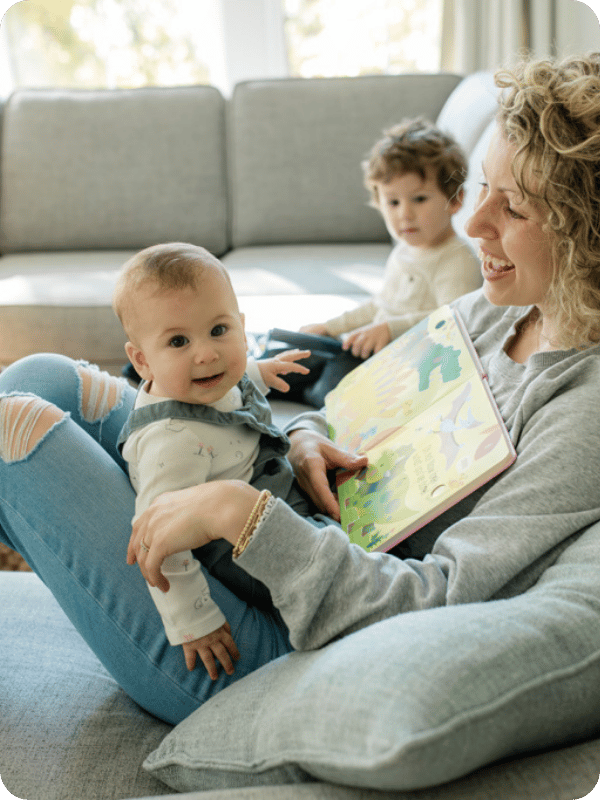
- Recline baby (like the picture above) and sing a song while brushing in gentle circles all over baby’s teeth! Sing Twinkle, Twinkle, the ABCs, or any song your little one likes. This position is optimal because it mimics the position of a dentist’s chair and it allows you to best see their entire mouth.
- Start small with just 5-10 seconds of brushing. Try to end on a happy note or when the verse to a song ends.
- Do this morning and night. Start with just a wet toothbrush for acceptance, and then when your routine is established put a very small dot of toothpaste on the brush. It should be no bigger than a grain of rice!
This is all well and good if your little one allows a toothbrush in their mouth. For some parents, these steps might be all you need.
But what if you can’t even get NEAR your little one with a brush? We’ve got your back.
How to get baby to accept a toothbrush
The First Step
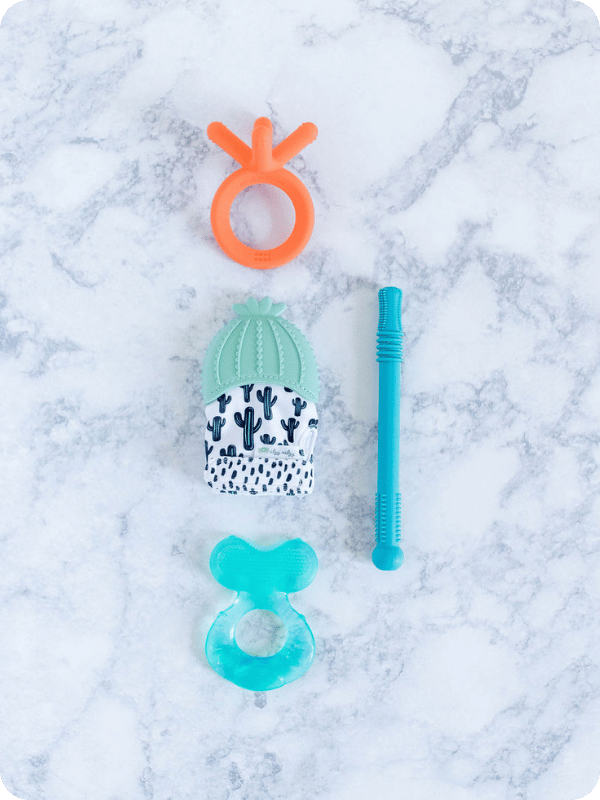
Let. Them. Mouth. Things. (Safely, of course).
That’s right! Take a look back to our mouthing and teether blogs for more on this! Establishing a good relationship with teeth brushing starts with your baby or toddler feeling safe and comfortable having things in their mouths, and playtime is the best time to do that.
Letting their mouths explore different textures and densities is not only helpful for teething, but for teeth brushing as well. Just like mouthing objects allows baby’s oral sensory system to prepare for food in the mouth, it is also preparing for other items in the mouth like a toothbrush.
The Second Step
One of the easiest ways to help your little one warm up to teeth brushing is to fit it into your bedtime/evening routine. Routines are predictable and safe for our little ones and consistently brushing teeth every evening can really help your little one to adjust and feel comfortable with it. When you make it a part of your daily or evening routine, your little one will begin to expect it, which will help the newness to die down. Eventually, it will be less scary and more normal.
You can even incorporate toothbrushing in the bath! Have your little one brush a bath toy’s teeth and when bathtime is over you brush their teeth! Find a time every night for toothbrushing and stick to it.
The Third Step
As always, start slow and build up! Maybe your little one can tolerate ~10 seconds of teeth brushing…perfect! Start there and aim for ~15 seconds tomorrow, then ~20 seconds a few days later, and so on.
We have to remember to meet our little ones where they are if we want to see progress. The truth is that we cannot expect little ones to dive in and accept new things right off the bat. Remember, you know and understand teeth brushing, but they do not. You have to give them time to learn and adjust to this new routine. That means starting super small!
Once you get your routine and timeline down pat, there are some more things you can do to actually get your little one to accept the brush in their mouth.
Tips for brushing baby teeth
Talk about why you’re brushing teeth
Understanding helps diminish fear! Don’t underestimate your little one. Their hesitancy with teeth brushing could be linked to a lack of understanding of what in the world you are trying to do with them.
Talk to them about why we want them to brush their teeth. Use simple terms like dirty and clean.
You can say something like, “At the end of the day, our teeth are dirty from eating all day, so we have to brush them to clean them.” You can also say, “Just like we clean our hands, clean our hair, and clean our bodies, we also have to clean our teeth.”
Toddlers are so curious and eager to learn. Talking to them about the ‘why’ might help them understand what the purpose of this now routine is.
Read Some Teeth Brushing Books
Grab some books and start reading! Reading books about teeth brushing can help familiarize your little one with the language, routine, and process of teeth brushing. Here are some of our favorite teeth brushing books. Read these before and after teeth brushing to help get your little one comfortable!
Change Your Positioning or Location
While a reclined position is optimal, it might take a lot of little steps to get there! Head to the bathroom and look in the mirror together. Sit on the floor or couch together. Use a kitchen tower or stool and stand at the kitchen sink. Just switch things up! Or better yet, ask your little one where they would like to brush their teeth. Giving control where possible can do wonders!
Use 3 Brushes
This might seem excessive, but putting a toothbrush in each of their hands and then one in yours can help prevent them from pushing the brush out of your hand! And then you can “take turns” by letting them brush for a few seconds before you go back in! If you don’t want to use 2 toothbrushes in their hands, give them something else to hold in each hand. A teether or spoon would work!
Brush Your Stuffed Animals
Let your little one be the ‘teeth brusher’ for a change and brush their dolls’ or stuffed animals’ teeth. This will help your little one feel comfortable holding and having control of the toothbrush.
Ask them whose teeth they want to brush tonight, then go and find that stuffed animal and talk your little one through brushing the stuffed animal’s teeth. Try to use similar language as you use when brushing your toddler’s teeth, such as: “open wide,” “brush brush brush,” “almost done,” etc.
Join Your Little One
Instead of coming right at them with a toothbrush, make it an activity that you do together! Load up your toothbrushes together, take turns wetting them under water, get down on your little one’s level, and model (show them) exactly what you’re hoping they do.
Ask your little one to help you brush your teeth by letting them have control of your tooth brush (I promise this is helpful for them, but brace yourself for some forceful brushing!), then tell them it’s your turn to brush their teeth. You can also try the phrasing “your turn” and “my turn” to help them know when you are going to join in to help them brush their teeth. They will love that this is an activity that you all do together.
Work Outside In
If your little one is very averse to reaching into their mouth, start at their hands and work your way up! Tap the toothbrush on their fingers, hand, arm, elbow, shoulder, cheek, lips, etc. before going into their mouth! You can make it fun by singing a song as you work your way up, or you can tell them “Time to brush your ____” as you’re doing it! Once you brush their teeth for a few seconds, you can bring the brush back to their hands and start over. This is a great way to calm down brushing and slowly work your way in their mouth!
Visual or Auditory Timers
A visual timer is something that allows your little one to visually see the amount of time left for an activity or until the next activity occurs. Think about an hour glass that lets you know roughly how much time is left based on the amount of sand left. That’s a visual timer. An auditory timer is a familiar tune or song that would allow you little one to know how long the activity is going to last, such as singing a familiar nursery rhyme.
Visual and auditory timers help to let your little one know how long they are expected to brush their teeth, which could help relieve some anxiety because they know there will be an end. Pick a favorite nursery rhyme and sing it really fast to start out, so that the teeth brushing experience is fairly short, then begin to sing the song a slower and slower as your little one starts to get the hang of it.
Tell Them What They Ate
This is a silly one, but it works! When you brush your little one’s teeth, tell them what they ate that day. “Wow, I see cheese and berries! Oh wow, did you have a mango?!” They find it funny and are intrigued that you can see what food they ate on their teeth!
Best baby toothbrush
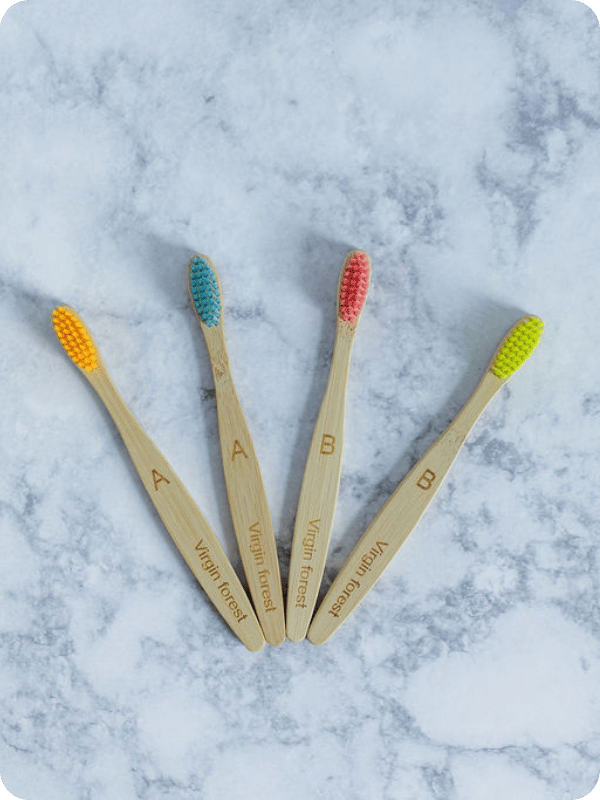
Finding the best toothbrush for your little one can take a few tries. Our toothbrushing favorites are all here! The most important thing is finding a toothbrush your little one will let you use, but extra bonus if it’s got super soft bristles and is BPA free.
More parenting support
If you’ve tried all of these strategies and more and your little one is still fighting the toothbrush, it’s possible that your little one could have some oral sensitivities that might require the help of an occupational therapist.
You can self-refer to your state’s Early Intervention for an OT evaluation for free. You can also book a consultation with our occupational therapist if you want individualized help in a matter of days!
For more support from our team of child development experts, check out our searchable blog (no Google necessary!) or dive into our collection of Handbooks! Our handbooks are yours forever and come with hundreds of pages of actually useful support and no fluff. Whether you need help with starting solids, weaning, or finding ways to play with your little one—we’ve got you!
Sources
- David M. Krol, Kaitlin Whelan, THE SECTION ON ORAL HEALTH; Maintaining and Improving the Oral Health of Young Children. Pediatrics January 2023; 151 (1): e2022060417. 10.1542/peds.2022-060417
OTHER POSTS YOU MAY LIKE:


MS, SLP
Founder of Eat Play Say, Speech-Language Pathologist, Feeding Specialist, Play Expert, Mom of 3
Jordyn Koveleski Gorman
SPECIALIZES IN: Infant and toddler speech-language, play, and feeding development, and curating a team that provides expert help that feels like a reassuring text from that one mom friend
EDUCATION: Jordyn received her BS in Speech-Language Pathology from Bloomsburg University and her MS in Speech-Language Pathology from Towson University
FAVE PARENTING FIRST: “The first true smile, it’s the sweetest!”

MS, CCC-SLP, CBS, IBCLC
Speech-Language Pathologist & Feeding Specialist, Certified Breastfeeding Specialist, International Board Certified Lactation Consultant
Jessica Nicholson Cocca
SPECIALIZES IN: Breast and bottle feeding, tongue ties, oral motor dysfunction, starting solids, infant and toddler speech, treating oral motor disorders
EDUCATION: Jessica received her BS in Communication Sciences and Disorders from Pennsylvania State University in 2015 and her MS in Speech-Language Pathology from Towson University in 2017
FAVE PARENTING FIRST: “Baby’s first wave! What a fun first communication gesture!”

MA, CCC-SLP, CLC
Speech-Language Pathologist, Certified Lactation Counselor
Jennifer McFarlin
SPECIALIZES IN: Breast and bottle feeding, tongue ties, starting solids, infant and toddler speech development
EDUCATION: She received her BS in Speech-Language Pathology from Ball State in 2014 and a MA in Speech-Language Pathology from Ball State in 2016.
FAVE PARENTING FIRST: “My favorite baby’s first is their first true smile that just warms your soul knowing they are smiling at you. My other favorite is their first word. I love watching their language explode!”

MS, CCC-SLP
Bilingual Speech-Language Pathologist
Nicole La Petina Kelly
SPECIALIZES IN: Bilingual development (Spanish-English), supporting multilingual families, infant and toddler speech
EDUCATION: She received her BA in Communication Sciences and Disorders and in Spanish from the University of Wisconsin-Madison in 2014 and her MS in Speech-Language Pathology with an English-Spanish Specialization from Marquette University in 2016.
FAVE PARENTING FIRST: “It’s the first slobbery kisses for me!”

RDN, LD
Licensed Registered Dietitian
Kimberly Vede
SPECIALIZES IN: Infant and pediatric nutrition including breastfeeding, formula feeding, and starting solids. She also specializes in prenatal and postpartum nutrition.
EDUCATION: She received her BSc in Biology in 2014 from Life University, and her BSc in Dietetics from Life University in 2019.
FAVE PARENTING FIRST: ”The first time they say ‘mama!’”


This checklist was created with input from a Speech-Language Pathologist, Occupational Therapist and Physical Therapist and has been downloaded over 20,000 times by parents worldwide. Learn the important milestones to pay attention to, and keep it in your digital back pocket during the baby + toddler years!
Comprehensive Milestone Checklist for gross motor, fine motor, and speech-language milestones for 0-36 months,
DOWNLOAD FOR FREE


