


Are Pacifiers Good for Babies?
February 18, 2023
Jordyn Koveleski Gorman

Last Updated on May 26, 2026 by Jordyn Koveleski Gorman
This page contains affiliate links. We will receive a commission on qualifying purchases using these links.
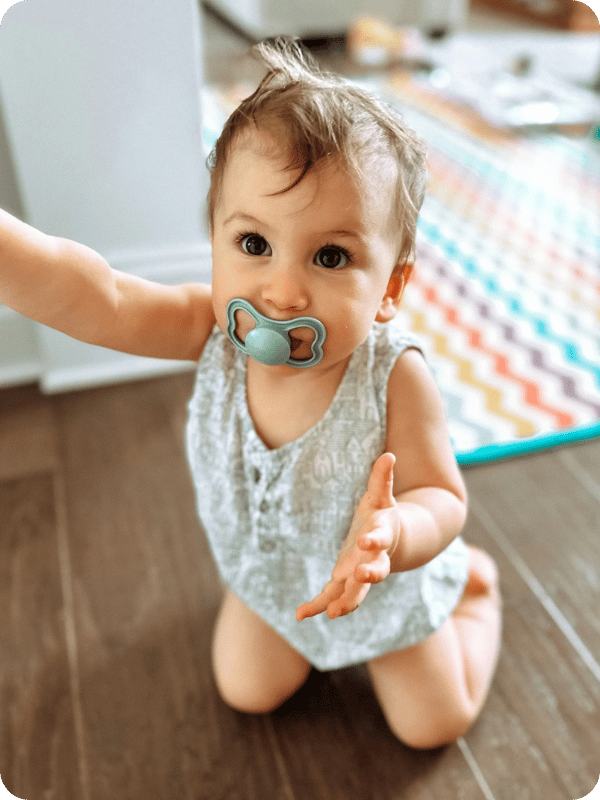
Are pacifiers good for babies?
Confused by conflicting information, parents are asking more and more if pacifiers are good or bad for their babies. As a speech-language pathologist and feeding specialist, the mouth and its function is my specialty, and I can confidently say that the internet has us asking the wrong questions.
Pacifiers are neither good nor bad: they just are! Like many things, the specific item, how it is used, and for how long, matters. Questions that are more beneficial to ask include, “What is the pacifier’s purpose, and when do I use it?”
By answering these questions first, parents are able to make more informed decisions about pacifiers!
What is an infant pacifier for?
The pacifier’s purpose is to pacify.
Newborns especially find sucking very comforting. They may have even sucked their thumb in the womb to soothe. It’s natural! Some infants have really high suck needs and even after breastfeeding or bottle feeding, they want to suck more, but aren’t actually hungry.
Usually after the first few weeks of life, parents start to learn when baby wants to eat versus when baby wants to suck on a pacifier to soothe. Although this can be helpful for everyone, the recommended lifespan of pacifier use is actually pretty short. Most likely, the best time to wean from the pacifier is much earlier than you’d expect. Keep reading!
Are some pacifiers better than others?
Yes, some pacifiers are made in a “preferred” shape, just like there is a preferred shape of the nipple on a bottle. Long and sloped nipples are preferred as they mimic the shape of a mother’s breast when actively breastfeeding.
Pacifiers that have a flat (also called orthodontic) shape, or a bulbed shape at the tip, are not the most optimal. They push the tongue down, don’t promote tongue cupping, and can make a “shelf” for baby’s teeth/gums to rest when baby is not sucking.
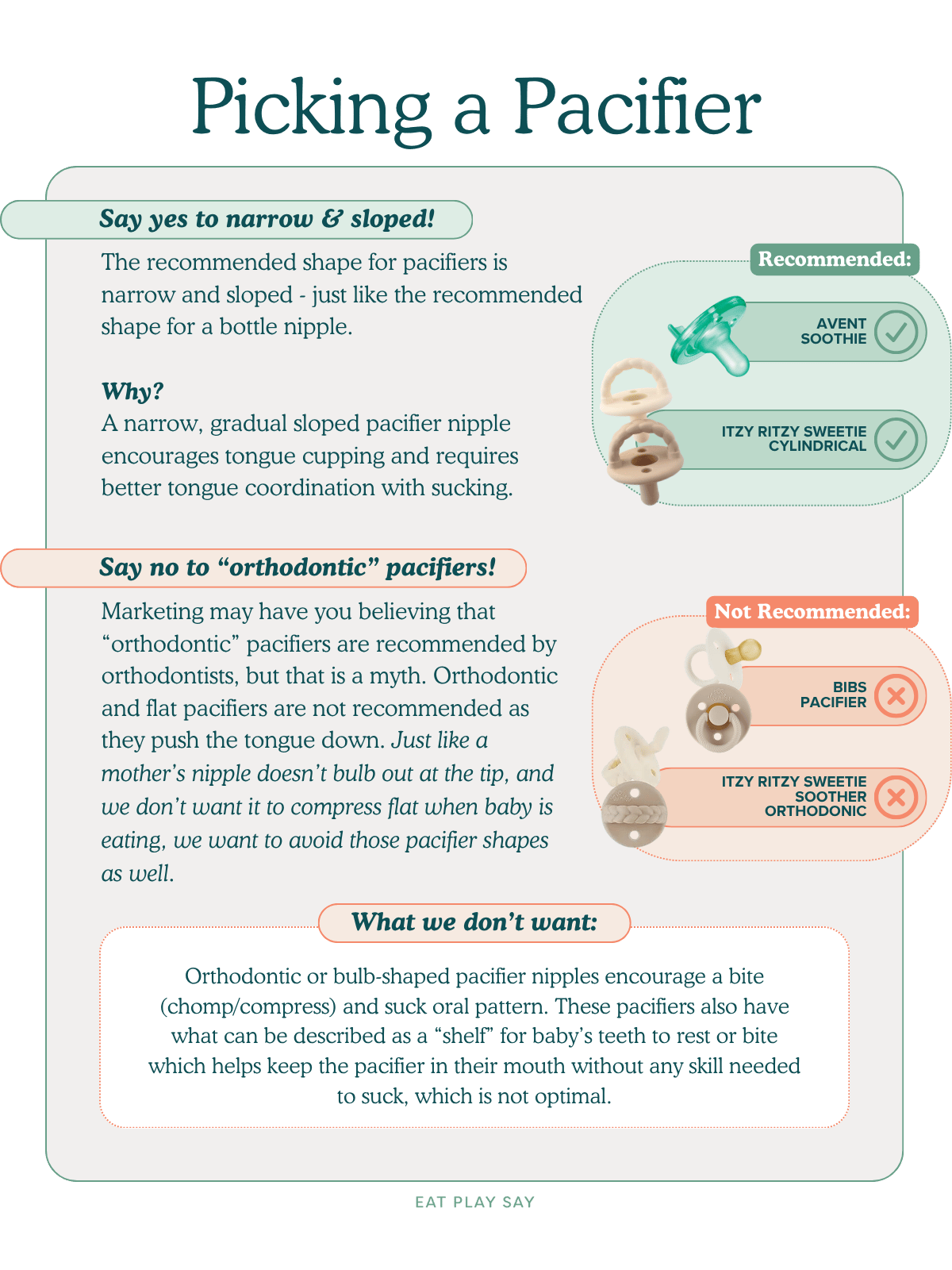
You can find specific pacifiers we recommend here.
When to wean from pacifiers
From an oral motor therapist’s perspective, the recommendation is to wean by 6 months of age if possible. Maybe you’re thinking there’s no way, that’s so early. But there’s a good reason to start weaning early, reducing use between 3–6 months, and fully stopping between 6–12 months.
The suckling pattern that is reflexive at birth starts to integrate (or decrease) between 3-6 months, and babies start to suckle to eat from the breast or bottle on purpose rather than by reflexive instinct.
Babies also start to learn how to suck, like on a straw, around this time. This transition from suckle to suck is important as baby learns how to drink from cups and straws, uses an up-and-down chomping pattern to manage solid foods, and eventually starts to wean off the bottle around 1 year. Since that natural reflexive change is happening in the body between 3-6 months of age, it makes sense that we also recommend decreasing pacifier use around that time.
And if you have a baby who loves to suck their thumb? The same guidelines apply! Of course, the thumb is a bit harder to take away, seeing as it’s attached. More on that below.
Lastly, although we can’t say that extended pacifier use and persistent thumb sucking cause speech delays, there are possible connections. Clinically, we notice that children with persistent pacifier use and thumb sucking sometimes also have speech-language and feeding/oral motor difficulties. Why? Because those “habits” indicate that there may be something else underlying that is likely contributing to the speech-language delay or oral motor difficulties.
Pacifier mouth and anatomy
Understanding the anatomy of the mouth and how a pacifier rests in it is important.
Pause what you are doing. Take some breaths and notice how you are breathing. You’re likely breathing in and out through your nose with your mouth closed. Notice where your tongue is. It is likely positioned up underneath your hard palate, with the tip of your tongue behind your front teeth.
That resting tongue position is so important. The hard palate has many sensory receptors. Our tongues resting under the hard palate helps calm us and keep us regulated throughout the day. Taking breaths through our nose is meditative, while taking breaths through our mouth is not. (1) These anatomical features of our tongue position and palate stimulation matter. (If I could shout this, I would!)
In a lot of cases (not all!), extended pacifier use or thumb sucking into toddlerhood can indicate that the tongue is not resting where it should be. (2) So your little one might be using a thumb or a pacifier to do what the tongue should be doing at rest: providing sensory input to the hard palate.
Additionally, long term use of a pacifier (or thumb sucking) is a risk factor for a high and narrow palate and change in teeth shape. (3)
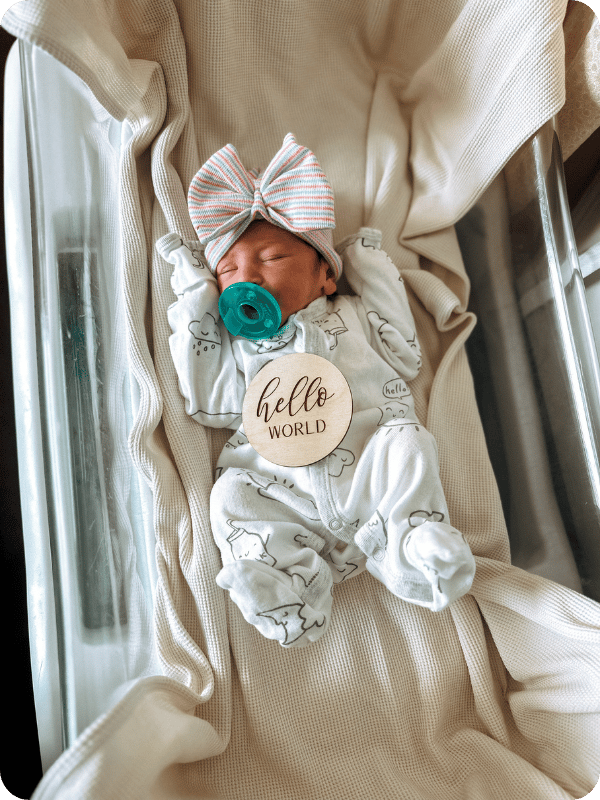
Why does my baby rely so much on the pacifier?
If your little one relies on the pacifier for sleep, uses it in play, or seems to suck her thumb a lot when she is tired, we need to look at some other things to help understand why that is happening. Regardless of how old your child is, ask yourself these questions:
- Does my child have an open mouth posture at rest? Are their lips parted slightly? Do they breathe through their mouth at all, even inconsistently?
- Does my child seem nasally congested a lot? Does it seem laborious to breathe through their nose? Are they a noisy breather?
- Does my child snore? Can they only sleep in a certain position? Can they not sleep on their back without snoring or startling awake from noisy breathing?
- Does my child drool a lot? Do they have to wear a bib during the day to catch drool? Is their bottom lip always shiny with saliva?
- Did or does my child have difficulty breastfeeding? Did or does my child have difficulty with eating solids or managing certain textures? Is my child older than 18 months and a messy eater while chewing foods?
- Does my child have decreased clarity while talking? Slushy sounding speech? A tongue thrust or a “lisp?” Does their tongue seem to come forward when making certain sounds, which makes them sound imprecise?
If you answered “no”
If the answers to these questions are “no” and your child is less than a year old, that’s great! Baby is likely suckling to soothe, which can be expected at this age. Try to wean that pacifier by one year and keep hands busy in play to decrease thumb sucking. Try to only offer the pacifier if your little one is not able to be calmed in other ways. Introducing teethers around 3 months can help increase jaw strength and replace pacifiers in play!
If the answers to these questions are “no” and your child is more than a year old, but still uses a pacifier/sucks on their thumb, your child is also likely still suckling to soothe and calm. At this point, it is likely a habit, but may not be due to underlying oral motor difficulties. Try your best to wean the pacifier.
If you answered “yes”
If you answered “yes” to any of these questions, regardless of how old your little one is, it’s recommended to talk to an oral motor specialist about an evaluation. This is to ensure there isn’t an underlying issue such as an airway obstruction, tongue tie, oral tension, etc. There might not be! But it’s a good idea to ask questions and look into potential factors.
Extended pacifier use and thumb sucking can (but not always!) indicate that something else is going on, and if those underlying reasons are not addressed, the thumb sucking or pacifier use will be difficult to decrease. Additionally, if your baby or toddler needs a pacifier or their thumb to soothe and regulate themselves, and we take that away without finding something to replace it, we can be doing more harm than good. A specialist can help you work towards decreasing pacifier use and thumb sucking in a way that supports your child’s needs.

How to get rid of the pacifier
If you are interested in trying to decrease thumb sucking and pacifier use, try these tips:
- Offer crunchy snacks before bedtime/naptime to provide input to the mouth.
- Keep hands busy in play. You can look into a thumb block with guidance from a professional if you think that is appropriate for your child and something your family agrees on using. But, this is not recommended as a first move.
- Try to replace the pacifier with another soothing toy.
- Positively reinforce when your little one is not thumb sucking or using a pacifier.
- Don’t be too hard on yourself! If your little one is developing well, and you don’t have concerns about her oral motor skills or tongue position, take it slow during this transition.
- Offer teethers instead if your little one will take them. If they don’t accept teethers as a replacement initially, keep offering them during play anyway. Exposure may help them feel comfortable choosing teethers in the future!
Remember that if your little one is sucking their thumb or using a pacifier beyond a year old, you haven’t done anything wrong! By asking questions, you are doing everything right. If you’re concerned about your little one, talk to a licensed oral motor therapist (SLP/OT) for help and support. Or you can book a virtual consultation with a member of our team!
More infant and toddler resources
Now that you understand the purpose of pacifiers, hopefully you feel more ready to tackle weaning when the time comes! You’re not alone, and you’ve got this!
Need more support? We’ve got you covered. Whether you need help with breast & bottle feeding, starting solids, or learning more about infant and toddler development, our blog is full of resources.
Looking for support that goes deeper? Our Handbooks include tips, tricks, and education from our entire team—with hundreds of pages of evidence-backed guidance to help you feel empowered for every stage of parenting littles.
Sources
- Jefferson Y. Mouth breathing: adverse effects on facial growth, health, academics, and behavior. Gen Dent. 2010;58:18–25.
- Grippaudo, C., Paolantonio, E. G., Antonini, G., Saulle, R., La Torre, G., & Deli, R. (2016). Association between oral habits, mouth breathing and malocclusion. Associazione fra abitudini viziate, respirazione orale e malocclusione. Acta otorhinolaryngologica Italica : organo ufficiale della Societa italiana di otorinolaringologia e chirurgia cervico-facciale, 36(5), 386–394. https://doi.org/10.14639/0392-100X-770
- Larsson E. (1994). Artificial sucking habits: etiology, prevalence and effect on occlusion. The International journal of orofacial myology: official publication of the International Association of Orofacial Myology, 20, 10–21.
OTHER POSTS YOU MAY LIKE:


MS, SLP
Founder of Eat Play Say, Speech-Language Pathologist, Feeding Specialist, Play Expert, Mom of 3
Jordyn Koveleski Gorman
SPECIALIZES IN: Infant and toddler speech-language, play, and feeding development, and curating a team that provides expert help that feels like a reassuring text from that one mom friend
EDUCATION: Jordyn received her BS in Speech-Language Pathology from Bloomsburg University and her MS in Speech-Language Pathology from Towson University
FAVE PARENTING FIRST: “The first true smile, it’s the sweetest!”

MS, CCC-SLP, CBS, IBCLC
Speech-Language Pathologist & Feeding Specialist, Certified Breastfeeding Specialist, International Board Certified Lactation Consultant
Jessica Nicholson Cocca
SPECIALIZES IN: Breast and bottle feeding, tongue ties, oral motor dysfunction, starting solids, infant and toddler speech, treating oral motor disorders
EDUCATION: Jessica received her BS in Communication Sciences and Disorders from Pennsylvania State University in 2015 and her MS in Speech-Language Pathology from Towson University in 2017
FAVE PARENTING FIRST: “Baby’s first wave! What a fun first communication gesture!”

MA, CCC-SLP, CLC
Speech-Language Pathologist, Certified Lactation Counselor
Jennifer McFarlin
SPECIALIZES IN: Breast and bottle feeding, tongue ties, starting solids, infant and toddler speech development
EDUCATION: She received her BS in Speech-Language Pathology from Ball State in 2014 and a MA in Speech-Language Pathology from Ball State in 2016.
FAVE PARENTING FIRST: “My favorite baby’s first is their first true smile that just warms your soul knowing they are smiling at you. My other favorite is their first word. I love watching their language explode!”

MS, CCC-SLP
Bilingual Speech-Language Pathologist
Nicole La Petina Kelly
SPECIALIZES IN: Bilingual development (Spanish-English), supporting multilingual families, infant and toddler speech
EDUCATION: She received her BA in Communication Sciences and Disorders and in Spanish from the University of Wisconsin-Madison in 2014 and her MS in Speech-Language Pathology with an English-Spanish Specialization from Marquette University in 2016.
FAVE PARENTING FIRST: “It’s the first slobbery kisses for me!”

RDN, LD
Licensed Registered Dietitian
Kimberly Vede
SPECIALIZES IN: Infant and pediatric nutrition including breastfeeding, formula feeding, and starting solids. She also specializes in prenatal and postpartum nutrition.
EDUCATION: She received her BSc in Biology in 2014 from Life University, and her BSc in Dietetics from Life University in 2019.
FAVE PARENTING FIRST: ”The first time they say ‘mama!’”


This checklist was created with input from a Speech-Language Pathologist, Occupational Therapist and Physical Therapist and has been downloaded over 20,000 times by parents worldwide. Learn the important milestones to pay attention to, and keep it in your digital back pocket during the baby + toddler years!
Comprehensive Milestone Checklist for gross motor, fine motor, and speech-language milestones for 0-36 months,
DOWNLOAD FOR FREE


