


When to Introduce Stage 1 Baby Food
January 15, 2025
Jordyn Koveleski Gorman

Last Updated on July 18, 2026 by Jordyn Koveleski Gorman
Thinking about starting solids by introducing stage 1 baby food, but not sure when to start? Starting solids can be an exciting and overwhelming era of parenthood, and conflicting information about when and how to start solids can be confusing.
For instance, organizations like the American Academy of Pediatrics, the World Health Organization, and UNICEF, recommend exclusive breast feeding (or formula feeding) for the first six months. Yet pediatricians commonly give parents the green light to start solids at baby’s 4 month well visit. No wonder parents are stressed!
Guiding parents through starting solids is one of my favorite parts of being a speech-language pathologist and feeding specialist. That includes providing education about the best time to introduce solids to your little one. So, when do babies start solids? Is it 4 months, 5 months, or 6 months? Is there a perfect time? And what about potential risks of starting solids early or even later? Let’s talk about it!

What is stage 1 baby food?
Stage 1 baby food is essentially the smoothest and thinnest puree. It’s usually a watery consistency. Stage 1 baby food examples include a thin yogurt or very smoothly pureed fruits or vegetables. They thinly coat the spoon and run off of it easily.
As the “stage” number increases on packages, the purees get thicker. Stage 2 baby food is a slightly thicker texture, like Greek yogurt. Stage 3 baby food would include a thicker applesauce or cottage cheese consistency.
When should you introduce stage 1 baby food?
Introducing solids, including stage 1 baby food, should wait until ~6 months of age. You may have heard that it’s “okay to start purees” before 6 months old and just wait to introduce “solid” foods at 6 months. But that’s actually not a research-backed recommendation. Purees are solids, too. Any texture of food is considered a “solid.”
There are two main reasons why waiting until around 6 months to start solids is a good idea. First, this is likely when your baby will be ready from a motor development standpoint. Second, from a nutrition lens, breastmilk or formula provides everything your baby needs until 6 months. There really is no nutritional benefit to starting solids early. (1)
Note: If your baby was born premature, use their adjusted age to help determine readiness. For example, babies born at 32 weeks are 2 months premature. So their chronological age will be 6 months when their adjusted age is 4 months. Most premature babies “catch up” over time, but making sure that they are developmentally ready for solids is more important than their chronological age. Some premature babies may be more ready for solids when they are 6 months adjusted.
Motor skills baby needs before starting stage 1 baby food
There are certain gross motor skills that are important to develop before starting stage 1 baby food. For most babies, those skills, commonly called “readiness signs,” aren’t usually present before 6 months. These signs of readiness really should not be brushed off, as they are important for swallowing safely.
Sitting unsupported
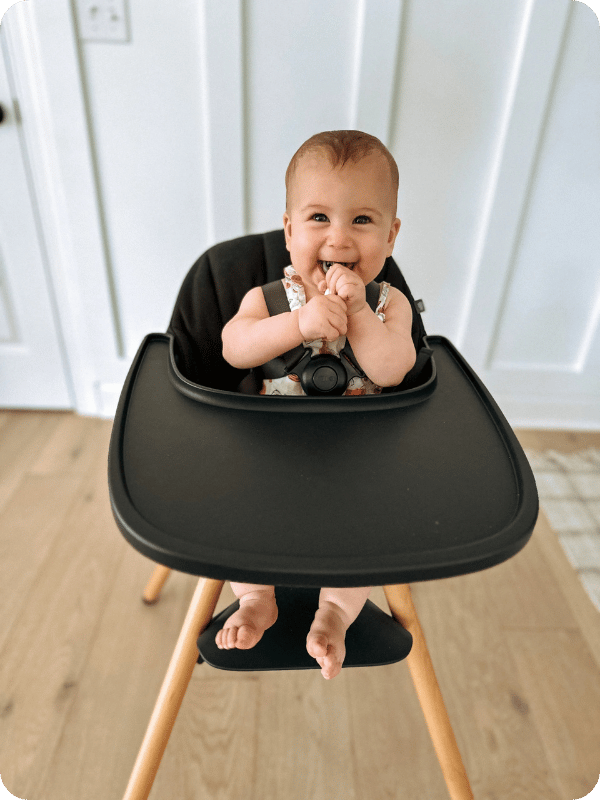
First and most importantly, baby should be able to sit unsupported for a few minutes.
Sitting alone on the floor for a few minutes indicates that they have the head, neck, and trunk strength and control necessary to safely swallow. This also means that they can independently bring items to their mouth because their core is strong enough to sit without support from the hands. Most babies younger than 6 months of age do not have the necessary motor skills for starting solids. Therefore, they are not physiologically ready to swallow anything besides breast milk or formula.
Interestingly, stage 1 foods are often explicitly marketed for babies who can “sit supported.” Unfortunately, just because something is marketed a certain way does not mean that it is the best or most accurate information. And, as long as parents continue to receive advice to start solids at 4 months from healthcare professionals, this outdated advice will continue to spread. Babies who are not yet able to sit on their own are not ready to start solids.
If baby is nearing or past 7 months and is not able to sit unsupported, it may be time to consult with a physical or occupational therapist. You can talk with your child’s pediatrician for a referral, or self-refer to Early Intervention in your state for a free evaluation. You can also schedule a consultation with one of our specialists here.
Active participation
Often, when babies are offered food before they are developmentally ready, they become “passive participants.” This happens when caregivers, meaning well, feed spoonfuls of puree directly to baby before they are able to self-feed. Since they aren’t yet ready to reach for the spoon, hold onto it, or bring it to their mouth, baby cannot actively participate in meals. Instead, they sit and wait for bites to be fed to them instead of practicing feeding themselves.
Additionally, baby should also be showing interest in food, along with bringing teethers and toys to their mouth. These are important readiness signs for starting solids. Development of these gross motor skills means that baby is ready to work on the fine motor skills required during eating.
You can “check and see” where your baby is at with milestones using our Free Milestone Checklist! Get your copy below and join 40,000+ other parents who are supporting their littles through development!
Nutritional need for solids at 6 months
Around 6 months of age, baby’s energy and nutrition needs start to increase. Introducing solid food helps supplement (or complement) what baby gets from breast milk and/or formula. The two main nutrients baby needs more of around this age are iron and zinc. (2)
Most babies will have adequate iron stores until 6 months. (3) For breastfed babies especially, additional iron intake is important at this age. Breast milk has less iron than formula, but the iron in breast milk is better absorbed. (2) Babies who are primarily fed iron-fortified formula may have their iron needs met through formula in the first year.
Regardless, it’s still recommended to focus on offering iron-rich foods, as baby won’t receive iron from formula once they are toddlers. Whether baby is breastfed, formula fed, or a mix of both, at around 6 months they will benefit from additional sources of iron.
Read more about the best sources of iron for babies and toddlers on our blog.
Risks of introducing stage 1 baby food early
Another thing to consider is the maturity of your little one’s digestive system and how well equipped it is to handle food other than breast milk and/or formula. This is an area that many professionals debate and is still being researched.
Research supports that solid foods are not well digested and absorbed prior to 6 months because the digestive enzymes and stomach acid needed for digestion are not yet at full capacity. (4) Additionally, multiple studies have raised concerns that early introduction of solids could be a contributing factor to some allergies and illnesses. (5) Learn more information about introducing allergens to your baby here.
A study done by Johns Hopkins found that “infants who were started on solid foods at or before 3 months of age showed changes in levels of gut bacteria and bacterial byproducts.” (6) This finding was supported by another study, which found that introducing solids drastically alters the gut microbiome regardless of age. (7) This study also found that early introduction of solids was linked to negative long-term health effects, including obesity. (7)
As research continues, it’s important for parents to know that current data supports that starting solids early can negatively impact baby’s digestive system.
What if baby is not gaining weight with breastmilk or formula?
Concerns about baby’s weight or growth curve can be overwhelming. Depending on your baby’s age, their doctor may recommend starting solids early in an effort to supplement calories and promote weight gain. Although this decision should be made in conjunction with your baby’s provider, it may be a good idea to include a specialist (such as a registered dietitian or lactation consultant) to better understand what’s going on and how to best support your baby.
Starting solids early is likely not the best option to help with weight gain, even if your little one is 4 months old or older. Not gaining sufficient weight from breastmilk or formula alone is not a reason to start solids in most cases.
Consider that baby’s stomach capacity is low, and offering pureed foods will likely fill their stomach with lower calorie solids. There are 10–15 calories in a few teaspoons of vegetable puree. Breastmilk and formula contain ~70 calories per 3.3 oz. Babies starting solids don’t eat many bites of food! If baby’s stomach hadn’t been filled with solid food, they could have consumed more breastmilk or formula, which is higher in calories and protein that would help with weight gain.
Often with issues of weight gain, baby just needs to be monitored or supported in drinking more breastmilk or formula. That can be done with support from a feeding specialist or lactation consultant. If your baby is diagnosed with growth faltering or failure to thrive, a pediatric dietitian and lactation consultant are the specialists who will help you fortify your baby’s milk supply.
Stage 1 baby food can wait: Starting early has no real benefits
Starting solid foods early has essentially no benefits and instead only increases the potential for harm. Increased risks of choking, food allergies, possible GI infections, and improperly digested food are well documented. (4, 5, 6, 7)
Does this mean that if you start solids a day or a week before your baby is 6 months they are going to experience all these drawbacks? No, likely not. There is no perfect day or exact age that starting solids is best. It is more of a window of time, with right around 6 months being the goal. Making sure baby displays all of the signs of readiness before starting is important.
More infant feeding resources
If starting solids feels overwhelming or you need more support, we’ve got you covered. Our team of pediatric specialists, including feeding specialists, lactation consultants, and a registered dietitian have teamed up to create our best-selling Starting Solids Handbook and Baby’s First 100 Foods bundle!
With more than 200 pages of research-backed guidance and more than 100 ways to serve foods to your little one, we answered all of your feeding questions!
Sources
- Jennifer M. Zubler, Lisa D. Wiggins, Michelle M. Macias, Toni M. Whitaker, Judith S. Shaw, Jane K. Squires, Julie A. Pajek, Rebecca B. Wolf, Karnesha S. Slaughter, Amber S. Broughton, Krysta L. Gerndt, Bethany J. Mlodoch, Paul H. Lipkin; Evidence-Informed Milestones for Developmental Surveillance Tools. Pediatrics March 2022; 149 (3): e2021052138. 10.1542/peds.2021-052138
- Dewey KG. The challenge of meeting nutrient needs of infants and young children during the period of complementary feeding: an evolutionary perspective. J Nutr. 2013 Dec;143(12):2050-4. doi: 10.3945/jn.113.182527. Epub 2013 Oct 16. PMID: 24132575; PMCID: PMC3827643.
- Ziegler EE, Nelson SE, Jeter JM. Iron stores of breastfed infants during the first year of life. Nutrients. 2014 May 21;6(5):2023-34. doi: 10.3390/nu6052023. PMID: 24853888; PMCID: PMC4042569.
- University of Wisconsin School of Medicine and Public Health. 2013. An Integrative Approach to Feeding Your Baby: Starting Solids and Baby-Led Weaning (Baby-Led Solids).
- Herrera-Quintana, L., Vázquez-Lorente, H., Hinojosa-Nogueira, D., & Plaza-Diaz, J. (2024). Relationship between Infant Feeding and the Microbiome: Implications for Allergies and Food Intolerances. Children, 11(8), 1030. https://doi.org/10.3390/children11081030
- Johns Hopkins Bloomberg School of Public Health. 2025. Infants Introduced Early to Solid Foods Show Gut Bacteria Changes that May Portend Future Health Risks. https://publichealth.jhu.edu/2020/infants-introduced-early-to-solid-foods-show-gut-bacteria-changes-that-may-portend-future-health-risks
- Ding M, Ross RP, Dempsey E, Li B, Stanton C. Infant gut microbiome reprogramming following introduction of solid foods (weaning). Gut Microbes. 2025 Dec 31;17(1):2571428. doi: 10.1080/19490976.2025.2571428. Epub 2025 Nov 9. PMID: 41208251; PMCID: PMC12604632.
OTHER POSTS YOU MAY LIKE:



MS, SLP
Founder of Eat Play Say, Speech-Language Pathologist, Feeding Specialist, Play Expert, Mom of 3
Jordyn Koveleski Gorman
SPECIALIZES IN: Infant and toddler speech-language, play, and feeding development, and curating a team that provides expert help that feels like a reassuring text from that one mom friend
EDUCATION: Jordyn received her BS in Speech-Language Pathology from Bloomsburg University and her MS in Speech-Language Pathology from Towson University
FAVE PARENTING FIRST: “The first true smile, it’s the sweetest!”

MS, CCC-SLP, CBS, IBCLC
Speech-Language Pathologist & Feeding Specialist, Certified Breastfeeding Specialist, International Board Certified Lactation Consultant
Jessica Nicholson Cocca
SPECIALIZES IN: Breast and bottle feeding, tongue ties, oral motor dysfunction, starting solids, infant and toddler speech, treating oral motor disorders
EDUCATION: Jessica received her BS in Communication Sciences and Disorders from Pennsylvania State University in 2015 and her MS in Speech-Language Pathology from Towson University in 2017
FAVE PARENTING FIRST: “Baby’s first wave! What a fun first communication gesture!”

MA, CCC-SLP, CLC
Speech-Language Pathologist, Certified Lactation Counselor
Jennifer McFarlin
SPECIALIZES IN: Breast and bottle feeding, tongue ties, starting solids, infant and toddler speech development
EDUCATION: She received her BS in Speech-Language Pathology from Ball State in 2014 and a MA in Speech-Language Pathology from Ball State in 2016.
FAVE PARENTING FIRST: “My favorite baby’s first is their first true smile that just warms your soul knowing they are smiling at you. My other favorite is their first word. I love watching their language explode!”

MS, CCC-SLP
Bilingual Speech-Language Pathologist
Nicole La Petina Kelly
SPECIALIZES IN: Bilingual development (Spanish-English), supporting multilingual families, infant and toddler speech
EDUCATION: She received her BA in Communication Sciences and Disorders and in Spanish from the University of Wisconsin-Madison in 2014 and her MS in Speech-Language Pathology with an English-Spanish Specialization from Marquette University in 2016.
FAVE PARENTING FIRST: “It’s the first slobbery kisses for me!”

RDN, LD
Licensed Registered Dietitian
Kimberly Vede
SPECIALIZES IN: Infant and pediatric nutrition including breastfeeding, formula feeding, and starting solids. She also specializes in prenatal and postpartum nutrition.
EDUCATION: She received her BSc in Biology in 2014 from Life University, and her BSc in Dietetics from Life University in 2019.
FAVE PARENTING FIRST: ”The first time they say ‘mama!’”


This checklist was created with input from a Speech-Language Pathologist, Occupational Therapist and Physical Therapist and has been downloaded over 20,000 times by parents worldwide. Learn the important milestones to pay attention to, and keep it in your digital back pocket during the baby + toddler years!
Comprehensive Milestone Checklist for gross motor, fine motor, and speech-language milestones for 0-36 months,
DOWNLOAD FOR FREE


