


When Do Babies Start Talking?
October 5, 2026
Jordyn Koveleski Gorman

Last Updated on October 5, 2026 by Jordyn Koveleski Gorman
There are moments when life would be simpler if your little one could tell you exactly what they need or why they’re upset. Waiting for your baby to start talking can feel like an eternity. After all, their little coos and babbles are adorable, but they’re not exactly descriptive.
Rest assured, long before baby’s first words, they are communicating with you! Spoken words may take a while to develop, but every speech-language milestone before is a building block toward a future of words, thoughts, and conversation.
So, when can you expect your infant to become a talker? Let’s talk about all the milestones that lead up to talking, as well as when first words might become short sentences and, eventually, full paragraphs!
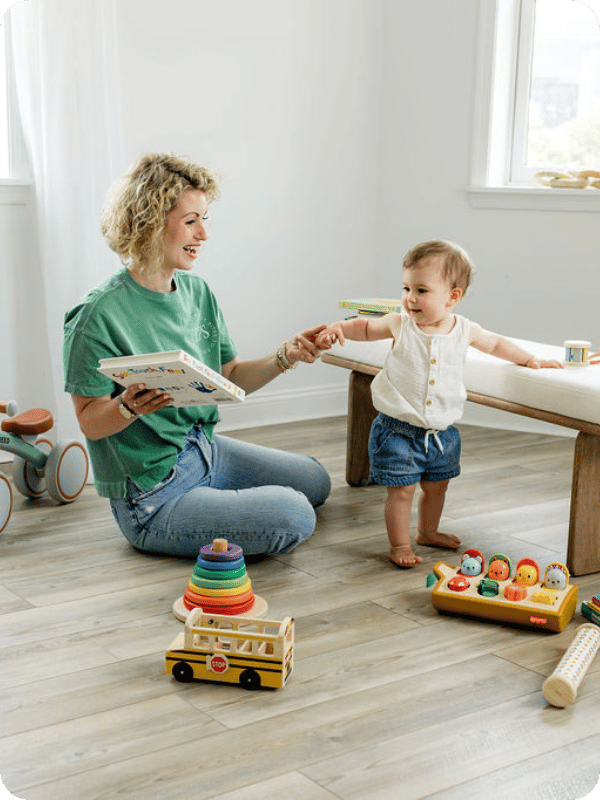
Speech-language milestones for infants and toddlers
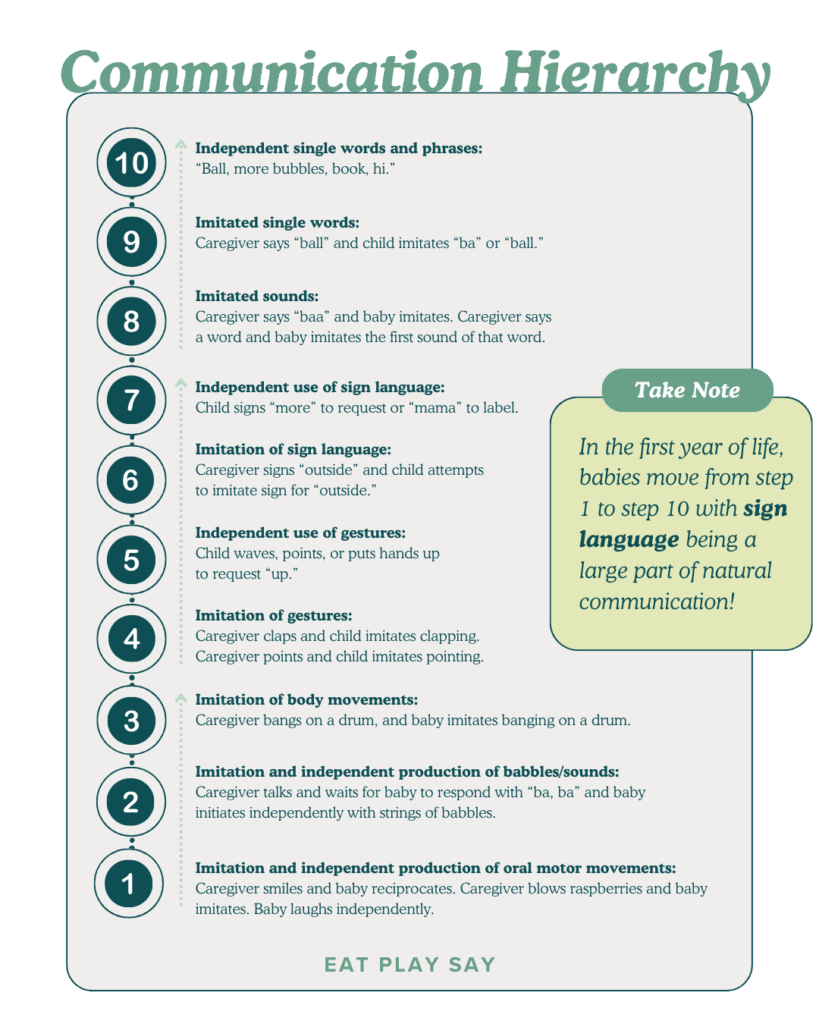
There are several pieces to spoken language that babies and toddlers must “put together” before they can begin talking. Below, the Communication Hierarchy shows how each step leads to further development, with the final piece being baby’s first word!
Remember that, like all developmental milestones, every baby is unique and develops at their own pace. Yes, there are milestones we expect to see emerge around certain timeframes, but for most babies who are hitting their milestones overall, one slightly delayed milestone is not usually a concern. We’ll talk more about concerns with delays further down on this post.
3 month speech-language milestones
These are just a few of the communication milestones we look for from birth to 3 months:
- Smiling purposefully in response to caregiver
- Looking at a caregiver’s face
- Vocalizing and/or cooing in response when spoken to, such as “ga” vowel sounds made in the back of the throat (1)
6 month speech-language milestones
As baby begins noticing more of their environment around 6 months, we look for milestones such as:
- Taking turns vocalizing in “conversation” (e.g., you say, “Hi, baby!” so they make a sound or coo back)
- Turning toward someone talking to them and looks for people talking in the room
- Producing coos, vowel sounds, yells, squeals, and shrieks
- Producing Consonant-Vowel (CV) syllable shapes with /p, b, m/ sounds spontaneously, such as “ba, ma, pa” (1)
9 month speech-language milestones
Some communication milestones we expect to see around 9 months are:
- Producing or imitating reduplicated babbles and oral sounds, such as raspberries (“ba ba ba” and “ma ma ma”)
- Shifting attention between an activity/item and a caregiver to share in that activity (baby looks at you and the train while playing)
- Communicating with vocalizations, eye contact, and some early gestures (1)
12 month speech-language milestones
As baby transitions into toddlerhood, communication milestones we look for around 1 year include:
- Babbling with a variety of consonant and vowel sounds. “ga, ma, ba, da”
- Producing early gestures like waving, clapping, and pointing
- Understanding about 50 words and familiar phrases
- Saying one true word by end of 12 months (1)
18 month speech-language milestones
At 1.5 years old, baby is putting many pieces together to start talking more frequently! Milestones we look for include:
- Saying 10-50 words (2)
- Imitating simple words frequently and learning new words daily/weekly (e.g. ball, mama, dada, up, boo!)
- Pointing to identify common vocabulary including body parts
- Following one-step directions independently, such as, “Go get me a diaper please!” (1)
2 year speech-language milestones
At 2 years, speech skills often skyrocket for littles. We look for milestones such as:
- Following 2-step directions like, “Pick up the diaper and throw it in the trash”
- Imitating and produces two-word phrases, such as “more milk”
- Using 50 or more different words
- Referring to self by name and uses “me, my” pronouns, such as, “Give me,” and “my turn” (2)
3 year speech-language milestones
By the age of 3, most toddlers have developed conversational skills and parents/caregivers should be able to understand them most of the time. Milestones we expect include:
- Asking questions that showcase curiosity, beginning to engage in “why” questioning
- Following a three-step unrelated direction like, “Go put that in the trash, get your coat, and go on the porch”
- Conversing in sentences
- Counting to 3
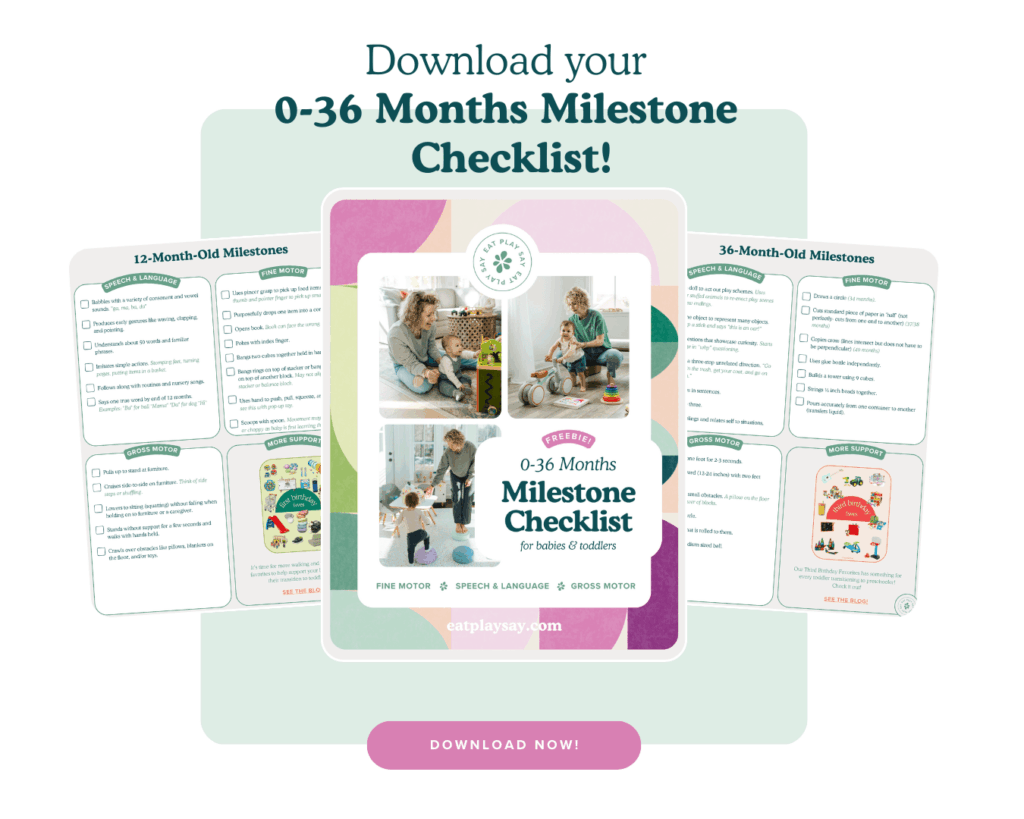
Don’t “wait and see.” Download your FREE Milestone Checklist to “check and see” where your little one is at developmentally from ages 0–3!
When do babies start talking?
As you can see, babies start “talking” without spoken words essentially from birth! If you’re wondering when you can expect your little one to tell you why they’re crying or what they want to eat for snack time, that’s a little more nuanced. When will your little one be able to talk to you to tell you the names of things? Around age 1–1.5! Then, you’ll begin to gather bits and pieces of true, understandable conversation around the time your little one turns 2. For some, that may come a little sooner, and for others, that may come a bit later. Both are okay!
Parents are often encouraged by healthcare professionals to “wait and see” if their little one’s speech seems to be developing slower than expected. As speech-language pathologists, we always encourage getting evaluated if there are concerns. The “check and see” approach ensures that littles get support when they need it, and parents can be reassured that they have advocated for their child in the process.
Although most children whose speech develops slower than expected will ultimately “catch up” later on, that doesn’t mean we shouldn’t offer support early! (3) The earlier that we provide support, the sooner littles can catch up and start hitting their milestones. This is true for speech skills as well as gross and fine motor skills.
Early Intervention evaluations are free in the US, and you can self-refer if you have concerns. Sometimes, wait times can be long. Families sometimes choose to seek out an evaluation with a private practice specialist to avoid waiting. Our team offers virtual consultations in a matter of days!
How can I help baby start talking?
Supporting baby’s developing communication skills doesn’t require expensive toys or flashcards. Instead, you can help your baby learn from day one by implementing a few simple routines in daily life.
- Model imitation. When your little one coos or babbles, repeat it back! Imitation is an important step on the Communication Hierarchy, and modeling imitation by imitating them will help them also learn to imitate you.
- Provide moments of silence. That’s right, you don’t need to fill every moment with talking. Instead, we recommend spending ~50% of your infant’s wake time without speaking. This gives infants the chance to practice new skills, such as squealing or babbling. If they start to “talk,” you should reply! But don’t feel the need to fill every gap with spoken words.
- Use functional words rather than long sentences. Parents are often tempted to either “baby talk” to their little one or, the opposite, to speak in full, complex sentences. Instead, try using language this is simple and functional. If baby needs a diaper change, you can try saying something like, “Stinky diaper, let’s change it! Clean diaper, yay!”
- Introduce sign language early. You can begin to model signs for baby as early as a few weeks of age! Research indicates that sign language is linked to speech-language benefits. Learn more about implementing sign language with your little one here.
- Pause when talking to baby! Perhaps the most important practice you can start from day one, pausing helps give your infant time to process and respond. Learn more about the importance of pausing here.
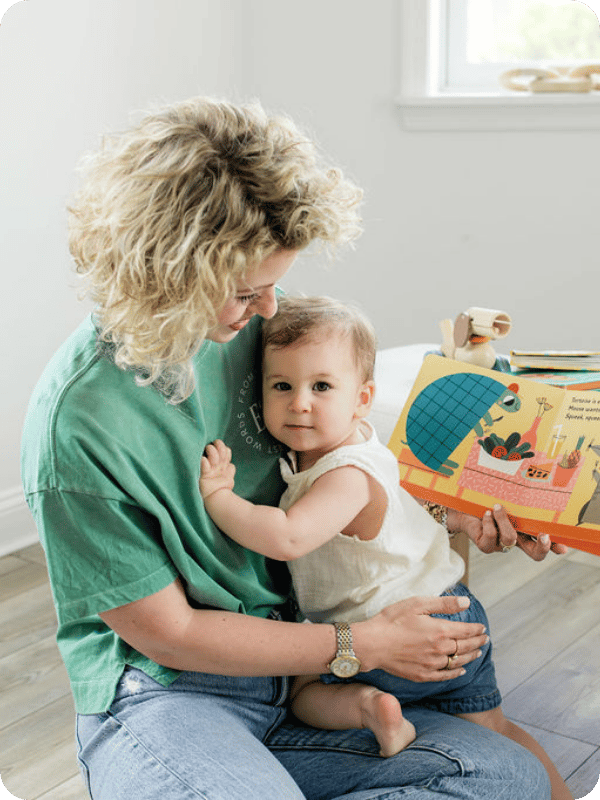
Another great way to help your baby start talking is by reading to them every day. The benefits of daily reading are well documented, not just for littles, but for grown ups, too! Our favorite books for littles can be found here.
More infant development resources
Looking for more support with your little one? We’ve got your back!
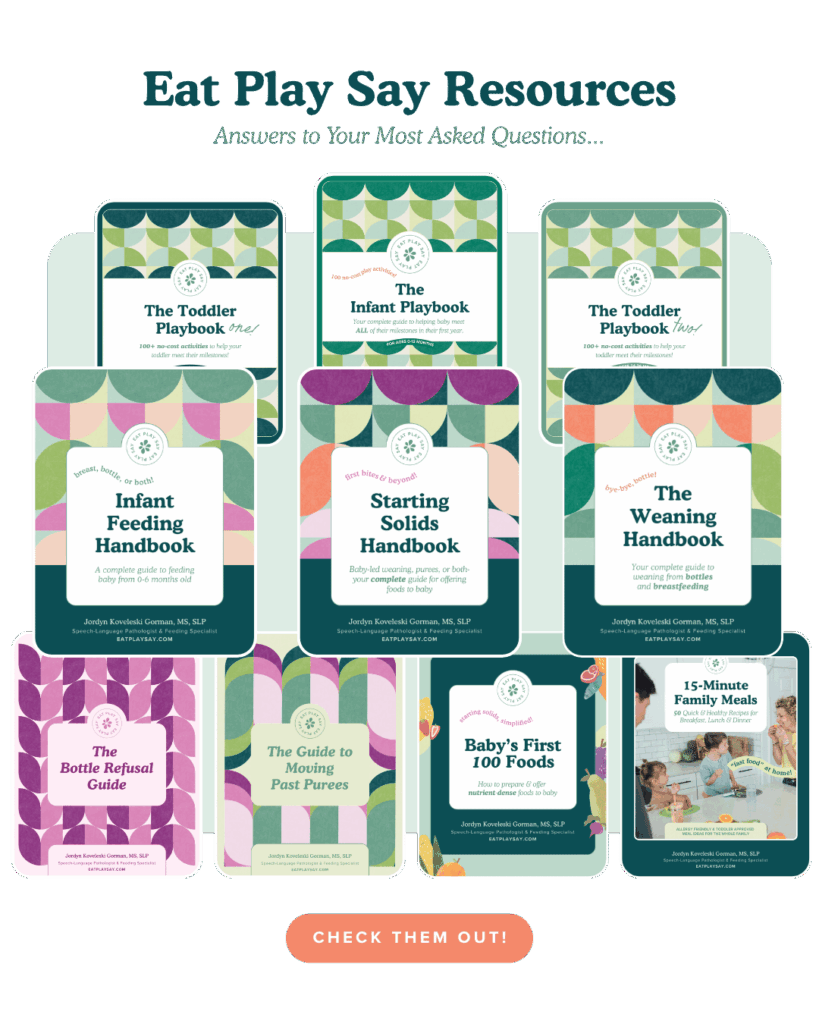
Eat Play Say’s most in-depth resources feature hundreds of pages of expert-written guidance that’s backed by research. From baby’s first bites to play that helps them build skills, we have a Handbook for you!
For more posts like this one, check out our blog:
- Support with starting solids
- Breast and bottle feeding
- Infant & toddler development
- Play activities that support your child’s development
- More speech and language resources
Sources
- Jennifer M. Zubler, Lisa D. Wiggins, Michelle M. Macias, Toni M. Whitaker, Judith S. Shaw, Jane K. Squires, Julie A. Pajek, Rebecca B. Wolf, Karnesha S. Slaughter, Amber S. Broughton, Krysta L. Gerndt, Bethany J. Mlodoch, Paul H. Lipkin; Evidence-Informed Milestones for Developmental Surveillance Tools. Pediatrics March 2022; 149 (3): e2021052138. 10.1542/peds.2021-052138
- Mayo Clinic. Language Development: Speech Milestones for Babies. Published 19 February 2025. Accessed August 2026.
- Fernald A, Marchman VA. Individual differences in lexical processing at 18 months predict vocabulary growth in typically developing and late-talking toddlers. Child Dev. 2012 Jan-Feb;83(1):203-22. doi: 10.1111/j.1467-8624.2011.01692.x. Epub 2011 Dec 16. PMID: 22172209; PMCID: PMC3266972.
Leave a Reply
OTHER POSTS YOU MAY LIKE:


MS, SLP
Founder of Eat Play Say, Speech-Language Pathologist, Feeding Specialist, Play Expert, Mom of 3
Jordyn Koveleski Gorman
SPECIALIZES IN: Infant and toddler speech-language, play, and feeding development, and curating a team that provides expert help that feels like a reassuring text from that one mom friend
EDUCATION: Jordyn received her BS in Speech-Language Pathology from Bloomsburg University and her MS in Speech-Language Pathology from Towson University
FAVE PARENTING FIRST: “The first true smile, it’s the sweetest!”

MS, CCC-SLP, CBS, IBCLC
Speech-Language Pathologist & Feeding Specialist, Certified Breastfeeding Specialist, International Board Certified Lactation Consultant
Jessica Nicholson Cocca
SPECIALIZES IN: Breast and bottle feeding, tongue ties, oral motor dysfunction, starting solids, infant and toddler speech, treating oral motor disorders
EDUCATION: Jessica received her BS in Communication Sciences and Disorders from Pennsylvania State University in 2015 and her MS in Speech-Language Pathology from Towson University in 2017
FAVE PARENTING FIRST: “Baby’s first wave! What a fun first communication gesture!”

MA, CCC-SLP, CLC
Speech-Language Pathologist, Certified Lactation Counselor
Jennifer McFarlin
SPECIALIZES IN: Breast and bottle feeding, tongue ties, starting solids, infant and toddler speech development
EDUCATION: She received her BS in Speech-Language Pathology from Ball State in 2014 and a MA in Speech-Language Pathology from Ball State in 2016.
FAVE PARENTING FIRST: “My favorite baby’s first is their first true smile that just warms your soul knowing they are smiling at you. My other favorite is their first word. I love watching their language explode!”

MS, CCC-SLP
Bilingual Speech-Language Pathologist
Nicole La Petina Kelly
SPECIALIZES IN: Bilingual development (Spanish-English), supporting multilingual families, infant and toddler speech
EDUCATION: She received her BA in Communication Sciences and Disorders and in Spanish from the University of Wisconsin-Madison in 2014 and her MS in Speech-Language Pathology with an English-Spanish Specialization from Marquette University in 2016.
FAVE PARENTING FIRST: “It’s the first slobbery kisses for me!”

RDN, LD
Licensed Registered Dietitian
Kimberly Vede
SPECIALIZES IN: Infant and pediatric nutrition including breastfeeding, formula feeding, and starting solids. She also specializes in prenatal and postpartum nutrition.
EDUCATION: She received her BSc in Biology in 2014 from Life University, and her BSc in Dietetics from Life University in 2019.
FAVE PARENTING FIRST: ”The first time they say ‘mama!’”


This checklist was created with input from a Speech-Language Pathologist, Occupational Therapist and Physical Therapist and has been downloaded over 20,000 times by parents worldwide. Learn the important milestones to pay attention to, and keep it in your digital back pocket during the baby + toddler years!
Comprehensive Milestone Checklist for gross motor, fine motor, and speech-language milestones for 0-36 months,
DOWNLOAD FOR FREE


