


When Do Babies Start Solids?
October 9, 2025
Jordyn Koveleski Gorman

Last Updated on October 11, 2025 by Jordyn Koveleski Gorman
With all the information out there about starting solids, it can feel overwhelming. But, I am here to give you the research-backed information on when to start solids, and how to know if your baby is ready.
The American Academy of Pediatrics (AAP) states that babies are ready to start solids at about 6 months of age (1). This number is not arbitrary, but rather it is due to factors like developmental milestones, gut health, and iron needs.
3 Main Considerations when Starting Solids
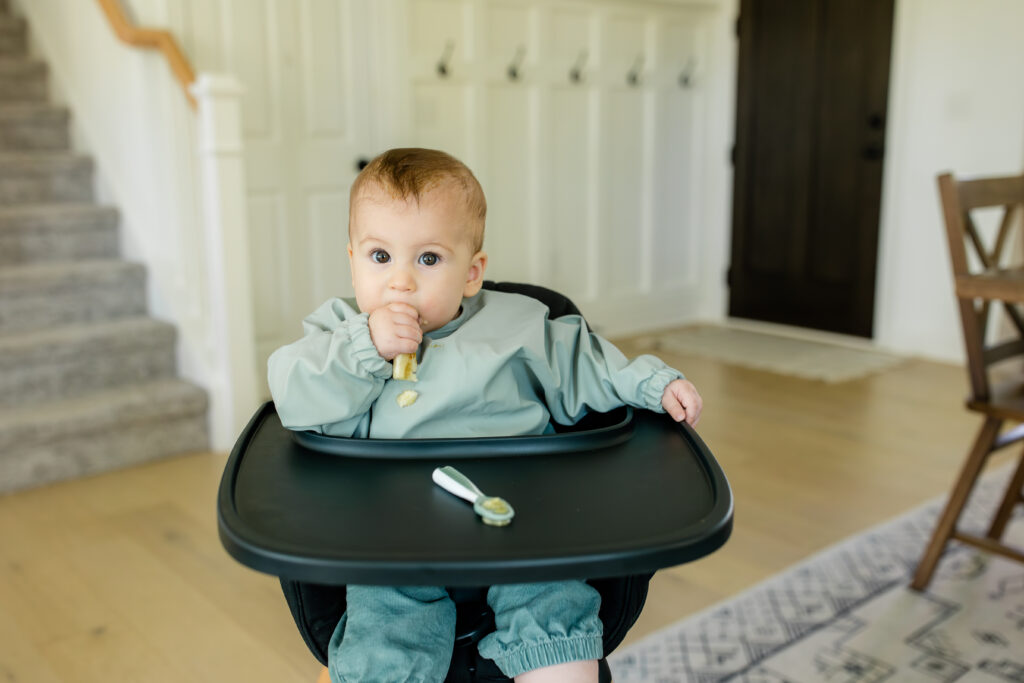
Developmentally, babies are ready to start solids when they can sit up with and without support. When baby can sit up well, they are in a safe position for swallowing. Sitting up well in the high chair also decreases risks for choking. And if a baby can sit up well in the high chair, they can self-feed pieces of food. These are all important markers for starting solids.
Some research supports that starting solids too early, before 6 months of age, puts them at risk for negative health outcomes. There is information to support that babies have an “open gut” before 6 months of age, and exposing them to foods can impact their digestive system long term. (2) Waiting until 6 months of age to start solids can be better for overall gut health.
At 6 months of age, infants’ iron stores begin to deplete. They require iron from additional food sources in order to meet their needs. An infant’s iron needs are higher than that of an adult male, so it’s important to start offering iron-rich foods when starting solids.
Readiness Signs for Starting Solids
Babies are ready to start solids when they have checked the boxes on The First Bites Checklist from our Starting Solids Handbook:
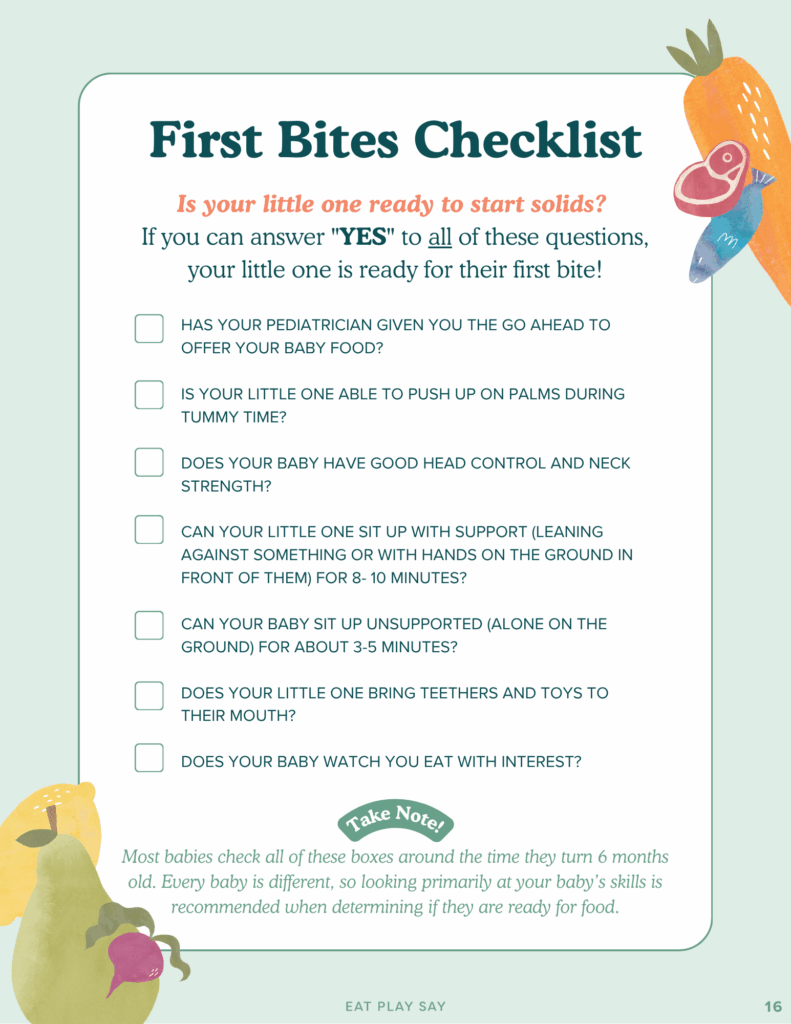
Along with sitting up with and without support, bringing objects to mouth and pushing up on palms in tummy time are important markers for starting solids.
Things like baby showing an interest in food and getting a green light from your pediatrician to start solids are also important. Overall, it is important that your baby checks all of the boxes on the list. For most babies that is around 6 months, give or take a few weeks!
Starting Solids at 4 Months- Yes or No?
Some parents are told by their pediatrician that they can start solids at 4 months of age. But, is that the best recommendation? The AAP states that, “Introduction to solids prior to 4 months is associated with increased weight gain and adiposity, both in infancy and early childhood.” (1)
Nutritionally, babies do not need anything besides breastmilk or formula for the first 6 months of life. (1) While some pediatricians recommend starting solids at 4 months of age, it’s important to remember that current guidelines from the American Academy of Pediatrics do not support that recommendation. If a baby is not gaining weight well, offering supplementary foods early is not the best solution. Parents are encouraged to look into why their babies are not gaining weight well. Consulting with a lactation counselor or feeding specialist is recommended.
There are other potential risks to starting solids early. If baby is not ready from a motor perspective, they could be at an increased risk for choking. If they cannot self-feed, they are more likely to passively participate in meals. At 4 months old, parents are also more likely to start with purees instead of whole foods. While starting with purees is not a bad thing, offering different textures early on is important. And self-feeding while eating is very important for development.
How to Start Solids
Starting solids with baby can be simple, as long as you have the right information! Its best to start by offering any nutritionally-dense food. That can be an avocado, a banana, sweet potato, or even chicken or beef. Previous recommendations were to start with rice cereal. But, that recommendation is no longer research-backed. (1) Rice cereal provides little to no nutritional value and it can increase baby’s risks to heavy metals. So, it’s just not a necessary food to offer.
It’s best to let baby take the lead and self-feed as many bites as possible. You can start with purees or take a baby-led weaning approach. But, it’s best to read baby’s cues when feeding. They don’t have to eat a lot during those first days of starting solids! Remember that food is supplemental to breastmilk and formula. So, while it’s important to offer foods, it’s expected that baby won’t eat that much during those first meals.
For more about when and how to start solids, be sure to check out our best selling resources!
Sources:
- American Academy of Pediatrics. 2023. Infant Food and Feeding. https://www.aap.org/en/patient-care/healthy-active-living-for-families/infant-food-and-feeding/?srsltid=AfmBOorNY9KF7QPTs0LnNNYVCu2mL6cqQ9a0U78xS9S_cqnTIVsrq4Pk
- University of Wisconsin School of Medicine and Public Health. 2013. An Integrative Approach to Feeding Your Baby: Starting Solids and Baby-Led Weaning (Baby-Led Solids). https://eatplaysay.com/wp-content/uploads/2025/01/handout_baby-led_weaning.pdf
Leave a Reply
OTHER POSTS YOU MAY LIKE:


MS, SLP
Founder of Eat Play Say, Speech-Language Pathologist, Feeding Specialist, Play Expert, Mom of 2
Jordyn Koveleski Gorman
SPECIALIZES IN: Infant and toddler speech-language, play, and feeding development, and curating a team that provides expert help that feels like a reassuring text from that one mom friend
EDUCATION: Jordyn received her BS in Speech-Language Pathology from Bloomsburg University and her MS in Speech-Language Pathology from Towson University
FAVE PARENTING FIRST: “The first true smile, it’s the sweetest!”

MS, CCC-SLP, CBS, IBCLC
Speech-Language Pathologist & Feeding Specialist, Certified Breastfeeding Specialist, International Board Certified Lactation Consultant
Jessica Nicholson Cocca
SPECIALIZES IN: Breast and bottle feeding, tongue ties, oral motor dysfunction, starting solids, infant and toddler speech, treating oral motor disorders
EDUCATION: Jessica received her BS in Communication Sciences and Disorders from Pennsylvania State University in 2015 and her MS in Speech-Language Pathology from Towson University in 2017
FAVE PARENTING FIRST: “Baby’s first wave! What a fun first communication gesture!”

MA, CCC-SLP, CLC
Speech-Language Pathologist, Certified Lactation Counselor
Jennifer McFarlin
SPECIALIZES IN: Breast and bottle feeding, tongue ties, starting solids, infant and toddler speech development
EDUCATION: She received her BS in Speech-Language Pathology from Ball State in 2014 and a MA in Speech-Language Pathology from Ball State in 2016.
FAVE PARENTING FIRST: “My favorite baby’s first is their first true smile that just warms your soul knowing they are smiling at you. My other favorite is their first word. I love watching their language explode!”

MS, CCC-SLP
Bilingual Speech-Language Pathologist
Nicole La Petina Kelly
SPECIALIZES IN: Bilingual development (Spanish-English), supporting multilingual families, infant and toddler speech
EDUCATION: She received her BA in Communication Sciences and Disorders and in Spanish from the University of Wisconsin-Madison in 2014 and her MS in Speech-Language Pathology with an English-Spanish Specialization from Marquette University in 2016.
FAVE PARENTING FIRST: “It’s the first slobbery kisses for me!”

RDN, LD
Licensed Registered Dietitian
Kimberly Vede
SPECIALIZES IN: Infant and pediatric nutrition including breastfeeding, formula feeding, and starting solids. She also specializes in prenatal and postpartum nutrition.
EDUCATION: She received her BSc in Biology in 2014 from Life University, and her BSc in Dietetics from Life University in 2019.
FAVE PARENTING FIRST: ”The first time they say ‘mama!’”


This checklist was created with input from a Speech-Language Pathologist, Occupational Therapist and Physical Therapist and has been downloaded over 20,000 times by parents worldwide. Learn the important milestones to pay attention to, and keep it in your digital back pocket during the baby + toddler years!
Comprehensive Milestone Checklist for gross motor, fine motor, and speech-language milestones for 0-36 months,
DOWNLOAD FOR FREE


