


Baby Feeding Schedule by Age
June 21, 2024
Jordyn Koveleski Gorman

Last Updated on March 30, 2026 by Jordyn Koveleski Gorman
Feeding your baby might seem like something that should just come naturally, but let me tell you: it’s hard work! Landing on a baby feeding schedule is hard because the second you get comfortable and used to the plan, it’s going to change again.
As feeding specialists and lactation counselors, our team has become familiar with common parent questions like, “How much and how often should I feed my baby?” As professionals, we know the typical guidelines of how many ounces a baby should be eating like the back of our hands.
However, as a mom to both a formula fed baby and a breastfed baby, I understand how stressful it can be in reality. As it turns out, there isn’t a magical instinct that tells a mom when their baby’s had enough to eat. Figuring out if they’re eating enough and how much to offer can be draining.
Let’s make it a little simpler and break it down together. We’ll review the guidelines, differences between formula and exclusively breastmilk feeding, and what changes happen when baby starts eating solids.

Baby feeding schedule
First of all, every baby is different. The only child your baby should be compared to is themselves. If you heard that a friend’s baby consumes double the amount of milk than your baby does, what does that mean? It means nothing! They simply cannot be compared effectively. There is always a range of normal.
It’s important to remember that feeding journeys are unique to each child. Some babies are able to take in larger amounts at one time and extend time between feeds, while other babies rely on more frequent, smaller feeds. Both are normal!
If you have concerns about your little one’s feeding journey based on signs, symptoms, or struggles that you are noticing, be sure to speak with your pediatrician or a feeding specialist.
Feeding schedule for formula fed babies
Formula feeding is more black and white than breastmilk feeding. The volume of bottles and frequency of offering feeds is linear. This just means that as your baby grows, so does the amount in their bottles!
Simply put, in order to increase the calories your growing baby needs, you will need to offer more formula. Your baby may be content to accept bottles with a consistent amount of milk for a period of time. However, you may notice that over time they seem hungry sooner. Or, they may get frustrated when their bottle is empty. When baby shows signs like these, it might be time to increase the ounces in their bottle!
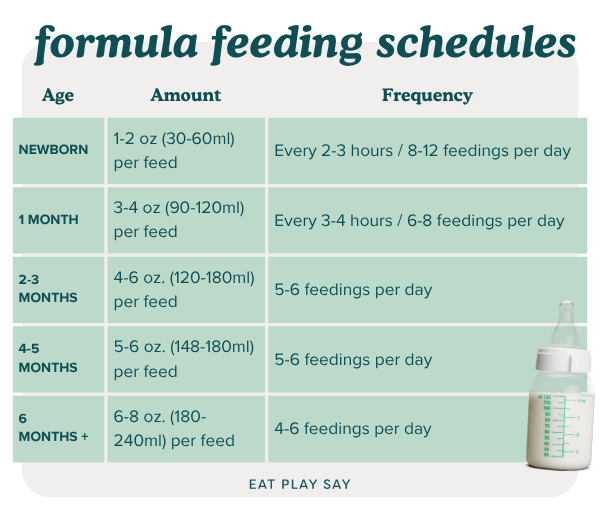
Note that all the information below is based on averages. On average, a baby should consume 2.5oz of formula per 24 hours for every pound they weigh. We included a handy formula feeding graphic below you can screenshot for reference!
Note: below are general amounts for babies who are formula fed. Breastfeeding guidelines are further below!
Newborn feeding schedule
If you are a new mom seeing feeding schedules for the first time, remember that the first few weeks of your baby’s life may not have a true feeding schedule. This is normal! Your little one is trying to adjust to being in a brand new world. They are figuring out what works best for them! Together, you and your little one will find a routine. In the first few weeks of life, it’s especially important to understand your baby’s hunger cues.
Newborns receiving formula in the first few weeks of life will generally take in 1–2oz (30-60ml) per feed every 2–3 hours. In total, your newborn will have 8–12 feeds per day.
1 month feeding schedule
Fortunately, with formula fed babies, you should start to notice a more predictable schedule around the one month mark. Typically, your baby will start wanting a bottle every 3-4 hours.
Generally, a feeding schedule for a formula fed one month old will be 3–4oz (90–120ml) per feed every 3–4 hours. Formula fed babies generally take 6–8 bottles a day at this age.
2 and 3 month feeding schedule
From two to three months of age, there is usually only a small increase in formula intake. Babies may take 4–6 ounces per feed, 5–6 times per day. It is common in this age range for little ones to drop one to two feedings and for a more consistent routine to be noticeable.
4 to 5 month feeding schedule
From four to five months, babies tend to take in 5–6oz of formula at each feeding. They may drop a feed around this age, for 5–6 feeds per day. Baby is also likely starting to show signs of readiness for starting solids in this timeframe. It’s best to wait until they display all signs of readiness, including sitting unassisted, before jumping into solids!
6 month feeding schedule
By 6 months old, most babies are ready to start solids, and that leads to a lot of questions about milk intake! At this age, though, there isn’t much change to the amount of formula baby needs. Feeds are generally about 6–8oz per bottle, every 4-5 hours.
Keep reading for more guidance on introducing solids to your baby’s feeding schedule!
7 to 9 month feeding schedule
There is still minimal change to feeding habits at this stage, even as solid intake gets a little more consistent. Formula fed babies often take 6–8oz bottles 4–6 times per day from seven to nine months old.
9 to 12 month feeding schedule
From 9 to 12 months, you may start seeing a decrease in the amount of formula your baby consumes. At this age, babies drink anywhere from 4–8oz bottles four to five times a day.
Oftentimes, daytime bottles will become smaller, from 4–6oz, while bottles offered before bed may remain closer to 6–8oz. Variation is expected here!
Feeding schedule for breastfed babies
Breastmilk feeding can be a bit less black and white. Providing specific schedules and ounces to give a breastmilk-fed baby is not as simple. Not only that, it might not work at all for your family! And that’s okay.
Breastmilk fed babies typically do smaller, more frequent feedings. A difference between formula and breastmilk is that breastmilk changes over time. The nutrients and calories in breastmilk become more concentrated over time. (1) As a result, they are able to take in smaller amounts during feeds!
Instead of thinking about how many ounces per bottle should my baby be getting, think of how many ounces they should be getting in a 24 hour period. This takes a little pressure off the expectation!

Breastfed baby feeding schedule: Week 1
In the first week of life, a breastfed baby may seem like they are constantly attached to their mother. This is actually great, but yes it can be hard! Bringing baby to the breast often is what signals the breasts to make more milk. (2) If mom is exclusively pumping, then it’s important to pump whenever baby has a feed to establish supply, and also signal the body to make more milk.
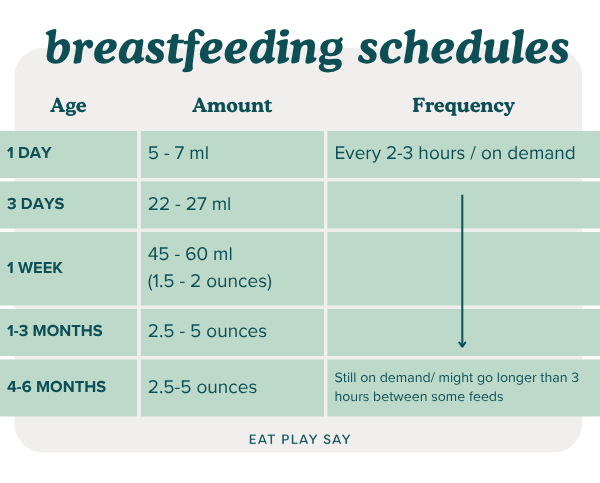
On the first day out of the womb, breastfed babies will take in an average of 5–7ml every 2–3 hours, or more frequently based on demand. By day 3, they will take in as much as 22–27ml at every feed, which will still be every 2–3 hours and/or on demand. (3)
By 1 week of age, your little one will take as much as 45–60ml in breastmilk (1.5–2oz) at every feed. This will still be every 2–3 hours based on demand. During the first three months of life, especially during the first few weeks, it may seem like your baby constantly wants to eat. Phew, it is exhausting, but totally normal!
Breastfed baby feeding schedule: Months 1–6
From months 1–6 of life, your baby will consume anywhere from 2.5–5oz of breastmilk at every feeding. Feeding on demand is a phrase that will soon be second nature. Some babies will feed less frequently than others, but in general, most breastfed babies will nurse or feed more frequently than formula fed babies.
If your baby is exclusively nursing, which means no pumping or bottles, then you obviously won’t know the exact amounts they consume. That can feel stressful! Watching your baby’s fullness cues and seeing how they grow is a great way to know that they are taking in enough milk.
Breastfed baby feeding schedule: Months 6–12
Although baby is starting to eat solid foods at this age, milk is still their primary source of nutrition. From 6–12 months, babies continue consuming 2.5–5oz of breastmilk per feed. Remember that breastmilk changes as your baby grows. Just because they’re older doesn’t mean that they need more breastmilk!
Feeding schedule for babies receiving pumped breastmilk
If offering pumped milk, you may notice around 3–4 months of age that your baby’s intake levels out. They may start to take the same amount of ounces until they are weaned from breastmilk.
Some babies take 2–3 oz with more frequent feedings and others may take 4–5 oz with feeds more spaced out. Either way is totally okay!
It’s important to note that if you’re pumping, you’ll be able to see more clearly how many ounces your little one is taking. If you’re exclusively nursing or doing a combination of pumping and nursing, you won’t know exactly how much baby takes.
That “unknown” can feel a little overwhelming, but that’s where trusting your baby’s cues and your intuition comes into play! Look at baby’s growth and behavior and trust that you know best. Baby will communicate what they need, and you will answer – you got this!
Feeding schedule for combination feeding
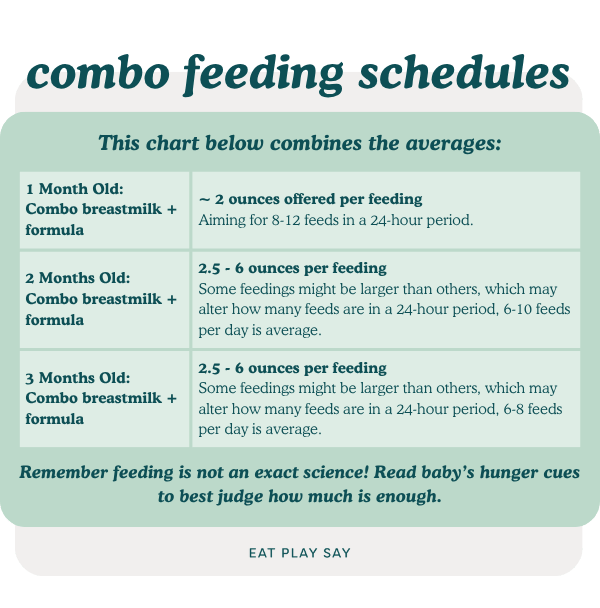
Exact feeding volumes for combo feeders are hard to narrow in on. Every journey is different!
Babies exclusively receiving formula tend to take in more on a daily basis than exclusively breastfed babies. When it comes to combo feeding, the average volume of daily milk will likely fall somewhere in between. Check out the chart below for guidance on combo feeding amounts.
If you need help introducing the bottle to your baby, check out this blog.
Feeding schedule for starting solids
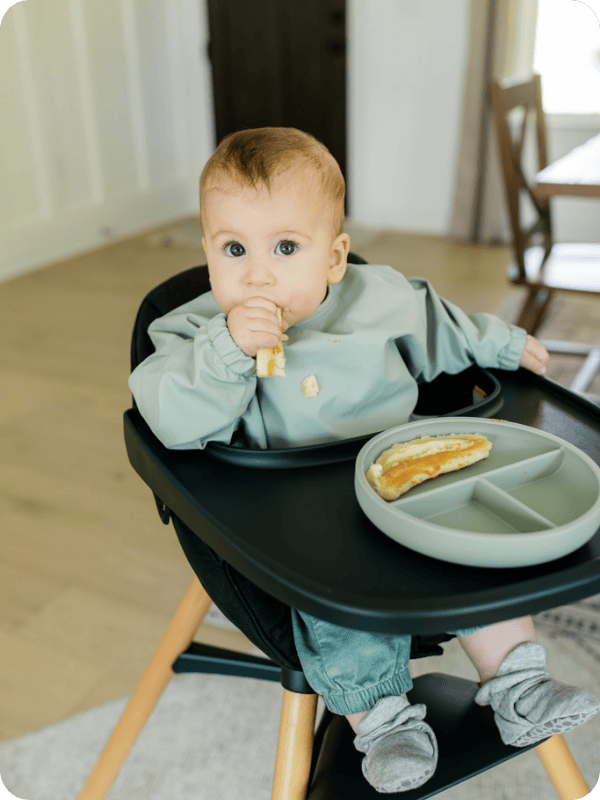
When your little one starts eating solid food, remember that formula or breastmilk remains your baby’s primary source of nutrition. Solid food is complementary to formula or breastmilk until baby is about a year old.
The purpose of starting solids is learning how to eat, not necessarily increasing calories just yet.
During the first few months of solids, offer formula or breastmilk first—before offering solids. You don’t want your little one to be hangry while sitting in the highchair trying to eat a new food!
Baby feeding schedule for starting solids: 6-9 months
- It’s recommended to offer 1-2 meals around baby’s bottle feedings and nursing sessions.
- Bottle feeds and nursing sessions take priority. You will likely not see any decrease in ounces consumed or changes in nursing sessions during this stage.
- Baby can begin trying sips of water at mealtimes, but their intake should not exceed 4–8 ounces per day until 1 year of age. (4)
Baby feeding schedule for starting solids: 9-11 months
- It’s recommended to increase to 2-3 meals, still working around baby’s bottles and nursing sessions.
- You may start to see a small dip in ounces fed via bottle, or shorter nursing sessions. It is also normal if you do not see that decrease yet.
- No need for snacks right now, but you can start to think about what snacks may look like. They are coming soon!
Baby feeding schedule for starting solids: 12+ months
- Here’s the start of the switch! It’s recommended to offer 3 meals plus 1-2 snacks. (Check out the Free Healthy Snacks Guide!)
- Continue offering new foods your little one tolerates, and prioritize offering food first as you can.
- Moving to offering bottles and nursing sessions around food as the priority is the new goal. This all depends on how much formula or breastmilk they are still consuming. The transition is usually very slow.
- Water becomes more important with little ones drinking at least 8 ounces of water per day along with a nutrient dense drink such as cow’s milk.
Toddlers can continue to drink breastmilk for as long as they’d like. If baby was formula fed, it’s recommended to wean to a nutrient-dense drink after 1 year of age and offer water.
Feeding on demand
Once your baby becomes more confident and consumes more solid foods, you may start to notice a dip in consumption of formula or breastmilk. This typically happens as babies get closer to 12 months of age, but, of course, there is a range of normal.
You may notice your baby starts to gradually wean themselves from formula or breastmilk without you even trying.
No matter if your baby is formula fed or breastmilk fed, always remember to follow your baby’s cues. This is true no matter their age.
If you offer a 6oz bottle of formula to your baby and they only drink five ounces, but are happy and content, call that a win! Or, if your breastmilk fed baby ate a 2oz bottle 30 minutes ago, but is fussing and acting hungry, offer another ounce!
Don’t worry so much about the clock. Focus on their cues.
It’s important to share general feeding schedules as a guideline, but the best recommendation to follow is your baby!
More feeding support
No matter where you are at on your feeding journey with your baby (or toddler), we have resources built for you.
Learn more from our blog by searching the Breast & Bottle category, or Starting Solids! Questions about Development or Speech & Language? We’ve got those too.
For more in-depth resources, check our collection of Handbooks. Our Handbooks are written by child development specialists, covering topics from feeding and development to play!
Sources
- Czosnykowska-Łukacka M, Królak-Olejnik B, Orczyk-Pawiłowicz M. Breast Milk Macronutrient Components in Prolonged Lactation. Nutrients. 2018 Dec 3;10(12):1893. doi: 10.3390/nu10121893. PMID: 30513944; PMCID: PMC6316538.
- Kent J, Prime D, Garbin C. Principles for Maintaining or Increasing Breast Milk Production. Journal of Obstetric, Gynecologic & Neonatal Nursing, 41, 114-121.
- https://my.clevelandclinic.org/health/articles/9693-feeding-your-baby-the-first-year
- Lott M, Callahan E, Welker Duffy E, Story M, Daniels S. Healthy Beverage Consumption in Early Childhood: Recommendations from Key National Health and Nutrition Organizations. Consensus Statement. Durham, NC: Healthy Eating Research, 2019. Available at http://healthyeatingresearch.org.
OTHER POSTS YOU MAY LIKE:




MS, SLP
Founder of Eat Play Say, Speech-Language Pathologist, Feeding Specialist, Play Expert, Mom of 2
Jordyn Koveleski Gorman
SPECIALIZES IN: Infant and toddler speech-language, play, and feeding development, and curating a team that provides expert help that feels like a reassuring text from that one mom friend
EDUCATION: Jordyn received her BS in Speech-Language Pathology from Bloomsburg University and her MS in Speech-Language Pathology from Towson University
FAVE PARENTING FIRST: “The first true smile, it’s the sweetest!”

MS, CCC-SLP, CBS, IBCLC
Speech-Language Pathologist & Feeding Specialist, Certified Breastfeeding Specialist, International Board Certified Lactation Consultant
Jessica Nicholson Cocca
SPECIALIZES IN: Breast and bottle feeding, tongue ties, oral motor dysfunction, starting solids, infant and toddler speech, treating oral motor disorders
EDUCATION: Jessica received her BS in Communication Sciences and Disorders from Pennsylvania State University in 2015 and her MS in Speech-Language Pathology from Towson University in 2017
FAVE PARENTING FIRST: “Baby’s first wave! What a fun first communication gesture!”

MA, CCC-SLP, CLC
Speech-Language Pathologist, Certified Lactation Counselor
Jennifer McFarlin
SPECIALIZES IN: Breast and bottle feeding, tongue ties, starting solids, infant and toddler speech development
EDUCATION: She received her BS in Speech-Language Pathology from Ball State in 2014 and a MA in Speech-Language Pathology from Ball State in 2016.
FAVE PARENTING FIRST: “My favorite baby’s first is their first true smile that just warms your soul knowing they are smiling at you. My other favorite is their first word. I love watching their language explode!”

MS, CCC-SLP
Bilingual Speech-Language Pathologist
Nicole La Petina Kelly
SPECIALIZES IN: Bilingual development (Spanish-English), supporting multilingual families, infant and toddler speech
EDUCATION: She received her BA in Communication Sciences and Disorders and in Spanish from the University of Wisconsin-Madison in 2014 and her MS in Speech-Language Pathology with an English-Spanish Specialization from Marquette University in 2016.
FAVE PARENTING FIRST: “It’s the first slobbery kisses for me!”

RDN, LD
Licensed Registered Dietitian
Kimberly Vede
SPECIALIZES IN: Infant and pediatric nutrition including breastfeeding, formula feeding, and starting solids. She also specializes in prenatal and postpartum nutrition.
EDUCATION: She received her BSc in Biology in 2014 from Life University, and her BSc in Dietetics from Life University in 2019.
FAVE PARENTING FIRST: ”The first time they say ‘mama!’”


This checklist was created with input from a Speech-Language Pathologist, Occupational Therapist and Physical Therapist and has been downloaded over 20,000 times by parents worldwide. Learn the important milestones to pay attention to, and keep it in your digital back pocket during the baby + toddler years!
Comprehensive Milestone Checklist for gross motor, fine motor, and speech-language milestones for 0-36 months,
DOWNLOAD FOR FREE


