


Raising Bilingual Children: What Does Bilingualism Mean?
August 1, 2024
Jordyn Koveleski Gorman

Last Updated on August 21, 2026 by Jordyn Koveleski Gorman
This page contains affiliate links. We will receive a commission on qualifying purchases using these links.
Parents in bilingual homes often wonder what language they should use when speaking to or around their child. Should one parent speak one language while the other speaks the second language? And what does being bilingual really mean for a baby who can’t talk yet, anyway?
In addition to these unanswered questions, parents often receive incorrect information about bilingualism from medical professionals. Making a clear plan for raising bilingual children can feel overwhelming.
Luckily, bilingual speech-language pathologists are specialists in the area of bilingual language development, and their expertise can help guide parents toward informed and empowered decisions about introducing multiple languages to their little one! Our team at Eat Play Say includes a bilingual SLP. Let’s talk about what it means to be bilingual, the benefits, and the research behind bilingualism and children!
What does bilingual mean?
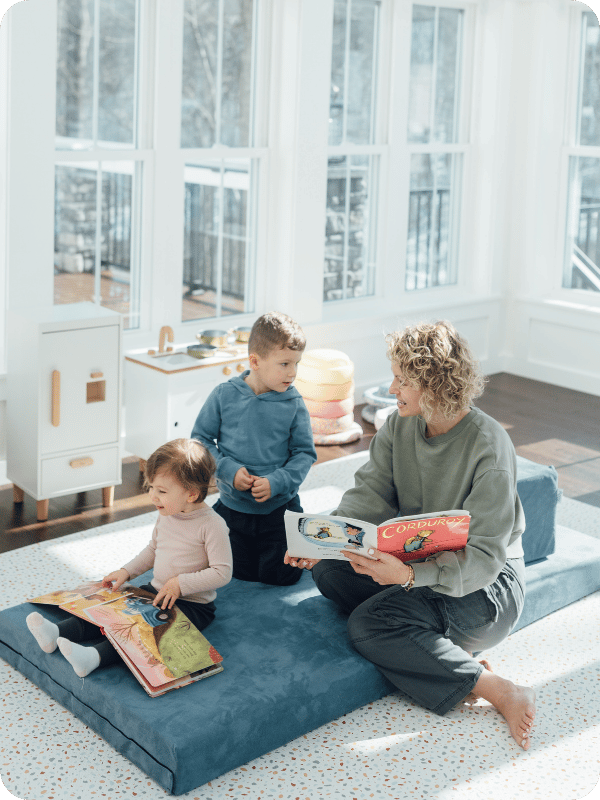
Being bilingual means having the ability to use two languages, whether through reading, writing, and/or speaking. When it comes to infants, becoming bilingual involves repeated exposure to spoken and written language (such as through looking at books). For many families, choosing to raise bilingual children can come with cultural challenges.
Parents may find themselves being pressured by community members or healthcare professionals to stick to one language. However, the effects of taking away a shared language can be detrimental to the child’s place within the family and the community.
Culture represents a way of life. It includes the arts (e.g. music, literature, dance), belief systems (e.g. religion), values, food and drink, and so much more. Culture allows us to develop an understanding of the lives and motivations of the people around us, and helps us connect to others through shared interests, priorities, and world views.
Just like language, culture is learned over time rather than inherited genetically. Because of this, there has to be a means for sharing culture. That’s where language comes in! We show culture when we greet others, participate in prayers, sing songs, and tell nursery rhymes. Language can open doors of communication, or it can keep communication closed between communities and generations.
When a child exists in a family structure of multiple cultures, especially those where two or more languages are spoken, having access to communicate with other members of the community can make all the difference in the world.
Research indicates that children who do not speak the same language as their cultural group begin to lose pride for their heritage. (1) In addition to this, studies have found that children who are immersed in the culture involving a language may learn the language more easily and fully! (2)
How do babies learn language?
So you’ve decided to teach baby two (or more!) languages. But how? It can feel like a difficult task to help your baby learn their first word in one language, let alone two! Parents don’t need to panic. Bilingualism comes more naturally to littles than you may think!
First of all, the neurological development of language is something that has been studied for years, and is largely still a mystery. Although researchers have made a great deal of progress in understanding elements of language learning, there is still a great deal that hasn’t been explained by research or even been able to be reproduced by the most complex computer programming. (3)
For instance, studies on brain development in infants have found that in the first 6 months of life, babies’ brains are tuned into almost all languages at once! (4) This means in an environment where multiple languages are being spoken, a young baby will be aware of each language. When raising a bilingual child, young infancy is the best time to begin exposure to both language systems.
Social interactions are vital to learning language and speech. Interacting with other people, rather than watching videos or television, allows infants to learn language more easily. (5) Additionally, research has found that the way others respond to an infant plays a major role in speech-language development, with studies indicating that interactions with baby’s mother are particularly influential. (3, 5)
Incorporating simple language activities into daily life at home can help babies learn multiple languages at once. You can find our favorite bilingual activities for little ones on our blog!
Bilingual language learning & delays in children
Bilingual children are expected to meet their language milestones within the same timeframe as children learning one language. Yes, your baby who is learning two (or more) languages is expected to babble, say their first words, and put words together to make sentences at the same time as children learning one language. (6)
While the language they use first may depend on how often they are exposed to each language and/or who they are communicating with, milestone checklists apply to bilingual babies, too! In fact, words said in both languages count as two words! If your baby says “wawa” for water in English, but “agua” for water in Spanish, that counts as two words.
A common concern for bilingual parents is that simultaneously learning two languages from birth will confuse their baby. Parents, teachers, or even pediatricians, may mistake a bilingual child using two languages within the same sentence (i.e. “I see a perro”) as confusion. However, using two languages in a single sentence or conversation is a normal aspect of bilingual development. (7)
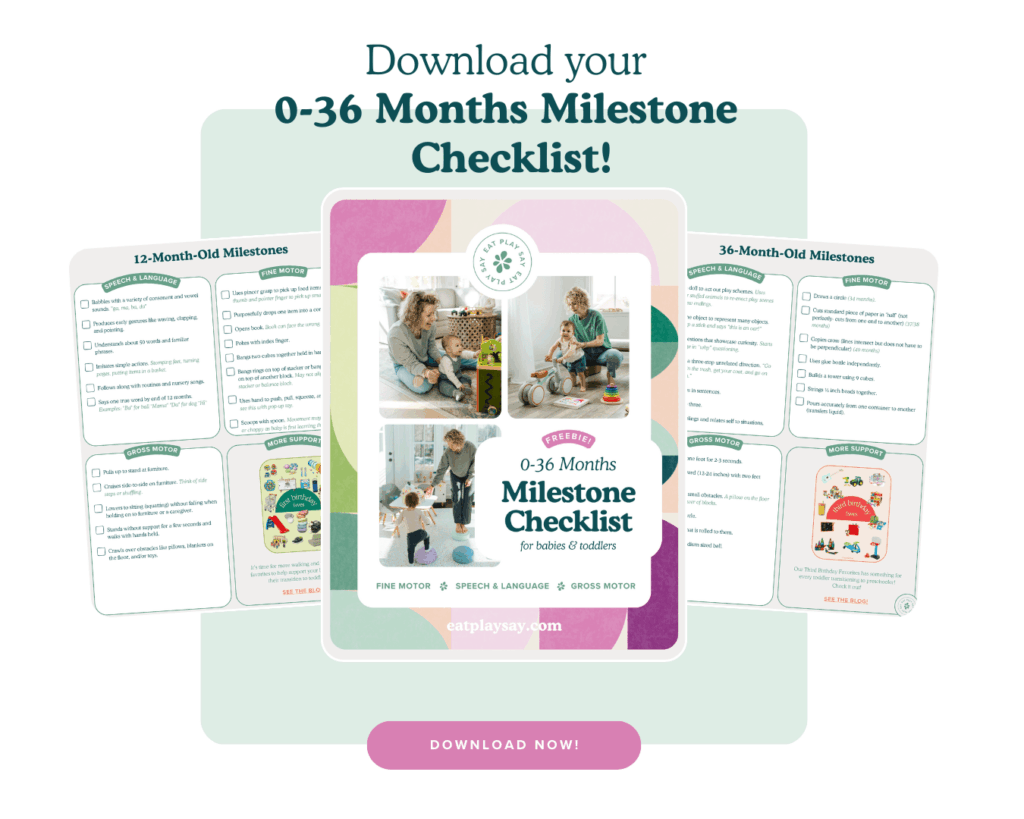
Join 40,000+ other parents to “check and see” where baby is developmentally. Download your FREE Milestone Checklist for 0–36 months!
Bilingual language delays
While there are differences to bilingual language development, these differences do not cause language delays. Bilingual children are not at a higher risk for communication delays. (6) If a child has a language delay, it will be present in all languages in which they speak and not just one, and is not caused by being exposed to multiple languages.
In fact, given the opportunity to use all the languages they speak, a typically developing bilingual child has equal to or greater vocabulary size than their peers who speak only one language. (8)
This vocabulary development also applies to reading skills. The skills that prepare children for reading, such as learning letters and knowing how to handle a book, and reading itself transfer across languages. (9) Even if your child reads more often in one language, they can apply these skills to reading in a second language.
All in all, speaking in two languages won’t delay your child, but it may change the way their brain is structured, in a good way!
Bilingual brain development and lifelong fluency
Exposure to multiple languages has been shown to impact how the brain works.
One example of this is executive functioning. This is a set of cognitive skills that help people manage everyday tasks, including how people plan, manage and prioritize their time. Executive functioning skills are important for school readiness and achievement, as they help us follow directions and solve problems. For bilingual speakers, performance in these tasks may be better than their monolingual classmates because their brain has changed, grown, and adapted to learning multiple languages. (10)
Across their lifetime, having the ability to speak two languages will also allow your child to interact with people from multiple cultures, including their own family members.
Maybe they will learn songs/games from grandparents born in a different country, or engage in play with children of a different linguistic background at the park. Because of this, they may have an easier time relating to others’ perspectives; research even supports this, finding that bilingual people are more empathetic than people who only speak one language. (11)
Plus, being exposed to a language from a variety of different speakers may support their language development even more than the number of hours they are exposed to a given language. (12) Put simply, communicating with grandparents over dinner in a second language may advance your little one’s bilingual language skills more than speaking only to a parent in that same language for hours on end!
Resources for bilingual children
If you want your child to continue to speak the native language as they grow older, encouraging use of the second language across all aspects of daily life is crucial.
So invite grandma and grandpa over, and sing those traditional songs without hesitation! Trust in your bilingual language learner, but as always, seek advice from a bilingual speech-language pathologist if you have concerns. Your little one is lucky to have this skill!
You can find more resources for bilingual children on our blog, including:
- Activities for bilingual language learning
- Our favorite books for Spanish/English bilingual learning
For more parenting support, check out our Handbooks! Whether you need help starting solids or finding developmentally-appropriate ways to play with your infant or toddler, our team of pediatric specialists has you covered!
Sources
- Tong, H. K., & Cheung, L. H. (2011). Cultural identity and language: a proposed framework for cultural globalisation and glocalisation. Journal of Multilingual and Multicultural Development, 32(1), 55–69. https://doi.org/10.1080/01434632.2010.527344
- Fidz, H. Linguistics across Cultures: The Impact of Culture on Second Language Learning. November 2006.
- Wu, Z., & Gros-Louis, J. (2014). Infants’ prelinguistic communicative acts and maternal responses: Relations to linguistic development. First Language, 34(1), 72-90.
- Tierney AL, Nelson CA 3rd. Brain Development and the Role of Experience in the Early Years. Zero Three. 2009 Nov 1;30(2):9-13. PMID: 23894221; PMCID: PMC3722610.
- Kuhl, P. Early language acquisition: cracking the speech code. Nat Rev Neurosci 5, 831–843 (2004). https://doi.org/10.1038/nrn1533
- Genesee, Fred. (2015). Myths About Early Childhood Bilingualism. Canadian Psychology / Psychologie canadienne. 56. 6-15. 10.1037/a0038599.
- Nicoladis, E., & Genesee, F. (1997). Language development in preschool bilingual children. Journal of Speech-Language Pathology and Audiology, 21(4), 258–270.
- Allman, Bohdana. (2005). Vocabulary Size and Accuracy of Monolingual and Bilingual Preschool Children. 58-77.
- Shoghiro, R. Acquisition of Literacy in Bilingual Children.
- Barac R, Bialystok E, Castro DC, Sanchez M. The Cognitive Development of Young Dual Language Learners: A Critical Review. Early Child Res Q. 2014;29(4):699-714. doi: 10.1016/j.ecresq.2014.02.003. PMID: 25284958; PMCID: PMC4180217.
- Chen, Muzi & Fang, Yuqi. (2022). The Relationship between Bilingual and Empathy. 10.2991/assehr.k.220504.423.
- Hoff E, Core C. Input and language development in bilingually developing children. Semin Speech Lang. 2013 Nov;34(4):215-26. doi: 10.1055/s-0033-1353448. Epub 2013 Dec 2. PMID: 24297614; PMCID: PMC4457512.
OTHER POSTS YOU MAY LIKE:



MS, SLP
Founder of Eat Play Say, Speech-Language Pathologist, Feeding Specialist, Play Expert, Mom of 3
Jordyn Koveleski Gorman
SPECIALIZES IN: Infant and toddler speech-language, play, and feeding development, and curating a team that provides expert help that feels like a reassuring text from that one mom friend
EDUCATION: Jordyn received her BS in Speech-Language Pathology from Bloomsburg University and her MS in Speech-Language Pathology from Towson University
FAVE PARENTING FIRST: “The first true smile, it’s the sweetest!”

MS, CCC-SLP, CBS, IBCLC
Speech-Language Pathologist & Feeding Specialist, Certified Breastfeeding Specialist, International Board Certified Lactation Consultant
Jessica Nicholson Cocca
SPECIALIZES IN: Breast and bottle feeding, tongue ties, oral motor dysfunction, starting solids, infant and toddler speech, treating oral motor disorders
EDUCATION: Jessica received her BS in Communication Sciences and Disorders from Pennsylvania State University in 2015 and her MS in Speech-Language Pathology from Towson University in 2017
FAVE PARENTING FIRST: “Baby’s first wave! What a fun first communication gesture!”

MA, CCC-SLP, CLC
Speech-Language Pathologist, Certified Lactation Counselor
Jennifer McFarlin
SPECIALIZES IN: Breast and bottle feeding, tongue ties, starting solids, infant and toddler speech development
EDUCATION: She received her BS in Speech-Language Pathology from Ball State in 2014 and a MA in Speech-Language Pathology from Ball State in 2016.
FAVE PARENTING FIRST: “My favorite baby’s first is their first true smile that just warms your soul knowing they are smiling at you. My other favorite is their first word. I love watching their language explode!”

MS, CCC-SLP
Bilingual Speech-Language Pathologist
Nicole La Petina Kelly
SPECIALIZES IN: Bilingual development (Spanish-English), supporting multilingual families, infant and toddler speech
EDUCATION: She received her BA in Communication Sciences and Disorders and in Spanish from the University of Wisconsin-Madison in 2014 and her MS in Speech-Language Pathology with an English-Spanish Specialization from Marquette University in 2016.
FAVE PARENTING FIRST: “It’s the first slobbery kisses for me!”

RDN, LD
Licensed Registered Dietitian
Kimberly Vede
SPECIALIZES IN: Infant and pediatric nutrition including breastfeeding, formula feeding, and starting solids. She also specializes in prenatal and postpartum nutrition.
EDUCATION: She received her BSc in Biology in 2014 from Life University, and her BSc in Dietetics from Life University in 2019.
FAVE PARENTING FIRST: ”The first time they say ‘mama!’”


This checklist was created with input from a Speech-Language Pathologist, Occupational Therapist and Physical Therapist and has been downloaded over 20,000 times by parents worldwide. Learn the important milestones to pay attention to, and keep it in your digital back pocket during the baby + toddler years!
Comprehensive Milestone Checklist for gross motor, fine motor, and speech-language milestones for 0-36 months,
DOWNLOAD FOR FREE


