


Nipple Sizes for Bottles
December 10, 2025
Jordyn Koveleski Gorman

Last Updated on December 10, 2025 by Jordyn Koveleski Gorman
The size of a bottle nipple is actually very important when it comes to feeding your baby. There are many misconceptions about nipple size and flow rate. It can feel so overwhelming, especially when you see so many different baby bottles on the market.
Having the right nipple size, and knowing if and when to change it is an important part of learning how to bottle feed your baby. So let’s break down different nipple sizes, how do you know what size bottle nipple to use, and when it’s time to upgrade (or not)!
What Are The Nipple Sizes for Bottles?
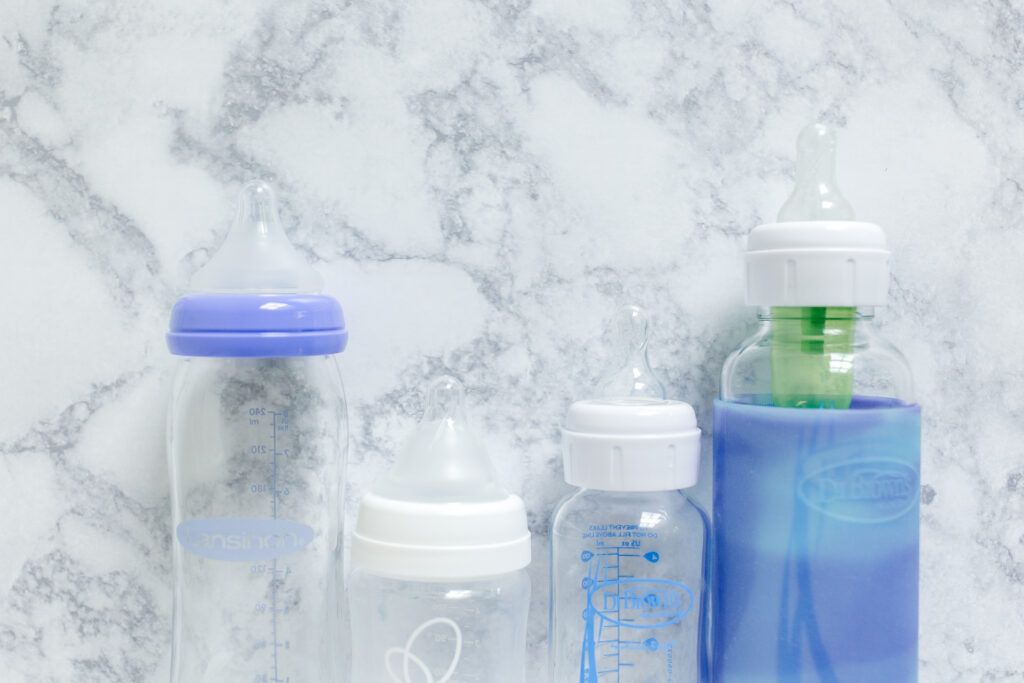
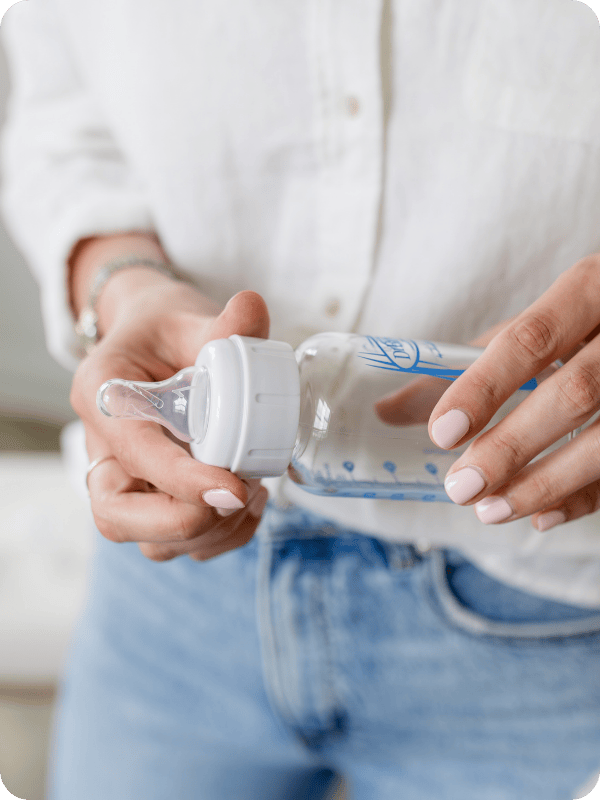
A bottle nipple size refers to the hole present in the tip of a nipple through which milk comes out. It actually doesn’t have to do with the physical shape of the nipple. Size of the nipple directly determines flow rate, which is the speed at which milk flows into the baby’s mouth through the nipple opening.
There isn’t a universal “best” nipple size for bottle feeding all babies. Different bottle brands have slightly different nipple sizes and flow rates. They may label it with a name like slow, medium, or fast, or a number like 0, 1, 2, or 3.
These various nipple sizes exist because your baby’s feeding skills and preferences may change as they grow. A newborn usually needs a slower flow of milk as they’re learning to coordinate sucking and swallowing. Especially for mothers who are nursing and bottle feeding, keeping the flow very slow will be important. Sometimes, after the first few months, babies may (or may not) need to go up in nipple size or flow rate. This is usually seen in babies who are exclusively bottle fed.
To make sure your baby is feeding comfortably, choosing the right nipple size is as important as picking a good bottle. Nipple flow rate matters because we want baby to take in just the right amount of milk according to their needs and feed efficiently.
Nipple Sizes by Flow Rate
Nipple sizes almost always vary by brand, and even with different bottles of the same brand. Here’s a quick glance at common flow rates:
This is just a general guideline that most brands follow. It’s important that you always check the label by the brand to confirm the size and flow.
Size 0-1: Nipple size 0 or ultra-slow flow rate is often best for premature babies. Size 1 is usually referred to as ‘slow flow,’ and has a small hole for slower feeds. We always recommend starting with a slow flow nipple, no matter when you introduce the bottle. And “slow flow” is best for babies who are also nursing so they don’t develop a feeding preference and can go back and forth between breast and bottle.
Size 2: Nipple level 2 is considered a medium flow. Many babies may not go up past a level 2 during their entire bottle feeding journey, which is totally okay!
Size 3-4: Size 3 is fast flow, and size 4 is extra-fast or thick flow nipple. Level 3 or 4 nipple size has the largest hole, and is usually not needed for most babies. But some may transition to this size near the end of their feeding journey, especially if they are exclusively bottle fed.
Again, these nipple flow rates are not standardized. Size 2 in one brand may be slower than Size 1 in another. Always see how your baby responds.
Try not to focus on your baby’s age when determining which nipple size is best for them. Sometimes packaging can suggest that a Level 2 is best for babies 6 months +, but the flow rate can actually be too fast for your baby. You don’t want to switch too quickly to a fast-flowing nipple, especially just because packaging encourages it!
Signs Baby Should Go Down in Flow Rate
The following are the most common signs that your baby is not ready for a faster flow rate:
- Coughing or choking upon taking in milk
- Milk often spilling from sides of their mouth
- Gulping the milk down, or gagging while feeding
- Worsening reflux
What Size Bottle Nipple to Use for Newborns
When you’re bottle feeding your newborn, always go with the slowest flow available for the bottle brand you’re using when starting out. (1) This is usually size 0 or size 1 depending on the brand.
A slow flow nipple for newborns supports paced bottle feeding, which mimics the natural pace of breastfeeding. It allows you to really watch your baby’s cues, and let them lead the feed depending upon their needs.
When to Change Nipple Size for Bottles
When you’re choosing bottle flow rate, you should always confirm it with your baby’s feeding behavior, and not just brand label or baby’s age. There is no right time or age to change your baby’s nipple size.
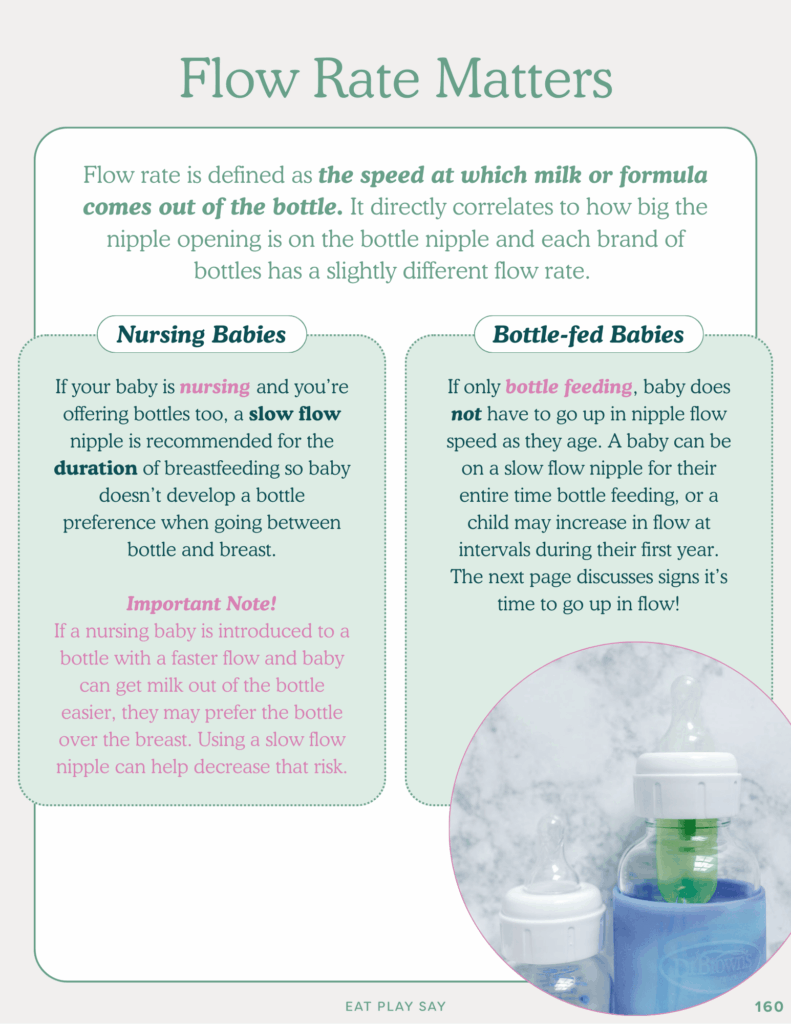
If your baby is also nursing along with bottle feeding, you may want to continue with slow flow nipple for the duration of breastfeeding. If you offer a faster flow rate nipple to a breastfeeding baby, they may prefer it over nursing as they can get more milk with lower effort.
When you’re exclusively bottle feeding, you don’t always have to go up in nipple size by age! Your baby may like to stay on a slow flow nipple on their entire time bottle feeding, or they may increase in flow at intervals during the first year. (2)
A general rule of thumb is if your baby seems content and is feeding without difficulty, there’s no need to change nipple size or flow rate. Read your baby first above everything, and do what works best for them.
As long as your baby is growing well and enjoys feeding from their bottle, continue the same nipple size. However, when you notice your baby is showing the following signs, you may want to try going up to the next flow rate options:
Signs Baby is Ready to Go Up In Flow Rate
The following are the most common signs that your baby is ready for a faster flow nipple:
- Baby is losing interest at the bottle and not finishing feeds but is still hungry once the feeding ends
- Baby is often getting frustrated at the bottle or crying while feeding
- Baby is not finishing bottles and seems to want to eat more frequently
- Baby may begin tugging, chewing or collapsing the nipple with their mouth while sucking
- Baby is suddenly taking longer to finish feeding (>30-40 minutes)
- Baby may start falling asleep too soon before feeding ends
These signs should usually go away when moving up a higher flow rate. If you still experience these signs after leveling up nipple size, your baby may be showing bottle refusal. You’d want to check out this blog post that covers what to do when your baby is refusing the bottle!
If you just had a newborn or your baby is under 6 months, check out Infant Feeding Handbook that covers all the ways to feed your baby, including everything you need to know to bottle feed your baby confidently.
If you’re excited for your baby to start solids, our Starting Solids Handbook is your complete guide to offering solids to your baby. Bundle it up with Baby’s First 100 Foods so you never run out of meal ideas!
And if you’re reading this when your baby is almost a toddler, you might want to check out our Weaning Handbook to say goodbye to the bottle!
Sources:
- Pados, B. F. (2021). Milk flow rates from bottle nipples: What we know and why it matters. Nursing for Women’s Health, 25(3), 229–235.
- Lagarde, M. L. J., van Alfen, A., de Groot, S. A. F., Geurts, A. C. H., & van den Engel-Hoek, L. (2019). Adaptive capacity of 2- to 5-month-old infants to the flow, shape, and flexibility of different teats during bottle feeding: a cross-sectional study. BMC Pediatrics, 19, Article 477.
Leave a Reply
OTHER POSTS YOU MAY LIKE:




MS, SLP
Founder of Eat Play Say, Speech-Language Pathologist, Feeding Specialist, Play Expert, Mom of 2
Jordyn Koveleski Gorman
SPECIALIZES IN: Infant and toddler speech-language, play, and feeding development, and curating a team that provides expert help that feels like a reassuring text from that one mom friend
EDUCATION: Jordyn received her BS in Speech-Language Pathology from Bloomsburg University and her MS in Speech-Language Pathology from Towson University
FAVE PARENTING FIRST: “The first true smile, it’s the sweetest!”

MS, CCC-SLP, CBS, IBCLC
Speech-Language Pathologist & Feeding Specialist, Certified Breastfeeding Specialist, International Board Certified Lactation Consultant
Jessica Nicholson Cocca
SPECIALIZES IN: Breast and bottle feeding, tongue ties, oral motor dysfunction, starting solids, infant and toddler speech, treating oral motor disorders
EDUCATION: Jessica received her BS in Communication Sciences and Disorders from Pennsylvania State University in 2015 and her MS in Speech-Language Pathology from Towson University in 2017
FAVE PARENTING FIRST: “Baby’s first wave! What a fun first communication gesture!”

MA, CCC-SLP, CLC
Speech-Language Pathologist, Certified Lactation Counselor
Jennifer McFarlin
SPECIALIZES IN: Breast and bottle feeding, tongue ties, starting solids, infant and toddler speech development
EDUCATION: She received her BS in Speech-Language Pathology from Ball State in 2014 and a MA in Speech-Language Pathology from Ball State in 2016.
FAVE PARENTING FIRST: “My favorite baby’s first is their first true smile that just warms your soul knowing they are smiling at you. My other favorite is their first word. I love watching their language explode!”

MS, CCC-SLP
Bilingual Speech-Language Pathologist
Nicole La Petina Kelly
SPECIALIZES IN: Bilingual development (Spanish-English), supporting multilingual families, infant and toddler speech
EDUCATION: She received her BA in Communication Sciences and Disorders and in Spanish from the University of Wisconsin-Madison in 2014 and her MS in Speech-Language Pathology with an English-Spanish Specialization from Marquette University in 2016.
FAVE PARENTING FIRST: “It’s the first slobbery kisses for me!”

RDN, LD
Licensed Registered Dietitian
Kimberly Vede
SPECIALIZES IN: Infant and pediatric nutrition including breastfeeding, formula feeding, and starting solids. She also specializes in prenatal and postpartum nutrition.
EDUCATION: She received her BSc in Biology in 2014 from Life University, and her BSc in Dietetics from Life University in 2019.
FAVE PARENTING FIRST: ”The first time they say ‘mama!’”


This checklist was created with input from a Speech-Language Pathologist, Occupational Therapist and Physical Therapist and has been downloaded over 20,000 times by parents worldwide. Learn the important milestones to pay attention to, and keep it in your digital back pocket during the baby + toddler years!
Comprehensive Milestone Checklist for gross motor, fine motor, and speech-language milestones for 0-36 months,
DOWNLOAD FOR FREE


