


When Do Babies Self-Feed? Introducing Baby Utensils
February 12, 2025
Jordyn Koveleski Gorman

Last Updated on June 22, 2026 by Jordyn Koveleski Gorman
This page contains affiliate links. We will receive a commission on qualifying purchases using these links.
As a speech-language pathologist and feeding specialist, I see firsthand how shocked parents are to discover self-feeding milestones about using baby utensils (and little hands!). Many parents think self-feeding milestones are expected much earlier than they actually are.
Self-feeding is hard, and it takes time! And it’s important to remember that even when baby is expected to self-feed developmentally, that still doesn’t mean they’re expected to self-feed every single bite. (Or without a mess!)
This blog will help you set realistic expectations for baby when learning to self-feed and use utensils. We’ll also talk about my most recommended baby utensils for learning these skills along the way!
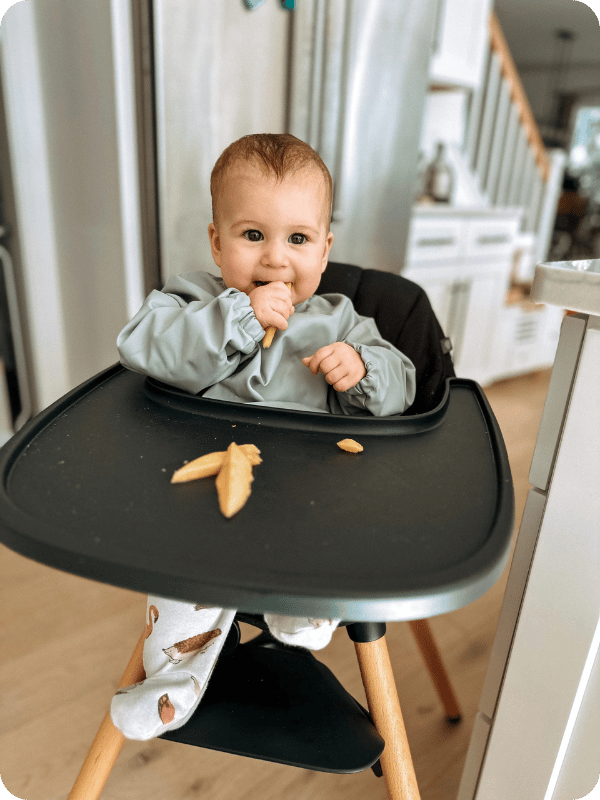
When should baby self-feed with baby utensils?
Babies are expected to bring teethers and toys to their mouth in a laying position (on their back), around 4 months of age. They are expected to bring those same objects to their mouth in a sitting position around 6 months of age. Naturally, then, self-feeding of preloaded spoons or slices of soft solids is expected at 6 months of age, too!
If your baby can sit alone on the floor and mouth toys, they should be able to sit in the high chair and mouth those same toys, too! Then, they can translate those skills to self-feeding bites!
If you’re worried that allowing baby to self-feed might mean they don’t get enough to eat, you can rest assured that’s not the case. Studies have shown that self-feeding, even inefficiently, allows baby to get enough nutrients as they learn. (1) Plus, since breast milk or formula are your child’s main nutrition source in their first year of life, they will be okay if a few bites miss their mouth!

When should baby learn to scoop with a spoon?
Scooping isn’t expected until much later. Most babies attempt to scoop around 9 months of age if they have been given opportunities to self-feed pre-loaded spoons. Scooping messily is expected at 12 months of age and refines over the next year!
The spoons on the graphic below are great for use as teethers in play before starting solids. I recommend giving them to baby around 4 months of age when they are rolling around on the floor. Then baby will be more likely to bring them to their mouth once they are sitting in the high chair!
Another bonus to letting baby play with spoons? Using a spoon can help develop speech and language skills! This isn’t just anecdotal evidence, either. Studies have shown a relationship between infant autonomy with utensils and increased speech-language skills later on. (2)

When should baby use a fork?
Piercing with a fork is usually mastered once scooping has started to refine, so more around 15–18 months.
These baby utensils are my favorites for self-feeding. This fork/spoon combo in particular is great because the fork is dense silicone and isn’t so harsh on baby’s teeth as they learn how to take food off the fork! Practice makes perfect, so give your little one time!
You can see all my favorite baby utensils here!
When should baby drink from a cup?
Similar to spoon feeding, babies can drink from an open cup and straw cup at 6 months old with support. One of my favorite ways to introduce an open cup is to fill it to the top with puree, then help baby take small sips. Puree moves slower than water, so it is easier to manage.
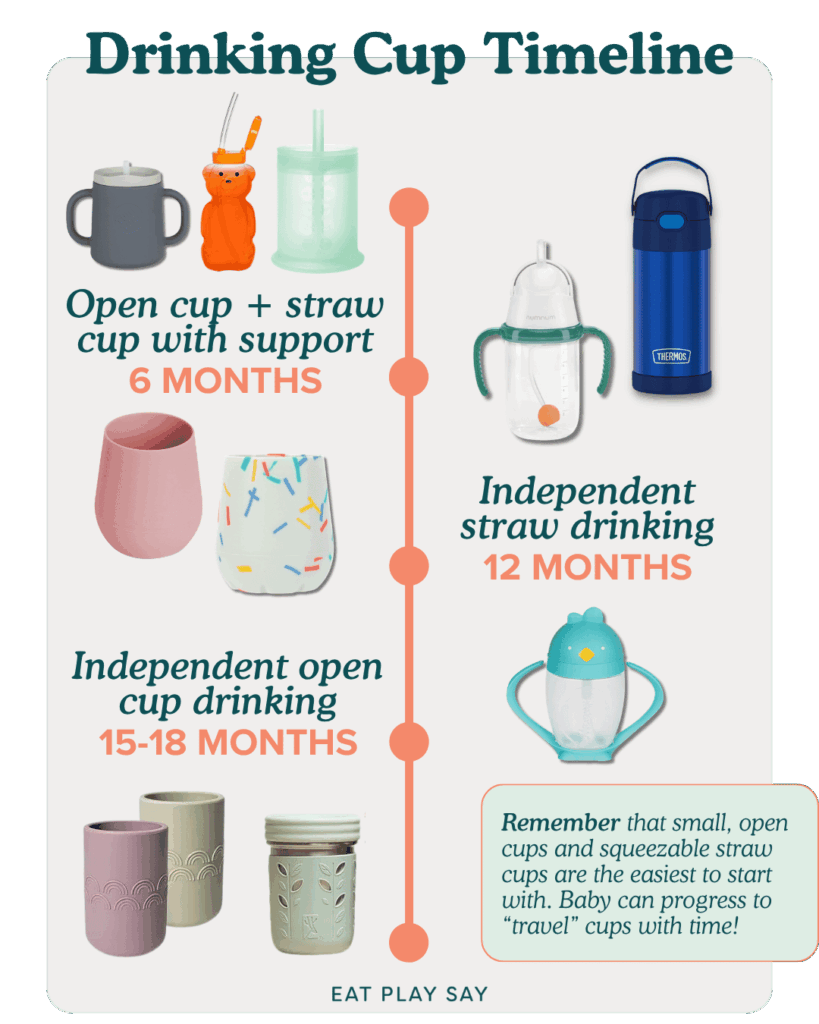
When should baby drink from a straw?
For straw drinking, picking a squeezable cup can help baby learn how to quickly drink! The first 3 cups in the graphic above can be squeezed. (Note: plug the small air hole in the lids before squeezing to help the water make its way up!)
Around 10 months, using travel straw cups when out and about can help prep for bottle weaning. My favorite “no-spill” cups are free flowing and promote mature oral motor patterns for drinking.
At meals from about 6 months onward, continue to practice cup drinking until your little one can regulate small sips of water on their own, which usually comes in around 18–24 months! Small open cups usually result in the most success.
See all my favorite cups for baby here!
When should baby self-feed with their hands?
Babies use their hands to eat and that is normal!
Not every meal needs to include a utensil, and that is okay. Well into toddlerhood, little ones will still use their hands to eat some foods. The main fine motor skills for finger feeding come into play around 7–9 months and 9–12 months. The raking and pincer grasps are ones to watch out for, as they help baby make it to their mouth with food!
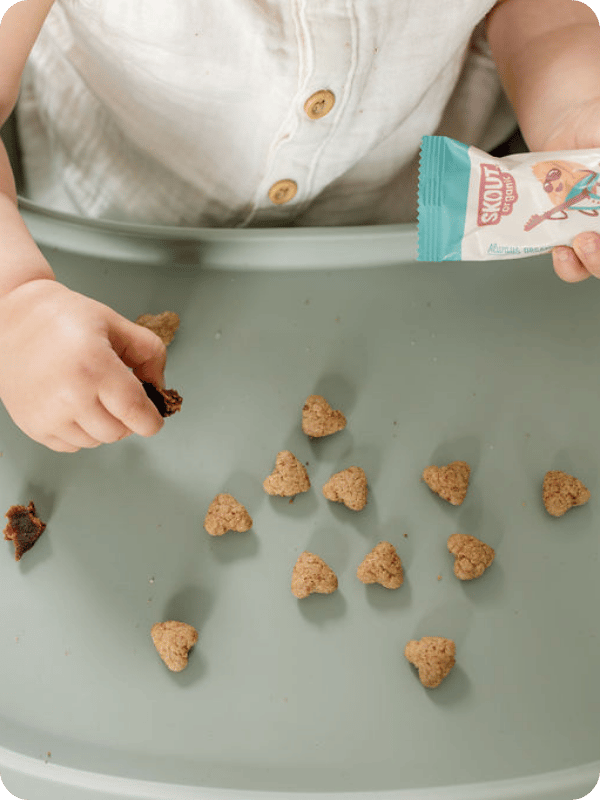
How to help baby self-feed
If you’re experiencing struggles with getting your little one to bring a utensil to their mouth or pick up pieces of food off the tray, try these tips:
- Bring familiar teethers to the tray! Dip them in puree that your little one likes and see if baby will bring a teether to their mouth instead of a spoon.
- Offer a pre-loaded fork with soft solid bites on it! If baby is chewing but not so interested in picking up foods to chew, this can help them bring bites to their mouth.
- Hold a preferred bite of food out and keep your hand several inches from their mouth. Wait for their hand to reach out and grab your hand, and work together to place the bite in their mouth. Do this several times, and then try to encourage them to take the bite from your hand and into their mouth.
- Work on holding their own open cup or straw cup for drinking! This “self-drinking” motor pattern is similar to self-feeding.
- Offer them a pouch (homemade or storebought) to see if they will hold it and bring it to their mouth. This is also a great step in the direction of using utensils and finger feeding. We like these pouches best!
Teethers can help with self-feeding
Many people think teethers are just for teething, but that’s not true! Around 10-12 weeks of age, babies start to chomp on their fisted hands or fingers. This is the first sign that teethers are ready to come into play!
Giving baby teethers to explore and mouth helps them practice self-feeding. Give your little one teethers (and spoons like this one) in play and then bring them into the high chair when starting solids and beyond. Find my most recommended teethers here.
If self-feeding is frustrating
If your baby is just not into self-feeding right now, and it’s more of a frustration than an enjoyment, here’s what to do:
Take a break!
It’s okay to step back and try again later. Involve your little one in making foods outside of the high chair, like putting ingredients in a blender for a smoothie, or moving ingredients from one bowl to another! Listen to your baby’s cues and proceed with what is best for you!
Another note: If your little one was born prematurely (before 37 weeks), use their adjusted age for these milestones until they are 2 years old. If your child has had some delays in gross motor skills (e.g., sitting up, standing, walking), then they may achieve these milestones a bit slower, and that is okay! These are guidelines, and if your child is not exactly on this timeline, don’t stress!
More infant and toddler resources
You can find more free support on our blog, whether you need help starting solids, feeding a toddler, or even play activities and development!
For our most in-depth, expert-written resource containing everything you need to know about starting solids, check out our Starting Solids Handbook!
Sources
- Carruth B, Ziegler P, Gordon A … Developmental milestones and self-feeding behaviors in infants and toddlers. Journal of the American Dietetic Association, 104, 51-56.
- Webber C, Blissett J, Addessi E, Galloway AT, Shapiro L, Farrow C. An infant-led approach to complementary feeding is positively associated with language development. Matern Child Nutr. 2021 Oct;17(4):e13206. doi: 10.1111/mcn.13206. Epub 2021 May 25. PMID: 34031998; PMCID: PMC8476407.
Leave a Reply
OTHER POSTS YOU MAY LIKE:


MS, SLP
Founder of Eat Play Say, Speech-Language Pathologist, Feeding Specialist, Play Expert, Mom of 3
Jordyn Koveleski Gorman
SPECIALIZES IN: Infant and toddler speech-language, play, and feeding development, and curating a team that provides expert help that feels like a reassuring text from that one mom friend
EDUCATION: Jordyn received her BS in Speech-Language Pathology from Bloomsburg University and her MS in Speech-Language Pathology from Towson University
FAVE PARENTING FIRST: “The first true smile, it’s the sweetest!”

MS, CCC-SLP, CBS, IBCLC
Speech-Language Pathologist & Feeding Specialist, Certified Breastfeeding Specialist, International Board Certified Lactation Consultant
Jessica Nicholson Cocca
SPECIALIZES IN: Breast and bottle feeding, tongue ties, oral motor dysfunction, starting solids, infant and toddler speech, treating oral motor disorders
EDUCATION: Jessica received her BS in Communication Sciences and Disorders from Pennsylvania State University in 2015 and her MS in Speech-Language Pathology from Towson University in 2017
FAVE PARENTING FIRST: “Baby’s first wave! What a fun first communication gesture!”

MA, CCC-SLP, CLC
Speech-Language Pathologist, Certified Lactation Counselor
Jennifer McFarlin
SPECIALIZES IN: Breast and bottle feeding, tongue ties, starting solids, infant and toddler speech development
EDUCATION: She received her BS in Speech-Language Pathology from Ball State in 2014 and a MA in Speech-Language Pathology from Ball State in 2016.
FAVE PARENTING FIRST: “My favorite baby’s first is their first true smile that just warms your soul knowing they are smiling at you. My other favorite is their first word. I love watching their language explode!”

MS, CCC-SLP
Bilingual Speech-Language Pathologist
Nicole La Petina Kelly
SPECIALIZES IN: Bilingual development (Spanish-English), supporting multilingual families, infant and toddler speech
EDUCATION: She received her BA in Communication Sciences and Disorders and in Spanish from the University of Wisconsin-Madison in 2014 and her MS in Speech-Language Pathology with an English-Spanish Specialization from Marquette University in 2016.
FAVE PARENTING FIRST: “It’s the first slobbery kisses for me!”

RDN, LD
Licensed Registered Dietitian
Kimberly Vede
SPECIALIZES IN: Infant and pediatric nutrition including breastfeeding, formula feeding, and starting solids. She also specializes in prenatal and postpartum nutrition.
EDUCATION: She received her BSc in Biology in 2014 from Life University, and her BSc in Dietetics from Life University in 2019.
FAVE PARENTING FIRST: ”The first time they say ‘mama!’”


This checklist was created with input from a Speech-Language Pathologist, Occupational Therapist and Physical Therapist and has been downloaded over 20,000 times by parents worldwide. Learn the important milestones to pay attention to, and keep it in your digital back pocket during the baby + toddler years!
Comprehensive Milestone Checklist for gross motor, fine motor, and speech-language milestones for 0-36 months,
DOWNLOAD FOR FREE


