


Newborn Wake Windows
September 14, 2026
Jordyn Koveleski Gorman

Last Updated on September 14, 2026 by Jordyn Koveleski Gorman
Newborn wake windows are notoriously short. The old adage that all newborns do is eat, sleep, and poop is pretty accurate. But there are a few minutes of every wake window that a newborn can often spare for other “activities,” such as crying, playing, bathing, or changing a blown out diaper for the second time in one day.
For many parents, the early newborn days are often foggy from exhaustion. Even veteran parents can find themselves lost and unsure what to do with their time amidst sleep deprivation, recovering from labor, and caring for other children, all while taking care of a new baby. Choosing what to do next when your newborn is staring up at you at 3 a.m. can feel overwhelming!
Understanding what’s happening in your little one’s rapidly developing brain can help ease feelings of panic when you’re not sure what to do next. Let’s talk about what to expect from your newborn’s wake windows, and some sample schedules to help you find a bit of stability in these early days of parenting your newborn.

What are newborn wake windows?
Newborns sleep approximately 70% of the day, totaling as much as 16–17 hours of sleep in any given 24-hour period. (1) At first, that might sound like more wake time than you might expect; being awake for 7–8 hours per day sounds like a lot for a newborn! Except that wake windows include time spent feeding. Most feeds take between 15–20 minutes, and newborns will feed anywhere from 8–12 or even more times per day when cluster feeding. That means half or more of your newborn’s wake windows will be spent feeding.
Fitting in so many feeds while also sleeping so much of the day means that newborns wake frequently and do not sleep for long stretches. About 4 hours is the longest stretch of sleep a newborn might take, and at that point it is necessary to wake them to feed anyway.
With all this sleep to work around, that leaves newborn wake windows as short as 30 minutes to 1 hour in the first month or so of life. As the newborn phase nears its end, some infants will begin stretching toward 2 hours of wake time between 1–3 months.
What to do during wake windows
If your newborn’s wake windows are just half an hour long, most of your time will be spent feeding. But what should you do with the rest of your baby’s wake time?
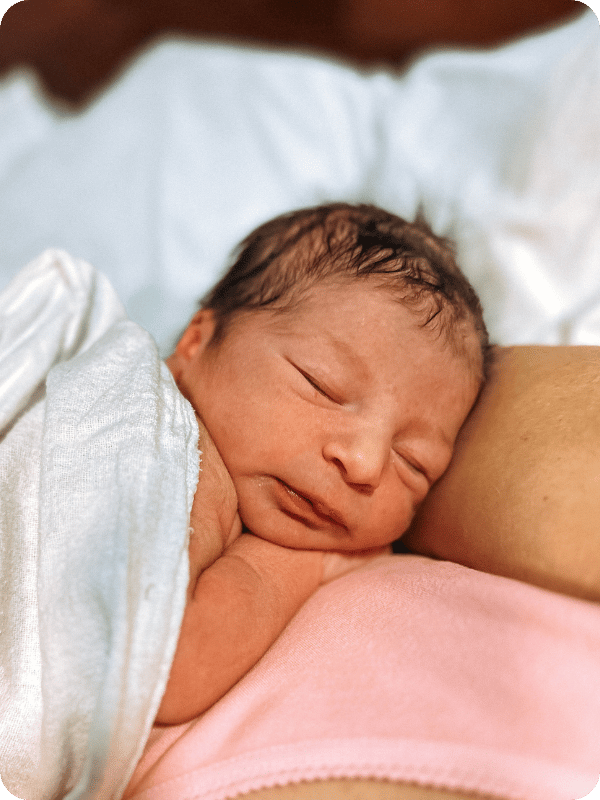
In the early days, making close eye contact (think the distance from their face to yours when feeding, or even a little closer) is one of the best things you can do with your newborn. Research has shown that newborns are sensitive to faces as early as the first few days of life. (2) And, baby’s attention is held longer when their caregiver’s gaze is focused on them. (2)
By 2–3 months, as your newborn becomes more interested in their surroundings, they will prioritize looking into your eyes over other parts of your face. (2) So, soak up the snuggles and hold them close. It may seem small, but making eye contact with your baby is the first stepping stone to establishing communication! (3)
It may feel strange to call this activity “play,” but that’s exactly what it is for your newborn! Play is a powerful learning tool for children, and it begins in infancy. This early form of play is called attunement, and it is the first building block for a lifetime of exploration and curiosity for your little one. (4)
Newborn wake window schedules
Short activities, usually just a few minutes long, are really the most you’ll get from a newborn in their first few weeks. That’s okay, and that’s normal! It takes time to adapt to this new little human’s needs, and finding what works takes practice. You’ll get there!
A few things to remember when thinking about a “schedule” for your newborn:
- Feeding baby on demand, rather than by the time on the clock, is important for development. If they’re showing hunger cues, it’s time to feed!
- Snuggling your baby is healthy, good for development, and productive!
- You’re allowed to take one wake window at a time; it’s okay if every one is different from the one before.
- Every baby is different. Temperament plays a huge role in how a baby sleeps, eats, and interacts. (5) Some babies are more calm and relaxed, while others prefer to be held constantly or tend to be more fussy. Differences in temperament are expected and normal!
Below are some sample wake window schedules. Feeding time is included in each sample schedule for reference, but you can fit feeds into wake windows based on your baby’s needs and cues!
30 minute wake window schedules
The first couple of weeks with baby will likely involve many short wake windows like these.
Schedule 1:
- Wake up, diaper change, etc. (1–3 minutes)
- Feed (15–20 minutes)
- Read a book with baby (5 minutes)
- Snuggle/feed to wind down for nap (5–10 minutes)
Schedule 2:
Try out a schedule like this if you need to leave the house.
- Wake from sleep, diaper change, etc. (1–3 minutes)
- Feed (15–20 minutes)
- Tummy time (1–3 minutes)
- Have facetime and conversation with baby (2–3 minutes)
- Babywear (if baby is big enough to safely wear), contact nap, or do a car nap if leaving the house
Schedule 3:
If baby is cluster feeding, a 30-minute wake window schedule might look something like this:
- Feed upon waking (15–20 minutes)
- Diaper change, outfit change, etc. (2-5 minutes)
- Stare at the ceiling fan (2–3 minutes)
- Feed to sleep (15–20 minutes)

1 hour wake window schedules
Baby will start to tolerate a little bit more wake time as they near 5–6 weeks. A one-hour wake window might look something like these schedule samples below.
Schedule 1:
- Wake up, diaper change, etc. (3–5 minutes)
- Feed (15–20 minutes)
- Babywear or lay on a play gym mat for household tasks (15–20 minutes)
- Tummy time (2–5 minutes depending on tolerance)
- Have facetime and conversation with baby (5–10 minutes)
- Read a book together (5 minutes)
- Snuggle or feed to ease into next nap (5–10 minutes)
Schedule 2:
Try a schedule like this if you need to leave the house during a wake window!
- Wake from sleep, diaper change, etc. (3–5 minutes)
- Feed (15–20 minutes)
- Chat face-to-face with baby (5 minutes)
- Tummy or floor time using high contrast toys (5–10 minutes)
- Get ready to leave the house, get in the car/stroller (10–15 minutes)
- Travel time nap, if baby can fall asleep while out and about
Schedule 3:
Try a routine like this when on an outing for a wake window:
- Wake up, diaper change, etc. (3–5 minutes)
- Feed (15–20 minutes)
- Active time, such as babywearing, tummy time (maybe on your lap or in the trunk of the car on a changing mat), or taking a walk, etc. (15–30 minutes)
- Face-to-face talk about your surroundings (5–10 minutes)
- Play with a toy or read a book (5–10 minutes)
- Begin settling for nap based on location; babywearing can be great for naps away from home (5–10 minutes)

Newborn wake window activities
As you get adjusted to new routines with your little one, you’ll likely be looking to swap activities in and out throughout your day. Below are some of our favorite activities to do at this age! These are just a few from our Infant Playbook, which has 100+ activities that support development using only what you have at home.
1. Upright tummy time
Hold baby upright against your chest, with their head on your shoulder. The goal is for baby to look over your shoulder. Walk around the house or outside. Talk about what you see, what you hear, or just sing some songs. Switch shoulders! This upright position is a modified tummy time position, and it’s great for the early days when baby isn’t quite ready for a lot of time spent on the floor yet.
2. Reflex squeeze
From the minute you get home from the hospital, you can start initiating that reflex squeeze by placing your thumb in baby’s palm. Wait for baby’s fingers to wrap around your thumb. Make eye contact with them as you hold their hands and sing to them. This is one of baby’s first reflexive movements that is going to serve them well in play later on!
3. Conversation coos
While baby is laying on their back, get face-to-face and say babbling sounds like “ba, ba, ba” or “ma, ma, ma” and pause. Wait at least 10 seconds before repeating yourself. This is like having a conversation with baby! Before long, they will start to squeal or coo back to you.
More infant resources
The first few months with a new baby are unlike any other time of life. There are challenges, anxieties, and information overload. But you’re doing it! You should be so proud.
Wondering what’s up ahead for baby as they get a little older? Check out our 3 month wake windows post for more sample schedules and activities!
Kick 2 a.m. Google searches to the curb with Eat Play Say Handbooks! Guides are packed with hundreds of pages of research-backed guidance from our team of pediatric specialists. Whether you need help figuring out how to feed your new baby or want to take the guess work out of playtime, we’ve got you covered!

Sources
- Yates J. PERSPECTIVE: The Long-Term Effects of Light Exposure on Establishment of Newborn Circadian Rhythm. J Clin Sleep Med. 2018 Oct 15;14(10):1829-1830. doi: 10.5664/jcsm.7426. PMID: 30353824; PMCID: PMC6175794.
- Serena Micheletti, Lorenzo Romagnoli, Erika Loi, Nicoletta Cusano, Elisa Fazzi, The eyes have it: Neurobiological roots, developmental trajectories, and social significance of mutual gaze in early parent-infant interactions, Neuroscience & Biobehavioral Reviews, Volume 175, 2025, 106220, ISSN 0149-7634, https://doi.org/10.1016/j.neubiorev.2025.106220.
- Hains, S. M. J., & Muir, D. W. (1996). Infant Sensitivity to Adult Eye Direction. Child Development, 67(5), 1940–1951. https://doi.org/10.2307/1131602
- Michael Yogman, Andrew Garner, Jeffrey Hutchinson, Kathy Hirsh-Pasek, Roberta Michnick Golinkoff, COMMITTEE ON PSYCHOSOCIAL ASPECTS OF CHILD AND FAMILY HEALTH, COUNCIL ON COMMUNICATIONS AND MEDIA; The Power of Play: A Pediatric Role in Enhancing Development in Young Children. Pediatrics September 2018; 142 (3): e20182058. 10.1542/peds.2018-2058
- Hayes MJ, McCoy SK, Fukumizu M, Wellman JD, Dipietro JA. Temperament and Sleep-Wake Behaviors from Infancy to Toddlerhood. Infant Child Dev. 2011 Sep;20(5):495-508. doi: 10.1002/icd.720. PMID: 22003317; PMCID: PMC3190304.
Leave a Reply
OTHER POSTS YOU MAY LIKE:



MS, SLP
Founder of Eat Play Say, Speech-Language Pathologist, Feeding Specialist, Play Expert, Mom of 3
Jordyn Koveleski Gorman
SPECIALIZES IN: Infant and toddler speech-language, play, and feeding development, and curating a team that provides expert help that feels like a reassuring text from that one mom friend
EDUCATION: Jordyn received her BS in Speech-Language Pathology from Bloomsburg University and her MS in Speech-Language Pathology from Towson University
FAVE PARENTING FIRST: “The first true smile, it’s the sweetest!”

MS, CCC-SLP, CBS, IBCLC
Speech-Language Pathologist & Feeding Specialist, Certified Breastfeeding Specialist, International Board Certified Lactation Consultant
Jessica Nicholson Cocca
SPECIALIZES IN: Breast and bottle feeding, tongue ties, oral motor dysfunction, starting solids, infant and toddler speech, treating oral motor disorders
EDUCATION: Jessica received her BS in Communication Sciences and Disorders from Pennsylvania State University in 2015 and her MS in Speech-Language Pathology from Towson University in 2017
FAVE PARENTING FIRST: “Baby’s first wave! What a fun first communication gesture!”

MA, CCC-SLP, CLC
Speech-Language Pathologist, Certified Lactation Counselor
Jennifer McFarlin
SPECIALIZES IN: Breast and bottle feeding, tongue ties, starting solids, infant and toddler speech development
EDUCATION: She received her BS in Speech-Language Pathology from Ball State in 2014 and a MA in Speech-Language Pathology from Ball State in 2016.
FAVE PARENTING FIRST: “My favorite baby’s first is their first true smile that just warms your soul knowing they are smiling at you. My other favorite is their first word. I love watching their language explode!”

MS, CCC-SLP
Bilingual Speech-Language Pathologist
Nicole La Petina Kelly
SPECIALIZES IN: Bilingual development (Spanish-English), supporting multilingual families, infant and toddler speech
EDUCATION: She received her BA in Communication Sciences and Disorders and in Spanish from the University of Wisconsin-Madison in 2014 and her MS in Speech-Language Pathology with an English-Spanish Specialization from Marquette University in 2016.
FAVE PARENTING FIRST: “It’s the first slobbery kisses for me!”

RDN, LD
Licensed Registered Dietitian
Kimberly Vede
SPECIALIZES IN: Infant and pediatric nutrition including breastfeeding, formula feeding, and starting solids. She also specializes in prenatal and postpartum nutrition.
EDUCATION: She received her BSc in Biology in 2014 from Life University, and her BSc in Dietetics from Life University in 2019.
FAVE PARENTING FIRST: ”The first time they say ‘mama!’”


This checklist was created with input from a Speech-Language Pathologist, Occupational Therapist and Physical Therapist and has been downloaded over 20,000 times by parents worldwide. Learn the important milestones to pay attention to, and keep it in your digital back pocket during the baby + toddler years!
Comprehensive Milestone Checklist for gross motor, fine motor, and speech-language milestones for 0-36 months,
DOWNLOAD FOR FREE


