


Baby Won’t Take a Bottle? Here’s How to Fix Bottle Refusal
August 3, 2024
Jordyn Koveleski Gorman

Last Updated on April 1, 2026 by Jordyn Koveleski Gorman
This page contains affiliate links. We will receive a commission on qualifying purchases using these links.
So you went to give your baby a bottle, and they said “NOPE!” You never pictured yourself here, with a baby who won’t take a bottle. You might even be panicking, especially if this is in conjunction with baby starting daycare or you returning to work. I get it. Take a deep breath, and read on!
As a feeding specialist and mom of a baby who refused the bottle, I have some expertise in this area. There are things you can do to help get you and your little one both through this process!
Our lactation consultant and feeding specialists came together to give all the tips and tricks to survive bottle refusal.
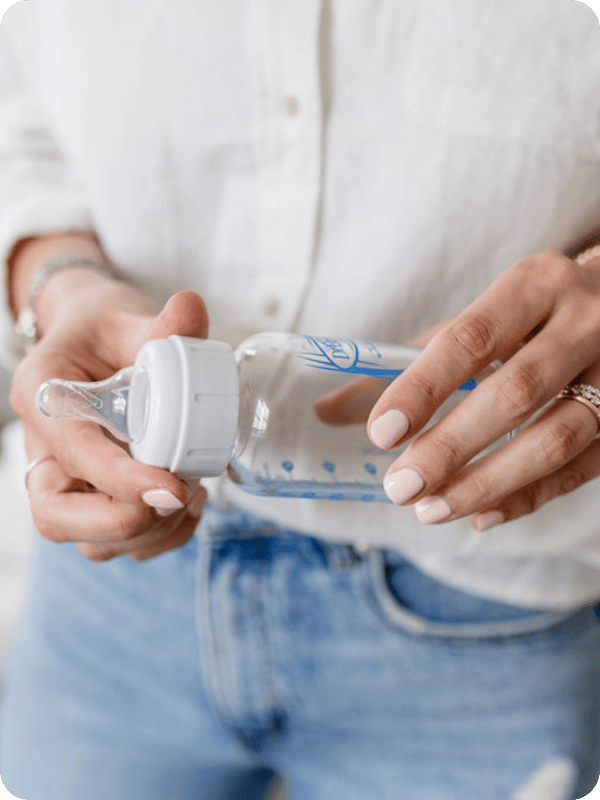
Baby refusing bottle
Why is your baby refusing the bottle? I wish there was a simple answer to this question, but every baby is different. Sometimes, the reason for bottle refusal can even be further distinguished by breast and formula feeding (but not always).
It’s important to keep suck reflex integration in mind. Baby’s suck reflex will start to integrate into voluntary sucking between 2-4 months of age. It is important to start offering a bottle to breastfed babies before this integration starts.
Offering a bottle before the suck reflex integration kicks in is especially important if you are planning on returning to work. Begin offering a bottle consistently (that means daily or at least 5x a week) once you and your baby have established breastfeeding and once baby is about 3-4 weeks of age. If you need help learning how to bottle feed baby, we’ve got you!
One piece of (bad) advice that parents seem to hear often when their baby is refusing a bottle is, “If your baby is hungry, they will take the bottle. Just wait until they are hungry enough.”
This is not the case. There are a variety of reasons a baby might be refusing a bottle, but not being hungry enough isn’t one of them. This type of advice can be harmful to both the baby and parent, and it causes way more frustration than anything.
Formula fed baby suddenly refusing bottles
If your baby is formula fed and has suddenly started refusing bottles, this is likely secondary to a different issue. Baby may not feel well or the temperature of the milk could be an issue (some babies are particular!). It’s also possible that the bottle you’re using is not working well for baby.
Additionally, it may be time to change the flow rate of the nipple. This could mean moving to a faster flow or stepping back to a slower one, especially if you recently changed the flow. For the most part, unless baby is feeding much slower than usual or showing signs of frustration, the nipple flow rate does not need to change. For more tips on when and how to change nipple flow, check out our blog.
For an exclusively bottle-fed baby, sudden bottle refusal can feel especially scary. Sorting through the “why” is important to get back on track. Always be sure to check with your child’s pediatrician for any medical concerns.
Breastfed baby won’t take bottle
It’s important to remember that a breastfed baby is not confused between the breast and bottle. But, they are likely to gravitate towards whatever way is easiest to get milk!
This is called “nipple preference,” and is often the main culprit of bottle refusal for breastfed babies. Other factors can play a part, too. These other factors can include comfort while feeding or even which caregiver is offering the feeding.
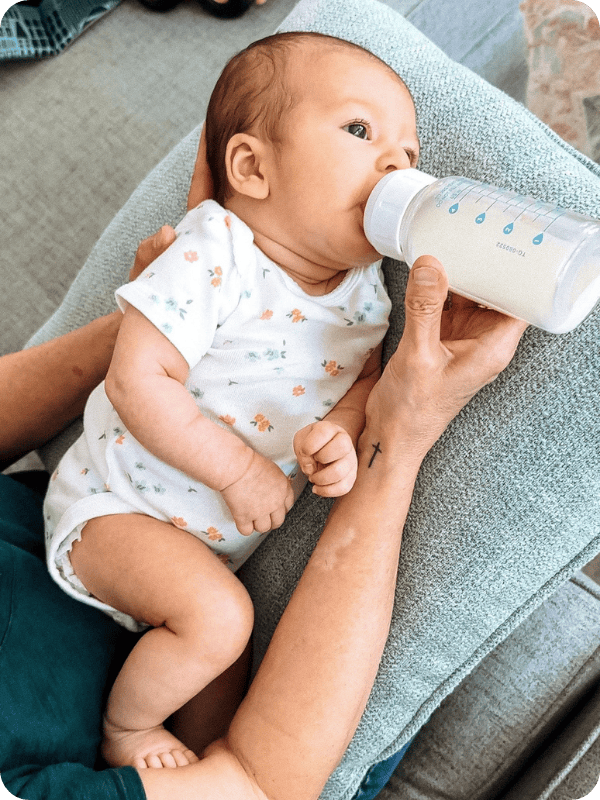
How to get an infant to take a bottle
You might know the why behind your little one’s bottle refusal now, but you need the how. The solution may be as simple as one of the recommendations below, or you may have to run through them all before seeing any progress. Even if your little one continues to refuse bottles, don’t give up hope. We’re here to help, and there are more ways you can support them!
Try a new position
Typically when a baby is offered a bottle, the instinct of the feeder is to hold the baby in the crook of their elbow with the baby’s body facing up (cradle hold).
This might be a comfortable position for you as the feeder, but especially for a breastfed baby, it isn’t the most optimal. In this position, your baby doesn’t have the ability to regulate the flow of milk, as gravity is forcing the milk into the nipple even if baby doesn’t want to suck.
Try positioning your baby across your legs on their side, slightly elevated. Elevated side-lying (pictured above) allows your baby to regulate the flow of milk and pace the feeding on their own. Elevated side-lying can occur on a pillow on propped legs.
Don’t offer the bottle when your baby is hungry
Yes, you read that right!
Think about when you’re super hungry and ready to eat right now. You don’t want to be offered food in a way that requires a skills lesson or in a way you don’t prefer. That’s frustrating! Your main focus is to get food in your stomach, not learn a new skill.
That’s how your baby feels when offered a bottle and they either don’t know how to drink from it or don’t want to. When they’re super hungry and expecting to eat immediately, they’re not prepared to learn something new. Try offering the bottle as practice at a non-feeding time first!
Let your little one take charge
When you present the bottle, don’t immediately shove the nipple into your little one’s mouth. Allow them to take their time coming to the bottle and latching on!
Remove the nipple from the bottle
Take the nipple off/out of the bottle and use the nipple kind of like a pacifier.
Put a few drops of breastmilk or formula in the tip of the nipple, and let your little one explore it with their mouth. Hold it up to their mouth for them.
Slowly increase how much is in the nipple as you do this across a few days, and work your way up to introducing a bottle once again. Start small (1 ounce is success!) and work your way up to a full feed.
Changing your bottle is an option, but instead of blowing tons of money on different bottles, first try to change the environment and the way you are feeding your baby! Try to stay calm and know that this is going to take a little bit of time.
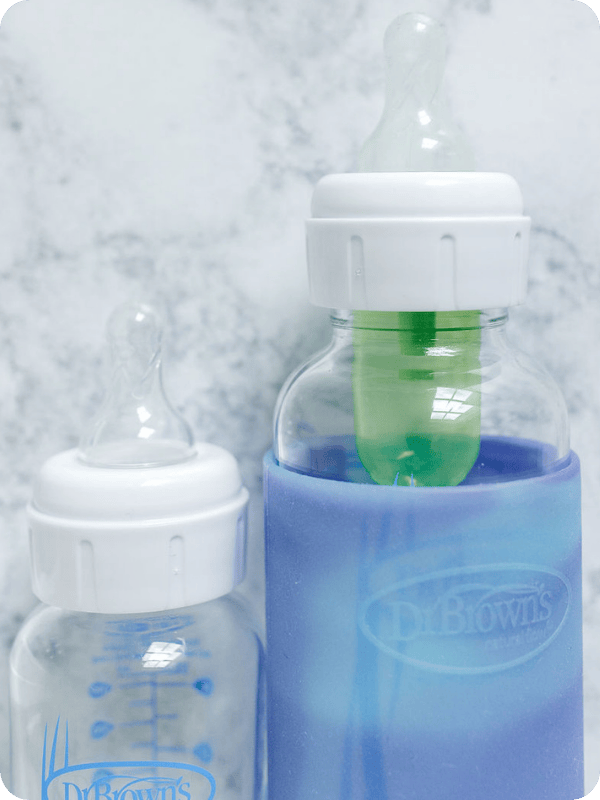
More tips for when baby won’t take bottle
Sometimes, the tips above seem to solve bottle refusal entirely. Other times, a little bit more hands-on work is required. Additionally, for babies who are in daycare, challenges may present differently at home vs. in daycare settings. You might have success solving bottle refusal at home, just to send baby to daycare and get the dreaded message: baby won’t take the bottle.
First and foremost, communicate with your daycare provider. Go over the tips above with them, especially if you are noticing success at home. It’s important that everyone who is feeding your baby is staying consistent.
You may also experience pressure to offer solids before your baby is ready. Daycare providers might suggest that they can offer baby cereal or purées instead of fighting with a bottle.
Keep in mind that it is highly discouraged to start offering solids before a baby is developmentally ready. The Academy of American Pediatrics (AAP) does not recommend starting solids before ~6 months of age, or before baby has shown all signs of readiness. (1)
But…did you know that you can offer formula or breastmilk with a spoon?
Sometimes, offering formula or breastmilk via spoon can help baby “warm up” to a bottle down the line. Sit baby upright and supported (perhaps with their back to your chest on your lap) and offer small spoonfuls. Baby is usually ready to sit up with support in this position around 4–5 months. This is when you can safely try spoonfuls of breastmilk or formula.
There are other ways to offer formula or breastmilk to your baby besides a bottle. Did you know your baby can use a straw or open cup? Introducing a straw or open cup around ~4 months is usually the sweet spot for helping with breastmilk or formula intake.
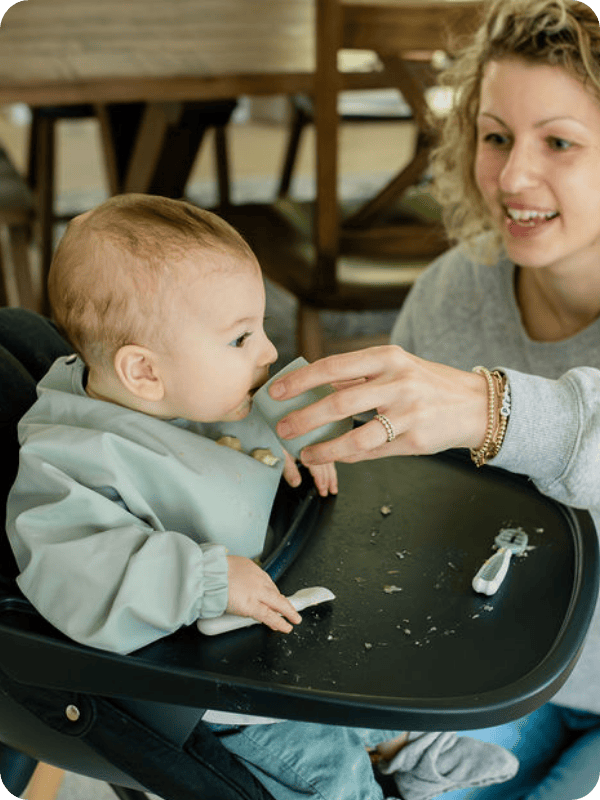
How to introduce a straw or open cup
You might be wondering, “If my baby is refusing a bottle, how are they going to take an open cup or straw?”
Well, drinking from open cups and straws actually involves different oral motor patterns than the breast or bottle. This is a great way to offer breastmilk or formula if baby is refusing the bottle!
Several cups have a squeezing mechanism on them to help push the liquid up the straw. This helps baby learn that if they suck, the liquid will come up! This one is my favorite and can be used as a regular straw, too!
Using a small open cup is a great way to offer sips of breastmilk or formula to baby. You bring it to their lips and let them figure out the rest!
More bottle refusal support
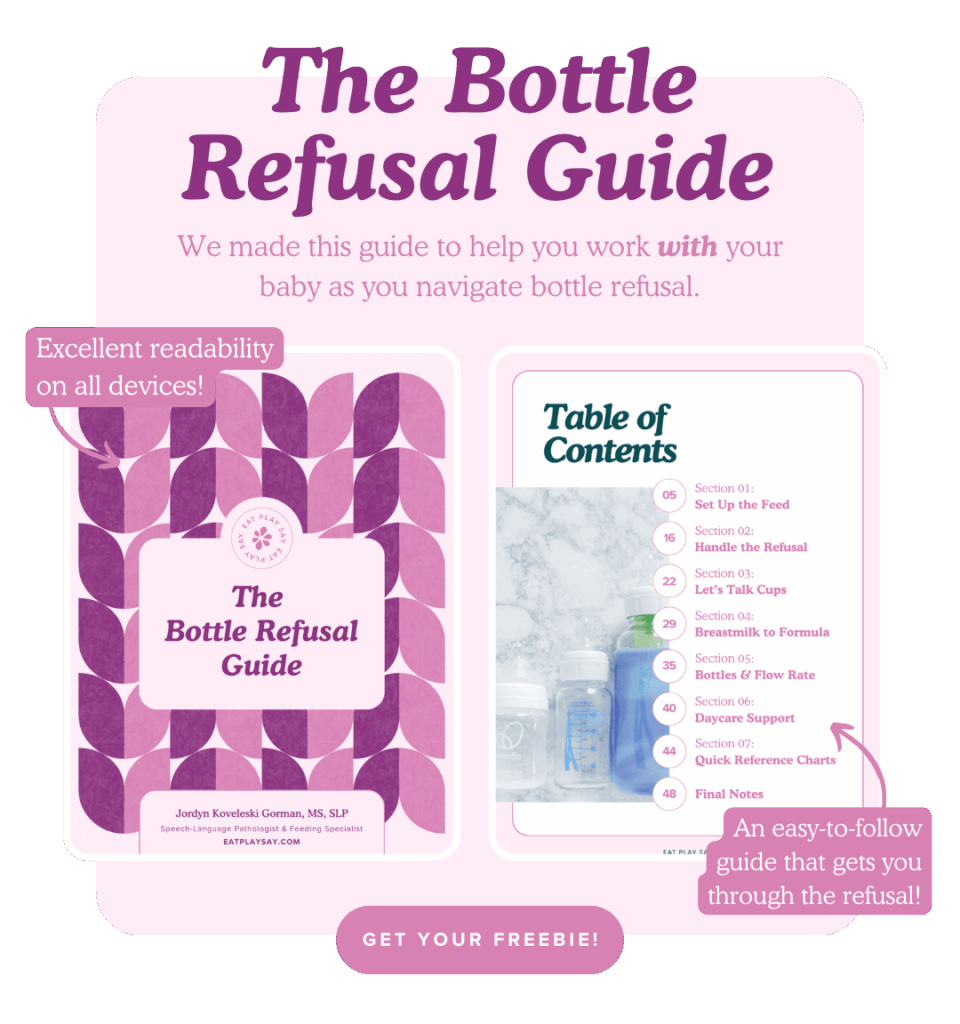
If you’ve tried our top tips above and things still are feeling stressful, or if you’re in a serious time crunch, check out our Bottle Refusal Guide!
This guide holds your hand step-by-step as you help your baby accept a bottle. Written by Feeding Specialists and two International Board Certified Lactation Consultants, it’s packed with 50 pages of information so you feel supported at all times!
Sources
- Food Fights: Winning the Nutritional Challenges of Parenthood Armed with a Bottle of Ketchup. By: Laura A. Jana, MD, FAAP, Jennifer Shu, MD, FAAP https://doi.org/10.1542/9781581106664
OTHER POSTS YOU MAY LIKE:



MS, SLP
Founder of Eat Play Say, Speech-Language Pathologist, Feeding Specialist, Play Expert, Mom of 3
Jordyn Koveleski Gorman
SPECIALIZES IN: Infant and toddler speech-language, play, and feeding development, and curating a team that provides expert help that feels like a reassuring text from that one mom friend
EDUCATION: Jordyn received her BS in Speech-Language Pathology from Bloomsburg University and her MS in Speech-Language Pathology from Towson University
FAVE PARENTING FIRST: “The first true smile, it’s the sweetest!”

MS, CCC-SLP, CBS, IBCLC
Speech-Language Pathologist & Feeding Specialist, Certified Breastfeeding Specialist, International Board Certified Lactation Consultant
Jessica Nicholson Cocca
SPECIALIZES IN: Breast and bottle feeding, tongue ties, oral motor dysfunction, starting solids, infant and toddler speech, treating oral motor disorders
EDUCATION: Jessica received her BS in Communication Sciences and Disorders from Pennsylvania State University in 2015 and her MS in Speech-Language Pathology from Towson University in 2017
FAVE PARENTING FIRST: “Baby’s first wave! What a fun first communication gesture!”

MA, CCC-SLP, CLC
Speech-Language Pathologist, Certified Lactation Counselor
Jennifer McFarlin
SPECIALIZES IN: Breast and bottle feeding, tongue ties, starting solids, infant and toddler speech development
EDUCATION: She received her BS in Speech-Language Pathology from Ball State in 2014 and a MA in Speech-Language Pathology from Ball State in 2016.
FAVE PARENTING FIRST: “My favorite baby’s first is their first true smile that just warms your soul knowing they are smiling at you. My other favorite is their first word. I love watching their language explode!”

MS, CCC-SLP
Bilingual Speech-Language Pathologist
Nicole La Petina Kelly
SPECIALIZES IN: Bilingual development (Spanish-English), supporting multilingual families, infant and toddler speech
EDUCATION: She received her BA in Communication Sciences and Disorders and in Spanish from the University of Wisconsin-Madison in 2014 and her MS in Speech-Language Pathology with an English-Spanish Specialization from Marquette University in 2016.
FAVE PARENTING FIRST: “It’s the first slobbery kisses for me!”

RDN, LD
Licensed Registered Dietitian
Kimberly Vede
SPECIALIZES IN: Infant and pediatric nutrition including breastfeeding, formula feeding, and starting solids. She also specializes in prenatal and postpartum nutrition.
EDUCATION: She received her BSc in Biology in 2014 from Life University, and her BSc in Dietetics from Life University in 2019.
FAVE PARENTING FIRST: ”The first time they say ‘mama!’”


This checklist was created with input from a Speech-Language Pathologist, Occupational Therapist and Physical Therapist and has been downloaded over 20,000 times by parents worldwide. Learn the important milestones to pay attention to, and keep it in your digital back pocket during the baby + toddler years!
Comprehensive Milestone Checklist for gross motor, fine motor, and speech-language milestones for 0-36 months,
DOWNLOAD FOR FREE


