


Baby Food Stages: How To Get Baby Off Purees
February 3, 2025
Jordyn Koveleski Gorman

Last Updated on June 26, 2026 by Jordyn Koveleski Gorman
No matter the approach you take to starting solids with your little one, you will go through all the baby food stages with them. Even the most intense baby led weaning methods involve introducing babies to different textures as they learn.
As a feeding specialist and a mom who has used a blended method for starting solids with my littles, I will die on the hill that purees should be included in the starting solids journey.
Purees are a great (and common) texture, and one that many parents feel comfortable starting with. They are excellent for self-feeding from a spoon, offer great nutrition in small portions, and provide hydration, as they are both a solid and a liquid.
Some babies start with purees and then move right along to mashed solids, soft solids, and so on with no issue. But many babies get “stuck” on purees and have some difficulty moving up the texture hierarchy. This can feel stressful for parents. But it can be worked on, and it doesn’t mean your little one will be exclusively eating jars of baby food forever. Let’s talk about how to help your little one move through the baby food stages into other textures.

Baby food stages: When do babies need to move on from purees?
The motor coordination needed to chew starts to develop between 6–9 months. (1) So developmentally, we want baby to be chewing soft solids by 9 months of age. That doesn’t mean baby shouldn’t be offered purees anymore, though. Instead, it means baby can be offered more variety as their skills develop.
Note, too, that it’s important not to introduce solids before baby shows all the signs of readiness. Most babies are ready to begin solids around 6 months old. There’s no race or rush to get started before they’re ready (even if the pediatrician says you can!). Additionally, starting solids before these signs of readiness appear carries essentially no nutritional benefits. This is because all of baby’s nutritional needs are met through breast milk (or formula) for the first 6 months. (2)
While there’s no hard and fast deadline for moving on from pureed baby foods, there is research to support a loose timeline. Progression through the texture hierarchy into soft, chewable foods by 9 months is the goal. Research indicates that babies who were not chewing foods by 10 months of age were more likely to be labeled as “picky eaters” in toddlerhood. (3)
If your baby is approaching 9 months (or is past 9 months) and isn’t chewing, no need to panic. We can help!
How to help baby move on from stage 1 & stage 2 baby food
Our top tips for moving on from purees onto more solid textures are below.
Thicken up the puree
If you’re offering a thinner puree like a Stage 1 or Stage 2 baby food, it’s time to make it thicker.
It’s easiest to use naturally occurring foods like cream cheese, sour cream, hummus, and thick applesauce to thicken purees. When thickening, start off small, adding just a bit of the thicker ingredients to your puree. Next time, make the puree a little thicker, and keep working at it from there.
You can also mash down soft fruits like banana and avocado and offer them as a thicker puree. Add water to thin if needed. Additionally, try to increase bite size and thickness at meals.
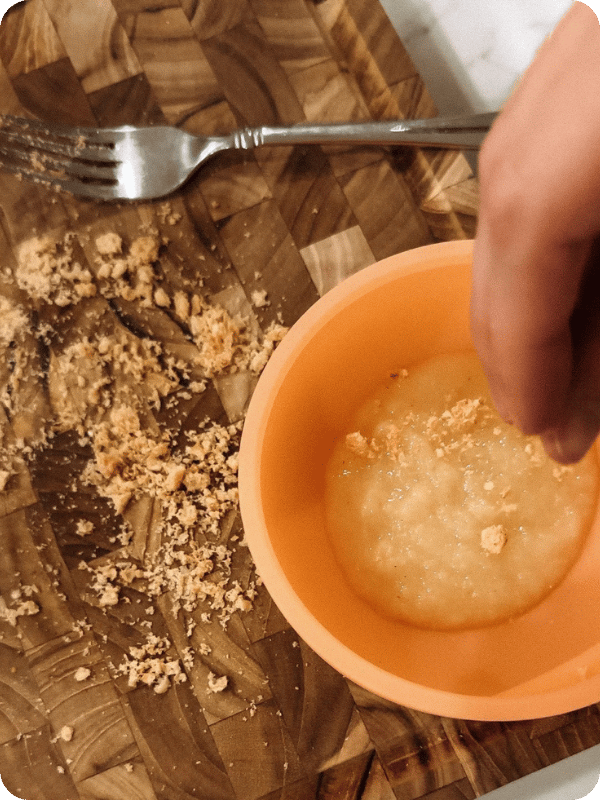
Add crumbs to stage 1 & stage 2 baby foods
Take the puree you are using and add some texture by sprinkling in some crushed dissolvables.
Puffs or crackers are great to crush and add into a puree that your baby likes. Try mixing them with applesauce or yogurt! Just use a fork to crush and sprinkle in.
Once the crumbs mix with the wet puree and your baby’s saliva, the crumbs will turn into a mashed consistency. This thickens the puree and will prompt baby to mash. Add more crushed crumbs to the puree over time to thicken it, or even sprinkle on top of each spoonful to really add some texture into every bite!
You should start to see your baby’s mouth move up and down in an emerging chewing pattern in response to this increase in texture.
Offer puree and mashed foods together
To slowly get to a mashed consistency, add a little mashed food (like banana, peaches, avocado, or mango) to a puree that baby enjoys. You can go back and forth between a bite of puree and a bite of the thicker mashed food. Over time, offer more and more of the mashed texture until you can fully transition over to it! Take it as slow as baby needs, and try to let baby self-feed the bites. If they are in control, they may be more interested in trying the bites.
My favorite combo is adding mashed banana to oatmeal. It tastes delicious and offers baby a lot of nutrients! You can use oatmeal, quinoa, or another grain of choice as a base if you’d like! Rice cereal is no longer recommended, however, so be mindful of the cereal you choose.
If you prefer to use a thicker base that’s not a grain, mashed potatoes of any kind are great for making purees thicker or lumpy foods smoother.
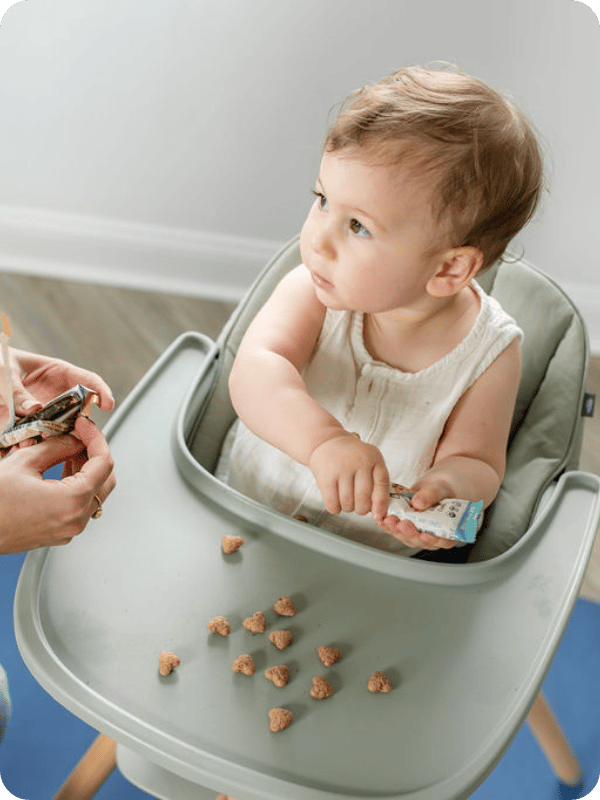
Change baby food stages by trying dissolvables
Sometimes a complete change in texture can go really well! Offer baby a dissolvable solid like melts or other dissolvable puffs. You can offer half to start if you’d like and then offer a full melt! Puffs and melts do exactly what their name suggests: melt on contact with saliva. Baby can mash the melted texture down and swallow it. Sometimes a quick shift to this texture can jumpstart baby’s chewing journey.
Think of dissolvables as a bridge that helps littles go from purees and mashed foods to soft solids!
More baby feeding support
Feeling “stuck” on purees can be hard! Take it slow and read baby’s cues. Remember that, developmentally, baby should be mashing and chewing by around the time they are 9 months old. Work up the texture hierarchy as best as you can to help baby along on their feeding journey.
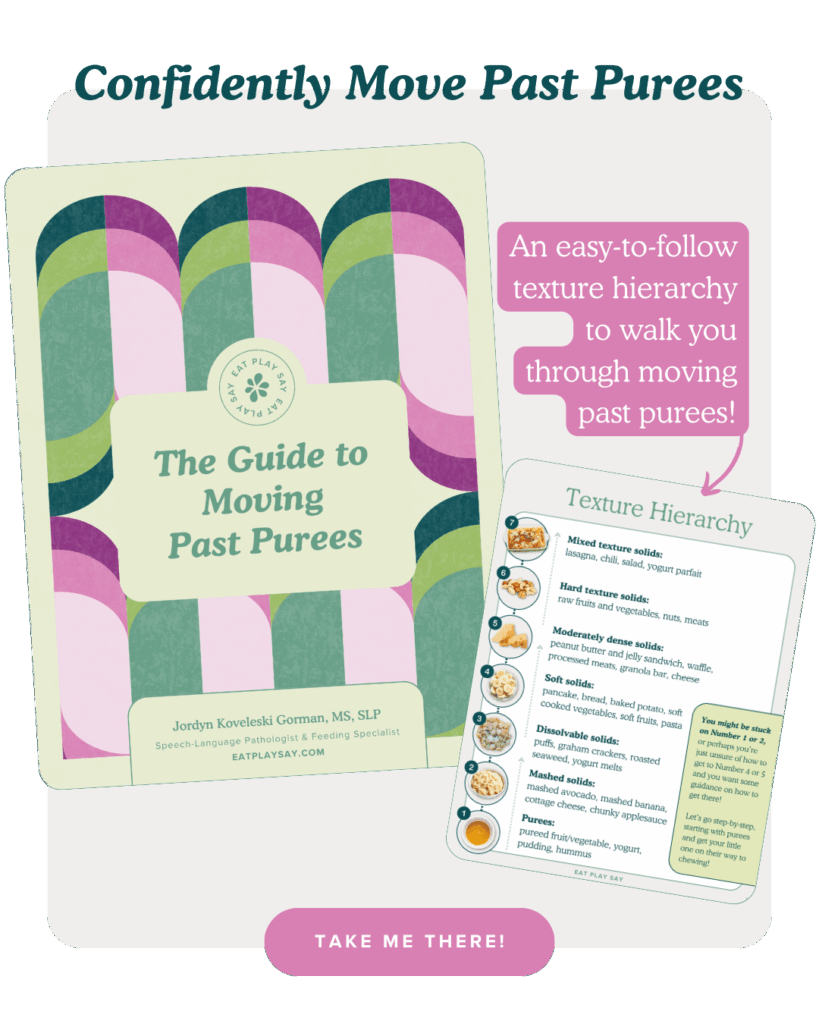
For more guidance on moving through the different baby food stages, check out our Guide to Moving Past Purees! With step-by-step instructions, troubleshooting tips for common challenges, and recipes for serving different textures, this guide gives you every tool you need to move up the texture hierarchy!
You can find more tips for starting solids on our blog, as well as more about baby & toddler development and even ways to play with your little one at every age!
If you notice that feeding time is consistently difficult and frustrating for you and baby, it may be time to schedule a consultation with a feeding specialist. Baby may just need a little extra help, and that’s okay!
Sources
- Kalhoff H, Kersting M, Sinningen K, Lücke T. Development of eating skills in infants and toddlers from a neuropediatric perspective. Ital J Pediatr. 2024 Jun 3;50(1):110. doi: 10.1186/s13052-024-01683-0. PMID: 38831369; PMCID: PMC11149262.
- American Academy of Pediatrics. 2022. Why Breastfeed: Benefits for You & Your Baby https://www.healthychildren.org/English/ages-stages/baby/breastfeeding/Pages/Why-Breastfeed
- University of Bristol. Should we worry about picky eating? Accessed June 2026.
OTHER POSTS YOU MAY LIKE:



MS, SLP
Founder of Eat Play Say, Speech-Language Pathologist, Feeding Specialist, Play Expert, Mom of 3
Jordyn Koveleski Gorman
SPECIALIZES IN: Infant and toddler speech-language, play, and feeding development, and curating a team that provides expert help that feels like a reassuring text from that one mom friend
EDUCATION: Jordyn received her BS in Speech-Language Pathology from Bloomsburg University and her MS in Speech-Language Pathology from Towson University
FAVE PARENTING FIRST: “The first true smile, it’s the sweetest!”

MS, CCC-SLP, CBS, IBCLC
Speech-Language Pathologist & Feeding Specialist, Certified Breastfeeding Specialist, International Board Certified Lactation Consultant
Jessica Nicholson Cocca
SPECIALIZES IN: Breast and bottle feeding, tongue ties, oral motor dysfunction, starting solids, infant and toddler speech, treating oral motor disorders
EDUCATION: Jessica received her BS in Communication Sciences and Disorders from Pennsylvania State University in 2015 and her MS in Speech-Language Pathology from Towson University in 2017
FAVE PARENTING FIRST: “Baby’s first wave! What a fun first communication gesture!”

MA, CCC-SLP, CLC
Speech-Language Pathologist, Certified Lactation Counselor
Jennifer McFarlin
SPECIALIZES IN: Breast and bottle feeding, tongue ties, starting solids, infant and toddler speech development
EDUCATION: She received her BS in Speech-Language Pathology from Ball State in 2014 and a MA in Speech-Language Pathology from Ball State in 2016.
FAVE PARENTING FIRST: “My favorite baby’s first is their first true smile that just warms your soul knowing they are smiling at you. My other favorite is their first word. I love watching their language explode!”

MS, CCC-SLP
Bilingual Speech-Language Pathologist
Nicole La Petina Kelly
SPECIALIZES IN: Bilingual development (Spanish-English), supporting multilingual families, infant and toddler speech
EDUCATION: She received her BA in Communication Sciences and Disorders and in Spanish from the University of Wisconsin-Madison in 2014 and her MS in Speech-Language Pathology with an English-Spanish Specialization from Marquette University in 2016.
FAVE PARENTING FIRST: “It’s the first slobbery kisses for me!”

RDN, LD
Licensed Registered Dietitian
Kimberly Vede
SPECIALIZES IN: Infant and pediatric nutrition including breastfeeding, formula feeding, and starting solids. She also specializes in prenatal and postpartum nutrition.
EDUCATION: She received her BSc in Biology in 2014 from Life University, and her BSc in Dietetics from Life University in 2019.
FAVE PARENTING FIRST: ”The first time they say ‘mama!’”


This checklist was created with input from a Speech-Language Pathologist, Occupational Therapist and Physical Therapist and has been downloaded over 20,000 times by parents worldwide. Learn the important milestones to pay attention to, and keep it in your digital back pocket during the baby + toddler years!
Comprehensive Milestone Checklist for gross motor, fine motor, and speech-language milestones for 0-36 months,
DOWNLOAD FOR FREE


