


Does Teaching Your Infant Sign Language Delay Spoken Words?
December 2, 2024
Jordyn Koveleski Gorman

Last Updated on July 14, 2026 by Jordyn Koveleski Gorman

Sign language is a research-backed form of communication with infants, helping them learn language skills long before their first spoken words. But does sign language delay those first out-loud words like “mama” and “dada”?
The short answer: no!
As a pediatric speech-language pathologist and mom, I have seen firsthand how valuable a tool sign language can be. There are countless benefits to using sign language with your infant. Let’s talk about it!
Sign language is natural
Sign language is part of typical language development.
Yes, you read that right: sign language should be included in communication exchanges with all babies from birth because it is a natural part of language development. How so? Take a look at the Communication Hierarchy below, paying special attention to numbers 6 and 7.
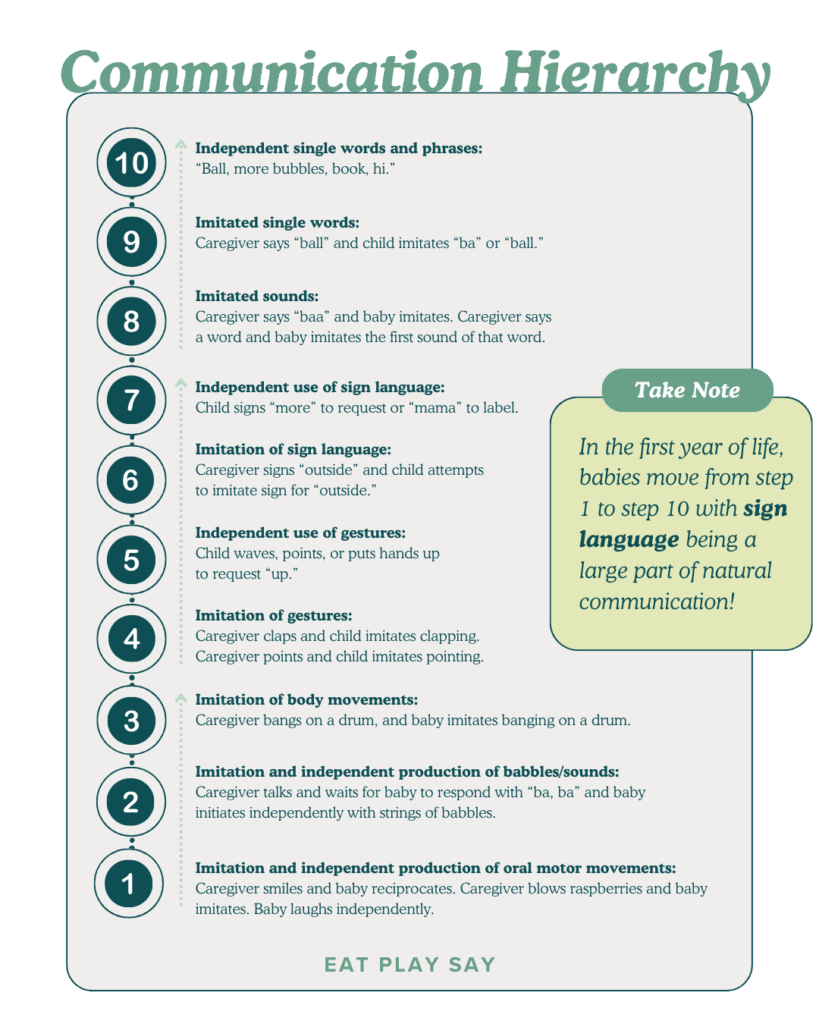
There are generally 10 steps in communication for little ones to achieve the milestone of a single, true, independent word around their first birthday. Just like we don’t want to skip any steps in motor development (like crawling), we don’t want to skip any steps in language development either! In the first year of life, creating a strong language foundation includes using sign language!
Research supports using sign language with infants
There are many published studies about sign language and language development in children who are deaf. Within this body of research is compelling evidence that sign language is processed in the brain in the same way as spoken language. (1)
Language development doesn’t inherently change because a child has hearing loss, is deaf, or faces other medical diagnoses like autism, Down syndrome, or developmental delay. The Communication Hierarchy from above remains the same, and therefore, communication strategies and recommendations do, too.
Communication begins at the bottom of the chart and continues to work up, catering to the needs of any child along the way. All children are deserving of language, and all children should be supported through their own communication journey.
Recent research has begun to explore sign language use in infants and children with hearing loss as well as those without. One 2021 study found that “early exposure to language, whether signed or spoken, supports the development of typical cognitive skills” for children with and without hearing loss. (2)
Another study noted that contrary to predictions in research, learning sign language does not hinder formation of the spoken vocabulary. (3) The American Academy of Pediatrics agrees, stating that baby sign language is a tool to help boost communication for infants and young children with normal hearing. (4)
Language is language. Early exposure to sign language and spoken language is beneficial for all children.
Sign language leads to spoken language
As a speech-language pathologist, one of the most common questions parents ask me is, “When will my baby say their first word?”
Of course, we can’t predict exactly when any one child will say their first true word. There are so many factors at play leading up to this fun milestone! Taking note of where a little one is at on the Communication Hierarchy can be a helpful guide. If baby is on earlier steps, it will be a little while before they get to step 10! If they are hanging out around steps 7 or 8, a first word is likely on its way soon.
Research has discovered some amazing predictors related to upcoming spoken words for infants and toddlers.
For instance, the size of a child’s spoken vocabulary can be predicted based on their early gesture vocabulary. (5) Additionally, it is possible to predict which words will enter a child’s spoken vocabulary based on the objects the child gestured toward in the months prior. (5)
You can see this in day-to-day life by noticing objects or things your child points at in order to communicate something. Does your little one point at a dog when you say, “Woof woof”? Or do they point to a ball to indicate they want to play? Your little one is preparing for spoken language by practicing these skills!
Signs are specialized gestures, and they are closer to single spoken words because they stand for a very specific item, object, or thing. If a child can communicate by using gestures (like pointing at the thing they are trying to communicate about), they are likely to communicate that word using spoken language just 3 months later. (5)
When will my infant use sign language with me?
If you start in infancy, your little one can communicate signs back to you as early as 4–6 months. Some have even reported imitation of signs as early as 3 months of age!
From my personal experience, I started signing with my daughter consistently around 3 months of age. She imitated the sign for “milk” at 6 months, was independently signing it at 8 months, and said the word independently at 10 months. By 12 months of age, she had more than 10 single spoken words and the signs to match them.
With my son, I started signing consistently around 8 months of age. He imitated signs by 9 months, independently used them by 11 months, and had 5 single spoken words at 12 months of age.
The earlier you sign, the earlier your baby is likely to sign back to you.
How can I start using sign language?
The first step is modeling signs consistently in routines early on.
Every time you throw away a diaper, model “dirty” and “all done” with the appropriate signs. When you go to pick baby up off the floor, model “up” with your arms up and pause before picking up baby. Every time you finish a book, clap and say “yay!” and add the sign for “all done!” Make sure to pause and look at baby with intent after performing a gesture, since you want to give them a cue that they should respond.
When is the best time to introduce infant sign language?
You can introduce infant sign language as soon as you’re ready! That will look different for everyone, but the sooner, the better! Signing is always beneficial and it’s never too early or too late to start. You can start including signs in your routines as soon as you’ve established them. For my second baby, that was around 3–4 months of age. With my third, signs were a natural part of communication from as early as a few weeks of age.
While any age is a good age to start signing, we want parents to keep the 9–10 month mark in mind for communication. Why? That is a milestone marker for gesture use, as 90% of babies are using some gestures (waving, clapping, putting arms up) consistently by that age. Many babies gesture earlier, too. If your little one is not using gestures or attempting to imitate your use of gestures by the 10 month mark, talk to your pediatrician or reach out to a specialist.
What signs should I use with my baby?
One of the most common signs to teach baby is “more,” since it can be used universally to request more of anything. However, it doesn’t teach baby to request anything specific. So although “more” is an important sign, teaching signs for actual items, like “milk,” “book,” or “car,” can be equally important for development.
When modeling signs, think about function. Words I typically model throughout the day are:
- All done
- Eat and drink
- More
- Clean and dirty
- Common toy items in play
- Mama and dada, or other important family members and caregivers
The words that you say most often will be the best ones to sign while you say them to your baby! Communication Junction is a great resource for parents, and they offer a free download sharing how to use common signs at home with your little one!
Using sign language at mealtimes
Many parents introduce signs for the first time in the high chair because baby is seated and you’re at eye level. I caution against baby’s first experience with signs being around food for two reasons.
First, feeding can be an overwhelming sensory experience. Adding a new communication component can cause more stress, especially if baby feels like communication demands are being placed on them. Instead, I recommend that you model signs in the high chair (like eat, drink, hot), but don’t expect baby to imitate them. Focus more on imitation of signs with toys and other motivating play items.
Second, you are going to feed your baby regardless if they use signs in the high chair. As a result, baby might not make the connection that signing is making a request or that signing results in them getting something. Sometimes baby will get another bite of food when they sign “more,” but other time they will get food when they don’t sign at all. You want baby to make a connection that signing results in an action consistently. So, again, model signs to show baby how to use them to request, label, and comment, but don’t withhold food or make baby sign to get something.
Remember the Communication Hierarchy
Remember that in order for baby to use gestures to communicate, they need to have established imitation of body movements first. If baby is imitating arms up for “up” and/or clapping, then putting their hands together to sign for “more” or “all done” is coming. And spoken language is likely to follow soon after.
Something to keep in mind: lack of imitation is a risk factor for a communication delay. If you have been modeling body movements, gestures, and signs, and your little one is approaching their first birthday and they don’t attempt to imitate you, reach out to your pediatrician or a specialist for an evaluation. Early intervention is key in making progress!
More parenting resources
You’re well on your way to using sign language with your baby! You’ve got this.
For more support raising littles, check out our blog:
- Get help starting solids
- Learn more about infant and toddler development
- Find ways to play with your little one
- Get more speech & language support
For our most in-depth resources, with hundreds of pages of research-backed tips and expert guidance from child development specialists, see our Handbooks!
Sources
- Fitzpatrick, E.M., Stevens, A., Garritty, C. et al. The effects of sign language on spoken language acquisition in children with hearing loss: a systematic review protocol. Syst Rev 2, 108 (2013). https://doi.org/10.1186/2046-4053-2-108
- Goodwin, C., Carrigan, E., Walker, K., & Coppola, M. (2022). Language not auditory experience is related to parent-reported executive functioning in preschool-aged deaf and hard-of-hearing children. Child Development, 93, 209–224. https://doi.org/10.1111/cdev.13677
- Pontecorvo E, Higgins M, Mora J, Lieberman AM, Pyers J, Caselli NK. Learning a Sign Language Does Not Hinder Acquisition of a Spoken Language. J Speech Lang Hear Res. 2023 Apr 12;66(4):1291-1308. doi: 10.1044/2022_JSLHR-22-00505. Epub 2023 Mar 27. PMID: 36972338; PMCID: PMC10187967.
- Jana, L. A., & Shu, J. (2025). Heading Home With Your Newborn: From Birth to Reality (5th ed.). American Academy of Pediatrics.
- Iverson JM, Goldin-Meadow S. Gesture paves the way for language development. Psychological Science. 2005;16:368–371. doi: 10.1111/j.0956-7976.2005.01542.x.
OTHER POSTS YOU MAY LIKE:


MS, SLP
Founder of Eat Play Say, Speech-Language Pathologist, Feeding Specialist, Play Expert, Mom of 3
Jordyn Koveleski Gorman
SPECIALIZES IN: Infant and toddler speech-language, play, and feeding development, and curating a team that provides expert help that feels like a reassuring text from that one mom friend
EDUCATION: Jordyn received her BS in Speech-Language Pathology from Bloomsburg University and her MS in Speech-Language Pathology from Towson University
FAVE PARENTING FIRST: “The first true smile, it’s the sweetest!”

MS, CCC-SLP, CBS, IBCLC
Speech-Language Pathologist & Feeding Specialist, Certified Breastfeeding Specialist, International Board Certified Lactation Consultant
Jessica Nicholson Cocca
SPECIALIZES IN: Breast and bottle feeding, tongue ties, oral motor dysfunction, starting solids, infant and toddler speech, treating oral motor disorders
EDUCATION: Jessica received her BS in Communication Sciences and Disorders from Pennsylvania State University in 2015 and her MS in Speech-Language Pathology from Towson University in 2017
FAVE PARENTING FIRST: “Baby’s first wave! What a fun first communication gesture!”

MA, CCC-SLP, CLC
Speech-Language Pathologist, Certified Lactation Counselor
Jennifer McFarlin
SPECIALIZES IN: Breast and bottle feeding, tongue ties, starting solids, infant and toddler speech development
EDUCATION: She received her BS in Speech-Language Pathology from Ball State in 2014 and a MA in Speech-Language Pathology from Ball State in 2016.
FAVE PARENTING FIRST: “My favorite baby’s first is their first true smile that just warms your soul knowing they are smiling at you. My other favorite is their first word. I love watching their language explode!”

MS, CCC-SLP
Bilingual Speech-Language Pathologist
Nicole La Petina Kelly
SPECIALIZES IN: Bilingual development (Spanish-English), supporting multilingual families, infant and toddler speech
EDUCATION: She received her BA in Communication Sciences and Disorders and in Spanish from the University of Wisconsin-Madison in 2014 and her MS in Speech-Language Pathology with an English-Spanish Specialization from Marquette University in 2016.
FAVE PARENTING FIRST: “It’s the first slobbery kisses for me!”

RDN, LD
Licensed Registered Dietitian
Kimberly Vede
SPECIALIZES IN: Infant and pediatric nutrition including breastfeeding, formula feeding, and starting solids. She also specializes in prenatal and postpartum nutrition.
EDUCATION: She received her BSc in Biology in 2014 from Life University, and her BSc in Dietetics from Life University in 2019.
FAVE PARENTING FIRST: ”The first time they say ‘mama!’”


This checklist was created with input from a Speech-Language Pathologist, Occupational Therapist and Physical Therapist and has been downloaded over 20,000 times by parents worldwide. Learn the important milestones to pay attention to, and keep it in your digital back pocket during the baby + toddler years!
Comprehensive Milestone Checklist for gross motor, fine motor, and speech-language milestones for 0-36 months,
DOWNLOAD FOR FREE


