


Low Stimulation Shows for Toddlers & Preschoolers
September 3, 2026
Jordyn Koveleski Gorman

Last Updated on September 7, 2026 by Jordyn Koveleski Gorman
This page contains affiliate links. We will receive a commission on qualifying purchases using these links.
Screen time is an often divisive topic, and unfortunately it can be a source of anxiety or guilt for parents, too. The world isn’t like when today’s parents were little and the computer was a device that lived in its own room, and you couldn’t carry it around in your pocket!
With technology impossible to avoid in so many places, striking a balance between giving children space to play and learn in the “real world” with screen time can be hard. And not all screen time is created equal. There are some beneficial uses for screens! And there are some forms of screen time that can be more damaging than they are helpful, too.
When it comes to finding balance, one approach can be to offer screen time with low stimulation shows for toddlers and preschoolers. Let’s talk about why low stimulation shows are preferred over others, as well as where you can find some of these shows!
Research on screen time
A recent study found that littles from 0–2 get an average of ~1 hour of screen time daily, while 2–4 year olds average about 2 hours of screen time. (1) Once littles hit school age, from 5–8, the average daily screen use increased to about 3.5 hours. (1)
Whether these numbers align with your child’s experience of screen time or not, there are a few factors worth considering.
Screens can’t be avoided completely
The American Academy of Pediatrics recently published a policy statement regarding digital media, where researchers noted that “screen time” has grown beyond the scope of what individual families can manage. (2) Why? Because screens are everywhere! The AAP notes that promoting a “more child-centered digital ecosystem” requires commitment to change at every level, including the industry as a whole and through policy. (2)
Basically, families can choose what feels right for them in their homes, but there is little they can do when screens are required for registering at the doctor’s office, ordering food at a restaurant, or even buying groceries! Parents can do their best to avoid screens if they desire, but they will still encounter them in daily life.
So what can parents do to make the most out of screen time?
Choose high-quality, low stimulation shows
The AAP notes that the quality of screen time matters. (2) Things like tablet use, cell phones, noneducational content, and engaging with digital content by themselves are not recommended for young children and instead are associated with negative effects, such as reduced emotional regulation, increased anger, and delays in language and motor development. (2)
On the other hand, research has found that “high-quality educational content” is associated with benefits in language skills and prosocial behavior (e.g. actions that benefit or help others). (2) And there is a specific age when screens provide essentially no developmental benefits: before 18 months, children struggle receiving and processing information from screens, as their brains have not yet developed the cognitive skills needed to understand. (2)
No matter how screen time fits into your family, you know your little one best. You know if your child is engaging in daily life normally or if they are experiencing potential disruptions from the amount or type of digital content they engage with. You get to decide what screen time looks like for your little one!
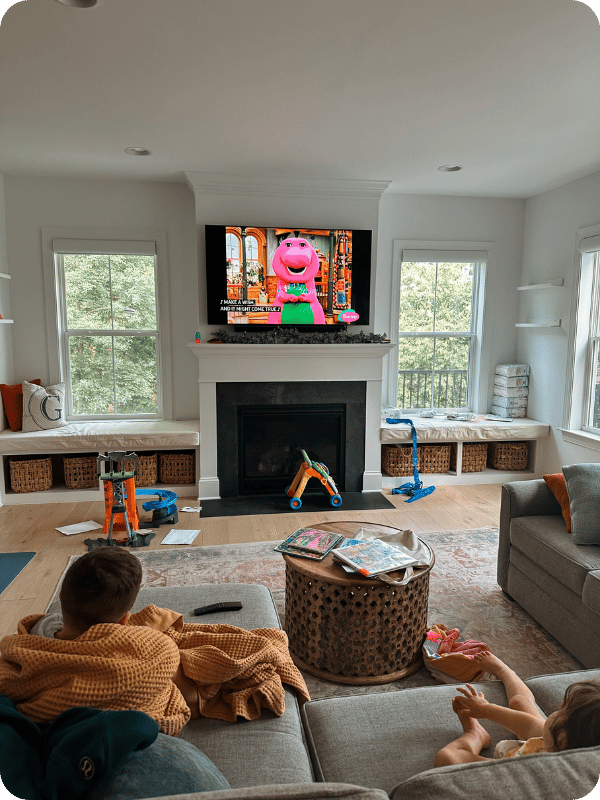
Low stimulation shows for kids
What makes a show low stimulation? Generally, a show can be considered low stimulation if it includes these features:
- Slow pacing, including pauses in dialogue that give little ones time to process
- Natural color schemes
- Mostly static backgrounds that avoid flashing lights, rapid movement, or frequent jump cuts
- Audio that isn’t too busy, loud, or jarring
Sometimes, a show might look low stimulation but is actually hypnotizing. Low stimulation shows should still be engaging for little ones, providing joy, laughter, or curiosity, rather than that glossy-eyed look of hypnosis.
No matter which platform you have, there are low stimulation options. Whether screen time helps you get an everything shower, bridges a gap while you prepare a meal, or you sit down to watch together, parents might even find that they like these shows, too.
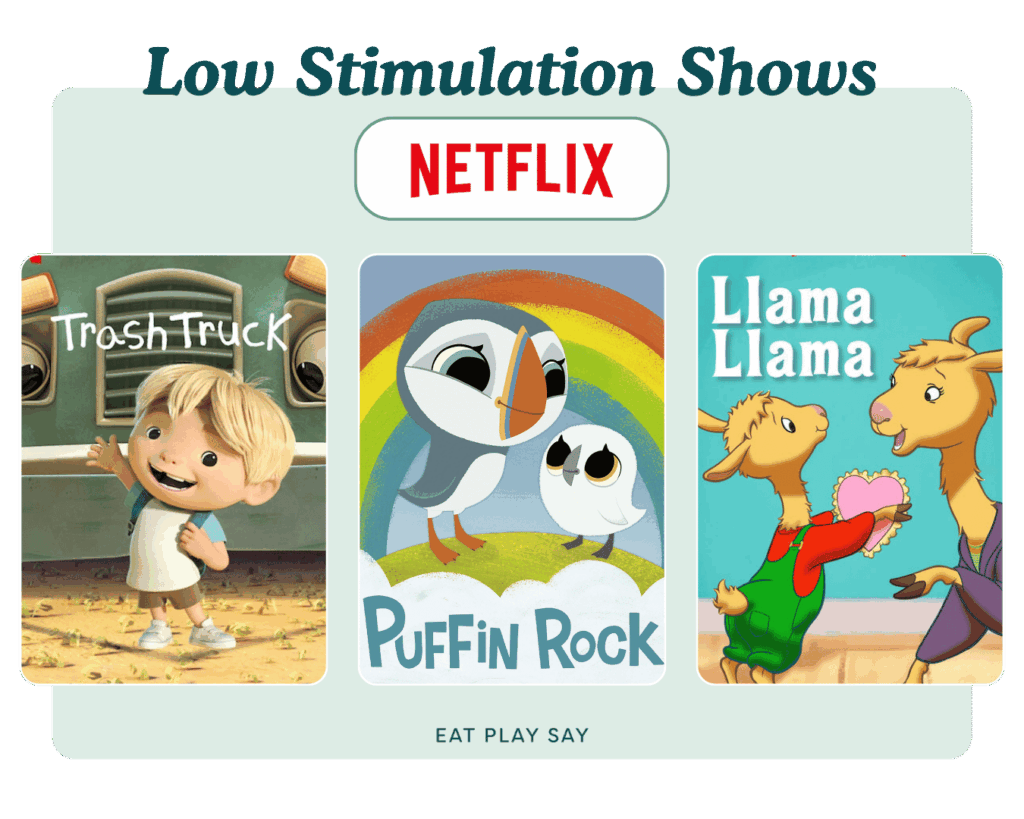
Low stimulation shows for toddlers on Netflix
Trash Truck
This an animated Netflix original show for preschoolers is about the adventures of Hank and his best friend Trash Truck. The pacing is slow and relaxing, and the scenes aren’t too visually overwhelming. Major themes across each episode include friendship, curiosity and creativity, kindness, and the importance of working together. Episodes are about 20 minutes in length. This is a good amount of time for a “break” or if you need to cook dinner or clean up!
Watch Trash Truck here.
Puffin Rock
A gentle low-stimulation show, Puffin Rock is about Oona the Puffin and her family and friends’ lives on the coast of Ireland. The show has soft, muted colors with gentle visuals and movement. The episodes are short and easy for littles to follow (only about 7 minutes per story line). Netflix often compiles 3 episodes into one for streaming.
Watch Puffin Rock here.
Llama Llama
It’s hard to avoid a Llama Llama book (there’s more than 30!), and if you’ve got a little one who loves the books, this show is a great option for screen time! The series models life experiences about family, friendship, navigating big feelings, and growing up. It’s worth noting that the main character, Llama Llama, seems to be a little bit older in the Netflix series than he is in many of the books.
Watch Llama Llama here.
Another popular Netflix show worth considering isn’t necessarily low stimulation.
Ms. Rachel gets an honorable mention for content quality! Wondering why Ms. Rachel isn’t low stimulation? Some of the backgrounds and animation effects can be a bit overwhelming for littles, and the audio can be as well.
Ms. Rachel creates educational content that highlights how beneficial screen time can be when parents watch with their little ones! This is called co-watching, and it’s recommended that parents co-watch as much as possible when littles are watching TV. Parents can help their children pick up on new concepts and practice speech and language skills while watching together, and they can more easily gauge when it might be time to move to a lower stimulation activity, too.
Watch Ms. Rachel on Netflix or on YouTube.
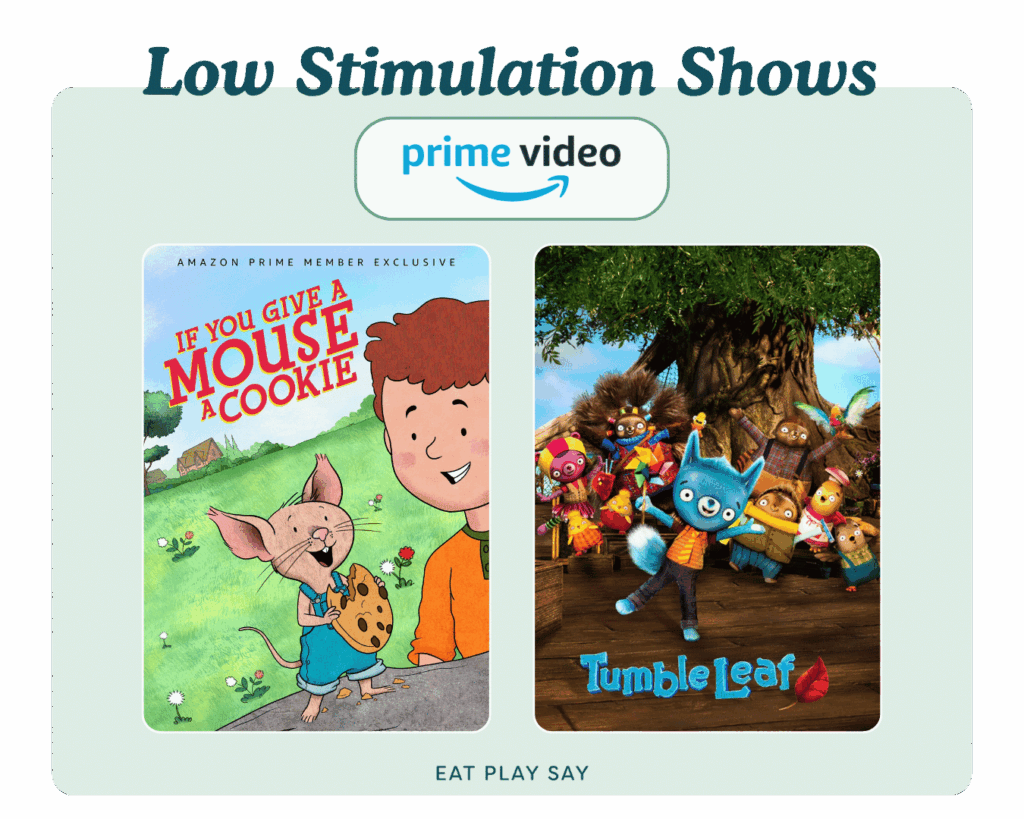
Low stimulation shows on Prime Video
If You Give a Mouse a Cookie
Based on the classic children’s book, this animated Prime series follows Mouse and his friends, including Pig, Moose, Dog, and Cat, and their humans. The animation is similar to the illustration style of the books, which feels familiar and fun for littles who recognize their favorite characters. There are special holiday episodes for Christmas, Halloween, and Valentine’s Day. Episodes are also on the shorter side, running about 25 minutes long.
Watch If You Give a Mouse a Cookie here.
Tumble Leaf
One of the best low stimulation shows for preschoolers, Tumble Leaf features calming, slow, and intentional storytelling. It uses stop-motion animation to create the relaxed pacing and visuals. The main character, Fig, is a blue fox exploring the whimsical land around him as he makes friends and learns about the world. Episodes are about a half hour long and split into two segments.
Watch Tumble Leaf here.
Low stimulation shows on Disney+
Disney+ actually doesn’t have any newer true low stimulation shows for toddlers and preschoolers. Unfortunately, many modern Disney+ shows for toddlers and preschoolers tend to be moderate to high stimulation shows that can quickly overwhelm little ones and their parents. However, there are countless older Disney films and kids’ shows from the 90s that tend to be lower stimulation (see some examples toward the bottom of this post).
Even though Disney+ is lacking overall in low stimulation shows, one was definitely worth mentioning for its content alone.
Bluey
Bluey is widely beloved, and it is kind of low-stimulation, though it probably fits better in a low-to-moderate stimulation category. The animation style isn’t overly stimulating, though there are bright colors and the audio can sometimes be a little loud. For littles who are easily overstimulated, Bluey may not be the best bet. However, Bluey has become so well known in part because it includes storylines that parents and littles can enjoy together. Episodes are short, about 7–8 minutes, and there is a series of mini episodes as well that are only 2–3 minutes.
Watch Bluey here or on the official Bluey YouTube page.
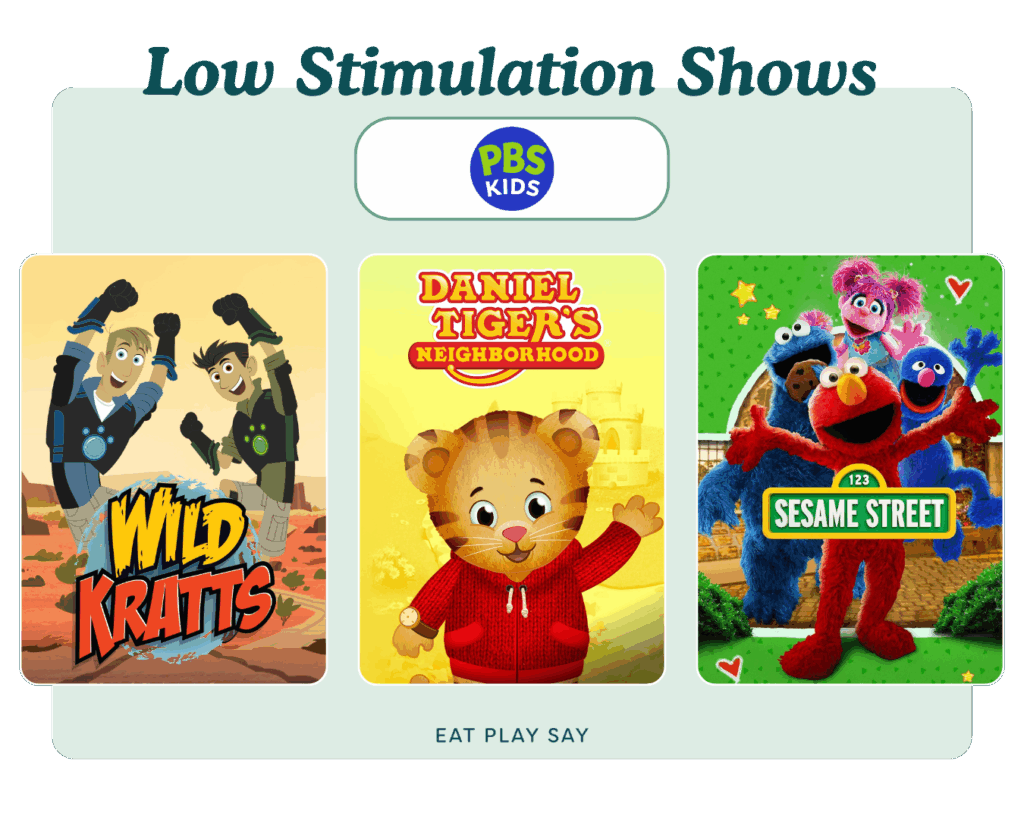
Low stimulation shows on PBS Kids
Wild Kratts
One of the only lower stimulation television shows that blends live action with fully animated scenes, Wild Kratts is an educational show that opens with the live action Kratt brothers as they teach viewers about animals. The animated portion of the show helps littles use their imagination while incorporating science and what they learned in the opening live action segment! We personally like to watch an episode and then find books at the library about that topic, animal, or ecosystem.
Watch Wild Kratts on PBS Kids.
Daniel Tiger’s Neighborhood
Inspired by Mister Rogers himself, Daniel Tiger’s Neighborhood is an animated musical PBS show that also incorporates some live action scenes. Daniel Tiger features simple songs, predictable pacing, and soft colors. One strength of this show is that each episode’s theme is repeated across multiple short, digestible scenes. Some of the songs from Daniel Tiger will get stuck in your head. (Don’t say I didn’t warn you!)
Watch Daniel Tiger’s Neighborhood on PBS Kids.
Sesame Street
You can stream old episodes of Sesame Street in a few different places (including Netflix for new and old episodes), but new releases can be found for free on PBS! Big Bird, Elmo, Cookie Monster, and the rest of the Sesame Street gang have been helping kids learn since 1969! Sesame Street helps kids learn things like the alphabet, counting, how to solve problems with your friends, and how to be kind.
Watch Sesame Street on PBS Kids or on Netflix.
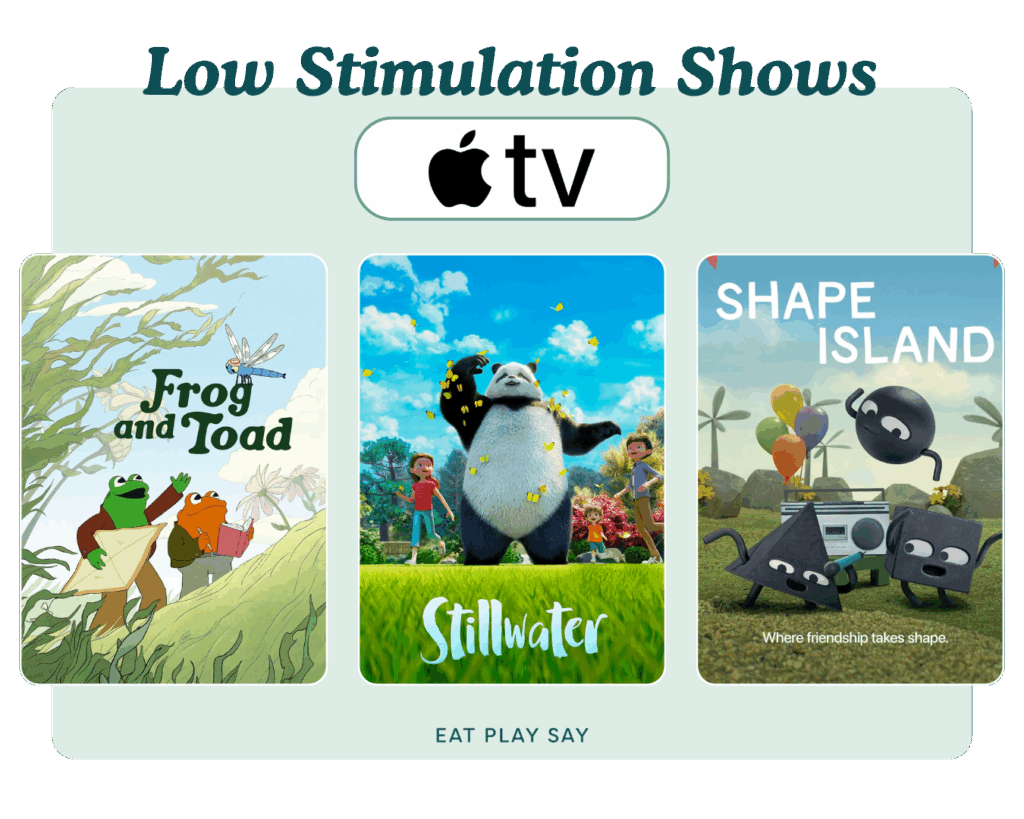
Low stimulation shows on Apple TV
Frog and Toad
Another show based on a beloved children’s book series, Frog and Toad is about friendship with someone who is very different from you. Frog is adventurous and loves new things, while Toad is more reserved and prefers to stay home. Even though this show premiered in 2023, it feels reminiscent of some animated kids’ shows in the 90s, with warm, cozy colors and stories that feel nostalgic. We like to read the books, as well, and sometimes my kids will even request books after the show!
Watch Frog and Toad here.
Shape Island
Shape Island is a stop-motion animation series that helps children learn about friendship, problem solving, and how everyone’s unique differences make connection important. Square, Circle, and Triangle have distinct personalities that often lead to conflict for the friends, but each storyline is age appropriate while also being low stimulation. This show is based on the book trilogy, which is very fun to read. Just like the show, the books focus on problem solving and resolutions, and they leave the reader asking questions, too!
Watch Shape Island here.
Stillwater
Whenever siblings Michael, Addy, and Karl find themselves in need of a hand, it’s their trusted, wise neighbor Stillwater the panda who they turn to. This series helps model important life lessons told in age-appropriate ways for toddlers and preschoolers. The background of this show is very peaceful and calming, which is rare to find in children’s shows. Episodes are about a half hour in length.
Watch Stillwater here.
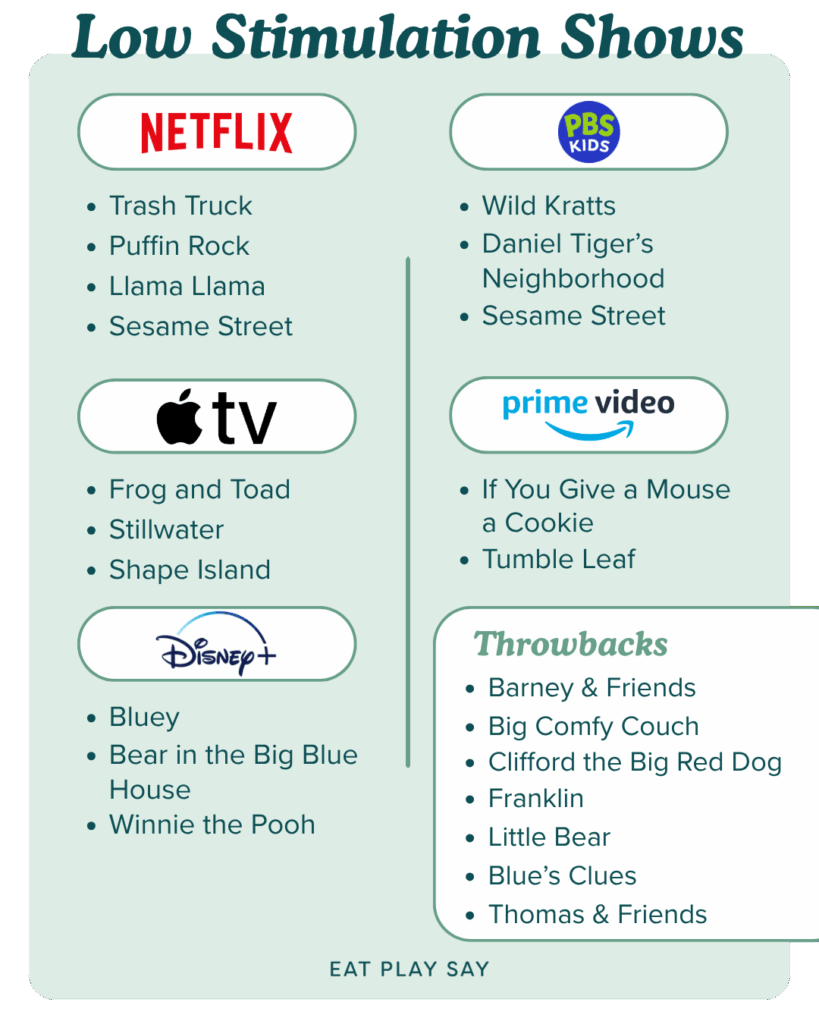
Best throwback shows for preschoolers
In addition to so many new shows that prioritize low stimulation for kids, there are some great throwbacks that fit the bill, too! Many of these can be found on streaming services, some for free!
A few low stimulation shows that are a bit older include:
- Barney & Friends
- Big Comfy Couch
- Clifford the Big Red Dog
- Franklin
- Little Bear
- The Many Adventures of Winnie the Pooh
- Bear in the Big Blue House
- Thomas & Friends
- Blue’s Clues (with Steve!) or Blue’s Clues and You (a bit more stimulating than the original)
Screen-free tech toys
There are great alternatives to screen time that can provide similar engagement and excitement for little ones. Our favorite toys to use instead of screen time are the Toniebox or the Yoto Player. These portable audio players give toddlers and preschoolers access to a variety of characters and stories, as well as fun songs, too!
The Toniebox is our pick for younger listeners (you can find our favorite Tonies here), while the Yoto Player tends to be more enjoyable for preschoolers and up.
More infant & toddler development resources
Looking for ways to fill the time with your little one once screen time is over? We’ve got your back! The Playbooks include 100+ age-appropriate ways to play with littles using only what you have at home.
Find more free resources like this on our blog:
- Speech & language support
- Starting solids tips
- Breast & bottle feeding support
- Play activities for littles
- Infant & toddler development
- Get help feeding toddlers
Sources
- Common Sense Media, Media Use by Kids Zero to Eight, 2025.
- Tiffany Munzer, Joanna Parga-Belinkie, Libby Matile Milkovich, Suzy Tomopoulos, Taiwo Ajumobi, Corinn Cross, Roslyn Gerwin, Sheri Madigan, R. Psych, Council on Communications and Media; Digital Ecosystems, Children, and Adolescents: Policy Statement. Pediatrics February 2026; 157 (2): e2025075320. 10.1542/peds.2025-075320
- American Academy of Pediatrics, Average Amount of Screen Time for Children and Young Adults, Updated 22 June 2026. Accessed 28 August 2026.
Leave a Reply
OTHER POSTS YOU MAY LIKE:



MS, SLP
Founder of Eat Play Say, Speech-Language Pathologist, Feeding Specialist, Play Expert, Mom of 3
Jordyn Koveleski Gorman
SPECIALIZES IN: Infant and toddler speech-language, play, and feeding development, and curating a team that provides expert help that feels like a reassuring text from that one mom friend
EDUCATION: Jordyn received her BS in Speech-Language Pathology from Bloomsburg University and her MS in Speech-Language Pathology from Towson University
FAVE PARENTING FIRST: “The first true smile, it’s the sweetest!”

MS, CCC-SLP, CBS, IBCLC
Speech-Language Pathologist & Feeding Specialist, Certified Breastfeeding Specialist, International Board Certified Lactation Consultant
Jessica Nicholson Cocca
SPECIALIZES IN: Breast and bottle feeding, tongue ties, oral motor dysfunction, starting solids, infant and toddler speech, treating oral motor disorders
EDUCATION: Jessica received her BS in Communication Sciences and Disorders from Pennsylvania State University in 2015 and her MS in Speech-Language Pathology from Towson University in 2017
FAVE PARENTING FIRST: “Baby’s first wave! What a fun first communication gesture!”

MA, CCC-SLP, CLC
Speech-Language Pathologist, Certified Lactation Counselor
Jennifer McFarlin
SPECIALIZES IN: Breast and bottle feeding, tongue ties, starting solids, infant and toddler speech development
EDUCATION: She received her BS in Speech-Language Pathology from Ball State in 2014 and a MA in Speech-Language Pathology from Ball State in 2016.
FAVE PARENTING FIRST: “My favorite baby’s first is their first true smile that just warms your soul knowing they are smiling at you. My other favorite is their first word. I love watching their language explode!”

MS, CCC-SLP
Bilingual Speech-Language Pathologist
Nicole La Petina Kelly
SPECIALIZES IN: Bilingual development (Spanish-English), supporting multilingual families, infant and toddler speech
EDUCATION: She received her BA in Communication Sciences and Disorders and in Spanish from the University of Wisconsin-Madison in 2014 and her MS in Speech-Language Pathology with an English-Spanish Specialization from Marquette University in 2016.
FAVE PARENTING FIRST: “It’s the first slobbery kisses for me!”

RDN, LD
Licensed Registered Dietitian
Kimberly Vede
SPECIALIZES IN: Infant and pediatric nutrition including breastfeeding, formula feeding, and starting solids. She also specializes in prenatal and postpartum nutrition.
EDUCATION: She received her BSc in Biology in 2014 from Life University, and her BSc in Dietetics from Life University in 2019.
FAVE PARENTING FIRST: ”The first time they say ‘mama!’”


This checklist was created with input from a Speech-Language Pathologist, Occupational Therapist and Physical Therapist and has been downloaded over 20,000 times by parents worldwide. Learn the important milestones to pay attention to, and keep it in your digital back pocket during the baby + toddler years!
Comprehensive Milestone Checklist for gross motor, fine motor, and speech-language milestones for 0-36 months,
DOWNLOAD FOR FREE


