


When Do Babies Start Rolling Over?
August 12, 2026
Jordyn Koveleski Gorman

Last Updated on August 12, 2026 by Jordyn Koveleski Gorman
This page contains affiliate links. We will receive a commission on qualifying purchases using these links.
Bringing home a scrunchy, snuggly newborn is an experience unlike anything else. Newborns really do seem to just eat, sleep, cry, and poop at all hours of the day! But don’t be fooled, every day from birth onward, baby is learning new skills at warp speed.
Before long, those tiny hands and feet are ready to explore the world. One of the first major milestones that helps them see the world from a new view? Rolling over!
If you’re wondering when your baby should start to roll over or if there’s anything you can do to help them get there, you’re in the right place. Let’s break down how and when rolling develops for your little one, as well as some of our pediatric physical therapist’s favorite activities to support your baby as they learn to roll!

When do babies start rolling over?
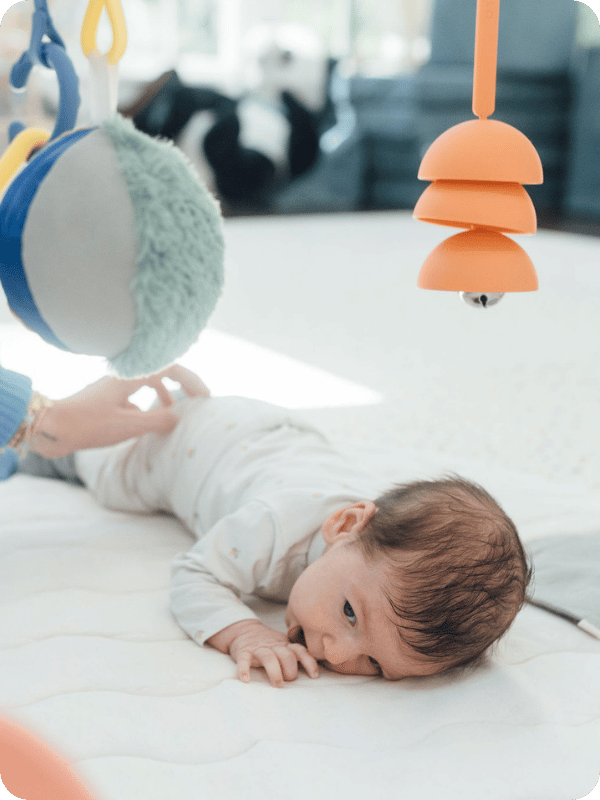
By around the end of baby’s third month, we expect to see them roll from their side to their back. Most babies then roll from their belly to their back for the first time between 4–6 months of age. (1)
Developmentally, it’s easiest and most common for babies to roll from their belly to their back first. From there, it can take a few weeks or a couple of months to roll from their back to their belly. Rolling from back to belly requires baby to coordinate and strengthen more muscle groups than going from belly to back. Additionally, going from back to belly means baby has to build more momentum while fighting against gravity. It’s hard work for such a little body!
Usually by around 12 weeks, babies have begun showing some signs that rolling is near. This coincides with an important sleep safety recommendation. If baby sleeps swaddled, it is no longer safe once baby shows signs that they might roll soon. The potential that baby may roll while asleep cannot be ruled out, which poses a significant suffocation risk due to baby’s hands being stuck under them in the swaddle. Freeing baby’s hands is important once baby starts to wiggle! You can keep their hands out of the swaddle or transition to a sleep sack.
Signs that baby might start rolling soon
How can you tell if baby is about to become a roly-poly? Watch for these signs that rolling is near for your little one:
- Arching their back during play time
- Reaching both arms over their body to one side during play
- “Rocking” back and forth, as if they’re gearing up to roll
- Positioning themselves on their side during play
- Kicking their legs back and forth, like they are trying to gain momentum
Babies may build these skills for several weeks before putting them all together to accomplish their first roll from one side to the other, but it could also be a matter of days.
Why rolling matters
Rolling in particular is a major stepping stone for other important developmental changes. It is the first movement milestone that allows an infant to have some control over their environment and what they see. Additionally, rolling is associated with other cognitive and motor developments, such as sitting, crawling, and walking. (2)
Like other milestones, rolling develops at different times for every baby, which is why there is a range of normal. Noticing the precursors to rolling certainly signals that this new skill is near, but there are a few other things that baby’s specific roll method can teach us.
For instance, babies that struggle with body tension or torticollis may prefer rolling to only one side. They may even resist rolling the opposite direction from discomfort. Babies that are experiencing motor delays may struggle to coordinate their bodies for the roll or have weakness in one of the key muscle groups needed for rolling. Or baby may successfully roll, but their movements are out of balance or require them to compensate for weakness somewhere in their body.
When parents are aware of rolling as a milestone, and know about the different “techniques” baby may use for rolling, they are better able to advocate in the event that baby needs additional support. (2) Having the knowledge and confidence to speak up about concerns can make all the difference. For instance, sole reliance on standard developmental screening surveys can lead to delayed or missed diagnoses for motor delays. (3) The more parents know, the better!
Whether baby is 3 months or 6 months old, it’s okay if they need a little help! Rolling is a big milestone, and sometimes an extra hand from a caregiver or a few sessions of PT/OT is all they need to sort it out.
Join 40,000+ other parents to “check and see” where your little one is at with milestones. Download our FREE Milestone Checklist!
What to do if baby isn’t rolling as expected
Early intervention is key, and the sooner a child receives the extra support they need, the faster and more likely they are to “catch up.” If your little one hasn’t started to roll at least one way by 5 months or you are concerned about their motor development, contact Early Intervention in your state for a free evaluation and/or speak to your child’s pediatrician. You can also find a private practice or hospital-based provider that may have sooner availability, or schedule a virtual consultation with one of our professionals.
In the meantime, there are ways you can help baby at home while waiting for an evaluation.
How to help baby roll over
From early newborn play to when baby is nearing 3 months, you’ll find that they get more and more interested in looking at your face and engaging in their environment. You can use this to your advantage when helping baby build the strength and coordination needed to roll!
Try these activities to support and encourage baby to roll.
Side Rolling
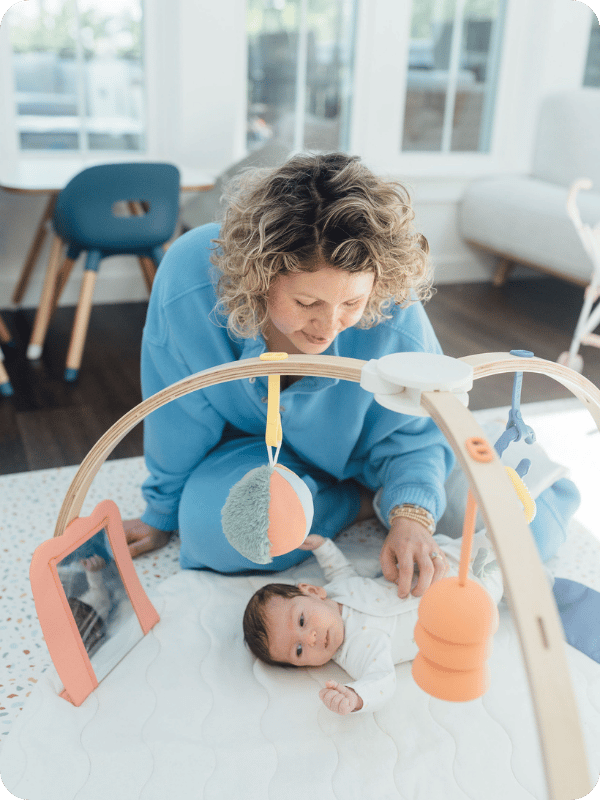
Lay baby down on the floor, on a blanket or play gym. They should be on their back. Gently roll baby to their side. Lift their bottom arm so that it is next to their head, then help baby roll all the way over to their tummy. (Need a visual? The videos in this post can help!) If baby doesn’t yet have good head control, their head will need to lay to the side on the blanket. That’s okay! Lay down on the floor next to baby and talk to them. Start with a few seconds, working up to a few minutes at a time. Baby will soon start to lift their head and turn it to the other side. Other tummy time activities are great for promoting rolling, too!
Diaper Change Play
After each diaper change, roll baby onto their side and hold for 30–60 seconds while singing a song like Twinkle, Twinkle Little Star or Itsy Bitsy Spider. When you are finished singing, gently pull your hand back and see if baby rolls onto their back by themselves. Try both sides after each diaper change or alternate between sides.
Side Rocks
Place baby on their back while on the floor. Bring their feet and hands to their belly button so their arms and legs meet at their midline. While holding onto baby’s hands and feet, gently rock them from side-to-side. As you rock them, wait for their head and neck to also turn to that side. This is a fabulous activity to get those pre-rolling bodies practicing and ready to move, as well as integrating some primitive reflexes.
Roll Out
This one is great as baby starts having some success with rolling. While baby is playing on the floor on their back or side, place some fun household items (like wipes or the remote) just out of reach. Watch as they try to scoot and roll to get to the items. You can help them get into position if they need it! If they start to get frustrated, move the items closer so they have success, then move them farther away again.
Remember that every baby is different, and it’s okay if your little one doesn’t roll over at the same time as another baby! Give your baby a little time to practice, and help them along the way as you can. If you are concerned about your baby’s development, always talk with your child’s pediatrician or schedule a consultation with a specialist if you feel dismissed! You know your child best!
More infant resources
Raising little ones is hard work. Having the right resources to support you can make all the difference.
Check out our blog for more posts about:
- Infant & toddler development
- Breast and bottle feeding
- Starting solids
- Play activities and crafts
- Speech and language skills
For more activities like the ones in this post, grab your copy of the Infant Playbook! With 100+ activities to support your little one’s milestones using only what you have at home, this guide will help you play through your baby’s first year of life without stress!
Sources
- Jennifer M. Zubler, Lisa D. Wiggins, Michelle M. Macias, Toni M. Whitaker, Judith S. Shaw, Jane K. Squires, Julie A. Pajek, Rebecca B. Wolf, Karnesha S. Slaughter, Amber S. Broughton, Krysta L. Gerndt, Bethany J. Mlodoch, Paul H. Lipkin; Evidence-Informed Milestones for Developmental Surveillance Tools. Pediatrics March 2022; 149 (3): e2021052138. 10.1542/peds.2021-052138
- Siegel DN, Ogle MM, Wilson C, Scholes O, Prow A, Mannen EM. How do babies roll? Identifying the coordinated movements of infant rolling through video compared to laboratory techniques. Technol Health Care. 2024;32(4):2527-2539. doi: 10.3233/THC-231281. PMID: 38251079; PMCID: PMC11222302.
- Garey H. Noritz, Nancy A. Murphy, NEUROMOTOR SCREENING EXPERT PANEL, Nancy A. Murphy, Joseph F. Hagan, Paul H. Lipkin, Michelle M. Macias, Dipesh Navsaria, Garey H. Noritz, Georgina Peacock, Peter L. Rosenbaum, Howard M. Saal, John F. Sarwark, Mark E. Swanson, Max Wiznitzer, Marshalyn Yeargin-Allsopp; Motor Delays: Early Identification and Evaluation. Pediatrics June 2013; 131 (6): e2016–e2027. 10.1542/peds.2013-1056
Leave a Reply
OTHER POSTS YOU MAY LIKE:



MS, SLP
Founder of Eat Play Say, Speech-Language Pathologist, Feeding Specialist, Play Expert, Mom of 3
Jordyn Koveleski Gorman
SPECIALIZES IN: Infant and toddler speech-language, play, and feeding development, and curating a team that provides expert help that feels like a reassuring text from that one mom friend
EDUCATION: Jordyn received her BS in Speech-Language Pathology from Bloomsburg University and her MS in Speech-Language Pathology from Towson University
FAVE PARENTING FIRST: “The first true smile, it’s the sweetest!”

MS, CCC-SLP, CBS, IBCLC
Speech-Language Pathologist & Feeding Specialist, Certified Breastfeeding Specialist, International Board Certified Lactation Consultant
Jessica Nicholson Cocca
SPECIALIZES IN: Breast and bottle feeding, tongue ties, oral motor dysfunction, starting solids, infant and toddler speech, treating oral motor disorders
EDUCATION: Jessica received her BS in Communication Sciences and Disorders from Pennsylvania State University in 2015 and her MS in Speech-Language Pathology from Towson University in 2017
FAVE PARENTING FIRST: “Baby’s first wave! What a fun first communication gesture!”

MA, CCC-SLP, CLC
Speech-Language Pathologist, Certified Lactation Counselor
Jennifer McFarlin
SPECIALIZES IN: Breast and bottle feeding, tongue ties, starting solids, infant and toddler speech development
EDUCATION: She received her BS in Speech-Language Pathology from Ball State in 2014 and a MA in Speech-Language Pathology from Ball State in 2016.
FAVE PARENTING FIRST: “My favorite baby’s first is their first true smile that just warms your soul knowing they are smiling at you. My other favorite is their first word. I love watching their language explode!”

MS, CCC-SLP
Bilingual Speech-Language Pathologist
Nicole La Petina Kelly
SPECIALIZES IN: Bilingual development (Spanish-English), supporting multilingual families, infant and toddler speech
EDUCATION: She received her BA in Communication Sciences and Disorders and in Spanish from the University of Wisconsin-Madison in 2014 and her MS in Speech-Language Pathology with an English-Spanish Specialization from Marquette University in 2016.
FAVE PARENTING FIRST: “It’s the first slobbery kisses for me!”

RDN, LD
Licensed Registered Dietitian
Kimberly Vede
SPECIALIZES IN: Infant and pediatric nutrition including breastfeeding, formula feeding, and starting solids. She also specializes in prenatal and postpartum nutrition.
EDUCATION: She received her BSc in Biology in 2014 from Life University, and her BSc in Dietetics from Life University in 2019.
FAVE PARENTING FIRST: ”The first time they say ‘mama!’”


This checklist was created with input from a Speech-Language Pathologist, Occupational Therapist and Physical Therapist and has been downloaded over 20,000 times by parents worldwide. Learn the important milestones to pay attention to, and keep it in your digital back pocket during the baby + toddler years!
Comprehensive Milestone Checklist for gross motor, fine motor, and speech-language milestones for 0-36 months,
DOWNLOAD FOR FREE


