


Torticollis and Body Tension in Babies
July 18, 2024
Jordyn Koveleski Gorman

Last Updated on April 10, 2026 by Jordyn Koveleski Gorman
Torticollis, or tight neck, is a condition primarily seen in newborns and young babies. Typically, one side of the neck is tighter than the other, causing a baby to have difficulty turning his or her head. It can also cause a head tilt toward the side of the tightness.
Torticollis can cause plagiocephaly (flat spots on the head) and delayed motor milestones. Recognizing the signs can help ensure quick treatment, which can sometimes prevent the need for additional interventions.
The Eat Play Say physical therapist joined in for this post about treating one of the most common conditions in newborn babies.
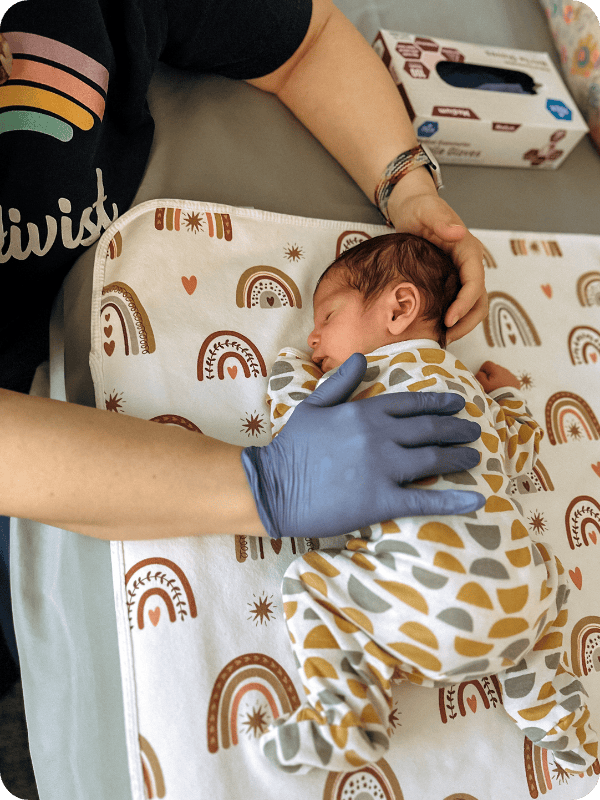
Understanding torticollis in babies
Have you noticed your baby prefers to look in one general direction when lying on their back or stomach? Or maybe that they have more difficulty tracking a toy to one side? Does every picture of your baby show them looking the same way? Does your baby prefer to breastfeed on the same side or have difficulty accepting a bottle when holding them one way?
These are all potential signs of torticollis. If you notice any of these, remember that early intervention is key to correcting torticollis!
My son Paul had torticollis, and I missed it. But looking back through my camera roll, I can see his head turning preference so clearly! He also struggled to get into position to feed and didn’t enjoy being moved out of his “comfortable” position. For Paul, that position was his head turned to the right and nestled down near his shoulder.
Some babies are born with torticollis due to positioning in the womb or due to events that occurred during labor and delivery. (1) For example, many babies that move quickly through the birth canal present with body tension. Anecdotally, this was the case for all three of my babies! Others develop torticollis in the early months of life due to muscle tightness, positioning, or excessive use of equipment like swings, bouncer seats, and infant loungers. (2) Reducing the amount of time spent in infant “containers” is an important step to preventing Container Baby Syndrome.
Early intervention, such as receiving physical/occupational therapy, cranial sacral therapy or chiropractic care, stretching routines, modifying activities, and positioning, is important when body tension and torticollis are observed. It may help correct torticollis, prevent or help reverse head flattening, and, if help is received early enough, it can prevent the need for a helmet due to head flattening! Learn more about head flattening here.
Signs of torticollis and body tension in babies
If you notice any of the following, your baby may have torticollis or body tension and an evaluation with a trained professional is recommended to confirm or rule out:
- Your baby only rolls one direction or mainly looks in one direction
- Feeding baby is difficult: poor latch, arching back, discomfort during and after feeding, and/or reflux
- Baby moves one arm or leg more freely than the other
- Red neck creases are present, especially if more prominent on one side of the neck
- Difficulty with tummy time
- Baby seems uncomfortable in the car seat

How to treat torticollis in infants
The sooner torticollis and body tension is corrected, the sooner babies can catch up with their milestones and feel more comfortable in their body. If you’re noticing any of the signs above, it’s worth getting evaluated.
You can start with your child’s pediatrician. Additionally, you can self-refer to early intervention in the USA if you have a concern. Evaluations are free in all states and therapy is no-cost or low-cost if baby qualifies. All you have to do is find the number for your state and make a call.
The term “wait and see” is one that gained popularity for a while, but is not a recommended method to monitor development. It is better to “check and see” and be told there’s no concern than wait too long and miss the window for best results. There is no harm in getting an evaluation, but there could be negative impacts if something you noticed is left untreated.
Torticollis stretches
Sometimes, evaluations take a while to get scheduled. Even if you call right away, you may have to wait a while. You can also schedule an evaluation with a private practice or hospital-based provider. Insurance may cover part of these services, and wait times may be less. Whatever feels best for your family, trust your gut!
Here are some things to try at home while you wait for an evaluation:
- Give your baby the most chances to look the other direction as possible. Rotate which end of the bed your baby faces when they sleep, switch their direction on the changing table, and hold them alternating directions in your arms.
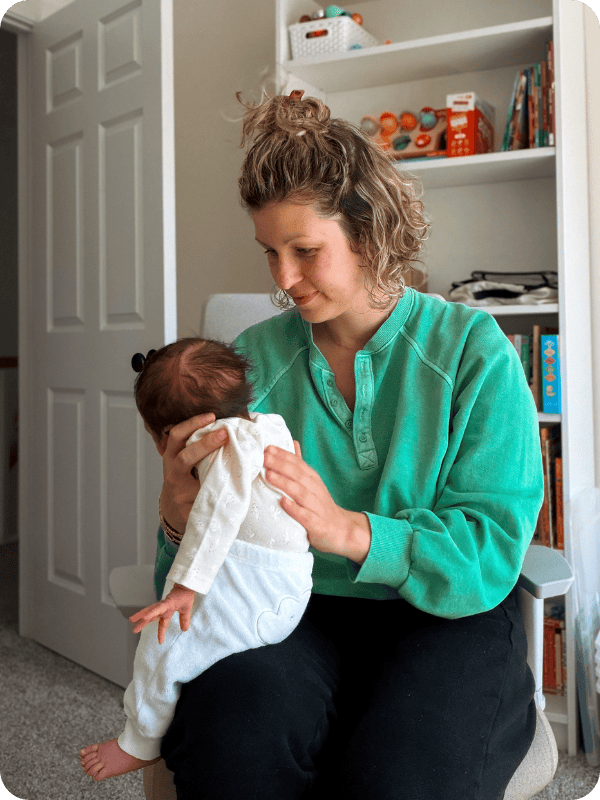
- Hold your baby in a sitting position with their back to your chest. Baby will face outward. Place one hand under their butt and one hand under their chin. Gently turn your baby’s head from side to side in this position. Lightly bouncing can help! (See picture below).
- Work on tracking toys in both directions when lying down. You want your baby to look both ways equally on their back and belly. Babies are most attracted to high contrast or brightly colored toys and your face! Slowly move these objects side to side as your baby looks at them on their back.
- Play with your baby in sidelying. This is a great way to work on bringing baby’s hands to midline and give your baby time off the back of their head. Commonly recommended for newborns during tummy time, the sidelying position has benefits long after they learn to hold their head upright!
- Practice tummy time in short spurts on the floor or on your chest. Use a baby carrier to get chores done around the house instead of a bouncer or swing. Limit container use to 15 minutes because bouncers and swings tend to limit head movement. Use a playpen or a blanket on the floor to lay your baby down instead.

What if torticollis in babies is left untreated?
If torticollis or body tension is left untreated, babies can develop flat spots on their head. Sometimes, even with proper and early treatment for torticollis, flat spots do not resolve adequately on their own.
Significant flattening of the skull may require helmet therapy. Helmets are most beneficial before one year of age, so it is best to get evaluated early if you notice that your baby has a flat spot or uneven eyes or ears.
Head shape is important later in life for proper fit of bike/sports helmets, hats, and glasses! My son Paul used a helmet to treat his plagiocephaly. You can read about our helmet journey here!
Delayed motor milestones are another concern with untreated torticollis. Babies with torticollis often prefer to roll one direction and can develop weakness on one side of their bodies. They may have difficulty with movements that require using both sides of their bodies together, like crawling and walking. They can also have difficulty with sitting unsupported and reaching for toys while sitting. Eating difficulties may arise due to poor posture in sitting.
Treatment for torticollis has proven incredibly effective, with 90–95% of babies receiving treatment showing improvement before 1 year of age. (1) And, for babies who began treatment before 6 months of age, improvement is as high as 97%. (1)

More infant development support
Remember that torticollis and body tension are not your fault. Don’t be afraid to ask for help if you notice that your baby has tightness or a flat spot. And, if your baby needs a helmet or physical therapy, know that you’re in good company! Remember that you are just doing what is best for your baby, and nobody else’s opinion matters.
If you want to talk to a development professional about your little one, you can schedule a 1:1 consultation here!
If you are looking for a professional near you to treat torticollis or body tension, look for a physical therapist, occupational therapist, or cranial sacral therapist trained in helping young infants.
Being aware of milestones is a good thing. So, we put them all in one place for free! Grab our most downloaded freebie so you can always “check and see” where your baby is at!

Sources
- Gundrathi J, Cunha B, Tiwari V, et al. Congenital Torticollis. [Updated 2024 Mar 20]. In: StatPearls [Internet]. Treasure Island (FL): StatPearls Publishing; 2026 Jan-.
- Avruskin A. Physical Therapy Guide to Container Baby Syndrome. American Physical Therapy Association. ChoosePT Guide Website. Published 2018. Updated August 2023. Accessed April 6, 2026.
OTHER POSTS YOU MAY LIKE:




MS, SLP
Founder of Eat Play Say, Speech-Language Pathologist, Feeding Specialist, Play Expert, Mom of 2
Jordyn Koveleski Gorman
SPECIALIZES IN: Infant and toddler speech-language, play, and feeding development, and curating a team that provides expert help that feels like a reassuring text from that one mom friend
EDUCATION: Jordyn received her BS in Speech-Language Pathology from Bloomsburg University and her MS in Speech-Language Pathology from Towson University
FAVE PARENTING FIRST: “The first true smile, it’s the sweetest!”

MS, CCC-SLP, CBS, IBCLC
Speech-Language Pathologist & Feeding Specialist, Certified Breastfeeding Specialist, International Board Certified Lactation Consultant
Jessica Nicholson Cocca
SPECIALIZES IN: Breast and bottle feeding, tongue ties, oral motor dysfunction, starting solids, infant and toddler speech, treating oral motor disorders
EDUCATION: Jessica received her BS in Communication Sciences and Disorders from Pennsylvania State University in 2015 and her MS in Speech-Language Pathology from Towson University in 2017
FAVE PARENTING FIRST: “Baby’s first wave! What a fun first communication gesture!”

MA, CCC-SLP, CLC
Speech-Language Pathologist, Certified Lactation Counselor
Jennifer McFarlin
SPECIALIZES IN: Breast and bottle feeding, tongue ties, starting solids, infant and toddler speech development
EDUCATION: She received her BS in Speech-Language Pathology from Ball State in 2014 and a MA in Speech-Language Pathology from Ball State in 2016.
FAVE PARENTING FIRST: “My favorite baby’s first is their first true smile that just warms your soul knowing they are smiling at you. My other favorite is their first word. I love watching their language explode!”

MS, CCC-SLP
Bilingual Speech-Language Pathologist
Nicole La Petina Kelly
SPECIALIZES IN: Bilingual development (Spanish-English), supporting multilingual families, infant and toddler speech
EDUCATION: She received her BA in Communication Sciences and Disorders and in Spanish from the University of Wisconsin-Madison in 2014 and her MS in Speech-Language Pathology with an English-Spanish Specialization from Marquette University in 2016.
FAVE PARENTING FIRST: “It’s the first slobbery kisses for me!”

RDN, LD
Licensed Registered Dietitian
Kimberly Vede
SPECIALIZES IN: Infant and pediatric nutrition including breastfeeding, formula feeding, and starting solids. She also specializes in prenatal and postpartum nutrition.
EDUCATION: She received her BSc in Biology in 2014 from Life University, and her BSc in Dietetics from Life University in 2019.
FAVE PARENTING FIRST: ”The first time they say ‘mama!’”


This checklist was created with input from a Speech-Language Pathologist, Occupational Therapist and Physical Therapist and has been downloaded over 20,000 times by parents worldwide. Learn the important milestones to pay attention to, and keep it in your digital back pocket during the baby + toddler years!
Comprehensive Milestone Checklist for gross motor, fine motor, and speech-language milestones for 0-36 months,
DOWNLOAD FOR FREE


