


Flat Spots: When & How to Treat Them
October 9, 2024
Jordyn Koveleski Gorman

Last Updated on May 26, 2026 by Jordyn Koveleski Gorman
Did you know that up to 1 in 2 babies will develop a flat spot in infancy? (1)
Although flat spots have always existed, due to the nature of infant skulls being soft and malleable, awareness has certainly increased in recent history. Knowing when to offer extra support to your little one can feel overwhelming. Conflicting information is everywhere, and if you’re reading this, you probably don’t like the advice to “wait and see.” Trust me: same.
As a mom (and pediatric SLP and feeding specialist) whose child had a flat spot and was dismissed, please know that you’re not alone!
Understanding flat spots and how to manage them is important, and you deserve to feel empowered in supporting your little one. With our team of pediatric specialists, we’re here to help you gain the knowledge you need to make informed decisions for your baby!
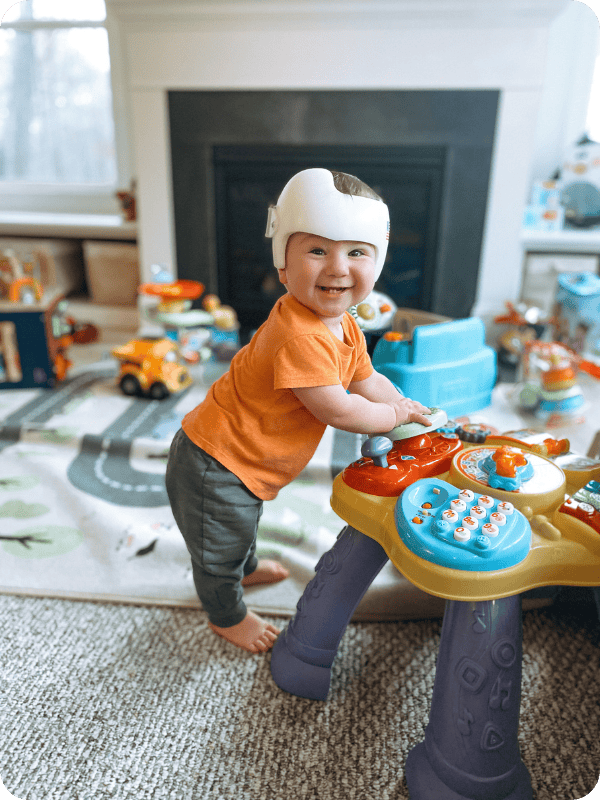
What is an infant flat spot?
Flat spots (also known as plagiocephaly) can range in severity from mild to severe and can be caused by many different scenarios. You can learn more about the causes of Flat Head Syndrome here.
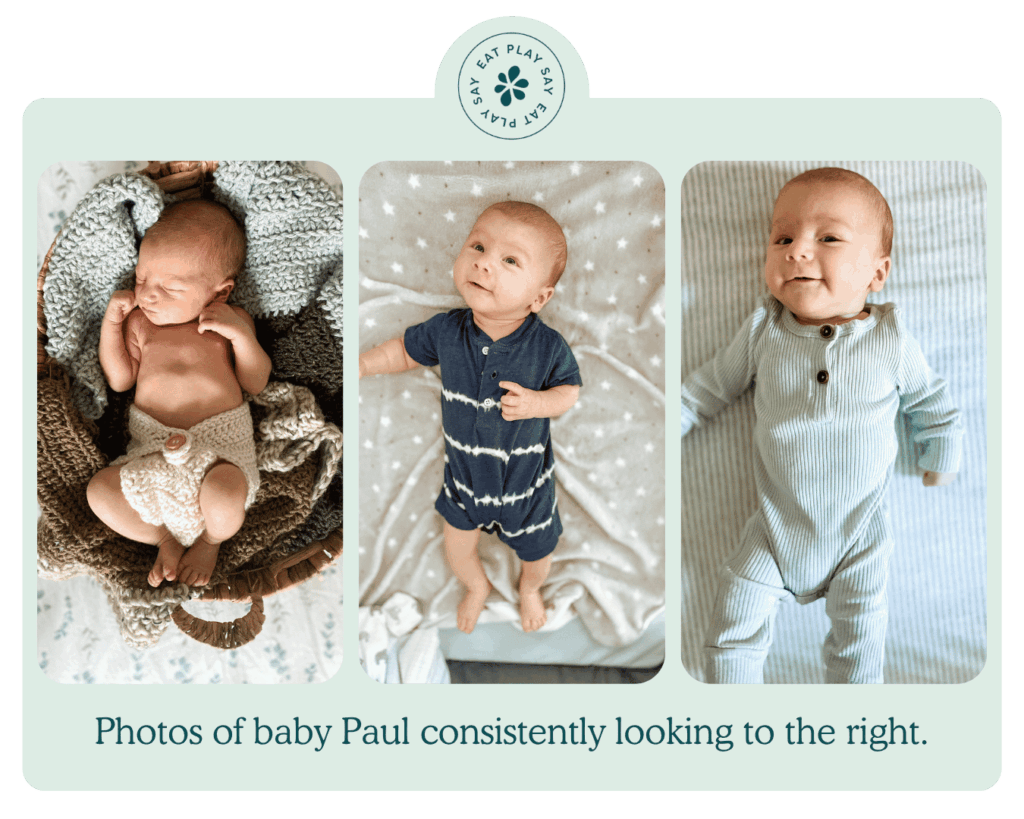
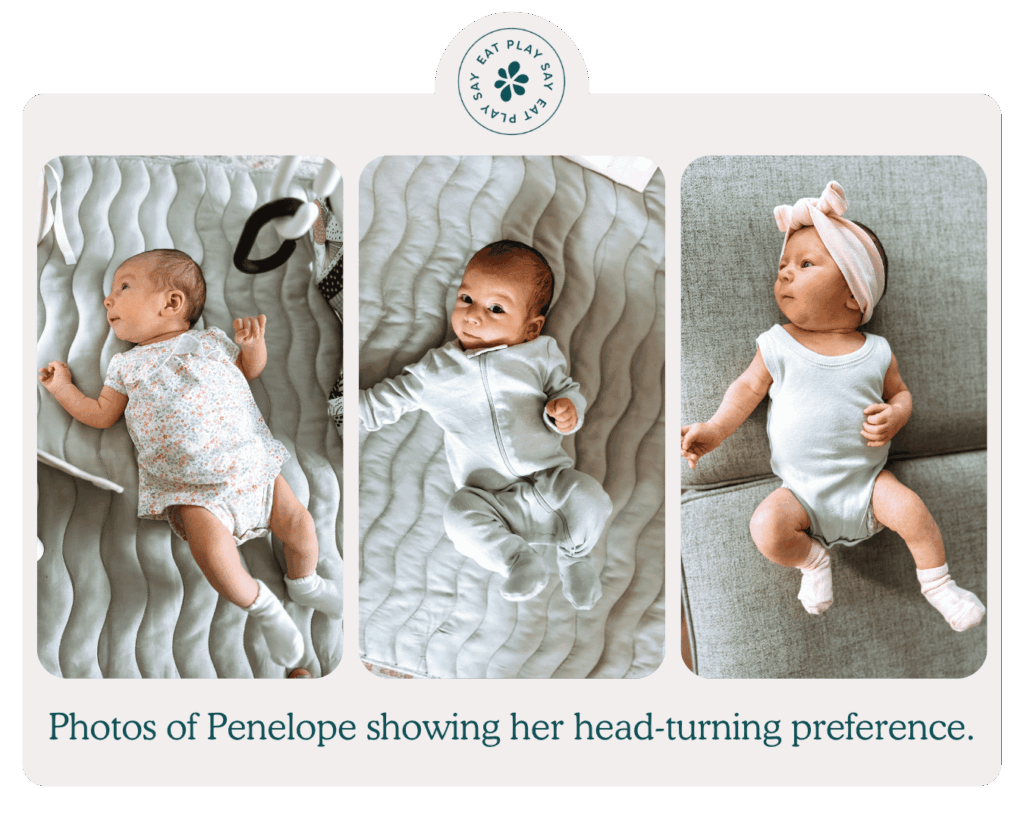
Some parents will notice a flat spot on their baby’s head as early as a few weeks of age. Often, flat spots are accompanied by a “head turning preference.” Signs of a head turning preference include:
- Baby’s head frequently turns/falls to one side when lying on their back
- They frequently look only one direction during play
- Baby consistently sleeps with their head turned the same direction
Head turning preference is often accompanied by a flat spot. My first two babies had a head turning preference due to their positioning in the womb and underlying body tension.
It’s important to be aware of your baby’s head shape and check to see if they have a head turning preference in the newborn phase. The easiest time to look at your little one’s head is during bath time or when getting ready for bed. Make it a habit to take a look at both sides of their head and the shape from the top down.
Hint: Your camera roll will tell you a lot! If baby is looking one way in lots of pictures, that’s a sign they may have a head turning preference!
Flat spot intervention: The earlier, the better. Always.
If you notice that your baby’s head seems to have some flattening or that your baby frequently likes to look to one side, it’s best to reach out to a physical therapist (PT) or occupational therapist (OT) for an evaluation as soon as you notice it.
You can talk to your pediatrician at the next scheduled well-visit, but you don’t have to wait! You can call your local Early Intervention program for free and schedule an evaluation without a referral from a doctor. All you have to do is call!
While you wait for an evaluation, there are some things you can do to help support your baby. Read about how you can help their flat spot at home here.
Why not to “wait and see” with a flat spot on baby’s head
The “wait and see” approach is something that’s often talked about with infants. Sometimes parents will bring up a concern or question to their pediatrician, or even ask a family member or friend for their thoughts, and they will be met with “let’s wait and see for a couple weeks/months, etc.” While, yes, sometimes babies need a little bit more time to reach milestones or develop skills, when it comes to flat spots, waiting and seeing is not the best option.
As babies grow, their head growth slows down.
The most rapid rate of head growth occurs before 6 months of age, making the ideal treatment window for flat spots prior to 6 months of age. If a cranial helmet is needed for reshaping, that ideal treatment window is between 4-6 months.
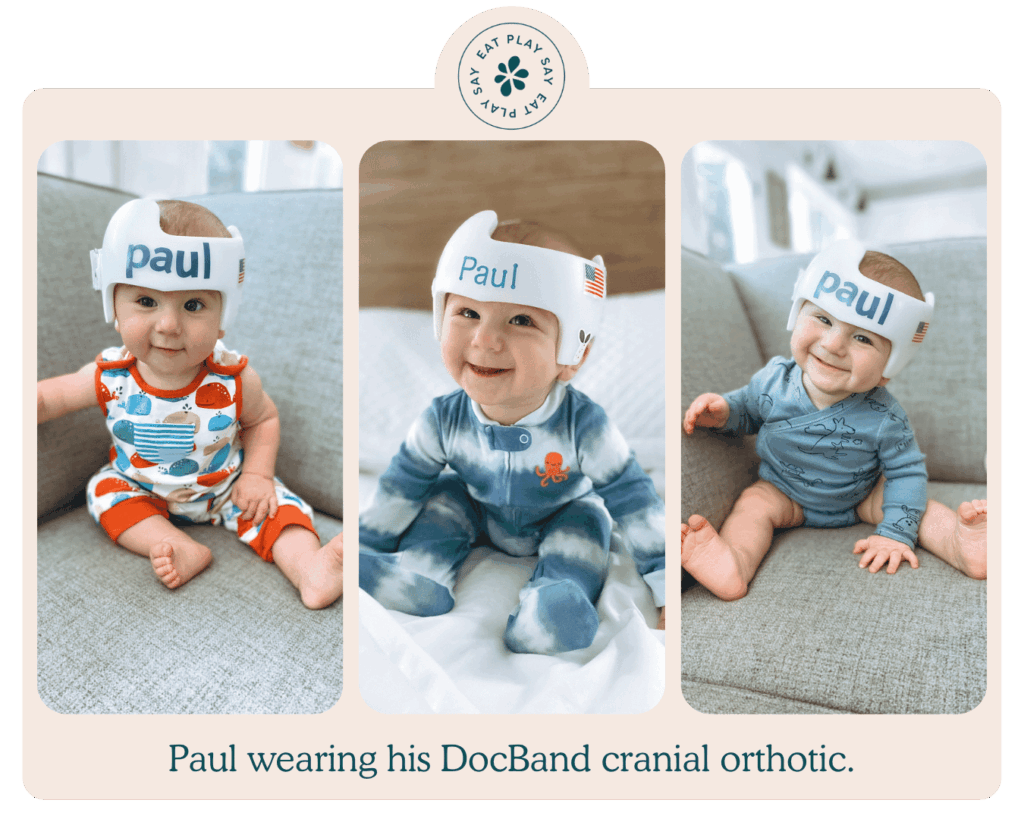
As baby gets older, treatment for flat spots is still effective, but is likely to take longer to round out the flat spot. For example, for babies wearing a DocBand (which is what my son, Paul, wore) at 4 months of age, the average treatment time with the helmet is about 6–9 weeks. If baby isn’t fitted for a helmet until 6 months, that average time increases to 2.5–3.5 months.
Acting early is important
Contacting your local Early Intervention or a private physical or occupational therapist should be your first step when you have a concern about head flattening. You can call them at any age. Contrary to what you may be told, there is no minimum age requirement.
Additionally, places like Cranial Technologies or a local Hanger Clinic offer free head shape screening evaluations beginning around 3 months of age. At these appointments, measurements of your baby’s head are taken and you receive objective data regarding your little one’s head shape and flatness. These evaluations are intended to help determine the need for a cranial orthotic that helps reshape the head (for moderate to severe flatness).
Will flat spots round out on their own?
Since every baby and every flat spot is different, there isn’t a way to answer this question for certain. Given that many flat spots are secondary to underlying body tension or head turning preferences, if those difficulties aren’t addressed, a flat spot will likely not round out on its own.
Sometimes, even with early intervention treatment from a PT or OT, head flattening will remain once those underlying issues are resolved. A helmet will be recommended to help resolve remaining flatness.
Yes, flat spots may round out without the use of a helmet. However, some form of early intervention (PT, OT) will likely be needed to help achieve normal head shape. Without any intervention, it is likely that the head will continue to have flatness and not round out on its own.
Flat spots can generally be treated in the first year and a half of life, but the earlier treatment starts, the better! As your little one grows, the effectiveness of a helmet tends to decrease.
So remember, if you notice signs of a flat spot, here’s what to do:
- Schedule an evaluation with a physical therapist or occupational therapist, whether through your local Early Intervention or a private practice.
- Try the tips in this blog while you wait for an evaluation.
- Consider a free evaluation for a cranial helmet. If nothing more, this can provide you with clear data on the status of your child’s flat spot! We worked with Cranial Technologies for my son’s helmet, but there are many places that create these orthotics!
More resources
Advocating for your little one is important, and you’re doing that hard work better than you think you are. You should be so proud. Your little one is lucky to have you!
If you’re thinking, “Cool, now I know what to do about flat spots, but how do I…?” We’ve got your back!
More resources on the blog:
- Developmental milestones and other development information here
- Breast & bottlefeeding support
- Maybe you’re starting solids soon
- Looking for ways to play with your little one? Find that here!
For support that goes with you everywhere, check out our Handbooks! Each one is written by our multidisciplinary team of child development experts, and you keep them forever!
Sources
- Unnithan AKA, Sina RE. Plagiocephaly. [Updated 2025 Dec 13]. In: StatPearls [Internet]. Treasure Island (FL): StatPearls Publishing; 2026 Jan-. Available from: https://www.ncbi.nlm.nih.gov/books/NBK564334/#
- Collett B, Breiger D, King D, Cunningham M, Speltz M. Neurodevelopmental implications of “deformational” plagiocephaly. J Dev Behav Pediatr. 2005 Oct;26(5):379-89. doi: 10.1097/00004703-200510000-00008. PMID: 16222180; PMCID: PMC3393045.
OTHER POSTS YOU MAY LIKE:




MS, SLP
Founder of Eat Play Say, Speech-Language Pathologist, Feeding Specialist, Play Expert, Mom of 3
Jordyn Koveleski Gorman
SPECIALIZES IN: Infant and toddler speech-language, play, and feeding development, and curating a team that provides expert help that feels like a reassuring text from that one mom friend
EDUCATION: Jordyn received her BS in Speech-Language Pathology from Bloomsburg University and her MS in Speech-Language Pathology from Towson University
FAVE PARENTING FIRST: “The first true smile, it’s the sweetest!”

MS, CCC-SLP, CBS, IBCLC
Speech-Language Pathologist & Feeding Specialist, Certified Breastfeeding Specialist, International Board Certified Lactation Consultant
Jessica Nicholson Cocca
SPECIALIZES IN: Breast and bottle feeding, tongue ties, oral motor dysfunction, starting solids, infant and toddler speech, treating oral motor disorders
EDUCATION: Jessica received her BS in Communication Sciences and Disorders from Pennsylvania State University in 2015 and her MS in Speech-Language Pathology from Towson University in 2017
FAVE PARENTING FIRST: “Baby’s first wave! What a fun first communication gesture!”

MA, CCC-SLP, CLC
Speech-Language Pathologist, Certified Lactation Counselor
Jennifer McFarlin
SPECIALIZES IN: Breast and bottle feeding, tongue ties, starting solids, infant and toddler speech development
EDUCATION: She received her BS in Speech-Language Pathology from Ball State in 2014 and a MA in Speech-Language Pathology from Ball State in 2016.
FAVE PARENTING FIRST: “My favorite baby’s first is their first true smile that just warms your soul knowing they are smiling at you. My other favorite is their first word. I love watching their language explode!”

MS, CCC-SLP
Bilingual Speech-Language Pathologist
Nicole La Petina Kelly
SPECIALIZES IN: Bilingual development (Spanish-English), supporting multilingual families, infant and toddler speech
EDUCATION: She received her BA in Communication Sciences and Disorders and in Spanish from the University of Wisconsin-Madison in 2014 and her MS in Speech-Language Pathology with an English-Spanish Specialization from Marquette University in 2016.
FAVE PARENTING FIRST: “It’s the first slobbery kisses for me!”

RDN, LD
Licensed Registered Dietitian
Kimberly Vede
SPECIALIZES IN: Infant and pediatric nutrition including breastfeeding, formula feeding, and starting solids. She also specializes in prenatal and postpartum nutrition.
EDUCATION: She received her BSc in Biology in 2014 from Life University, and her BSc in Dietetics from Life University in 2019.
FAVE PARENTING FIRST: ”The first time they say ‘mama!’”


This checklist was created with input from a Speech-Language Pathologist, Occupational Therapist and Physical Therapist and has been downloaded over 20,000 times by parents worldwide. Learn the important milestones to pay attention to, and keep it in your digital back pocket during the baby + toddler years!
Comprehensive Milestone Checklist for gross motor, fine motor, and speech-language milestones for 0-36 months,
DOWNLOAD FOR FREE


