


What is W Sitting?
May 13, 2025
Jordyn Koveleski Gorman

Last Updated on May 22, 2026 by Jordyn Koveleski Gorman
This page contains affiliate links. We will receive a commission on qualifying purchases using these links.
Maybe you’ve seen things on the internet about not letting your little one sit in a W sitting position. Or maybe you have been told by a medical professional to “fix their legs” when you see your infant W sitting, but you have no idea why.
The good news is that we’re here to answer all of your W sitting questions! Our pediatric occupational therapist joined me to break down all you need to know about the W sit. We’re starting with one of the most common questions: what even is W sitting?
What is W sitting?
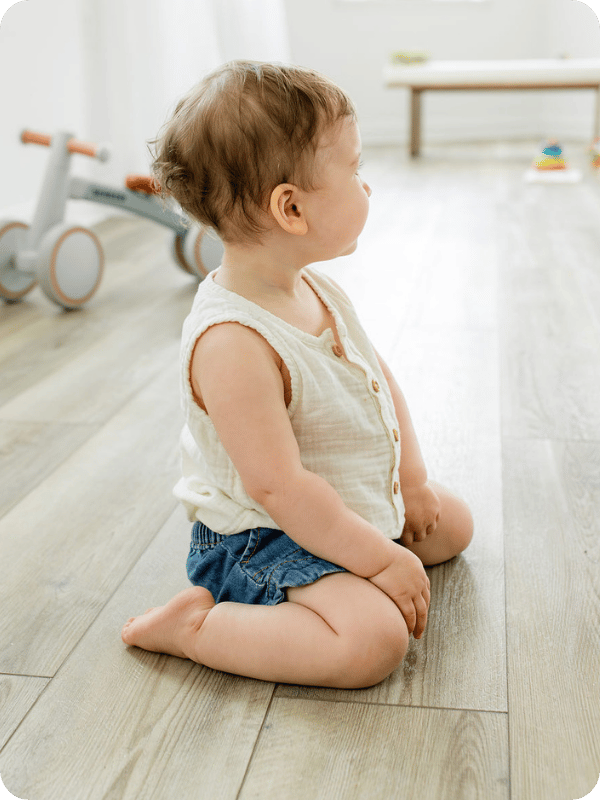
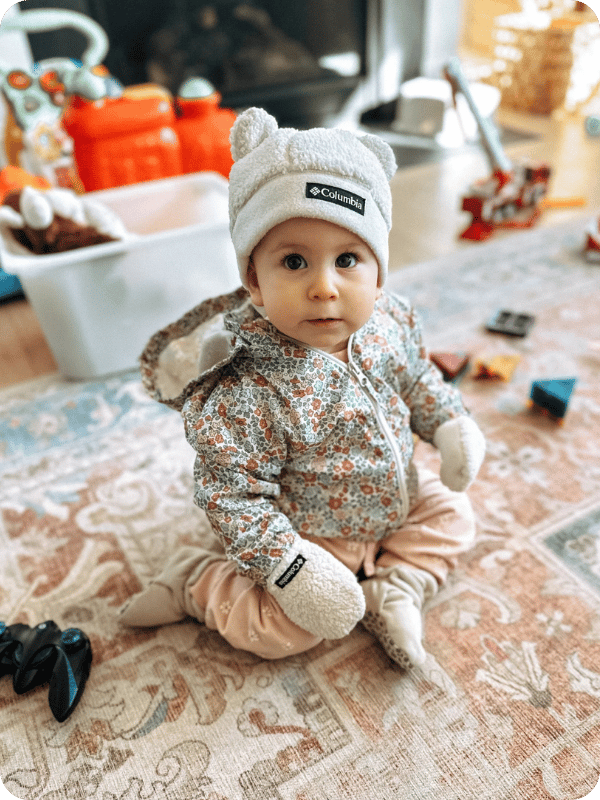
W sitting (also known as W-shaped sitting and television sitting) is when a little one sits on the floor in a position that looks like a “W” from above. Their bottom touches the floor while their left knee is bent and touching the ground on the left side of the body, and the right knee is bent and touching the ground on the right side of the body, like in the photo above.
Is W Sitting Bad?
So, what’s the big deal? Why do we even care if our little one is sitting like this? Studies have been largely conflicting, with no concrete evidence that the W sit causes any harm. (1) From the view of occupational therapy, the concern isn’t so much about the sitting position at all. It’s actually about their back and core muscles!
So when your little one sits in the W position, there’s no need to rush over to “fix their legs” or maneuver them out of the position. Instead, sit back and take a look at three things:
1. What does their back look like?
Are they sitting up straight (like the baby pictured above), engaging their back and core muscles? Or are they slouched over, almost sinking down into the W sitting position with their pelvis jutted forward? If their back is curved, it could be a sign that they’re sitting without engaging their core muscles.
The W position can become a preferred sitting posture for a little one because it widens their base of support and allows them to sit without using their back or core muscles.
Try it! If you sit on the floor criss-cross applesauce (you know exactly what position we mean, don’t you?!), you will feel how easy it is to stack your tummy over your pelvis and sit up straight (engaging your back and core muscles). Now, spread your legs out as wide as you can, and notice how much easier it is to slump down and slouch.
When we have a wider base of support, we don’t have to work as hard. Little ones are smart, and they can figure this out too!
2. Are they staying still or are they moving around?
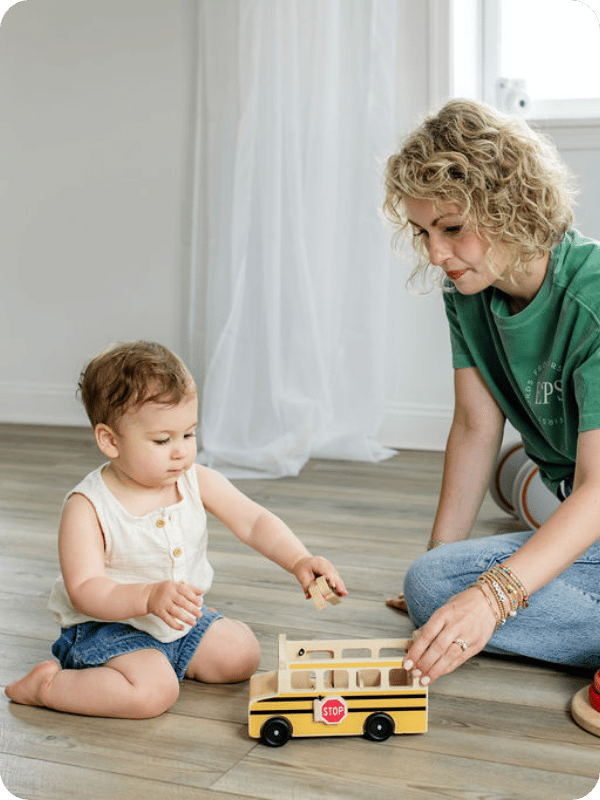
Young children will often transition in and out of W sitting as they are moving around and playing on the floor.
They might go from side sitting to W sitting up to high kneeling, then back down to their bottom with legs out in front of them. This type of movement when sitting is called dynamic sitting and is perfectly normal for toddlers. They’re relying on their back and core muscles to move through these positions.
On the other hand, if a little one is only in the W sitting position for an entire play series (several minutes or with several toys), they may be finding ways to avoid using their core and back muscles. We would call this a static sitting posture, meaning they essentially seem “stuck” in this one position.
3. Are they engaging in symmetrical crawling?
Symmetrical crawling (alternating left/right hands and knees evenly) is typically a good sign that your little one is using their back and core muscles appropriately. If you notice butt scooting, hitch crawling, any other ‘funky’ crawling with your little one, or your little one is not interested in crawling at all (we like to see littles engaging in symmetrical crawling no later than 10 months), this may be a sign they are avoiding using their back and core muscles.
How can I fix W sitting?
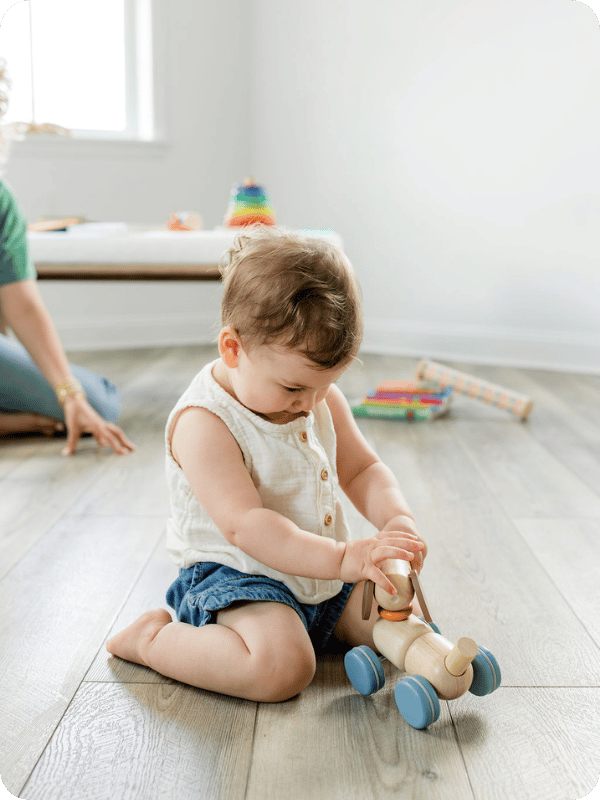
If you notice your little one is hunched over with a rounded back or “stuck” in W sitting, remember that they are likely resisting using their core and back muscles. As a result, simply repositioning their legs is not “cure” for helping them to evolve out of W sitting.
Instead, focusing on positions that can help strengthen back and core muscles is the best way to reduce reliance on W sitting.
Play positions to strengthen back & core muscles
High Kneeling
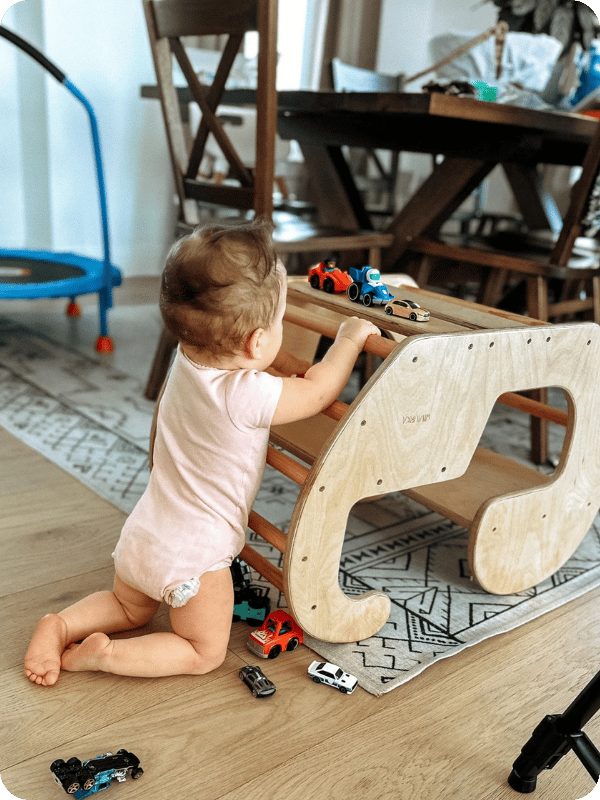
There is no way to sneak out of using the back and core muscles when in high kneeling. This position involves kneeling with both legs parallel to each other and knees directly under hips. You can see it in the photo below.
Ways to incorporate this in play include:
- Kneeling at an activity table to play with different objects on the table
- Kneeling in front of a body mirror with both hands flat on the mirror to help them support themselves (these suction spinners are my favorite for this)
- Kneeling in front of a toy bin, laundry basket, or empty diaper box to pull things out of and put back inside
Side Sitting
Also called the “cheerleader pose,” this sitting position happens when the little one’s bottom is touching the floor and both of the knees are tucked but facing the same direction.
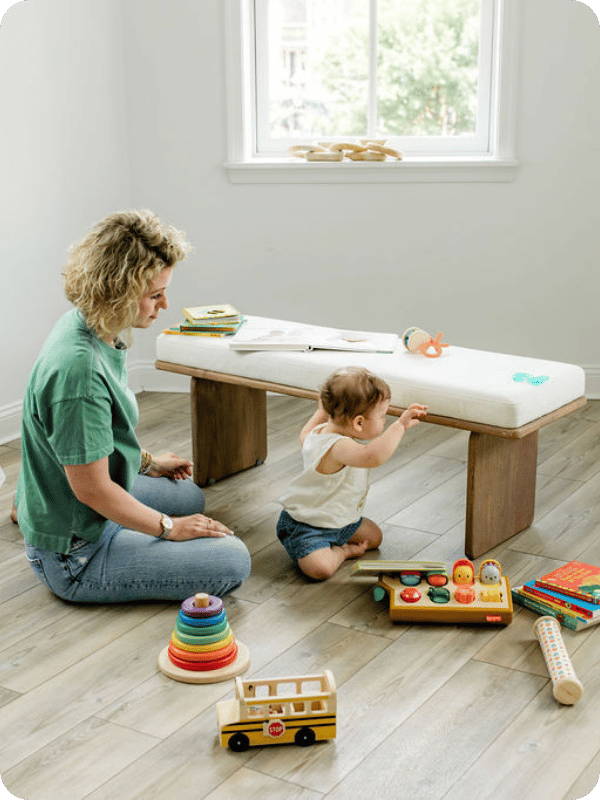
While side sitting, place a favorite toy to the left or right side of your little one and help them lean to that side to play. Their legs should be pointing the opposite way they are leaning, as pictured below. This positioning is impossible to maintain without back and core muscles. This position will also help your little one get comfortable moving around with their hands touching the floor. A slanted surface, like the front of a walker, is great for this kind of play!
Prop Up Their Butt
Place a pillow under your little one’s tail bone to straighten their legs out in front of them. This is a perfect time to read a book together! Hold the book up at eye level so you little one is encouraged to sit up taller. By lifting their butt up a little bit, their core muscles are forced to engage!
90-90-90 Sitting:
Grab a step stool and bring it out to your play area. Help your little one sit on the step so that their feet are flat on the ground and their knees are bent to 90 degrees. Again, placing them in front of a mirror, playing with a toy at eye level, or reading a book at eye level are perfect activities to do with your little one while they are in this position.
Remember: W sitting is not bad
In addition to studies, the International Hip Dysplasia Institute has publicly debunked the myth that W sitting is bad. They state:
“This way of sitting … is often noticed around the age of three years while the child is very flexible. During further growth, the bone twist goes away naturally in 99% of children without intervention. When this goes away, parents and doctors often credit whatever they did to ‘help’ it go away. Studies have shown that W-sitting does not cause any harm to the developing hips, and does not contribute to hip dysplasia.” (2)
So, if you’re noticing your little one W sitting here and there, there’s no need to panic.
Take into account their play positions as a whole, and then decide if they need some support or help in the area of core strength! Our blogs about helping baby stand and walk also provide great tips for helping baby move comfortably and meet their gross motor milestones.
When to contact Early Intervention
In some cases, just helping your little one get into these different sitting positions can be very challenging.
If your little one is not crawling, has an atypical crawling pattern, or is having a hard time trying the play positions listed above, it may be a sign that they have some underlying difficulties.
Common issues, such as overall weakness, low muscle tone, or unintegrated primitive reflexes, can be correlated to consistent W sitting. You can self-refer to your state’s Early Intervention Program for an OT or PT evaluation, or you can chat with one of our specialists in a matter of days.
More parenting resources
Have more questions about baby & toddler development? We have you covered! Our blog is also full of resources on starting solids, feeding toddlers, and ways to play with your little at every stage!
Our most in-depth resources are our Handbooks—written by our team of child development specialists, with hundreds of pages of practical and evidence-based tips, tricks, and education. And they’re yours forever!
Sources
- Nordon DG, Passone CGB, da Silva CAA, Grangeiro PM. W-SITTING IN CHILDHOOD: A SYSTEMATIC REVIEW. Acta Ortop Bras. 2025 Jan 10;32(6):e279277. doi: 10.1590/1413-785220243206e279277. PMID: 39802577; PMCID: PMC11723520.
- International Hip Dysplasia Institute Statement. Accessed May 2026. https://hipdysplasia.org/w-sitting-and-hip-development/
OTHER POSTS YOU MAY LIKE:


MS, SLP
Founder of Eat Play Say, Speech-Language Pathologist, Feeding Specialist, Play Expert, Mom of 3
Jordyn Koveleski Gorman
SPECIALIZES IN: Infant and toddler speech-language, play, and feeding development, and curating a team that provides expert help that feels like a reassuring text from that one mom friend
EDUCATION: Jordyn received her BS in Speech-Language Pathology from Bloomsburg University and her MS in Speech-Language Pathology from Towson University
FAVE PARENTING FIRST: “The first true smile, it’s the sweetest!”

MS, CCC-SLP, CBS, IBCLC
Speech-Language Pathologist & Feeding Specialist, Certified Breastfeeding Specialist, International Board Certified Lactation Consultant
Jessica Nicholson Cocca
SPECIALIZES IN: Breast and bottle feeding, tongue ties, oral motor dysfunction, starting solids, infant and toddler speech, treating oral motor disorders
EDUCATION: Jessica received her BS in Communication Sciences and Disorders from Pennsylvania State University in 2015 and her MS in Speech-Language Pathology from Towson University in 2017
FAVE PARENTING FIRST: “Baby’s first wave! What a fun first communication gesture!”

MA, CCC-SLP, CLC
Speech-Language Pathologist, Certified Lactation Counselor
Jennifer McFarlin
SPECIALIZES IN: Breast and bottle feeding, tongue ties, starting solids, infant and toddler speech development
EDUCATION: She received her BS in Speech-Language Pathology from Ball State in 2014 and a MA in Speech-Language Pathology from Ball State in 2016.
FAVE PARENTING FIRST: “My favorite baby’s first is their first true smile that just warms your soul knowing they are smiling at you. My other favorite is their first word. I love watching their language explode!”

MS, CCC-SLP
Bilingual Speech-Language Pathologist
Nicole La Petina Kelly
SPECIALIZES IN: Bilingual development (Spanish-English), supporting multilingual families, infant and toddler speech
EDUCATION: She received her BA in Communication Sciences and Disorders and in Spanish from the University of Wisconsin-Madison in 2014 and her MS in Speech-Language Pathology with an English-Spanish Specialization from Marquette University in 2016.
FAVE PARENTING FIRST: “It’s the first slobbery kisses for me!”

RDN, LD
Licensed Registered Dietitian
Kimberly Vede
SPECIALIZES IN: Infant and pediatric nutrition including breastfeeding, formula feeding, and starting solids. She also specializes in prenatal and postpartum nutrition.
EDUCATION: She received her BSc in Biology in 2014 from Life University, and her BSc in Dietetics from Life University in 2019.
FAVE PARENTING FIRST: ”The first time they say ‘mama!’”


This checklist was created with input from a Speech-Language Pathologist, Occupational Therapist and Physical Therapist and has been downloaded over 20,000 times by parents worldwide. Learn the important milestones to pay attention to, and keep it in your digital back pocket during the baby + toddler years!
Comprehensive Milestone Checklist for gross motor, fine motor, and speech-language milestones for 0-36 months,
DOWNLOAD FOR FREE


