


Signs of Tongue and Lip Ties in Babies & Toddlers
May 19, 2025
Jordyn Koveleski Gorman

Last Updated on March 30, 2026 by Jordyn Koveleski Gorman
Tongue ties, lip ties, and even cheek ties (yes, you read that right!) are popular topics of conversation. Maybe you’ve heard something in passing in the hospital, on a Facebook mom group, or even at an appointment.
You might be wondering things like: What are tongue and lip ties? Can my baby have a tongue and/or lip tie? What are the signs of a tongue tied baby?
Unfortunately, misinformation has spread rapidly about ties. Many professionals have added confusion to the mix with unclear, contradictory statements about tongue and lip ties. Some of those phrases can sound like this:
- “Your baby has a mild tongue tie, but don’t worry about it!”
- “Ties can stretch on their own.”
- “They’ll grow out of their issues.”
- “We can just cut the tie and you’ll be good!”
- “Getting a tongue tie procedure will fix all the feeding issues!”
If you’ve followed Eat Play Say for a while, you know that we strive to educate families on the root causes of potential issues. We don’t stop there, though—we also want to empower you to overcome those challenges!
Diagnosing tongue, lip, and cheek ties based on appearance alone is not sufficient, as function is what matters most. Additionally, claiming that something as simple as a little “snip” of a tongue tie will fix all the feeding problems is problematic.
Our Speech-Language Pathologist, Feeding Specialist, and Breastfeeding Specialist breaks down what you need to know about the signs and symptoms of tongue and lip ties for babies and toddlers below.

Understanding tongue and lip ties
Tongue, lip, and cheek ties are pieces of tissue, called frenula, made from collagen and/or muscular fibers, that restrict proper oral function. This tissue cannot stretch on its own.
You might be thinking, don’t we all have tissue that connects the bottom of the tongue to our mouth? Don’t we all have tissue that connects the lip to the gum line? So, do we all have tongue and lip ties?
This is important to understand: we do all have frenula. We do not all have lip and tongue ties. Diagnostically, we have to look at function over all else.
The frenula impact how the tongue, lips, and cheeks move for sucking, swallowing, eating solids, and breathing. If they have great movement and good stretching abilities, no functional impacts should be observed.
If frenula don’t have good movement and good stretching abilities, functional impacts while feeding will be observed. It’s important to identify those functional impacts early when possible. Having the right muscle movements helps further mouth and facial development needed to eat, speak, and breathe well.
What is a tongue tie?
A tongue tie occurs when the frenulum under the tongue is tight and restricted, with reduced movement and function. Remember that visual appearance is not enough to diagnose a tongue tie. Babies and toddlers have small mouths with tiny tongues, which means getting a clear visual can be difficult even on a good day!
Posterior tongue tie
A posterior tongue tie occurs at the back of the tongue, where it meets the floor of the mouth. In a posterior tongue tie, the frenulum is tight and restricted toward the back rather than the front. A tongue tie that extends farther back than normal is considered a posterior tongue tie.
Signs and symptoms of a posterior tongue tie are similar to those of a tongue tie, and only a comprehensive evaluation will be able to determine if a posterior tongue tie is present.
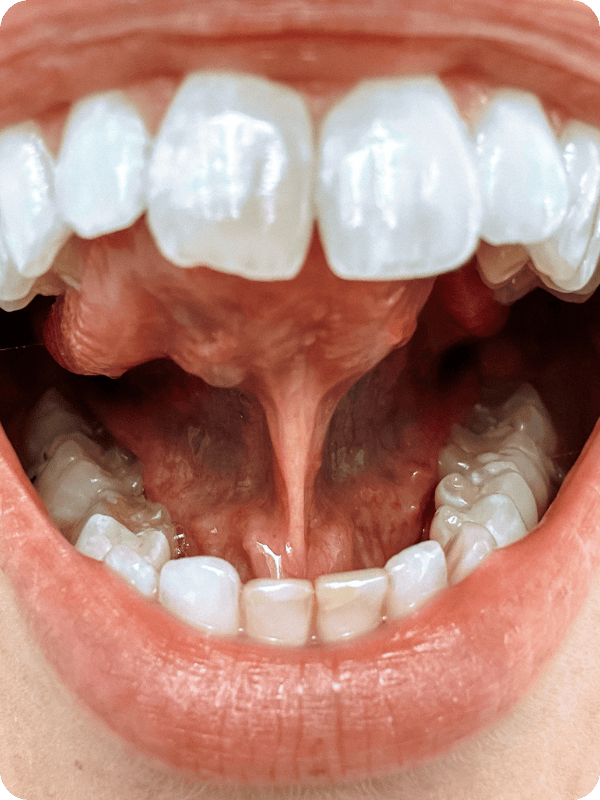
Tongue tie symptoms
Common signs of a tongue, lip, or cheek tie usually present as the feeding issues as seen below. (1)
- Inefficient transfer of milk at the breast or slow bottle feeds
- Spilling of milk at the lips
- Clicking while sucking
- Frequent gassiness or spit up that is not explained by an allergy
- Milk left on the tongue after feeds
- Mom’s nipples are cracked or bleeding
- Baby has lip blisters
- Breastfeeding is painful
- Bottle feeding is difficult or feeds take forever
If you notice these signs, it’s important to seek out the support of a professional skilled in assessing oral-motor structure and skills. This could be a lactation consultant or counselor, a speech pathologist, or an occupational therapist.
If you are breastfeeding, it is very important to have support from a lactation consultant who can assess the mother-baby pair as a whole.
If your older baby or toddler is having issues feeding, breathing, or speaking, it is important to seek out the support of a professional skilled in assessing oral-motor structure and feeding skills.
Examples of difficulties that need professional support include (but aren’t limited to):
- Struggling to move past purees or meltable foods
- Difficulties drinking from cups other than bottles
- Chronic open mouth breathing and/or drooling
- Delayed and/or difficult to understand speech
A speech pathologist or occupational therapist trained in feeding could offer support. They should also provide nearby referrals as needed for a dentist and/or ear-nose-throat doctor.
What is a lip tie?
A lip tie is defined as a restriction in the tissue connecting the lip to the gum line. Remember that all babies have tissue connecting their lips to their gums. It’s when that tissue is restricted and baby is experiencing functional deficits from that restriction that it is considered a “tie.”
Truthfully, there is not much published research about lip ties alone, as it is a subject area just now being researched.
However, clinically, we’ve seen that it is rare for a baby to have a lip tie without a tongue tie!
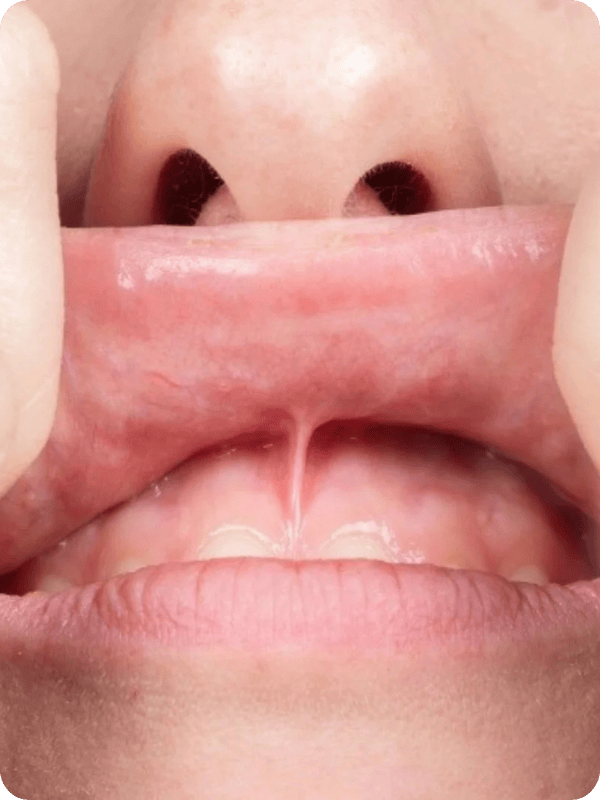
Lip tie symptoms
As a child gets older, a lip tie may have a “hooded” appearance, which can harbor bacteria and make tooth brushing uncomfortable. Some also state that lip ties can lead to gum recession due to excessive upwards pressure.
Many feeding challenges can occur due to both tongue and lip ties. Often, a lip tie is more heavily blamed for issues, while the tongue is actually what more greatly impacts a baby’s ability to suck.
This is why it is very important for a specialist to assess history, function, symptoms, and structure to help you determine the root cause of feeding and oral rest challenges. Only a specialist can properly assess a lip or tongue tie.
What is a buccal (cheek) tie?
Buccal ties are bands of connective tissue that connect the cheeks to the outer upper and lower gums. Though there is very little established research about buccal ties, they may be restrictive for the functions of eating. (2)
Common signs and symptoms of a cheek tie:
- Babies have a hard time opening their mouth wide to latch
- Babies have poor cheek contraction for sucking, also called an inefficient suck.
What if it’s not a tongue or lip tie?
Although social media would have you believe that all feeding difficulties are due to tongue/lip ties, that’s just not the case.
The list of symptoms is long, which can blur the lines sometimes. In reality, not every baby who shows the signs and symptoms of a tongue tie will have one. Because of this, we do not recommend jumping straight to a tongue tie release without first ensuring proper assessment.
Feeding is a whole body experience. If anything is “off” within the body, it can impact feeding.
While yes, the frenula in the mouth is a giant part of feeding, it’s not the only thing that can impact it.
Infant body tension
Many babies are born with body tension that can significantly impact feeding. Babies are really cramped in utero and therefore can become tight and stiff. Depending on their position in the womb, they can have a side preference (where their head likes to lay to one side).
An infant’s body can present asymmetrically at rest, where their hips and shoulders aren’t aligned. If their body is tense, certain feeding/swallowing muscles can also be tense. If their body is uncomfortable, feeding can be uncomfortable, too.
Low muscle tone in babies
On the opposite end, some babies are born with “low tone,” meaning that their muscles have less tension and less resistance to movement.
This can make breast and bottle feeding difficult, as feeding is an intricate skill. If low tone is identified, strategies such as offering jaw and cheek support while feeding and using specific feeding positions can help.
Sometimes even if body tension or low tone are identified, and treatment for those diagnoses has begun, signs and symptoms of a tongue tie can persist.
For example, releasing some body tension might have decreased gassiness and spit up incidents, but baby is still experiencing difficulty transferring milk efficiently. Or, maybe they continue to leak milk out the side of their mouth while feeding.
If signs and symptoms are still present, then further evaluation is recommended, which may ultimately lead to a tongue tie release.

Treating tongue and lip ties
So, who treats a tongue and lip tie?
We often hear parents say that their child’s pediatrician is not concerned about their child’s oral structure and symptoms. The follow-up question is almost always: “Does that mean there’s nothing wrong?”
If your gut is telling you there’s more going on, it’s always better to investigate the “why.” Pediatricians are an excellent source of information for medical needs. However, they should refer to specialists to provide a more thorough assessment where feeding concerns and signs of a possible tongue tie are also present.
A proper evaluation should explore your family and your child’s history. A thorough history includes gastrointestinal, airway, oral motor development, fine/gross motor development, feeding skills from birth, speech/language skills, and diet.
As a reminder, providers who are appropriate to discuss tongue ties with you are:
- International Board Certified Lactation Consultants (IBCLC)
- Speech-Language Pathologists trained in oral motor/feeding/oral ties
- Occupational Therapists trained in oral motor/feeding/oral ties
- Physical Therapists trained in oral motor/feeding/oral ties
- Cranial Sacral Therapists trained in oral motor/feeding/oral ties
- Pediatric Dentists trained in oral motor/feeding/oral ties
- Pediatric Otolaryngologists (ENTs) trained in oral motor/feeding/oral ties
You can learn more about treating tongue, lip, and cheek ties here.
More infant feeding support
We know that navigating tongue ties can feel very overwhelming. You aren’t alone in the journey. And, in case you need a boost, know that you are doing an amazing job. Your little one is lucky to have you!
We included a Bonus Guide in our Infant Feeding Handbook for parents who may encounter feeding difficulties and need to receive assessment and treatment for oral ties. Trust your gut!
Sources
- Yoon AJ, Zaghi S, Ha S, Law CS, Guilleminault C, Liu SY. Ankyloglossia as a risk factor for maxillary hypoplasia and soft palate elongation: A functional – morphological study. Orthod Craniofac Res. 2017 Nov;20(4):237-244. doi: 10.1111/ocr.12206. Epub 2017 Oct 10. PMID: 28994495.
- Baxter R, Merkel-Walsh R, Lahey L, Knutsen C, Zaghi S. The buccal frenum: Trends in diagnosis and indications for treatment of buccal-ties among 466 healthcare professionals. J Oral Rehabil. 2024 Feb;51(2):369-379. doi: 10.1111/joor.13609. Epub 2023 Oct 12. PMID: 37823364.
OTHER POSTS YOU MAY LIKE:






MS, SLP
Founder of Eat Play Say, Speech-Language Pathologist, Feeding Specialist, Play Expert, Mom of 2
Jordyn Koveleski Gorman
SPECIALIZES IN: Infant and toddler speech-language, play, and feeding development, and curating a team that provides expert help that feels like a reassuring text from that one mom friend
EDUCATION: Jordyn received her BS in Speech-Language Pathology from Bloomsburg University and her MS in Speech-Language Pathology from Towson University
FAVE PARENTING FIRST: “The first true smile, it’s the sweetest!”

MS, CCC-SLP, CBS, IBCLC
Speech-Language Pathologist & Feeding Specialist, Certified Breastfeeding Specialist, International Board Certified Lactation Consultant
Jessica Nicholson Cocca
SPECIALIZES IN: Breast and bottle feeding, tongue ties, oral motor dysfunction, starting solids, infant and toddler speech, treating oral motor disorders
EDUCATION: Jessica received her BS in Communication Sciences and Disorders from Pennsylvania State University in 2015 and her MS in Speech-Language Pathology from Towson University in 2017
FAVE PARENTING FIRST: “Baby’s first wave! What a fun first communication gesture!”

MA, CCC-SLP, CLC
Speech-Language Pathologist, Certified Lactation Counselor
Jennifer McFarlin
SPECIALIZES IN: Breast and bottle feeding, tongue ties, starting solids, infant and toddler speech development
EDUCATION: She received her BS in Speech-Language Pathology from Ball State in 2014 and a MA in Speech-Language Pathology from Ball State in 2016.
FAVE PARENTING FIRST: “My favorite baby’s first is their first true smile that just warms your soul knowing they are smiling at you. My other favorite is their first word. I love watching their language explode!”

MS, CCC-SLP
Bilingual Speech-Language Pathologist
Nicole La Petina Kelly
SPECIALIZES IN: Bilingual development (Spanish-English), supporting multilingual families, infant and toddler speech
EDUCATION: She received her BA in Communication Sciences and Disorders and in Spanish from the University of Wisconsin-Madison in 2014 and her MS in Speech-Language Pathology with an English-Spanish Specialization from Marquette University in 2016.
FAVE PARENTING FIRST: “It’s the first slobbery kisses for me!”

RDN, LD
Licensed Registered Dietitian
Kimberly Vede
SPECIALIZES IN: Infant and pediatric nutrition including breastfeeding, formula feeding, and starting solids. She also specializes in prenatal and postpartum nutrition.
EDUCATION: She received her BSc in Biology in 2014 from Life University, and her BSc in Dietetics from Life University in 2019.
FAVE PARENTING FIRST: ”The first time they say ‘mama!’”


This checklist was created with input from a Speech-Language Pathologist, Occupational Therapist and Physical Therapist and has been downloaded over 20,000 times by parents worldwide. Learn the important milestones to pay attention to, and keep it in your digital back pocket during the baby + toddler years!
Comprehensive Milestone Checklist for gross motor, fine motor, and speech-language milestones for 0-36 months,
DOWNLOAD FOR FREE


