


Newborn Activities: How Do You Play with a Newborn?
May 6, 2024
Jordyn Koveleski Gorman

Last Updated on March 20, 2026 by Jordyn Koveleski Gorman
This page contains affiliate links. We will receive a commission on qualifying purchases using these links.
POV: You’re fresh from the hospital, in awe of that perfect bundle of sweetness you just brought home. You’re also completely overwhelmed that now you have to care for this baby with virtually zero instructions.
Between navigating feedings, sleep, dirty diapers, and taking care of the rest of your home, playing with your newborn is probably somewhere at the bottom of the priority list. Take a breather, though, because playing with your newborn is a great opportunity to bond and build connections. Even as a newborn, play helps your baby learn about the world and how things work.
Doing activities with your newborn doesn’t have to be complicated. In fact, newborn wake windows are so short that you may only have a few minutes, sometimes 5-10 minutes tops, to play with your little one. This can be a good thing as you ease into play.
The infant stage is such an important time in a child’s early brain development. So many new connections are forming within the brain every second. In fact, a young child’s brain is nearly twice as active as an adult’s brain (1).
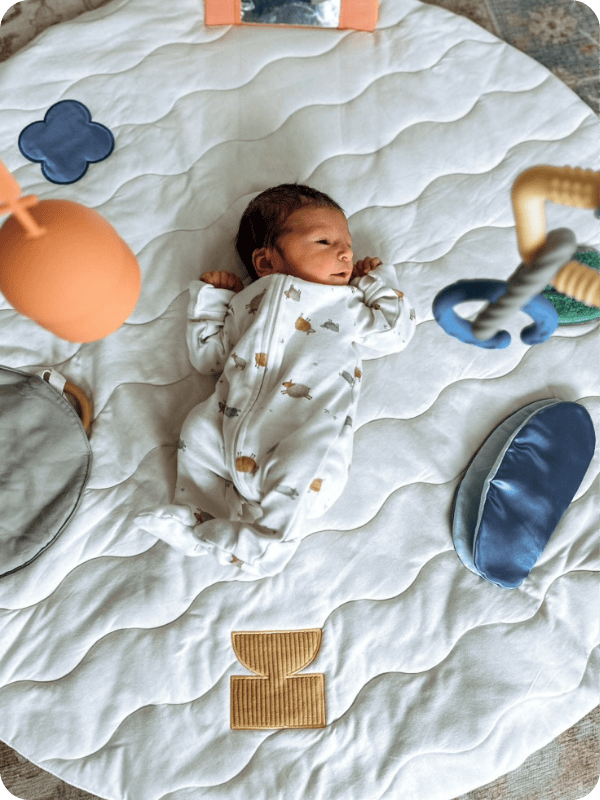
The best newborn activities
The best newborn activities are simple and quick because their wake windows are so short in the beginning. Developmentally, it’s important to get baby on the floor as frequently as possible. Why?
The open floor is the only place we can safely put babies that gives them the freedom to move, explore their bodies, signal primitive reflexes, and begin naturally meeting motor milestones.
Play gym activities
Hang a variety of different toys from a play gym and place your baby under them on their back. This is a great way to begin teaching cause and effect, focusing on objects, and eventually trying to reach for them. Pick toys that are large and easy to see, with high contrast colors.
Change up where your baby lies on the play mat to help them move their head in both directions, and use some rolled blankets to help prop them on their side.
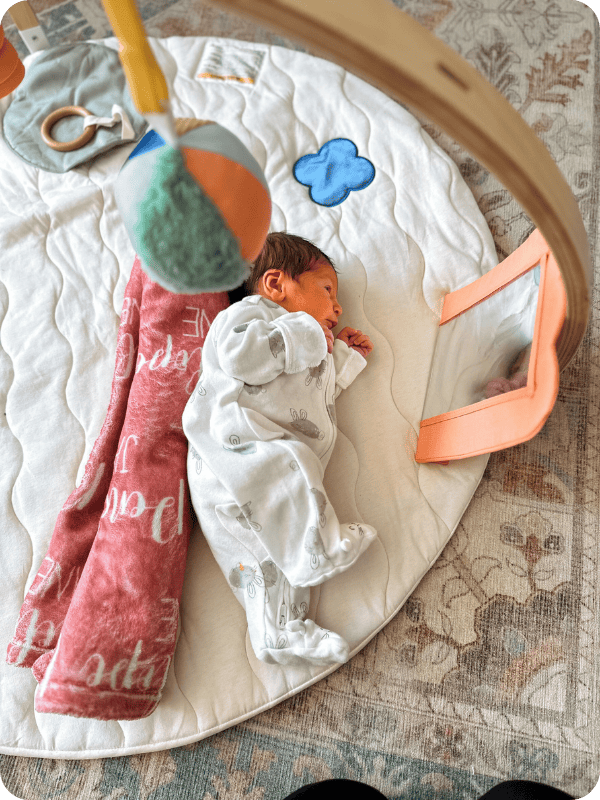
From the day you bring baby home, you can start practicing sidelying with them (see above photo!). It’s as simple as it sounds, just that halfway position between being on their back or their tummy. If you’re just warming up to doing tummy time, this is a great position to try!
The sidelying play position is crucial to development for several reasons. It helps them bring their hands together without working against gravity, gives them a new perspective on the world, and helps develop coordinated eye movements. Sidelying also keeps pressure off the back of your baby’s head during those critical early months when the skull is soft. This means it naturally prevents babies from forming flat spots. Eventually, playing in this position will even help your little one start to roll!
No matter the position your newborn lays in during these activities, they’ll benefit from a play gym for many months ahead.
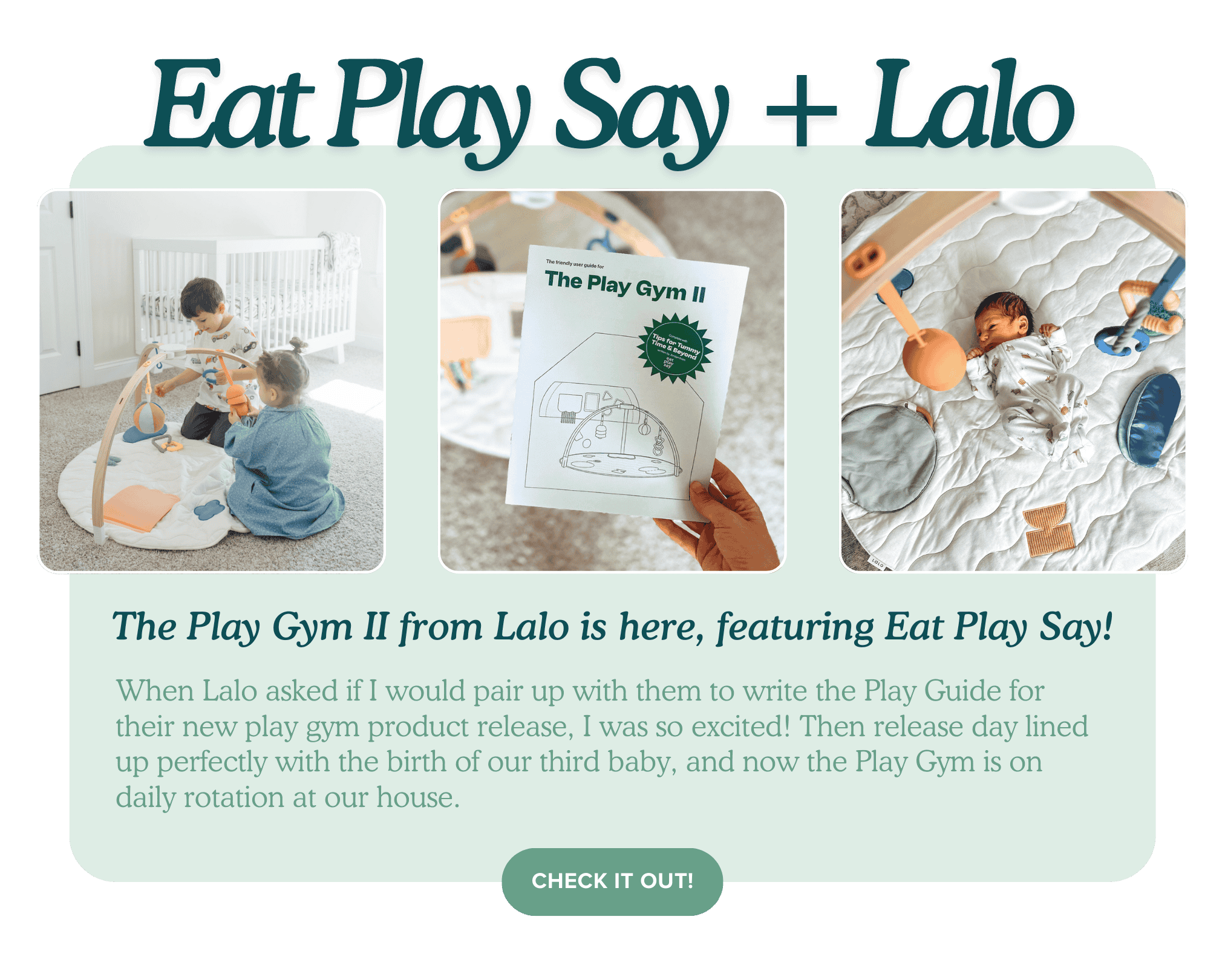
We recently paired up with Lalo on the release of their new Play Gym! You can check out The Play Gym II here. This tummy time mat will grow with your child long after they outgrow their newborn clothes, with a sit up play panel and tons of attachments your little one will love to play with!
Tummy time for newborns
Work on tummy time in small increments with your newborn. We’re talking very short periods of time at first, gradually building up to a few continuous minutes. In the first few weeks of life, start by placing your baby on your chest. Then move them to the floor (right on the play mat) for tummy time activities.
Prop up a soft mirror in front of your baby so that they can look at themselves, or have a high-contrast book in their view for them to look at. Put motivating toys all around them to try and get baby to move.
These are our favorite toys for tummy time!
Newborn face time
Spending time face-to-face with your baby is the ultimate newborn activity. Everyone gets a little oxytocin boost! Try singing, talking, cooing, making faces, and describing things around you. When your baby coos, coo back to them. Pause and wait with an expectant face to see if they will continue the interaction. Congratulations, you’ve just had your first heart to heart with your little one!
Your face is more interesting to your newborn than any toy. When in doubt, look at your baby and interact!
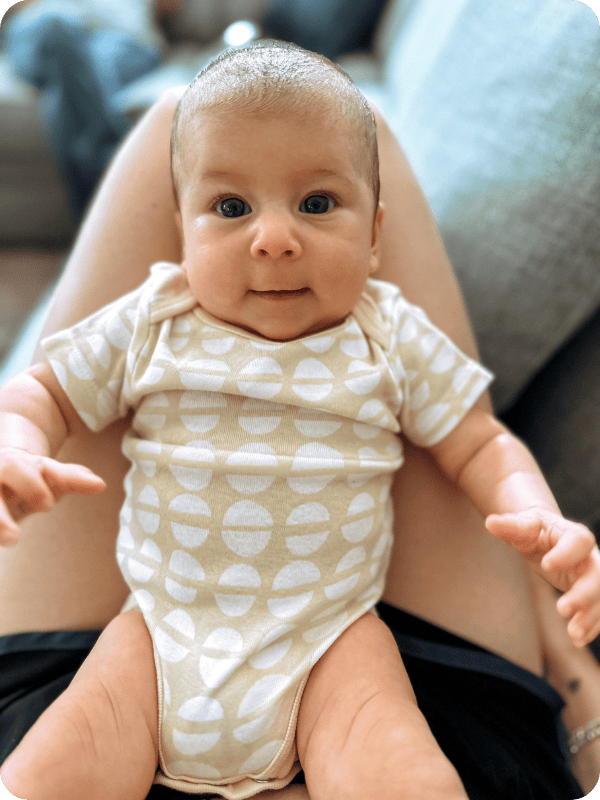
Newborn sensory activities
It’s not quite time to break out a viral sensory bin for your newborn’s play time, but you can still help them explore their senses right now.
Side rocking: Place your baby on their back while on the floor. Bring their feet and hands to their belly button, so their arms and legs meet at their midline. While holding onto their hands and feet, gently rock them from side-to-side. As you rock them, wait for their head and neck to also turn to that side. This is a wonderful activity for pre-rolling bodies to practice movement! It also helps integrate some of baby’s primitive reflexes.
Bath time fun: Baths are inherently sensory activities! While you’re getting into this new bath routine, pick a few routine phrases to say every time you do a bath. And don’t forget to sing a fun song! Great words to model are “pour, wash, splash.” Songs like Rubber Ducky or I Had a Little Froggy are great for bathtime! As bath time gets longer and baby gets older, adding in some fun bath toys can make the experience even more enjoyable!
By providing rich sensory experiences, strength building opportunities, face-to-face time, and of course lots of snuggles, you will set your newborn up for success.
Books for newborns
Research has shown that early and consistent reading to infants helps improve early language skills. (2) The more you read to your baby, the better. The sky is the limit! Reading may look different than you expect during the newborn stage, and that’s okay.
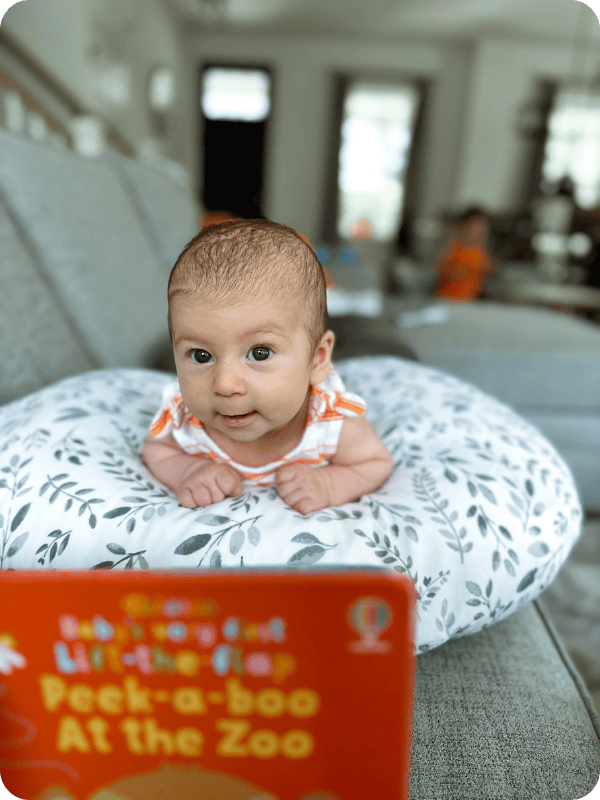
You can prop up black and white books for baby to study during tummy time or while side-lying. Placing your baby on your legs while sitting and reading face-to-face is another way to encourage eye contact, social smiles, and bonding with you!
Model one or two simple words at a time and remember to pause while reading to see if your baby will respond. Cooing comes in early, so they will likely vocalize back to you if you give them some time! There are tons of great books for newborns that encourage these skills.
When do newborns play with toys?
You might be wondering why you have a giant bucket of toys that your newborn couldn’t care less about. When will toys get interesting? The answer: it depends!
We expect to see developmental milestones such as batting at toys overhead by around the end of three months. Functional engagement with toys happens around six months. If you want to know when your baby will get hands-on and reach out for toys, the answer is soon. Just because they can’t do that yet, though, doesn’t mean toys are useless now!
For newborn activities, it’s best to use soft toys that have crinkle textures and teethers attached. This practices both tracking and focusing on objects. It also stimulates the senses with the different textures and helps your baby “organize” the mouth through early oral play. Toys with crinkle sounds help babies turn towards sound and locate objects.
Around 2 months of age, you can help guide the teether part of toys toward your baby’s mouth since they won’t be able to get it there on their own quite yet. Having early opportunities to explore safe textures within their mouth sets baby up for oral motor success down the road! For more on when babies start to play with toys, check out our blog.
Need more newborn activities?
The newborn haze is hard enough. You don’t also have to plan activities for the next few months (or years!). That’s where Eat Play Say comes in!
Even in these early days, you’re already building a solid play foundation for your child. There’s no need to complicate play just because they reach a new milestone or enter a new era, which will happen frequently for the next several months.
You’re the best parent for your baby, and you’re doing an amazing job. You’ve got this!
If you liked the activities in this post, you will love our Playbooks—more than 100 age-appropriate, developmentally supportive ways to play with your child using only what you have at home. Simplifying play from birth through toddlerhood? Yes please.
Sources
- The Urban Child Institute (n.d.). Baby’s Brain Begins Now: Conception to Age 3. Retrieved April 16, 2024 from http://www.urbanchildinstitute.org/why-0-3/baby-and-brain
- Adam M. Franks, Callie Seaman, Emily K. Franks, William Rollyson, Todd Davies. The Journal of the American Board of Family Medicine Dec 2022, 35 (6) 1156-1162; DOI: 10.3122/jabfm.2022.220064R2
OTHER POSTS YOU MAY LIKE:



MS, SLP
Founder of Eat Play Say, Speech-Language Pathologist, Feeding Specialist, Play Expert, Mom of 2
Jordyn Koveleski Gorman
SPECIALIZES IN: Infant and toddler speech-language, play, and feeding development, and curating a team that provides expert help that feels like a reassuring text from that one mom friend
EDUCATION: Jordyn received her BS in Speech-Language Pathology from Bloomsburg University and her MS in Speech-Language Pathology from Towson University
FAVE PARENTING FIRST: “The first true smile, it’s the sweetest!”

MS, CCC-SLP, CBS, IBCLC
Speech-Language Pathologist & Feeding Specialist, Certified Breastfeeding Specialist, International Board Certified Lactation Consultant
Jessica Nicholson Cocca
SPECIALIZES IN: Breast and bottle feeding, tongue ties, oral motor dysfunction, starting solids, infant and toddler speech, treating oral motor disorders
EDUCATION: Jessica received her BS in Communication Sciences and Disorders from Pennsylvania State University in 2015 and her MS in Speech-Language Pathology from Towson University in 2017
FAVE PARENTING FIRST: “Baby’s first wave! What a fun first communication gesture!”

MA, CCC-SLP, CLC
Speech-Language Pathologist, Certified Lactation Counselor
Jennifer McFarlin
SPECIALIZES IN: Breast and bottle feeding, tongue ties, starting solids, infant and toddler speech development
EDUCATION: She received her BS in Speech-Language Pathology from Ball State in 2014 and a MA in Speech-Language Pathology from Ball State in 2016.
FAVE PARENTING FIRST: “My favorite baby’s first is their first true smile that just warms your soul knowing they are smiling at you. My other favorite is their first word. I love watching their language explode!”

MS, CCC-SLP
Bilingual Speech-Language Pathologist
Nicole La Petina Kelly
SPECIALIZES IN: Bilingual development (Spanish-English), supporting multilingual families, infant and toddler speech
EDUCATION: She received her BA in Communication Sciences and Disorders and in Spanish from the University of Wisconsin-Madison in 2014 and her MS in Speech-Language Pathology with an English-Spanish Specialization from Marquette University in 2016.
FAVE PARENTING FIRST: “It’s the first slobbery kisses for me!”

RDN, LD
Licensed Registered Dietitian
Kimberly Vede
SPECIALIZES IN: Infant and pediatric nutrition including breastfeeding, formula feeding, and starting solids. She also specializes in prenatal and postpartum nutrition.
EDUCATION: She received her BSc in Biology in 2014 from Life University, and her BSc in Dietetics from Life University in 2019.
FAVE PARENTING FIRST: ”The first time they say ‘mama!’”


This checklist was created with input from a Speech-Language Pathologist, Occupational Therapist and Physical Therapist and has been downloaded over 20,000 times by parents worldwide. Learn the important milestones to pay attention to, and keep it in your digital back pocket during the baby + toddler years!
Comprehensive Milestone Checklist for gross motor, fine motor, and speech-language milestones for 0-36 months,
DOWNLOAD FOR FREE


