


How to Bottle Feed A Newborn
June 14, 2024
Jordyn Koveleski Gorman

Last Updated on March 30, 2026 by Jordyn Koveleski Gorman
This page contains affiliate links. We will receive a commission on qualifying purchases using these links.
Bottle feeding a newborn baby can feel incredibly overwhelming. Figuring out when to feed them is one battle. Figuring out how to feed them is another. If bottle feeding is part of your answer to that question, we’re here to help.
One trick to settling some feeding anxiety is finding a position that works best for you and your baby. From there, all the other pieces can seem a little less daunting.
Proper positioning is actually the key to efficient bottle feeding, especially in those early weeks. Some positions are more optimal compared to others. You also want the position to be comfortable for both you and your baby.
No matter what bottle you’ve picked for your little one, there are some general guidelines to remember while bottle feeding. As a speech-language pathologist and feeding specialist, plus a mom to three, I’m here to help.
Let’s talk about the do’s and don’ts of bottle feeding a newborn!
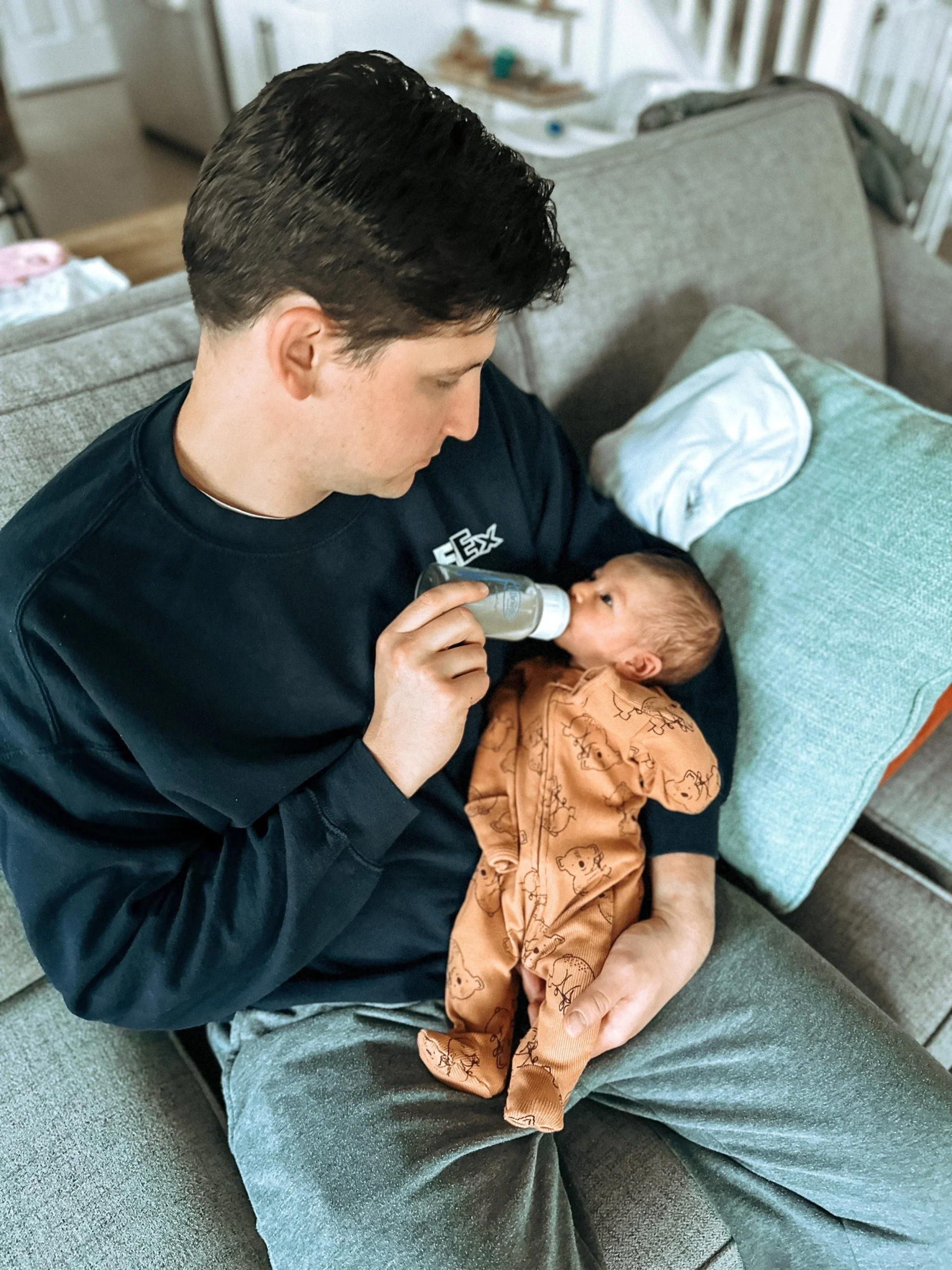
When to introduce bottle to breastfed baby
It goes without saying that if you are feeding your sweet little one with formula or are exclusively pumping, then you’ll be introducing a bottle right away! However, if you’re exclusively nursing and want to introduce a bottle, there is actually a recommended timeline.
Usually, a bottle should be introduced to baby after nursing is well-established and before baby’s suckling reflex starts to integrate. Usually that is somewhere between 2-6 weeks, with the sweet spot being around 3–4 weeks.
It’s important to offer bottles consistently once introduced, as baby may refuse a bottle if not offered early and often enough. Aim for at least 4-5 times a week to start and offer consistently to decrease the chances of bottle refusal.
Paced bottle feeding
You might have heard the term paced bottle feeding, but are wondering what it is exactly.
Similar to breastfeeding, paced feedings allow you to connect with your baby by watching their body language and guiding the feed according to their needs. This technique allows feedings to be slowed down.
Paced feeding helps your baby lead the feeding and take breaks when needed. Since the feeding is done at a slower rate, it allows your baby’s brain and stomach to stay in sync and helps prevent overfeeding.
How to offer paced bottle feeds
Follow these simple steps when bottle feeding your newborn:
- Present the bottle/nipple to your baby, and let them latch and begin feeding.
- When you notice your baby starting to slow down or stop sucking, gently tilt the bottle down away from your baby’s mouth. This slows down the flow of milk, but does not remove the nipple from their mouth.
- By not removing the nipple from their mouth, this allows their latch to stay in place! When your baby begins to suck again, tilt the bottle towards their mouth so they are able to get more milk. This also prevents milk from pooling in their mouth! Continue this until they show signs that they’re done feeding.
The most important guideline is to follow your baby’s lead! Our little humans know their bodies, so trust them!
Bottle feeding positions
Some of the best bottle feeding positions for your newborn are below.
Cradle Hold
This position is the most well-known and is a traditional feeding approach.
- Place your baby’s head in the bend of your arm and wrap that same arm/hand around their body.
- Then, elevate the baby’s head near your shoulder and offer the bottle.
- This position is convenient if you are out and need to feed your baby!
Elevated Side-Lying
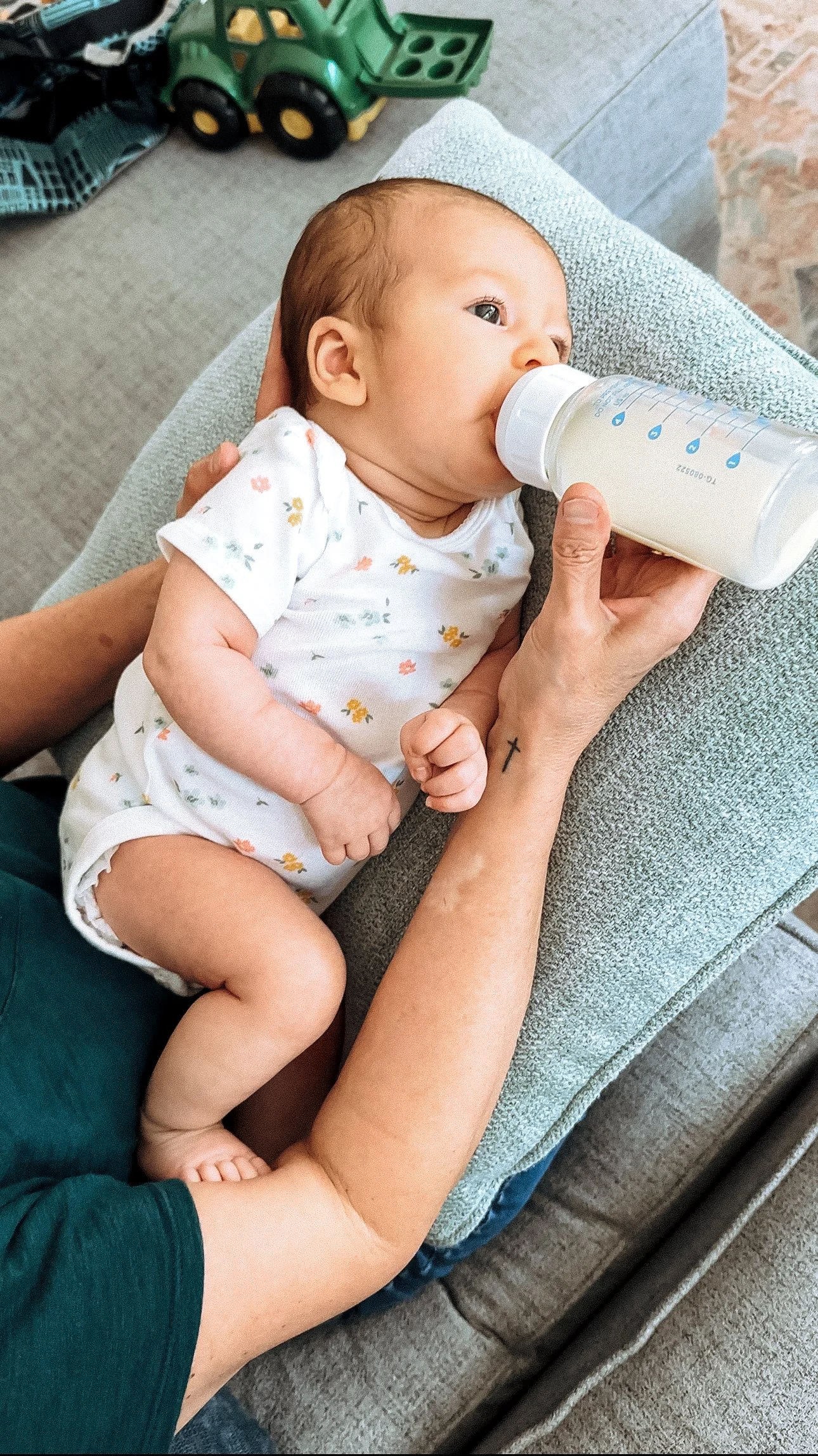
As a feeding specialist, this is my favorite position to bottle feed a newborn! It allows the feeding to be slowed down. Unfortunately, it’s not the most convenient position if you’re out and about, but it doesn’t mean you can’t try.
- Find a comfortable spot to sit, like on the couch or a bed, and slide your feet toward your body so your knees are up.
- Then, extend your legs out in front of you (for comfort) and place a pillow on your legs to achieve similar elevation.
- Next, place baby on their side with their body at a 45 degree angle and offer the bottle.
Upright Feeding
This position is just as it sounds: baby is sitting almost fully upright. This position may be a good option for babies who display reflux symptoms.
- Place your baby in a seated position. This can be done in many different ways, depending on your baby’s age.
- If your baby is younger and does not have great head and neck control, you will want to provide head and body support with your hand cupped around the base of their head or your arm behind their head like in the photo above.
- Then, offer the bottle!
If your baby has stable head control, but you still want to provide extra support, you can lean their back against your chest and hold the bottle out in front, facing you and baby.
Bottle propping
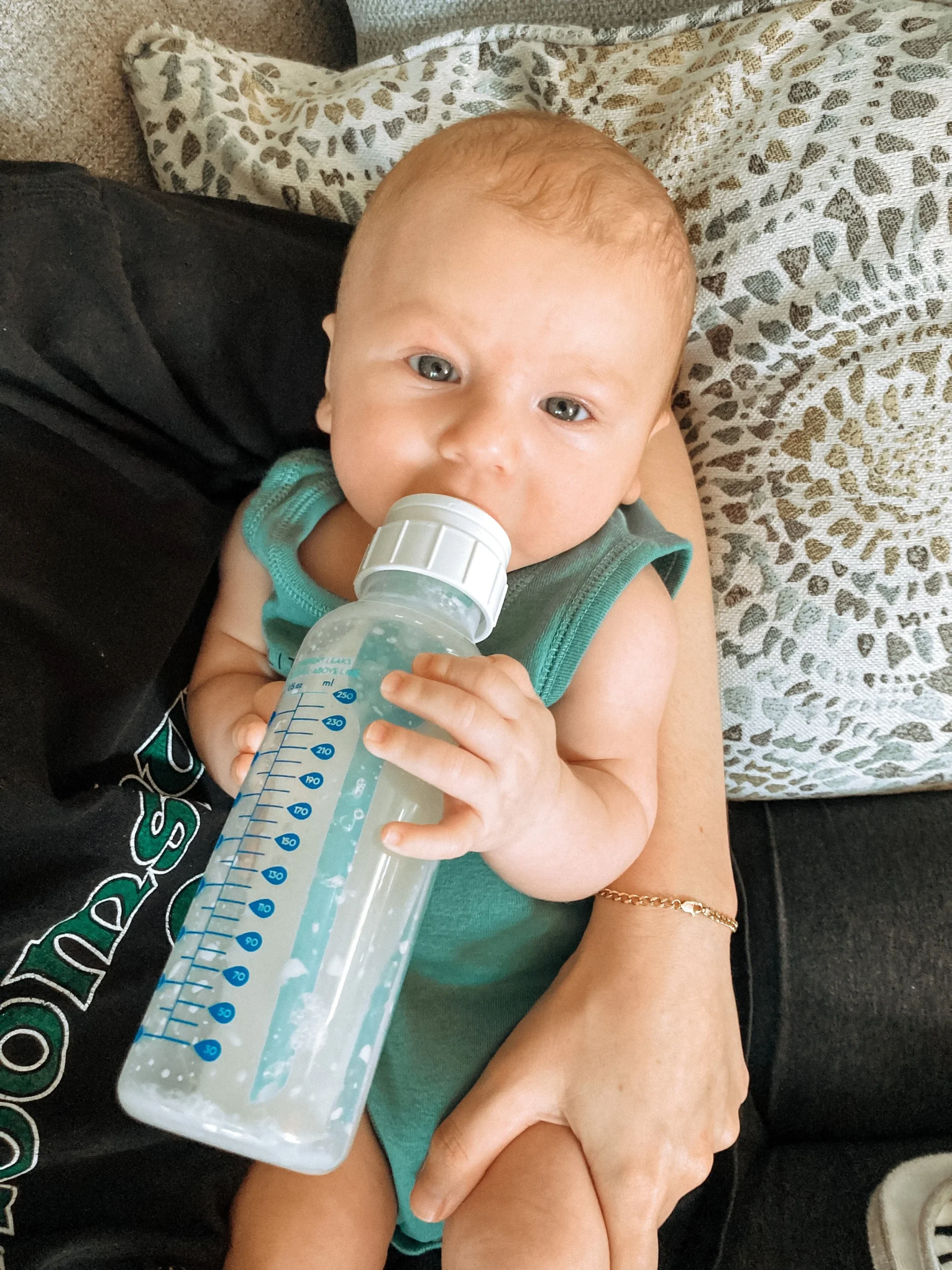
Bottle propping is a hard no. Let me say it again: don’t prop the bottle!
Bottle feeding your baby is an activity that requires active participation from the baby and their caregiver. Bottle propping is associated with several negative impacts, including overfeeding, since milk continues to pour out once baby stops suckling. (1)
Propping the bottle can also cause your baby to sputter, cough, or potentially choke while drinking. (1) A caregiver should actively feed baby their bottle until baby can and does hold it on their own.
Nipple flow rate
Did you know that you don’t have to change the nipple flow as your baby grows? That’s right! Don’t let those marketing gimmicks get you with levels of nipple flows for specific ages.
If your baby is content and eating without difficulty, then there is no need to change the nipple flow. If you notice your baby is taking longer to finish a bottle or becoming frustrated, try going up to the next flow option.
Some babies, especially breastfed babies, don’t ever need to change the flow of the nipple. Yes, you can have a one-year-old on a slow flow nipple and if that’s working for you, great! If it ain’t broke, don’t fix it!
For more information on nipple flow rate and if/when to make the change, check out this blog.
Remember: do not force feed or increase the flow just to make feeds go faster.
Signs your newborn needs a break from a bottle feed
If your baby is telling you that they aren’t interested or need a break, listen to them. These signs can look like:
- Pushing the nipple out with their tongue
- Turning their head
- Only drinking a few ounces and wanting a break
- Arching their back away or crying
If you see these behaviors, take a break from the feed and try again later. Baby could be teething, need to burp, or need to poop and just isn’t interested in eating right now.
It’s okay if your baby isn’t drinking the same amount at each feed! As adults, we don’t eat the same amount at each meal, and that’s normal!
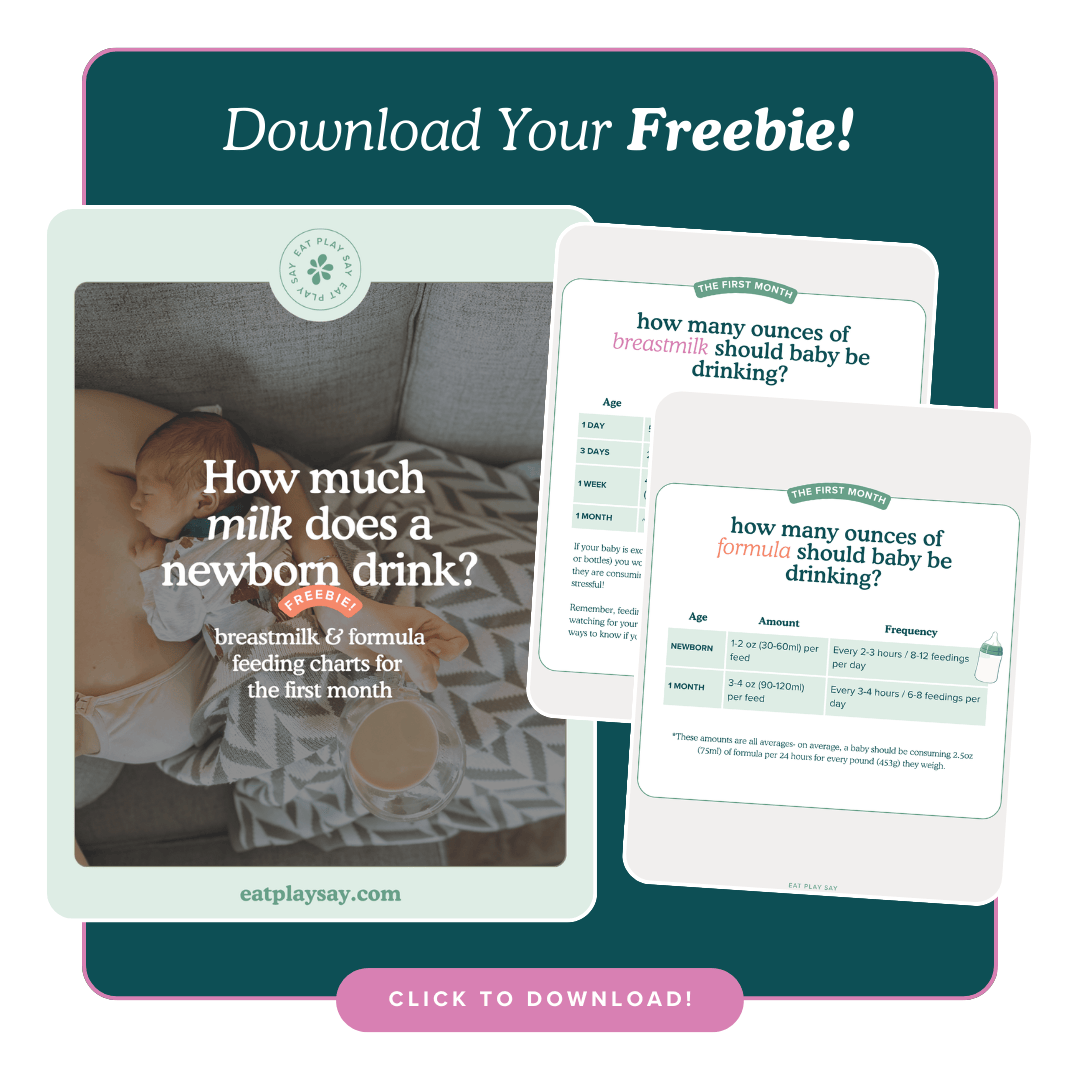
Wondering how much milk your baby should drink? We break that down in this downloadable freebie!
Signs baby needs bottle feeding help
Learning to eat is HARD! Yes, it is a natural thing our bodies do, but babies still have to learn how.
Babies are used to getting all their needs met without having to do anything. That’s what life is like in the womb! For newborns especially, having to work to fill their bellies can be tiring and difficult.
Not every feeding is going to be perfect. If you’re sensing something is off with your little one’s feeding despite trying all the tips we’ve outlined, there could be some oral dysfunction.
We recently dove into how to identify what bottle is best for a baby and why. As we know from that blog, the most optimal bottle/nipple is one that has a long narrow slope.
If your baby is consistently exhibiting any of the following, it’s likely time to talk to a professional:
- Open mouth breathing
- Drooling
- Snoring
- Low and forward tongue position in mouth
- Clicking during a feeding
- Trouble latching
- Falling asleep quickly during a feed
The Eat Play Say feeding team is here to help via virtual consultations. Additionally, remember that any medical concerns you have for your little one should be directed toward their pediatrician.
More bottle feeding resources
We know that parenting is hard work, and bringing home a newborn is beyond exhausting. It’s beautiful, and amazing, but it’s hard.
We provide resources to help you feel empowered through every stage of parenting little ones. You can find all of our breast and bottlefeeding blogs here, as well as information about development here.
Plus, don’t forget to take care of you—we’ve got a handy free download full of nutritious postpartum meals and snacks.
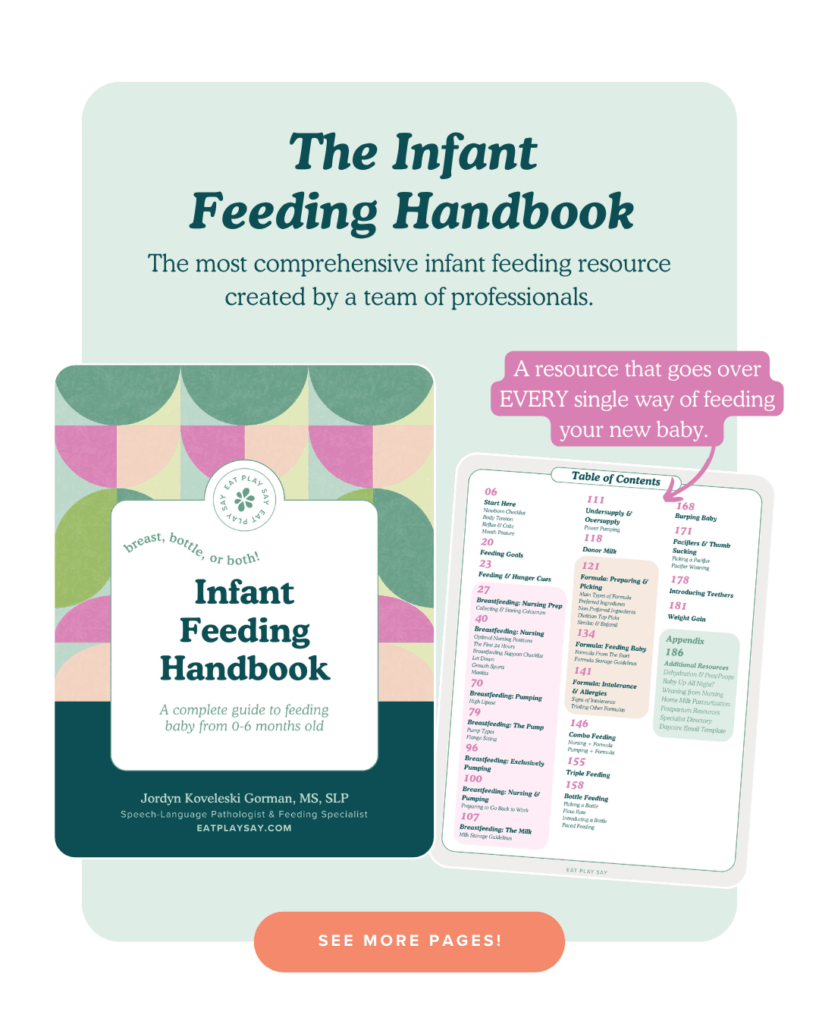
For more feeding support, check out our Infant Feeding Handbook. Everything you need to know about feeding your little one is inside!
Sources
- Khalil S, Gupta P. 50 Years Ago in the Journal of Pediatrics. The Journal of Pediatrics. 235129.
OTHER POSTS YOU MAY LIKE:




MS, SLP
Founder of Eat Play Say, Speech-Language Pathologist, Feeding Specialist, Play Expert, Mom of 2
Jordyn Koveleski Gorman
SPECIALIZES IN: Infant and toddler speech-language, play, and feeding development, and curating a team that provides expert help that feels like a reassuring text from that one mom friend
EDUCATION: Jordyn received her BS in Speech-Language Pathology from Bloomsburg University and her MS in Speech-Language Pathology from Towson University
FAVE PARENTING FIRST: “The first true smile, it’s the sweetest!”

MS, CCC-SLP, CBS, IBCLC
Speech-Language Pathologist & Feeding Specialist, Certified Breastfeeding Specialist, International Board Certified Lactation Consultant
Jessica Nicholson Cocca
SPECIALIZES IN: Breast and bottle feeding, tongue ties, oral motor dysfunction, starting solids, infant and toddler speech, treating oral motor disorders
EDUCATION: Jessica received her BS in Communication Sciences and Disorders from Pennsylvania State University in 2015 and her MS in Speech-Language Pathology from Towson University in 2017
FAVE PARENTING FIRST: “Baby’s first wave! What a fun first communication gesture!”

MA, CCC-SLP, CLC
Speech-Language Pathologist, Certified Lactation Counselor
Jennifer McFarlin
SPECIALIZES IN: Breast and bottle feeding, tongue ties, starting solids, infant and toddler speech development
EDUCATION: She received her BS in Speech-Language Pathology from Ball State in 2014 and a MA in Speech-Language Pathology from Ball State in 2016.
FAVE PARENTING FIRST: “My favorite baby’s first is their first true smile that just warms your soul knowing they are smiling at you. My other favorite is their first word. I love watching their language explode!”

MS, CCC-SLP
Bilingual Speech-Language Pathologist
Nicole La Petina Kelly
SPECIALIZES IN: Bilingual development (Spanish-English), supporting multilingual families, infant and toddler speech
EDUCATION: She received her BA in Communication Sciences and Disorders and in Spanish from the University of Wisconsin-Madison in 2014 and her MS in Speech-Language Pathology with an English-Spanish Specialization from Marquette University in 2016.
FAVE PARENTING FIRST: “It’s the first slobbery kisses for me!”

RDN, LD
Licensed Registered Dietitian
Kimberly Vede
SPECIALIZES IN: Infant and pediatric nutrition including breastfeeding, formula feeding, and starting solids. She also specializes in prenatal and postpartum nutrition.
EDUCATION: She received her BSc in Biology in 2014 from Life University, and her BSc in Dietetics from Life University in 2019.
FAVE PARENTING FIRST: ”The first time they say ‘mama!’”


This checklist was created with input from a Speech-Language Pathologist, Occupational Therapist and Physical Therapist and has been downloaded over 20,000 times by parents worldwide. Learn the important milestones to pay attention to, and keep it in your digital back pocket during the baby + toddler years!
Comprehensive Milestone Checklist for gross motor, fine motor, and speech-language milestones for 0-36 months,
DOWNLOAD FOR FREE


