


Is it Normal for Infants to Spit Up?
May 8, 2026
Jordyn Koveleski Gorman

Last Updated on May 8, 2026 by Jordyn Koveleski Gorman
This page contains affiliate links. We will receive a commission on qualifying purchases using these links.
Spit up is common in infants, but is it normal? And why do babies spit up?
As a pediatric feeding specialist, I get questions about spit up in my inbox fairly often. And personally, as a mom of 3 littles who all have had different experiences with spitting up, I totally understand why people wonder!
Some babies are so chill when they spit up, while others fuss or seem uncomfortable and bothered by the experience. Plus, recognizing the difference between things like spit up, abnormal reflux, and true vomit can be confusing at times. And how much spit up is too much?

Is it normal for infants to spit up?
In general, spit up is normal for infants and is not cause for concern. (1)
Spit up, or regurgitation, can be triggered by a few things. Things like overfeeding, swallowing too much air during feeds, crying, hiccuping, a change in body position, or coughing can lead to spit up episodes. It happens because the lower esophageal sphincter, a muscle between the stomach and esophagus, is immature. As this muscle strengthens, spit up episodes typically decrease before fading away entirely.
The AAP estimates about 50% of infants experience normal reflux (spit up), especially in the first few months of life. (2) For infants, reflux is rarely associated with stomach acid. (1)
But how are parents supposed to know the difference between normal reflux and abnormal reflux?
Why do babies spit up?
Think about your baby and their spit up. In general, are they:
- Happy and calm even when spitting up?
- Gaining weight appropriately?
- Spitting up no more than a mouthful or two at a time, usually soon after eating?
- Only spitting up occasionally and not every time they eat?
- Less than one year old?
If your answers to these questions are “yes,” then your baby most likely has a normal case of infant reflux. Babies with normal reflux are often known as “happy spitters.”
If your answers to the above questions are “no,” then it may be time for a consult with a feeding specialist.
Consider these questions when preparing for a visit:
- Is baby uncomfortable, irritable, or unable to be soothed for long periods after or in between feeds?
- Do spit up episodes happen frequently (after almost every feed) and for a long time after feeds?
- Is baby arching their back during or after feeds and it doesn’t stop after a burp?
- Does your baby’s spit up seem forceful rather than accidental, more like vomiting?
- Is baby not gaining weight well?
- Is baby spitting up a large volume?
If you notice baby is uncomfortable during feeds or is experiencing consistent and frequent spit up, reach out to a feeding specialist for help. Bring up concerns to your pediatrician, but remember, they are not the best professional to talk to about feeding concerns, as that is not their specialty. Signs of reflux should not be dismissed or just labeled as “colic.”

Is spit up a sign of food intolerance?
Spit up can be a sign of intolerance and GI upset, but isn’t necessarily the primary sign of an intolerance. Whether baby is formula fed or receiving breastmilk, there are a few additional signs to consider that may indicate milk isn’t able to be digested correctly. It’s important to look at the whole picture.
Signs baby isn’t tolerating milk, whether breast or formula:
- Projectile vomiting
- Blood in baby’s poop
- Poor weight gain from excessive spit up
- Decrease in wet diapers
- New rash, skin changes, or hives (take pictures for reference!)
- Large quantities of spit up or seeming uncomfortable or in pain
Baby spit up vs vomit
Usually, spit up happens almost casually, dribbling or leaking from baby’s mouth. Sometimes, spit up is accompanied by burping or is related to a sudden change in position (like from upright to laying on their back).
Vomit, on the other hand, is expelled up and out with force. Infants are also known for projectile vomiting. And if that happens, trust me, you’ll know. Frequent vomiting warrants follow-up with your child’s healthcare team.
What to do if baby spits up often
If baby is growing well and otherwise healthy, spitting up after the occasional feed is not generally a cause for concern. That’s great news! Spitting up after every feed—regardless of other symptoms—is worth investigating with a feeding specialist.
Infant reflux is not a disease, but it can be a symptom of a larger, whole body issue. Reflux is often related to whole body tension. Usually, treating the root cause also improves reflux symptoms.
If you notice that baby seems stiff, has a head turning preference, or is falling behind on developmental milestones, an evaluation can be a powerful tool to help your little one!
Early Intervention evaluations are free in the US, and you can self-refer without a referral from your pediatrician. Body tension can be evaluated by a physical or occupational therapist, or even a craniosacral therapist or chiropractor. Since Early Intervention evaluations can be booked out for a while, you may find it helpful to find a private practitioner who is in network with your insurance if you are concerned about the wait. Our team of specialists is also available for 1:1 virtual consultations!
While you wait for an evaluation, there are a few things you can try to help baby with their symptoms!
Tips for surviving spit up
Try a new feeding position
Upright supported feeding
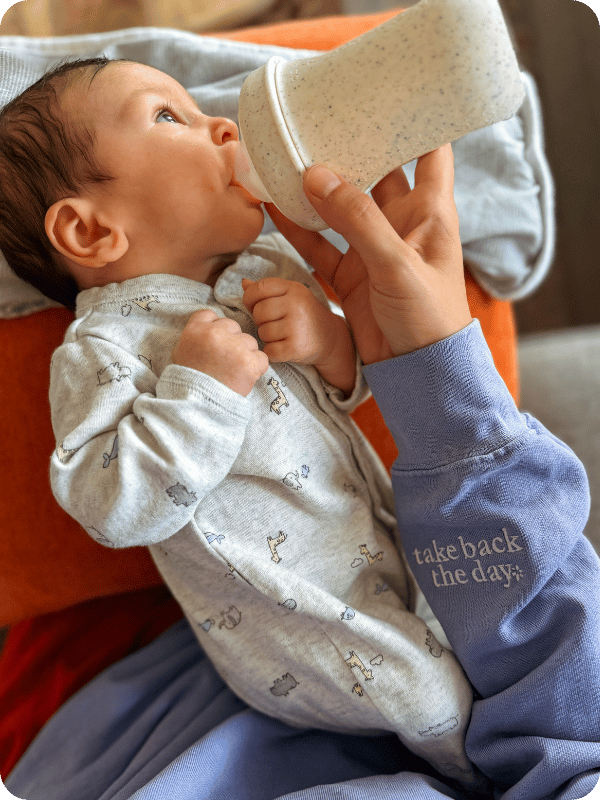
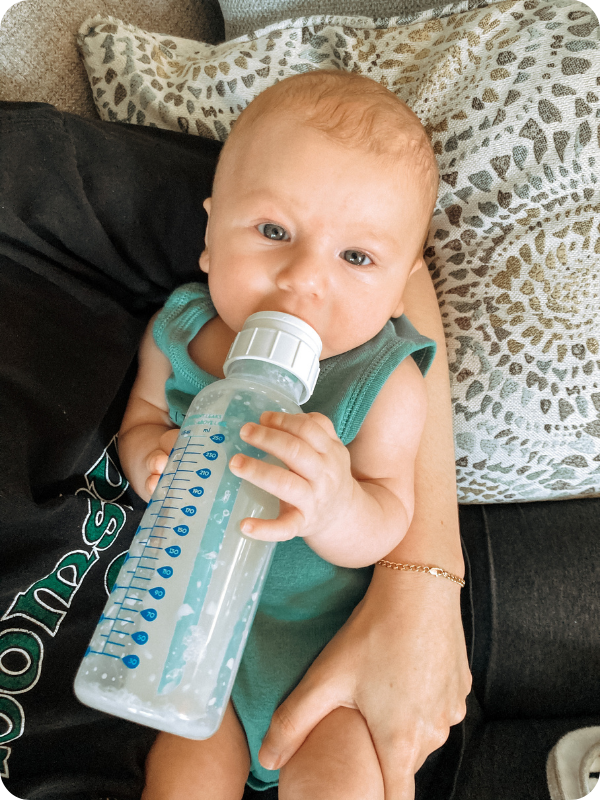
Place your baby in a seated position and offer a bottle. This can be done in different ways depending on your baby’s age. If baby doesn’t have great head and neck control, you will want to provide head and body support with your hand, or your arm behind their head like in the photo below. If your baby has stable head control, you can lean their back against your chest and hold the bottle out in front, facing you and baby.
Stay upright after feeds
This tip is all over the internet, but that’s because it works. It isn’t a cure-all, but keeping baby upright or propped for ~30 minutes after feeding can be helpful. This is hard to do before bedtime or if you’re on the go, but when possible, it’s worth trying.
Try sidelying
Left sidelying is a great position to support digestion. Prop baby on a pillow on your knees and show them high contrast cards or a book while they lay on their side after a feeding.
Also, keep in mind that swings, carseats, and bouncers actually put babies in a worse position for controlling reflux, so try to limit time spent in containers post-feedings.
Stop or reduce burping
Did you know that burping a baby with reflux symptoms can actually worsen symptoms? (3) Instead of burping, it can be helpful to try the tip above. Holding baby upright for a light walk after feeding may be more effective than burping. Try and see what works for you!
More parenting support
Now that you know how to spot the difference between “normal” spit up and the kind that warrants some extra care, hopefully you can feel reassured next time baby spits up. I know it can be tiresome to have to change baby’s outfit multiple times a day! Hopefully, this won’t last too long. Especially if there is some underlying body tension, there can be a remedy on the horizon!
You can find more helpful resources on our blog, whether you need help with breast & bottlefeeding, starting solids, or figuring out how to play with your baby in age-appropriate ways!
For hundreds of pages of expert-written information and tips on supporting your little one’s growth, check out our Handbooks! Our comprehensive Infant Feeding Handbook covers everything you need to know about feeding baby in their first few months of life.

Sources
- Indrio F, Riezzo G, Raimondi F, Cavallo L, Francavilla R. Regurgitation in healthy and non healthy infants. Ital J Pediatr. 2009 Dec 9;35(1):39. doi: 10.1186/1824-7288-35-39. PMID: 20003194; PMCID: PMC2796655.
- Schmitt Pediatric Care Advice; Spitting Up (Normal Reflux). Pediatric Patient Education 2025; 10.1542/ppe_schmitt_225
- Kaur R, Bharti B, Saini SK. A randomized controlled trial of burping for the prevention of colic and regurgitation in healthy infants. Child Care Health Dev. 2015 Jan;41(1):52-6. doi: 10.1111/cch.12166. Epub 2014 Jun 9. PMID: 24910161.
Leave a Reply
OTHER POSTS YOU MAY LIKE:




MS, SLP
Founder of Eat Play Say, Speech-Language Pathologist, Feeding Specialist, Play Expert, Mom of 3
Jordyn Koveleski Gorman
SPECIALIZES IN: Infant and toddler speech-language, play, and feeding development, and curating a team that provides expert help that feels like a reassuring text from that one mom friend
EDUCATION: Jordyn received her BS in Speech-Language Pathology from Bloomsburg University and her MS in Speech-Language Pathology from Towson University
FAVE PARENTING FIRST: “The first true smile, it’s the sweetest!”

MS, CCC-SLP, CBS, IBCLC
Speech-Language Pathologist & Feeding Specialist, Certified Breastfeeding Specialist, International Board Certified Lactation Consultant
Jessica Nicholson Cocca
SPECIALIZES IN: Breast and bottle feeding, tongue ties, oral motor dysfunction, starting solids, infant and toddler speech, treating oral motor disorders
EDUCATION: Jessica received her BS in Communication Sciences and Disorders from Pennsylvania State University in 2015 and her MS in Speech-Language Pathology from Towson University in 2017
FAVE PARENTING FIRST: “Baby’s first wave! What a fun first communication gesture!”

MA, CCC-SLP, CLC
Speech-Language Pathologist, Certified Lactation Counselor
Jennifer McFarlin
SPECIALIZES IN: Breast and bottle feeding, tongue ties, starting solids, infant and toddler speech development
EDUCATION: She received her BS in Speech-Language Pathology from Ball State in 2014 and a MA in Speech-Language Pathology from Ball State in 2016.
FAVE PARENTING FIRST: “My favorite baby’s first is their first true smile that just warms your soul knowing they are smiling at you. My other favorite is their first word. I love watching their language explode!”

MS, CCC-SLP
Bilingual Speech-Language Pathologist
Nicole La Petina Kelly
SPECIALIZES IN: Bilingual development (Spanish-English), supporting multilingual families, infant and toddler speech
EDUCATION: She received her BA in Communication Sciences and Disorders and in Spanish from the University of Wisconsin-Madison in 2014 and her MS in Speech-Language Pathology with an English-Spanish Specialization from Marquette University in 2016.
FAVE PARENTING FIRST: “It’s the first slobbery kisses for me!”

RDN, LD
Licensed Registered Dietitian
Kimberly Vede
SPECIALIZES IN: Infant and pediatric nutrition including breastfeeding, formula feeding, and starting solids. She also specializes in prenatal and postpartum nutrition.
EDUCATION: She received her BSc in Biology in 2014 from Life University, and her BSc in Dietetics from Life University in 2019.
FAVE PARENTING FIRST: ”The first time they say ‘mama!’”


This checklist was created with input from a Speech-Language Pathologist, Occupational Therapist and Physical Therapist and has been downloaded over 20,000 times by parents worldwide. Learn the important milestones to pay attention to, and keep it in your digital back pocket during the baby + toddler years!
Comprehensive Milestone Checklist for gross motor, fine motor, and speech-language milestones for 0-36 months,
DOWNLOAD FOR FREE


