


When Can Babies Sit Up On Their Own?
October 2, 2025
Jordyn Koveleski Gorman

Last Updated on September 10, 2026 by Jordyn Koveleski Gorman
This page contains affiliate links. We will receive a commission on qualifying purchases using these links.
The world sure gets boring after a while when all you can see is the ceiling.
Sitting up is a milestone that unlocks a whole new level of infancy: starting solids, playing with toys more functionally, and, before you know it, crawling!
Some babies learn to sit up and are content to stay in place for a while. We call those “happy sitters.” Other babies get a taste of the vertical world and are off to the races. Both are normal! Every baby is different, and the path yours takes to sitting is allowed to be unique.
That said, there are some basics to sitting that are helpful for parents to know! With the help of our team’s physical therapist, we’re breaking down everything you need to know about when your baby might start sitting!
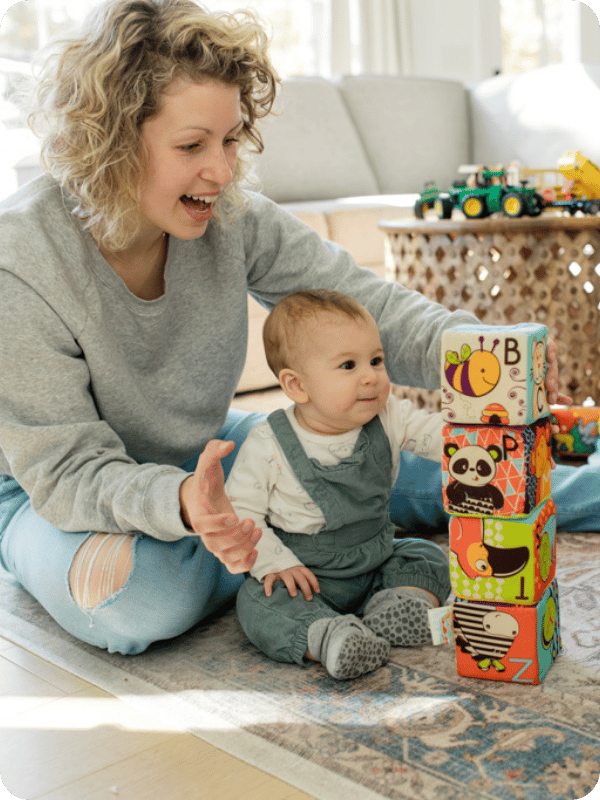
When do babies start sitting?
Sitting is a skill most babies are ready to start working on around 4.5-5 months old. (1) We already hinted that it’s incredibly important for some upcoming milestones, especially starting solids.
Developmentally, we want babies to be solid sitters (pun intended) in addition to other signs of readiness before they start eating purees and solid foods. These skills prepare them to bring food to their mouths, move food around in their mouths effectively, and swallow safely.
Before your baby can sit independently, your baby must be able to:
- Support themself on extended arms during tummy time
- Hold their head upright when supported in a vertical position
- Weight shift side-to-side while playing on their tummy (think reaching for toys with one hand or the other)
Some babies will push themselves up to sitting from tummy time by pushing up on their arms. They will push themselves all the way back into a sitting position. This tends to happen almost accidentally at first! Other babies will need more support to get into a sitting position until they figure out how to get there on their own.
When do babies sit on their own?
Most babies can sit with support between 5-7 months. We expect babies will be sitting independently, without any support, by no later than 8 months. (1)
If your baby isn’t showing signs of sitting independently by 7 months, or you have gross motor concerns, remember that you can self-refer to Early Intervention in the US. To check and see where your little one is at meeting milestones, download our free Milestone Checklist for 0–36 months!
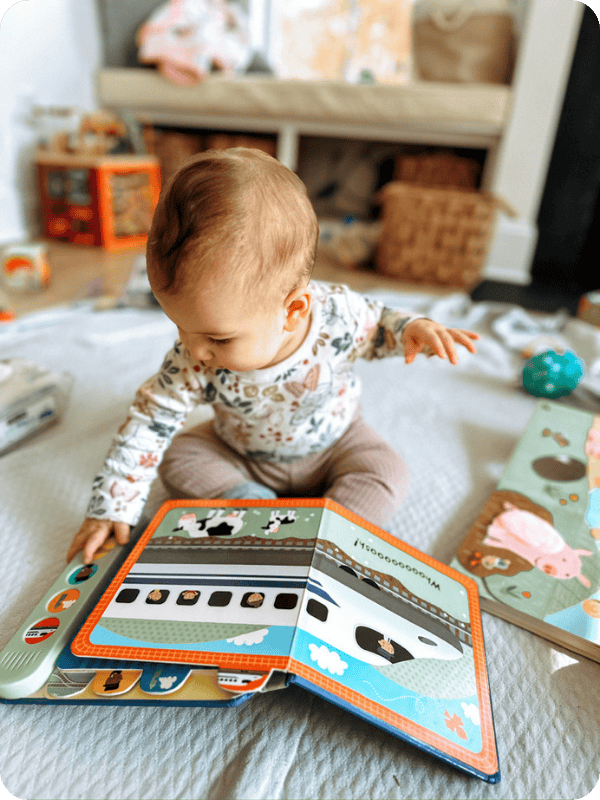
How to teach baby to sit up
All babies develop differently. Parents often wonder if it’s safe for them to assist baby into a seated position. According to the Eat Play Say physical therapist, it usually is! As long as your baby is willing to weight shift and move out of sitting without getting stuck indefinitely, you can help them!
Just like any other motor milestone, some babies need a little help getting started. If your baby has good head control and can sit well with support, you can put your baby in a seated position. A few easy tips for this are below.
Practice going from a sidelying position to sitting.
When your baby is lying on the ground on their side, help them get their bottom arm underneath their body. Then, shift their weight while extending their arm until they’re sitting up!
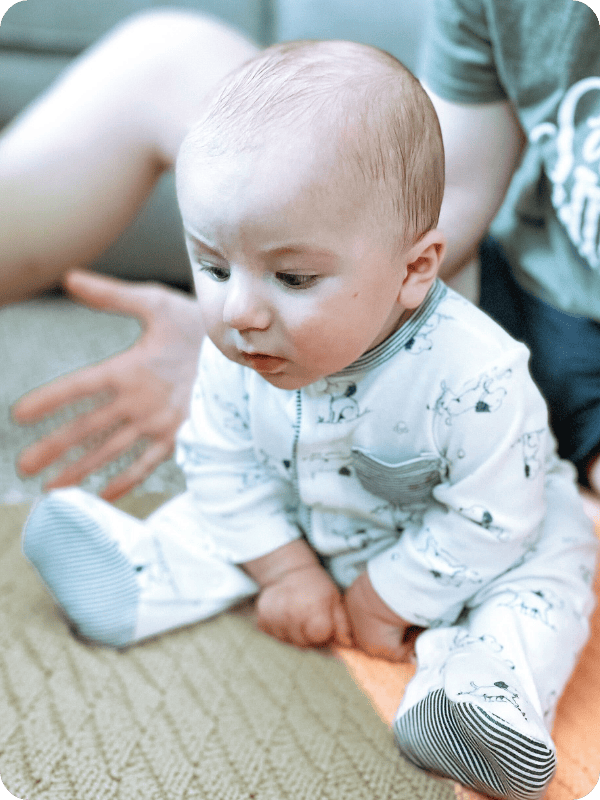
When infants first learn to sit alone, it usually starts as a “prop sit.” This is where your baby will hold themselves up using both arms on the floor for support, and then, eventually, maybe with one arm. You can see an example of prop sitting in the photo below.
When prop sitting or learning to sit, you should sit behind or beside your baby, or surround them with pillows in case they lose their balance. As they get more steady, they can start reaching for a toy with one hand at floor level, then hip level, then shoulder level, and finally overhead! Don’t expect them to master sitting without support overnight. It takes a few weeks of practice to build up the strength and balance for independent sitting. Remember, too, that the floor is the best place to practice sitting!
Activities to help your baby sit up on their own
Put your baby in a laundry basket with some clean laundry or towels.
Surround baby with the laundry for support and throw a few toys in. It might give you a few minutes to get something done while your baby is supported but still able to move their body more freely and work on sitting. Just make sure the basket is deep and heavy enough that your baby can’t tip it. Diaper boxes work great, too.
Sit in front of the couch with your baby on the edge of the couch.
Hold baby by their waist and move them side to side, front to back, and bounce up and down. You want to see your baby keep their head upright and in midline. You’re also looking for them to start correcting their head and trunk position as you move them in different directions. This activity also works with an exercise ball or pile of pillows on the floor.
Grab a ball and sit on the floor with your baby between your legs a few feet away from a wall.
Help roll the ball to the wall so it bounces off and comes back to you! Once your baby is more steady, you can sit across from your baby and roll the ball back and forth. Just don’t forget to put some pillows behind your baby in case they tip over!
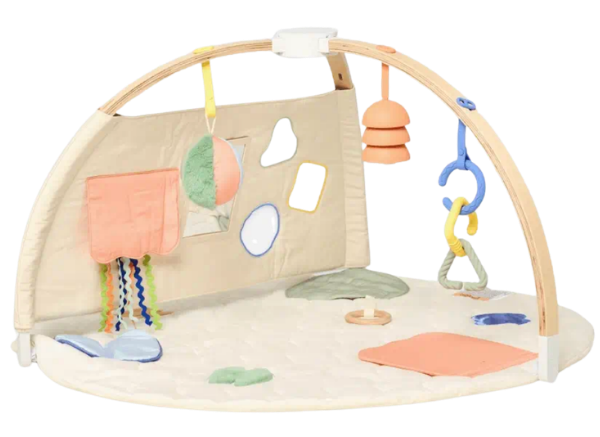
Practice sitting on your baby’s tummy time mat.
Sit with your baby on the floor, using pillows or your legs to steady them in case they topple. You can play with their favorite toys or find random objects around the house, like kitchen utensils or books. Our favorite play gym from Lalo comes with a sit up play panel to help keep baby engaged as they work on sitting!
Are infant seats good for development?
Short answer: no, not really. While infant seats are great if you need a moment to go potty in peace or get something out of the hot oven, those seats are still just “containers.” They won’t teach your baby how to sit.
Sitting requires lots of muscle activation, and all those fancy seats do the work for your baby by holding them upright. Many of these seats also don’t put babies in the optimal sitting position. They force babies into a rounded position of their spine, which is the opposite of what we’re aiming for when working towards independent sitting.
We encourage using seats sparingly for convenience and aim to work on sitting during floor time! You can see our physical & occupational therapist approved containers here. In general, though, our experts agree: the more floor time, and the less container time, the better.
More ways to play with your infant
There are so many fun moments ahead as your little one starts to see the world from a new perspective! Raising littles is hard work, and you should be so proud of yourself. You’ve got this!
For more support with your little one, who is undoubtedly growing like a weed, take a deep dive on the blog. We’ve got posts to help you play with your baby, as well as educational posts about meeting milestones! And if it’s starting solids or breast/bottlefeeding you need help with, we’ve got you covered too.
For more in-depth support, check out our collection of Handbooks written by our team of child development experts! Our handbooks are easy to read, yours for life, and don’t take a whole afternoon to understand. Whether you need more ways to play (our Infant Playbook) or help with Starting Solids, we’re here to help.
Sources
- Jennifer M. Zubler, Lisa D. Wiggins, Michelle M. Macias, Toni M. Whitaker, Judith S. Shaw, Jane K. Squires, Julie A. Pajek, Rebecca B. Wolf, Karnesha S. Slaughter, Amber S. Broughton, Krysta L. Gerndt, Bethany J. Mlodoch, Paul H. Lipkin; Evidence-Informed Milestones for Developmental Surveillance Tools. Pediatrics March 2022; 149 (3): e2021052138. 10.1542/peds.2021-052138
Leave a Reply
OTHER POSTS YOU MAY LIKE:



MS, SLP
Founder of Eat Play Say, Speech-Language Pathologist, Feeding Specialist, Play Expert, Mom of 3
Jordyn Koveleski Gorman
SPECIALIZES IN: Infant and toddler speech-language, play, and feeding development, and curating a team that provides expert help that feels like a reassuring text from that one mom friend
EDUCATION: Jordyn received her BS in Speech-Language Pathology from Bloomsburg University and her MS in Speech-Language Pathology from Towson University
FAVE PARENTING FIRST: “The first true smile, it’s the sweetest!”

MS, CCC-SLP, CBS, IBCLC
Speech-Language Pathologist & Feeding Specialist, Certified Breastfeeding Specialist, International Board Certified Lactation Consultant
Jessica Nicholson Cocca
SPECIALIZES IN: Breast and bottle feeding, tongue ties, oral motor dysfunction, starting solids, infant and toddler speech, treating oral motor disorders
EDUCATION: Jessica received her BS in Communication Sciences and Disorders from Pennsylvania State University in 2015 and her MS in Speech-Language Pathology from Towson University in 2017
FAVE PARENTING FIRST: “Baby’s first wave! What a fun first communication gesture!”

MA, CCC-SLP, CLC
Speech-Language Pathologist, Certified Lactation Counselor
Jennifer McFarlin
SPECIALIZES IN: Breast and bottle feeding, tongue ties, starting solids, infant and toddler speech development
EDUCATION: She received her BS in Speech-Language Pathology from Ball State in 2014 and a MA in Speech-Language Pathology from Ball State in 2016.
FAVE PARENTING FIRST: “My favorite baby’s first is their first true smile that just warms your soul knowing they are smiling at you. My other favorite is their first word. I love watching their language explode!”

MS, CCC-SLP
Bilingual Speech-Language Pathologist
Nicole La Petina Kelly
SPECIALIZES IN: Bilingual development (Spanish-English), supporting multilingual families, infant and toddler speech
EDUCATION: She received her BA in Communication Sciences and Disorders and in Spanish from the University of Wisconsin-Madison in 2014 and her MS in Speech-Language Pathology with an English-Spanish Specialization from Marquette University in 2016.
FAVE PARENTING FIRST: “It’s the first slobbery kisses for me!”

RDN, LD
Licensed Registered Dietitian
Kimberly Vede
SPECIALIZES IN: Infant and pediatric nutrition including breastfeeding, formula feeding, and starting solids. She also specializes in prenatal and postpartum nutrition.
EDUCATION: She received her BSc in Biology in 2014 from Life University, and her BSc in Dietetics from Life University in 2019.
FAVE PARENTING FIRST: ”The first time they say ‘mama!’”


This checklist was created with input from a Speech-Language Pathologist, Occupational Therapist and Physical Therapist and has been downloaded over 20,000 times by parents worldwide. Learn the important milestones to pay attention to, and keep it in your digital back pocket during the baby + toddler years!
Comprehensive Milestone Checklist for gross motor, fine motor, and speech-language milestones for 0-36 months,
DOWNLOAD FOR FREE


