


The Switch Witch: Halloween Candy Swaps & Treats for Kids
September 30, 2025
Jordyn Koveleski Gorman

Last Updated on October 29, 2026 by Jordyn Koveleski Gorman
This page contains affiliate links. We will receive a commission on qualifying purchases using these links.
Halloween is such a fun day for littles and parents alike, dressing up in costumes and trick-or-treating for so many treats! Handling Halloween candy after the fact can be difficult, though, and it can be tough to navigate for young children. Worries about too much sugar, choking hazards, and even avoiding ingredients that your family prefers not to eat can leave parents feeling like a villain on an otherwise exciting night.
No matter how good a parent’s reason might be for needing to remove some candy, the approach can change the way little ones view the holiday or even impact their relationship with food for better or for worse. Implementing a Switch Witch can provide a fun, engaging way to make Halloween swaps without causing a meltdown or creating a negative relationship with food that could cause harm down the road!
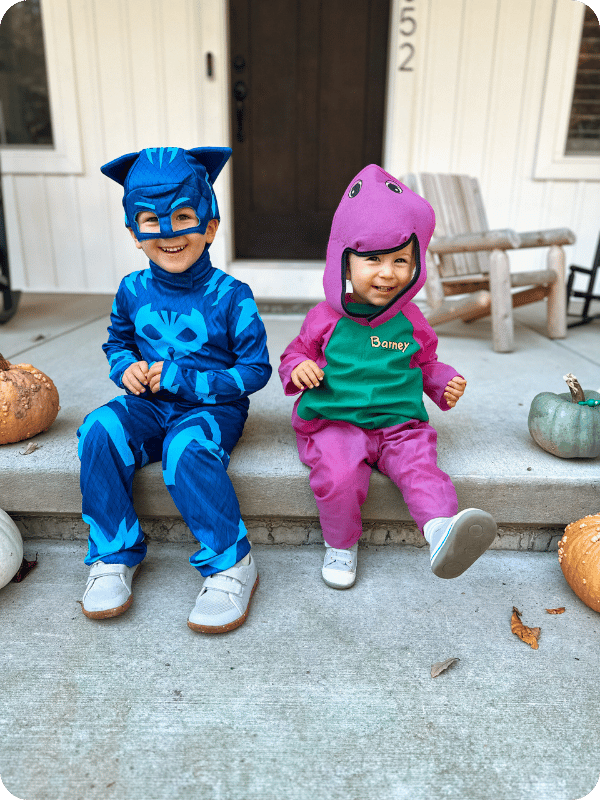
The Switch Witch
The Switch Witch is a made-up character who comes overnight after trick-or-treating and switches out Halloween candy for alternative options. She is something exciting that littles can look forward to, while helping parents maintain control over their approach to candy.
How to do the Switch Witch
After your little one is done trick-or-treating, parents can approach the goody bag of candy in a way that feels best for them. Some options include:
- Having little ones help sort candy as an activity, separating the “keeps” from the “switches”
- Parents choose some candy for littles to keep and setting the rest aside before littles have access to it (can be helpful for littles who are prone to sticking everything in their mouth, including choking hazards)
Remember, you set the boundaries! In our family, we usually let our littles (preschool and kindergarten) have a “safe” candy, like some plain milk chocolate, from their bag. We pick something that isn’t a choking risk and has the least amount of ingredients that we prefer to avoid.
When discussing swaps with our kids, we are honest with them! Being open about foods and what they can do to our bodies is important, but it’s equally important to avoid labeling foods as “good” or “bad,” which can create negative associations that cause harm later. (1) We say things like:
- “Too much at one time can hurt your belly.”
- “Our family doesn’t eat these ingredients, but some families do, and that’s okay!”
- “These foods have sugar and give us lots of energy, but it’s best to not eat too many at once.”
In the morning when your little one wakes up, their Halloween bag or basket will be filled with candy or treats from the Switch Witch. You can feel good knowing your little one is getting sweets that work for your family, and they feel special that they had an overnight visitor!
The Switch Witch can even bring in non-candy items like glow sticks, stickers, fidget spinners, bubbles, pencils, or a Halloween-themed craft!
Ingredients in Halloween candy
Our team’s registered dietitian helped me break down the facts about popular Halloween candy, as well as shed some light on potential alternatives if parents are interested.
Remember that labeling foods as “good” or “bad” can lead to anxiety and shame around food later on. (1) When discussing ingredients, terms like “preferred” or “best to avoid if possible” can be helpful.
In general, candy has ingredients that aren’t necessarily optimal for nutrition, but can often be eaten in moderation without harm. For children, these ingredients are sometimes recommended to avoid entirely if possible. For instance, added sugar intake before the age of 2 has been associated with health risks later in life, including diabetes and obesity. (2) As a result, the AAP recommends avoiding added sugars entirely before 2. (3)
Some common ingredients that may warrant a “switch” include:
- High Fructose Corn Syrup (HFCS) and Corn Syrup
- Artificial Colors: Blue 1, Yellow 5, Yellow 6, and Red 40
- Artificial Flavors
- Artificial Sweeteners: sucralose, aspartame
- Partially Hydrogenated Oils
- Preservatives: sodium benzoate, sulfites (sulfur dioxide), polysorbate 60, 65 or 80, nitrites, TBHQ, and BHT/BHA
- Soy (soybean oil, soy lecithin)
This list can look daunting, and reviewing ingredients labels quickly reveals that most candies in the trick-or-treat bag likely have some or many of these ingredients. What can parents who hope to avoid these ingredients do?
If you want to offer traditional candy to your little one or want to leave them with some candies in their Trick-or-Trick bucket, we recommend aiming to keep a few candies that are free from artificial dyes and high fructose corn syrup. These are often the easiest to avoid and also the best to eliminate if possible.
A few options we commonly get include:
- Hershey’s Milk Chocolate (Sugar, Milk, Chocolate, Cocoa Butter, Milk Fat, Lecithin, PGPR, Natural Flavor)
- Peppermint Patties (Sugar, Corn syrup, Chocolate, Cocoa, Invert sugar, Milk fat, Egg whites, Cocoa butter, Soy Lecithin, and Oil of peppermint)
- Brown/Chocolate Tootsie Roll Pop (Sugar, Corn syrup, Cocoa, Partially Hydrogenated Soybean Oil, Condensed Skim Milk, Whey, Artificial and Natural Flavors, Soy Lecithin)
Many candies are choking hazards
Regardless of ingredients families may choose to avoid or not, choking hazards are a significant concern for little ones on Halloween. Some candies can be choking hazards for children well into elementary school, such as jawbreakers.
Anything hard, round, extremely gooey or chewy puts your little one at risk for choking.
Some common candy choking risks:
- Blow Pops, Tootsie Pops, and other suckers
- Swedish Fish and Sour Patch Kids
- Gummy worms and gummy bears
- Candy Corn
- Hot Tamales
- Jawbreakers and Jolly Ranchers
- M&Ms, including peanut M&Ms, Reese’s Pieces, and Skittles
- Milk Duds
- Laffy Taffy
- Twizzlers
- Whoppers
Remember, candy that is hard, round and/or extremely squishy and sticky is a no-go for children under the age of 4–5. Parental supervision with candy is always recommended.
Other approaches to Halloween candy
For many families, the mindset that Halloween is “only one night” works well, allowing little ones more freedom to make choices about candy. What matters most is that parents feel comfortable with the boundaries they set with their children regarding candy.
Sometimes, having a tummy ache after eating too much candy can be a learning moment for children. It can be an opportunity to talk about how having too much candy makes their body feel yucky. Avoiding “good” or “bad” language, as well as shame-based language such as “I told you so,” can help open the door to dialogue that helps children learn. Parents can ask questions about how they feel (if they’re old enough) and discuss how a different approach next time might be better for them.
For some families, setting more boundaries around candy consumption might feel like a better option. Doing this can help prevent blood sugar spikes and the subsequent dips that occur from eating a lot of sugar. It’s worth noting that this still happens even with “healthier” candies, because they are still high in sugar. It can be tricky to find the right balance, and what you decide to do may depend on your child’s age.
For littles under 2, it’s likely easier to swap candy for healthier alternatives. Some littles this age may not even realize the candy they’ve collected is food, but rather a new toy to be sorted!
Kids ages 2–4 aren’t old enough to manage their candy and make sound decisions regarding how much they consume. Boundaries and clear expectations will help everyone feel their best at this age.
Kids older than 4 may be able to manage their candy stash and their consumption, but it is more likely that they will still need parental guidance and support.
Alternative Halloween candy options:
You don’t have to decide between having fun and letting your kids eat a ton of candy with less-than-ideal ingredients. Some of our favorite switches that the Switch Witch brings include:
- Lesser Evil Snack Pack Popcorns (for older kids, as popcorn is a choking risk until around age 5)
- Unreal Dark Chocolate Coconut Bars
- Justin’s Peanut Butter Cups
- Skinny Dipped Chocolate Covered Almonds (for older kids, as whole nuts are a choking risk)
- YumEarth Gummies or BlackForest Organic Gummies (3 years +)
- YumEarth Organic Pops (3 years +)
- Wedderspoon Manuka Honey Pops (3 years +)
- Alter Eco Chocolate Truffles
Our Healthy Snack Faves also has a ton of great pre-packaged snack ideas for you and your family!
A favorite Halloween treat: Homemade nut butter cups
Ingredients:
- 1 cup chocolate chips
- 3 Tablespoons melted coconut oil
- ½ cup natural, creamy peanut butter (or almond/cashew butter)
- ¼ cup pure maple syrup
Servings: Makes about 12 regular-sized peanut butter cups, or 24 mini peanut butter cups, depending on how thick you make your layers.
Directions:
- Line a regular-sized or mini muffin tin with paper or silicone liners.
- Melt 1 cup of chocolate chips and 1 Tablespoon of the coconut oil together either in the microwave or on the stovetop until smooth and creamy.
- Use a spoon to pour the melted chocolate into the bottom of each of the muffin liners. Use just enough to fully cover the bottom, about 1-2 tsp for regular-sized. (You will have chocolate left over for the top layer).
- Place muffin tin in the freezer for about 10 minutes to let chocolate harden.
- While the chocolate hardens, mix together ½ cup peanut butter, ¼ cup maple syrup and and 2 Tbsp coconut oil and melt together in the microwave or on the stovetop, until mixture is pourable.
- Remove muffin tin from freezer and distribute peanut butter mixture evenly on top of chocolate layer.
- Place muffin tin back in freezer for 5 minutes.
- Pour remaining chocolate mixture on top of peanut butter layer. You can sprinkle the top layer with sea salt, chopped peanuts, sprinkles, or whatever you want.
- Place muffin tin back in the freezer for about 30 minutes to set and then you can store in the fridge.

Tips for trick-or-treating
Last, but not least, make sure to feed little ones a balanced, high protein meal before the fun begins! This will help balance their blood sugar through the evening and keep them satiated so they aren’t digging into their candy bucket while hungry and treating it as their dinner. Keeping your little ones hydrated is also important. Skip the sugary drinks for the night if you can, and pack them a bottle of water.
Above all, don’t stress too much, enjoy the night with your children and make some great memories! Happy Halloween!
Sources
- Barrette, Lori, University of Rochester, Why We Need to Get Past Food Morality, 5 February 2025, Accessed October 2026.
- Gracner T, Boone C, Gertler PJ. Exposure to sugar rationing in the first 1000 days of life protected against chronic disease. Science. 2024 Nov 29;386(6725):1043-1048. doi: 10.1126/science.adn5421. Epub 2024 Oct 31. PMID: 39480913; PMCID: PMC12238948.
- American Academy of Pediatrics. Added sugar in kids’ diets: How much is too much? 25 March 2019. Accessed July 2026.
Leave a Reply
OTHER POSTS YOU MAY LIKE:




MS, SLP
Founder of Eat Play Say, Speech-Language Pathologist, Feeding Specialist, Play Expert, Mom of 3
Jordyn Koveleski Gorman
SPECIALIZES IN: Infant and toddler speech-language, play, and feeding development, and curating a team that provides expert help that feels like a reassuring text from that one mom friend
EDUCATION: Jordyn received her BS in Speech-Language Pathology from Bloomsburg University and her MS in Speech-Language Pathology from Towson University
FAVE PARENTING FIRST: “The first true smile, it’s the sweetest!”

MS, CCC-SLP, CBS, IBCLC
Speech-Language Pathologist & Feeding Specialist, Certified Breastfeeding Specialist, International Board Certified Lactation Consultant
Jessica Nicholson Cocca
SPECIALIZES IN: Breast and bottle feeding, tongue ties, oral motor dysfunction, starting solids, infant and toddler speech, treating oral motor disorders
EDUCATION: Jessica received her BS in Communication Sciences and Disorders from Pennsylvania State University in 2015 and her MS in Speech-Language Pathology from Towson University in 2017
FAVE PARENTING FIRST: “Baby’s first wave! What a fun first communication gesture!”

MA, CCC-SLP, CLC
Speech-Language Pathologist, Certified Lactation Counselor
Jennifer McFarlin
SPECIALIZES IN: Breast and bottle feeding, tongue ties, starting solids, infant and toddler speech development
EDUCATION: She received her BS in Speech-Language Pathology from Ball State in 2014 and a MA in Speech-Language Pathology from Ball State in 2016.
FAVE PARENTING FIRST: “My favorite baby’s first is their first true smile that just warms your soul knowing they are smiling at you. My other favorite is their first word. I love watching their language explode!”

MS, CCC-SLP
Bilingual Speech-Language Pathologist
Nicole La Petina Kelly
SPECIALIZES IN: Bilingual development (Spanish-English), supporting multilingual families, infant and toddler speech
EDUCATION: She received her BA in Communication Sciences and Disorders and in Spanish from the University of Wisconsin-Madison in 2014 and her MS in Speech-Language Pathology with an English-Spanish Specialization from Marquette University in 2016.
FAVE PARENTING FIRST: “It’s the first slobbery kisses for me!”

RDN, LD
Licensed Registered Dietitian
Kimberly Vede
SPECIALIZES IN: Infant and pediatric nutrition including breastfeeding, formula feeding, and starting solids. She also specializes in prenatal and postpartum nutrition.
EDUCATION: She received her BSc in Biology in 2014 from Life University, and her BSc in Dietetics from Life University in 2019.
FAVE PARENTING FIRST: ”The first time they say ‘mama!’”


This checklist was created with input from a Speech-Language Pathologist, Occupational Therapist and Physical Therapist and has been downloaded over 20,000 times by parents worldwide. Learn the important milestones to pay attention to, and keep it in your digital back pocket during the baby + toddler years!
Comprehensive Milestone Checklist for gross motor, fine motor, and speech-language milestones for 0-36 months,
DOWNLOAD FOR FREE


