


Constipation in Babies & Toddlers: How to Get Things Moving
November 19, 2026
Jordyn Koveleski Gorman

Last Updated on November 20, 2026 by Jordyn Koveleski Gorman
This page contains affiliate links. We will receive a commission on qualifying purchases using these links.
Babies and toddlers often struggle with constipation as their gut matures through digesting breastmilk, formula, and eventually solid foods. Resolving constipation, and ensuring that it doesn’t become a recurrent problem, can be an overwhelming process, especially when little ones can’t yet tell you what they’re experiencing.
Understanding what’s going on in an infant or toddler’s gastrointestinal (GI) tract can help parents take steps to avoid constipation. And, when constipation does occur, knowing what’s likely happening inside your little one’s gut can help parents provide the right support for their child before things get too backed up.
So, what do parents need to know about constipation in infants and toddlers? Our team’s registered dietitian joined me (a feeding specialist!) for this post to provide some nutritional guidance that can get things moving naturally, as well as signs that it might be time to see your child’s pediatrician for more support.

Gut development and constipation for babies & toddlers
Constipation in children is typically functional in nature, meaning there are often no structural abnormalities or underlying diseases causing symptoms. (1) For young infants especially, immature gut activity often involves periods where bowel frequency changes without constipation, which can be alarming for parents!
The Rome IV criteria is used to diagnose functional constipation, although some criteria are not applicable to young children. (2) In general, for infants and young children who cannot verbalize what they’re experiencing, diagnosis is made based on bowel movements that are delayed or infrequent and that involve hard stools, as well as pain and excessive straining. (1)
Additionally, meeting 2 or more of the criteria below indicate constipation in infants:
- Less than 3 stools per week
- Hard, large stool or stool that looks like rabbit droppings
- Distress and/or straining when trying to poop
- Bleeding associated with passing hard stool
- Previous episode(s) of constipation
- Previous or current anal fissure (3)
Studies report that constipation is a prevalent concern among children globally, occurring in as many as 30% of children and accounting for 3% of primary care visits and 25% of referrals to gastroenterology. (1)
So, as your little one’s gut matures, it’s important to understand that constipation can be a common part of child development! Just because it’s common, though, doesn’t mean that it’s “normal” or that children have to simply outgrow it with time. Managing constipation in coordination with your child’s pediatrician is important in order to rule out other causes and to ensure appropriate ongoing treatment if necessary.

Constipation in newborns and young infants
For exclusively breastfed infants younger than 6 months, true constipation is uncommon. (3) Stool frequency can vary in the first few months of life as baby’s digestive tract adapts to feeding. For breastfed babies especially, this can lead to stools that occur less than once a day, though often without hardening or difficulty passing stool.
On the other hand, research has shown that formula-fed infants are prone to harder stools, and are more likely to become constipated than breastfed infants. (4, 5) This is thought to be caused by the difference in compositions of formula and breastmilk, and can sometimes be improved by finding a formula that more closely matches breastmilk. (4)
Some research has indicated that formulas enriched with magnesium have successfully reduced or eliminated constipation for infants already diagnosed with functional constipation, though more research is needed. (6, 7)
Although it can be common for infants to poop less frequently than once per day, all humans (adults and babies alike) should be passing stools daily. Research about stool frequency is still developing, but this is important to point out!
If you’re concerned that your newborn or infant may be constipated, it’s important to consult your child’s pediatrician for necessary diagnostics and to create a treatment plan.
Constipation when starting solids
Constipation is frequently associated with starting solids, potty training, and starting school for the first time. (1) As complementary foods are introduced, episodes of constipation commonly increase for both breastfed and formula-fed infants.
Starting solids marks a period of significant change for baby’s gut microbiome and maturity. Introducing complementary foods triggers an almost immediate shift in the bacteria colonies within baby’s intestinal tract. (9) With the composition of baby’s diet changing, it can take the GI tract a while to regulate. Sometimes, this leads to harder stools and difficulty passing stool.
The best way to prevent constipation when starting solids is to keep “wet” foods in rotation. Foods like purees, pouches, and wet fruits can help keep bowels moving (more on that below). Selecting pouches with no added sugar is important, and look for high iron content as well. Serenity Kids makes a lot of vegetable and meat pouches that are helpful to have on hand. If you’re looking for a discount code, “JORDYN” saves 20% at checkout.
For babies 6 months and older, you can also offer sips of water in an open or straw cup during meals. Even just a few sips can make a difference in preventing constipation. Just make sure to not offer more than a couple ounces, as too much water can displace breastmilk or formula.
This video shows how you can offer sips of water to your baby who just started solids.
Toddlers and constipation
The median age of onset for functional constipation is ~2 years, making toddlerhood constipation a common concern. (1) Pain from passing a hard stool can lead to children withholding when they feel the urge to poop. And the behaviors associated with holding stool can be easily confused for a child straining to go, such as hiding in a corner, rocking back and forth, or fidgeting when they feel the urge. (1)
Withholding stool causes water to be absorbed back into the digestive system, leading to firmer, larger stools that are more difficult to pass. Additionally, when little ones withhold stool, over time the urge lessens as the body adjusts, which further reduces frequency of bowel movements. (1, 10)
Managing constipation in little ones can be overwhelming and can significantly impact quality of life. Getting the right support early, and preventing recurring episodes of constipation, can make a huge difference long-term.
How to help little ones poop
Depending on your child’s age, there are a few different ways to approach treating constipation. Note that especially for newborns and young infants, constipation should be evaluated and treated by a healthcare professional. Toddlers may respond well to early intervention at home, though a visit to the doctor is recommended if issues persist.
Some simple, relaxing techniques to support littles through constipation include:
- Gently rubbing baby’s belly in a clockwise direction to help move gas through the intestines
- Giving baby a warm bath to help relax the bowels and encourage movement of stool
- Providing gentle movement for baby, such as moving their legs in “bicycle kick” shape
Apple, pear or prune juice for constipation
In infants, dietary interventions are considered the first-line treatment. Research has shown that infants respond well to juices containing sorbitol, such as apple, prune, and pear juices. (1)
It’s important not to offer too much juice and not to overdilute juice with too much water, as young infants (before 6 months) are particularly at risk for electrolyte imbalances. The amount of juice a young infant requires will depend on their weight, and their pediatrician should provide instructions on how and when to offer juice to baby.
For older infants, specifically after starting solids, 1–2 oz of a fruit juice high in sorbitol can be helpful. Try warming the juice and stirring in ½ tsp coconut oil.
Juice may be helpful for mild constipation in toddlers, though further support is often required to resolve and prevent future episodes at this age. It’s worth noting that although too little fluid and fiber can cause constipation, increasing fluids and fiber above the recommended daily intake is not recommended and does not treat constipation in children. (1)
Kids stool softeners
If sorbitol-containing juice is not sufficient to treat constipation in infants, stool softening glycerin suppositories may be indicated to remove impactions. (1) Interventions such as enemas, laxatives, and oral stool softeners are generally not indicated for over the counter use in infants and should be avoided unless directed by a doctor.
For toddlers, in addition to dietary management (such as avoiding foods that can contribute to constipation and ensuring appropriate fluid and fiber intake), there are more options for managing constipation. The first-line treatment is polyethylene glycol, also known as Miralax, given at a weight-appropriate dose over a period of a few days. (1, 8) Enemas and glycerin suppositories may also be recommended in the event that first-line treatments are not available or are ineffective.
In some cases, it may be recommended to begin a maintenance treatment protocol to prevent recurrence of impactions.
Foods that can improve or worsen constipation
Appropriate water intake when starting solids and for toddlers is important to prevent constipation. In addition to ensuring your little one drinks an appropriate amount of water daily for their age, some foods provide excellent hydration and can be helpful when dealing with constipation.
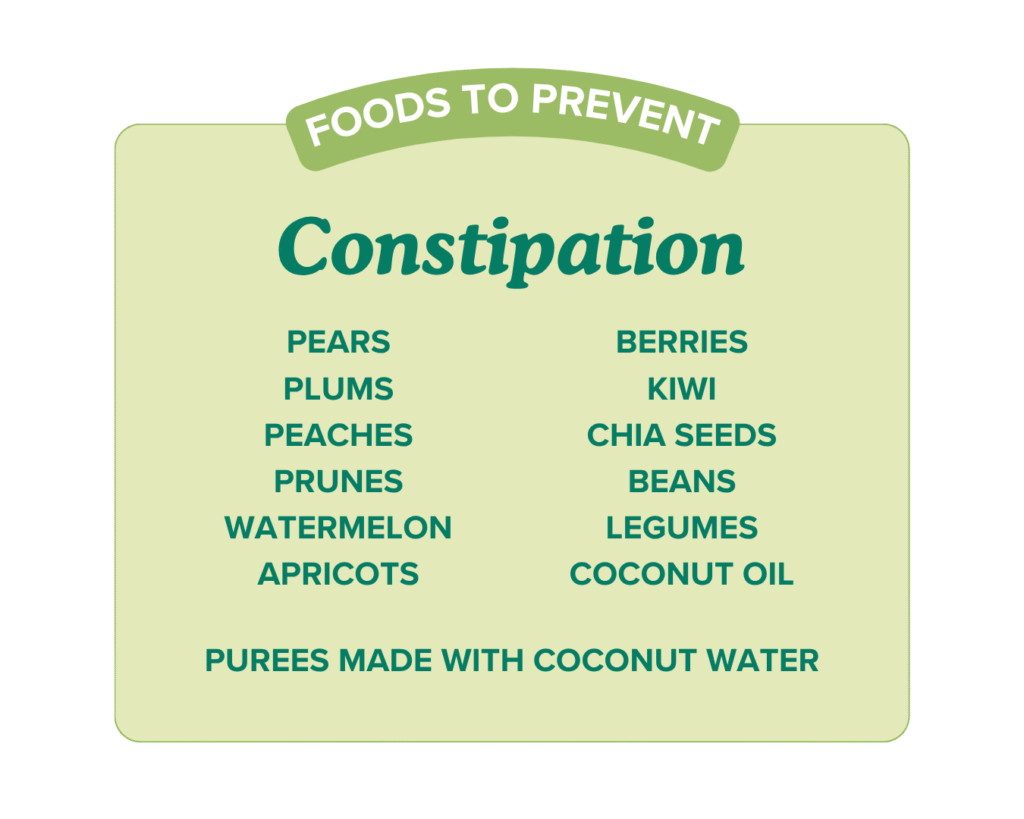
Foods to include in the diet:
- Pears
- Plums
- Peaches
- Prunes
- Watermelon
- Apricots
- Berries
- Kiwi
- Chia seeds
- Beans
- Legumes
- Coconut oil
- Purees made with coconut water
At the same time, some foods can have the opposite effect, creating an environment in the gut that can worsen constipation. While these foods don’t necessarily need to be avoided completely, it’s important to be mindful of how frequently they are served when your little one has trouble pooping.
Foods to reduce or avoid in the diet:
- Dairy, such as yogurt, cheese, or butter (and cow’s milk, if older than 1 year)
- Processed and refined grains, such as breads, rice, pasta, and crackers
- Bananas, especially when unripe/green
- Fried foods
Helping your little one through constipation comes with a lot of challenges; it’s hard to see your child in pain and not be able to fix it right away! By being proactive when noticing symptoms, parents can offer support quickly and hopefully reduce the length of symptoms while preventing future episodes. As always, if you have concerns about your child’s health, consult with their doctor for support!
More infant and toddler resources
Raising little ones is hard work, and parents deserve a village to support them along the way. That’s why Eat Play Say is here! Our team of pediatric specialists is here to provide their expertise so parents can feel confident, empowered, and prepared to tackle the many challenges of parenting.
For our most in-depth resources, check out our Handbooks! Written by our team of experts, we have resources to help you with feeding your newborn, starting solids, weaning, and even play ideas that support development!
For more free educational content just like this post, check out our blog:
- Infant & toddler development
- Breast and bottle feeding
- Starting solids
- Play activities and crafts
- Speech and language skills
Sources
- Elie Mulhem, MD; Faiza Khondoker, DO; and Sanjiv Kandiah, MD; Constipation in Children and Adolescents: Evaluation and Treatment, American Family Physician, Volume 105, Number 5, May 2022. Accessed October 2026.
- Rome Foundation, Rome IV Criteria, Accessed October 2026.
- Sarah Little, The GP Infant Feeding Network (UK), Constipation, 17 January 2020, Accessed October 2026.
- Mao M, Zhang L, Ge J, Yan J, Northington R, Yao M, Nowacki J, Hays NP. Infant Feeding Regimens and Gastrointestinal Tolerance: A Multicenter, Prospective, Observational Cohort Study in China. Glob Pediatr Health. 2018 Jan 9;5:2333794X17750271. doi: 10.1177/2333794X17750271. PMID: 29344559; PMCID: PMC5764142.
- Totur G, Baran M. The effect of mother’s and infant nutrition on functional constipation in children between 1-4 months. Trends in Pediatrics. 2024;5(3):64-71. https://doi.org/10.59213/TP.2024.139
- Benninga MA; MENA Infant Constipation Study Group; Vandenplas Y. The Magnesium-Rich Formula for Functional Constipation in Infants: a Randomized Comparator-Controlled Study. Pediatr Gastroenterol Hepatol Nutr. 2019 May;22(3):270-281. doi: 10.5223/pghn.2019.22.3.270. Epub 2019 Apr 18. PMID: 31110960; PMCID: PMC6506425.
- Xinias I, Analitis A, Mavroudi A, Roilides I, Lykogeorgou M, Delivoria V, Milingos V, Mylonopoulou M, Vandenplas Y. A Synbiotic Infant Formula with High Magnesium Content Improves Constipation and Quality of Life. Pediatr Gastroenterol Hepatol Nutr. 2018 Jan;21(1):28-33. doi: 10.5223/pghn.2018.21.1.28. Epub 2018 Jan 12. PMID: 29383302; PMCID: PMC5788948.
- Steurbaut, L., Levy, E. I., De Geyter, C., Buyse, S., & Vandenplas, Y. (2023). A narrative review on the diagnosis and management of constipation in infants. Expert Review of Gastroenterology & Hepatology, 17(8), 769–783. https://doi.org/10.1080/17474124.2023.2242255
- Pantazi AC, Balasa AL, Mihai CM, Chisnoiu T, Lupu VV, Kassim MAK, Mihai L, Frecus CE, Chirila SI, Lupu A, Andrusca A, Ionescu C, Cuzic V, Cambrea SC. Development of Gut Microbiota in the First 1000 Days after Birth and Potential Interventions. Nutrients. 2023 Aug 20;15(16):3647. doi: 10.3390/nu15163647. PMID: 37630837; PMCID: PMC10457741.
- Rajindrajith S, Devanarayana NM, Benninga MA. Childhood constipation: Current status, challenges, and future perspectives. World J Clin Pediatr. 2022 Sep 9;11(5):385-404. doi: 10.5409/wjcp.v11.i5.385. PMID: 36185096; PMCID: PMC9516492.
Leave a Reply
OTHER POSTS YOU MAY LIKE:




MS, SLP
Founder of Eat Play Say, Speech-Language Pathologist, Feeding Specialist, Play Expert, Mom of 3
Jordyn Koveleski Gorman
SPECIALIZES IN: Infant and toddler speech-language, play, and feeding development, and curating a team that provides expert help that feels like a reassuring text from that one mom friend
EDUCATION: Jordyn received her BS in Speech-Language Pathology from Bloomsburg University and her MS in Speech-Language Pathology from Towson University
FAVE PARENTING FIRST: “The first true smile, it’s the sweetest!”

MS, CCC-SLP, CBS, IBCLC
Speech-Language Pathologist & Feeding Specialist, Certified Breastfeeding Specialist, International Board Certified Lactation Consultant
Jessica Nicholson Cocca
SPECIALIZES IN: Breast and bottle feeding, tongue ties, oral motor dysfunction, starting solids, infant and toddler speech, treating oral motor disorders
EDUCATION: Jessica received her BS in Communication Sciences and Disorders from Pennsylvania State University in 2015 and her MS in Speech-Language Pathology from Towson University in 2017
FAVE PARENTING FIRST: “Baby’s first wave! What a fun first communication gesture!”

MA, CCC-SLP, CLC
Speech-Language Pathologist, Certified Lactation Counselor
Jennifer McFarlin
SPECIALIZES IN: Breast and bottle feeding, tongue ties, starting solids, infant and toddler speech development
EDUCATION: She received her BS in Speech-Language Pathology from Ball State in 2014 and a MA in Speech-Language Pathology from Ball State in 2016.
FAVE PARENTING FIRST: “My favorite baby’s first is their first true smile that just warms your soul knowing they are smiling at you. My other favorite is their first word. I love watching their language explode!”

MS, CCC-SLP
Bilingual Speech-Language Pathologist
Nicole La Petina Kelly
SPECIALIZES IN: Bilingual development (Spanish-English), supporting multilingual families, infant and toddler speech
EDUCATION: She received her BA in Communication Sciences and Disorders and in Spanish from the University of Wisconsin-Madison in 2014 and her MS in Speech-Language Pathology with an English-Spanish Specialization from Marquette University in 2016.
FAVE PARENTING FIRST: “It’s the first slobbery kisses for me!”

RDN, LD
Licensed Registered Dietitian
Kimberly Vede
SPECIALIZES IN: Infant and pediatric nutrition including breastfeeding, formula feeding, and starting solids. She also specializes in prenatal and postpartum nutrition.
EDUCATION: She received her BSc in Biology in 2014 from Life University, and her BSc in Dietetics from Life University in 2019.
FAVE PARENTING FIRST: ”The first time they say ‘mama!’”


This checklist was created with input from a Speech-Language Pathologist, Occupational Therapist and Physical Therapist and has been downloaded over 20,000 times by parents worldwide. Learn the important milestones to pay attention to, and keep it in your digital back pocket during the baby + toddler years!
Comprehensive Milestone Checklist for gross motor, fine motor, and speech-language milestones for 0-36 months,
DOWNLOAD FOR FREE


