


Cooing in Infants: When Do Babies Start Cooing?
November 17, 2026
Jordyn Koveleski Gorman

Last Updated on November 17, 2026 by Jordyn Koveleski Gorman
New parents are often surprised to discover that from the moment their baby is born, their little one makes a lot of noise. From squeaks, squeals, and grunts all the way to those distinct newborn cries, the tiniest babies can make quite a roar. Then, just a few weeks later, a new type of sound arrives: cooing!
Cooing is one of the first speech milestones to emerge in newborns, but when exactly do babies start to coo? And what does it mean when little ones coo? Let’s talk about it!
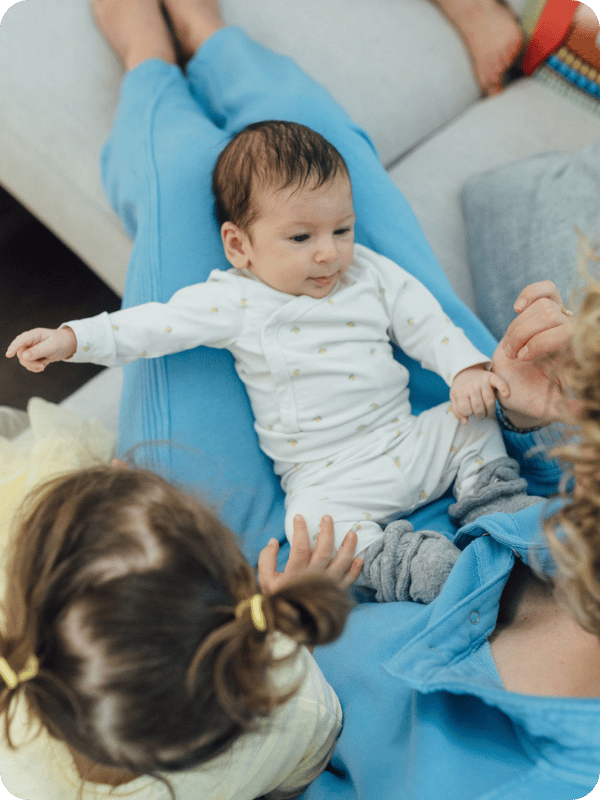
When do babies start cooing?
Depending on the milestone tracker you use, you will find cooing listed as a milestone between 2–4 months of age. (1, 2) The CDC and AAP consider cooing a 4 month milestone, but in general, as speech-language pathologists, this is not advice we give parents. Rather, we expect to see cooing start to emerge between 6–8 weeks of age, or around 2 months, aligning with the American Speech-Language-Hearing Association. (2)
Cooing may not develop completely until closer to 4 months, but early coos should happen sooner. This early language is made up of vowel sounds in the back of the throat, such as “oooh” or “ga.” Babies may also learn to make sounds through their lips, such as “mmmmm” with a closed mouth, around this time. (2) These coos are the precursor to babbles, which are coming right around the corner!
Several important communication milestones appear around the same time as cooing, making it easier for caregivers to have back-and-forth “conversation” with their little one. These milestones are:
- Smiling socially, with purpose
- Making eye contact with a caregiver
- Showing interest in people and interacting with them
- Responding to facial expressions, attempting to imitate them (1, 2)
Download our free Milestone Checklist and join 40,000+ parents who decided to “check and see” their baby’s development!
What does it mean when infants coo?
Cooing is one of the first ways that infants can experiment with their voices. Research actually shows that cooing, and eventually babbling, helps babies discover that they can influence their environment using their voice. (3)
An example of this in real life: babies use cooing and other vocalizations to try to regain the attention of a caregiver if communication is broken off. (4) That’s right, if you’re talking to your little one and then look away or go quiet for a period of time, your little one is likely going to make more noise to try and regain your attention!
Infants also coo or vocalize endogenously, which simply means they make sounds by their own power rather than in response to an external factor. This can look like a baby making sounds while they play alone on a play gym mat or when laying in their crib. Research suggests that these seemingly random solo conversations can actually play a positive role in speech development! (4)
Generally, when baby coos, it means they have something to tell you! They may be experimenting with the flow of conversation, imitating you, or exploring the sound of their own voice. Rest assured that those little coos are an important developmental milestone, and encouraging baby to keep practicing is the best way to support their development!
How to encourage baby to coo
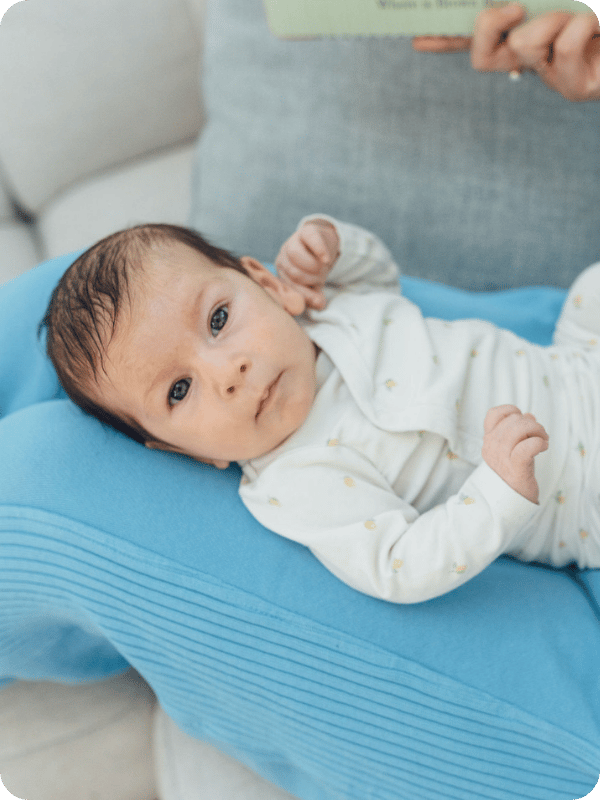
Encouraging those sweet baby coos can be as simple as having face-to-face play time with your little one.
Parents are often encouraged to “narrate” their day by filling every silent moment with chatter directed at their baby. Why doesn’t this work? Consider what it’s like trying to talk to someone who never takes a breath: you don’t get the chance to respond! So, yes, parents should absolutely talk to their baby, but keep in mind that the most benefit comes from the quiet pauses that allow baby to process, respond, and even initiate their own conversation!
Learn more about the power of pausing when talking to baby here.
Try these simple activities with your newborn to support this new skill:
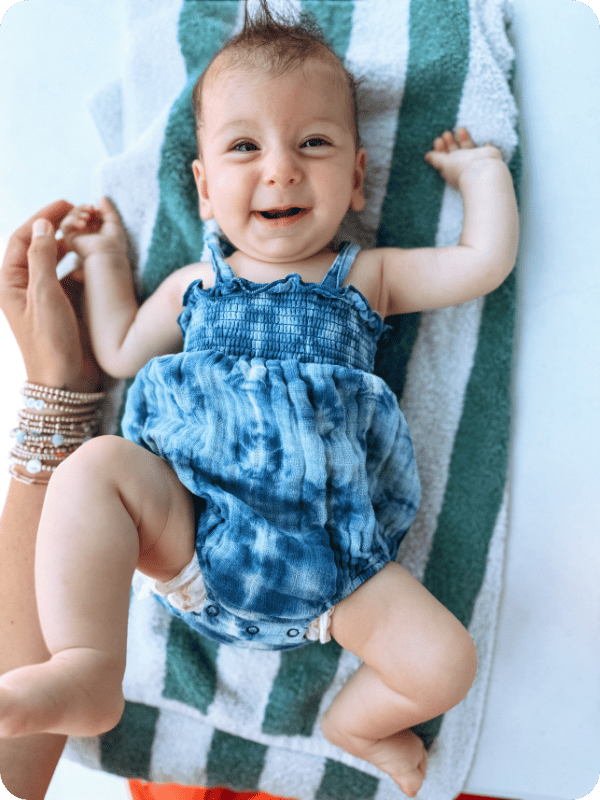
- While baby is laying on their back, get face-to-face and make babbling sounds like “ba, ba, ba” or “ma, ma, ma,” then pause. Wait at least 10 seconds before repeating yourself. They will likely squeal, smile, or coo back to you at this stage. This video demonstrates this with a 3 month old.
- Prop baby on your legs and face them while you sit on the couch or in bed. Look at your little one and smile. If they make a noise, imitate it back to them! This is playing with your newborn!
- Sit facing baby, such as having them propped on your legs and sing nursery rhymes, play peekaboo, read a book, or smile at baby. Look for verbal and body responses and short moments of eye contact and connection!
So, when your little one starts talking to you, be sure to listen! Give them ample time to work out the sounds they’re practicing, and then respond accordingly. And make sure to pause to give your little one time to reply, too. And if you notice baby chattering happily by themselves, remember that’s a great sign, too!
More infant development resources
Kick 2 a.m. Google searches to the curb with Eat Play Say Handbooks! Each guide is packed with hundreds of pages of research-backed guidance from our team of pediatric specialists. Whether you need help figuring out how to feed your new baby or want to take the guess work out of playtime, we’ve got you covered!
For more support raising little ones, check out our blog!
- Get help starting solids
- Learn more about infant and toddler development
- Find ways to play with your little one
- Get more speech & language support
Sources
- Jennifer M. Zubler, Lisa D. Wiggins, Michelle M. Macias, Toni M. Whitaker, Judith S. Shaw, Jane K. Squires, Julie A. Pajek, Rebecca B. Wolf, Karnesha S. Slaughter, Amber S. Broughton, Krysta L. Gerndt, Bethany J. Mlodoch, Paul H. Lipkin; Evidence-Informed Milestones for Developmental Surveillance Tools. Pediatrics March 2022; 149 (3): e2021052138. 10.1542/peds.2021-052138
- American Speech-Language-Hearing Association, Communication Milestones: Birth to 1 Year. Accessed October 2026.
- Blackwell, Kate, Cornell Chronicle, Babies learn power of voice through experimentation, 5 July 2022, Accessed October 2026.
- Long HL, Bowman DD, Yoo H, Burkhardt-Reed MM, Bene ER, Oller DK. Social and endogenous infant vocalizations. PLoS One. 2020 Aug 5;15(8):e0224956. doi: 10.1371/journal.pone.0224956. PMID: 32756591; PMCID: PMC7406057.
Leave a Reply
OTHER POSTS YOU MAY LIKE:


MS, SLP
Founder of Eat Play Say, Speech-Language Pathologist, Feeding Specialist, Play Expert, Mom of 3
Jordyn Koveleski Gorman
SPECIALIZES IN: Infant and toddler speech-language, play, and feeding development, and curating a team that provides expert help that feels like a reassuring text from that one mom friend
EDUCATION: Jordyn received her BS in Speech-Language Pathology from Bloomsburg University and her MS in Speech-Language Pathology from Towson University
FAVE PARENTING FIRST: “The first true smile, it’s the sweetest!”

MS, CCC-SLP, CBS, IBCLC
Speech-Language Pathologist & Feeding Specialist, Certified Breastfeeding Specialist, International Board Certified Lactation Consultant
Jessica Nicholson Cocca
SPECIALIZES IN: Breast and bottle feeding, tongue ties, oral motor dysfunction, starting solids, infant and toddler speech, treating oral motor disorders
EDUCATION: Jessica received her BS in Communication Sciences and Disorders from Pennsylvania State University in 2015 and her MS in Speech-Language Pathology from Towson University in 2017
FAVE PARENTING FIRST: “Baby’s first wave! What a fun first communication gesture!”

MA, CCC-SLP, CLC
Speech-Language Pathologist, Certified Lactation Counselor
Jennifer McFarlin
SPECIALIZES IN: Breast and bottle feeding, tongue ties, starting solids, infant and toddler speech development
EDUCATION: She received her BS in Speech-Language Pathology from Ball State in 2014 and a MA in Speech-Language Pathology from Ball State in 2016.
FAVE PARENTING FIRST: “My favorite baby’s first is their first true smile that just warms your soul knowing they are smiling at you. My other favorite is their first word. I love watching their language explode!”

MS, CCC-SLP
Bilingual Speech-Language Pathologist
Nicole La Petina Kelly
SPECIALIZES IN: Bilingual development (Spanish-English), supporting multilingual families, infant and toddler speech
EDUCATION: She received her BA in Communication Sciences and Disorders and in Spanish from the University of Wisconsin-Madison in 2014 and her MS in Speech-Language Pathology with an English-Spanish Specialization from Marquette University in 2016.
FAVE PARENTING FIRST: “It’s the first slobbery kisses for me!”

RDN, LD
Licensed Registered Dietitian
Kimberly Vede
SPECIALIZES IN: Infant and pediatric nutrition including breastfeeding, formula feeding, and starting solids. She also specializes in prenatal and postpartum nutrition.
EDUCATION: She received her BSc in Biology in 2014 from Life University, and her BSc in Dietetics from Life University in 2019.
FAVE PARENTING FIRST: ”The first time they say ‘mama!’”


This checklist was created with input from a Speech-Language Pathologist, Occupational Therapist and Physical Therapist and has been downloaded over 20,000 times by parents worldwide. Learn the important milestones to pay attention to, and keep it in your digital back pocket during the baby + toddler years!
Comprehensive Milestone Checklist for gross motor, fine motor, and speech-language milestones for 0-36 months,
DOWNLOAD FOR FREE


