


How To Increase Milk Supply: Schedule for Breastfeeding & Pumping
January 22, 2025
Jordyn Koveleski Gorman

Last Updated on April 4, 2026 by Jordyn Koveleski Gorman
This page contains affiliate links. We will receive a commission on qualifying purchases using these links.
Your little one is finally here, all squishy and sweet, and hungry. Whether you’re still figuring out how to feed your newborn or you’ve had a few months to establish a routine, feeding journeys are essentially full time jobs.
One of the most common questions parents ask is how to know if their baby is getting enough milk. Another important question that coincides with that one is “how can I increase my milk supply?”
There are many reasons a mom might want to increase her milk supply. Whether baby is about to transition to daycare or mom is returning to work, or maybe having some milk on hand is a goal. For approximately 10% of lactating mothers, low milk supply is a factor. (1)
Whatever the reason you’re hoping to increase your supply, there are a few approaches you can take. Led by our team of feeding specialists and lactation consultants, we’re here to help!

How to increase milk supply
A quick Google search will reveal a plethora of products to increase your milk supply (more on that below). As specialists in the mechanisms of feeding, however, we recommend focusing most on supply and demand.
For breastmilk production, when demand goes up, supply generally increases to meet that demand. Want more milk? Create more demand!
If baby is exclusively nursing at the breast, it’s hard to know exactly how much they are taking in. Monitoring their fullness cues, their wet and poopy diapers, and growth is best. For the purposes of increasing supply without pumping, you’ll need to bring baby to the breast more frequently for feeds.
Try not to watch the clock for scheduled feedings. Instead, let baby have little “snacks” on your breast when they are showing signs that they want to eat or are a little fussy. This mimics cluster feeding and can really help increase milk supply! These “snacks” may seem small, but in the big picture, the more your body is told to make milk, the more it will try to!
Pumping is an effective method that can help you increase your milk supply. Depending on what your feeding journey looks like, there are a few different ways you might incorporate pumping into your routine. Before we dive into schedules, let’s cover the pumping basics.
Pumping breastmilk efficiently
Learning how to pump efficiently is so important! Too many moms are pumping inefficiently, and once they learn what they need to do, they start to produce more milk.
Make sure you know how to use your pump and what all the buttons and functions mean. Pumps (no matter the brand) come with what seems like a million different settings and buttons to select. It can get confusing before you ever turn on the machine. Learning which setting on your pump is the most optimal for milk retrieval for you is key.
You want to start on your pump’s “let down” setting until you get sprays of milk. Then, switch to a slower cycle and higher vacuum for the middle of the pumping session. Toward the end, decrease to slower cycles to replicate baby’s slower suckling as they get full. Aim to pump for about 20 minutes or until milk significantly slows down.
You can find our favorite supplies for pumping moms here.
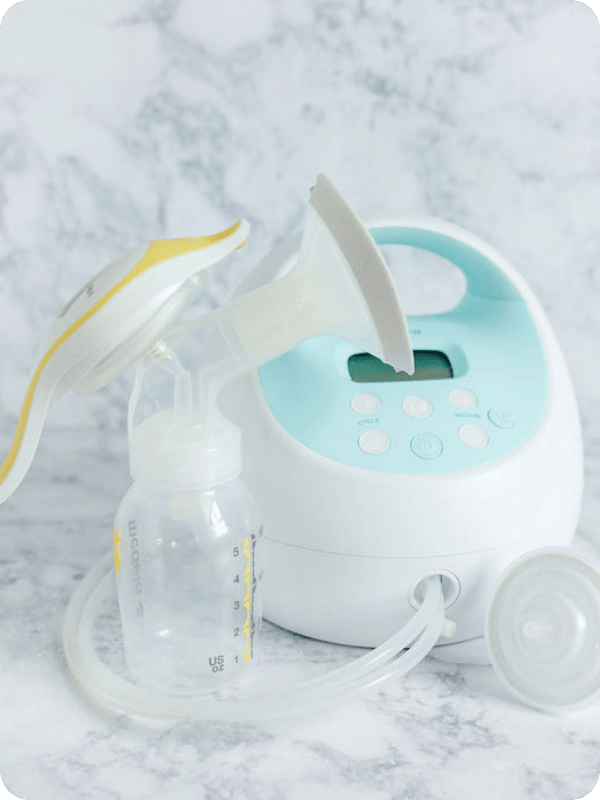
Breast pump flange size matters
PSA: There is a massive chance that the flanges that came with your pump are too big.
Sadly, the standard flanges that come with your pump are more than likely not the correct size. Pump companies typically give a size 24 or 28mm. Most women use 15mm-21mm flange sizes (sometimes even smaller).
If the flange is too big or too small, milk removal will not be the most efficient, which could increase your risk for clogged ducts/mastitis and decrease your milk supply. Using the wrong flange size can also cause breast tissue damage over time, so it’s important to investigate if your flange size is correct or not.
You can invest in a low-cost sizing kit to determine your size. There are countless sizing inserts online, though likely none from your actual pump brand. If you can, purchase an entire flange in your correct size instead of inserts that go inside the bigger flange. They are much better for milk removal. Purchasing the correct size will help you pump more milk more efficiently. If you’re currently using the wrong flange size, you should see an increase in milk immediately when you fix this!
If you can, the best way to determine your flange size and get support with increasing your milk supply is by meeting 1:1 with a certified lactation consultant. You can do that virtually, or find someone near you. It’s worth the investment!
How often should I pump to increase milk supply?
Just like nursing at the breast, you have to maintain a consistent and frequent schedule to remove milk. Remember, milk supply is largely driven by supply and demand. If you’re not removing milk consistently, then you’re signaling to your body that it doesn’t need to produce that much milk.
Waiting longer between feedings will not yield more milk over time.
You might end up with one fruitful pump because you waited 5 hours instead of 3, but continuing to do that actually tells your body to make less milk because you are engaging in less frequent pumping sessions. More frequent pumps signal to your body to make more milk. Try to pump at least every 3 hours around the clock if you can as you work to get your supply up.
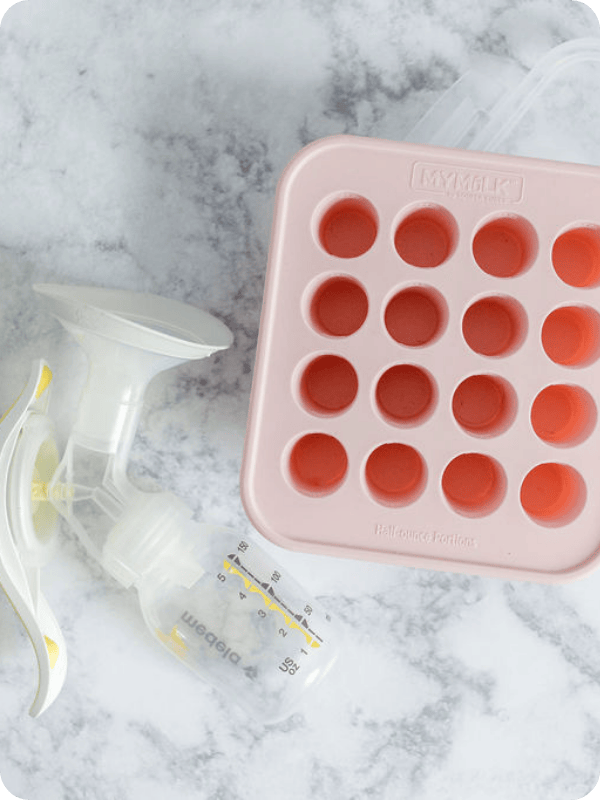
Pumping schedule to increase milk supply
Pumping in the early morning, between 2–6 a.m., can sometimes yield more milk as prolactin (the milk making hormone) levels are highest in the morning. (2)
If you are exclusively pumping, then you should pump around the same time that your baby takes a bottle—every feed, if possible. That can be incredibly taxing, but it will continue to signal to your body to make more milk. Newborns eat around 8–12 times a day, and sometimes more when cluster feeding. Note that, even if your baby is older and sleeping longer stretches at night, an overnight pump may still be important to increasing/maintaining your supply.
You may feel like you’re attached to the pump at all times. That may or may not be what you envisioned with your feeding journey. Any emotions you have related to that are valid, and as a mom whose feeding journey once went way different than I hoped—I see you. Feeding your little one is hard work, and you’re doing it. You are amazing.
An example of a pumping session that stimulates one let down (using a Spectra pump for reference) is below.
- Hit the “let down” button after turning the pump on. This puts the pump on its fastest cycle and mimics what baby does at the start of a feeding, which triggers a let down. The setting will read as 70 cycles per minute. The vacuum strength will be lower since the speed is higher.
- Wait until your breasts start to drop/spray milk, eliciting the let down. This usually takes about 2 minutes of pumping.
- Once you see sprays, hit the “let down” button again. Adjust the cycle number to 54, mimicking slower eating from baby after the let down. Adjust your vacuum as needed for comfort. Remember, pumping shouldn’t hurt!
- You can stay at 54 cycles/minute for the remainder of the pumping session. Or, you can move down to 38 cycles/minute as you near the end. This mimics baby’s sucking slowing down as they finish nursing.
- Pumping until your milk flow really slows down is a good indicator of when to stop. For most women, that’s around 20 minutes. Remember, pumping for longer doesn’t necessarily mean you’ll get more milk. Pumping more frequently is what signals your body to produce more milk

Schedule for breast feeding and pumping
In addition to the “snack” method mentioned earlier, pumping in between a few nursing sessions will further stimulate supply/demand.
Pumping while also trying to bring baby to breast more can feel incredibly overwhelming because it’s like you’re feeding your baby three times in one session (nursing, pumping, and bottle feeding). This is called Triple Feeding, and while it can help increase supply, it can be very draining on mom.
An example of pumping between nursing sessions to increase milk supply may look like the following:
- Nurse baby for 15-20 minutes.
- Wait 10 minutes.
- Pump following the schedule highlighted in the previous section (10-15 minutes instead of 20 if you’d like to try a shorter session first).
- Nurse baby when they cue next, not longer than 2-3 hours from previous nursing session.
Please note that these recommendations for increasing supply while nursing are meant to be used short term. You should not spend all day trying to feed your baby like this. That would be extremely hard on you and your little one. If you try to increase your supply on your own and don’t seem to be making progress, talk to a lactation consultant for specific recommendations and ways to help.
Feeding journeys are not linear. With every down, there can be an up!
Power pumping schedule
If you still need a boost in supply, the addition of a power pumping session can be very effective.
Power pumping is intended for short-term use and is not a long-term method to maintain supply. Similar to cluster feeding (which does not last forever, I promise), power pumping is short bursts of pumping in between regular pumping or nursing sessions. It can be done any time of day. However, the most optimal times are in the middle of the night or early in the morning (2–6 a.m.) when prolactin levels are highest.
Most power pumping sessions take 1 hour and follow a pattern of pump/rest, pump/rest. You can try a power pump session between two regular pump sessions. Power pumping is also something you can do at work to help keep your supply up. Sneak in a quick extra session or two if you can where time allows.
This is a great time to use a hand pump in between or after those longer pumping sessions. We recommend this one.
Example of power pumping session
- Pump 20 minutes, rest 10 minutes
- Pump 10 minutes, rest 10 minutes
- Pump 10 minutes, then end the session
Make sure to stay hydrated and enjoy a yummy snack while you pump. For best results (I know, this can be easier said than done), try to release stressors and focus instead on positive thoughts. Looking at your baby or even their photo can help increase the success of pump sessions!

What about supplements to increase milk supply?
There are a ton of companies with excellent marketing teams selling the newest, greatest supplement to increase breastmilk supply. In clinical research, however, results are mixed and the efficacy hasn’t been strongly supported. (3)
That said, some moms swear by the positive effects of herbal supplements. Research does indicate that many healthcare providers recommend lactating moms try supplementation with over the counter herbals. (4) There are some risks involved, especially for women with certain preexisting conditions. Discussing risk factors with your doctor in advance is recommended.
If you want to try the lactation cookies, or a special drink, or the capsule form—absolutely, go for it! You notice that we aren’t linking anything specific here though. That’s because our best recommendation is to continue boosting your milk supply by focusing on supply and demand, even with supplements.
More feeding support
If you have tried all of these tips without much change or are feeling overwhelmed by feeding, it’s time for a little extra support. Whether you speak to your birthing provider or a lactation consultant in your area, it’s important that you feel supported in your feeding journey. Our team offers virtual consultations in just days.
If you’re noticing issues with latching or ineffective emptying of the breasts, there are other things that can be done to help! If baby is refusing to take a bottle, we can help there, too!
You can find more breast and bottle feeding support on our blog, as well as information on starting solids and baby development.
For expert guidance on all things feeding, check out our Infant Feeding Handbook! It’s got nearly 200 pages of education and support for your feeding journey, no matter what it looks like.
Sources
- Jin X, Perrella SL, Lai CT, Taylor NL, Geddes DT. Causes of Low Milk Supply: The Roles of Estrogens, Progesterone, and Related External Factors. Adv Nutr. 2024 Jan;15(1):100129. doi: 10.1016/j.advnut.2023.10.002. Epub 2023 Oct 11. PMID: 37832920; PMCID: PMC10831895.
- Stern JM, Reichlin S. Prolactin circadian rhythm persists throughout lactation in women. Neuroendocrinology. 1990 Jan;51(1):31-7. doi: 10.1159/000125312. PMID: 2106085.
- Bazzano AN, Hofer R, Thibeau S, Gillispie V, Jacobs M, Theall KP. A Review of Herbal and Pharmaceutical Galactagogues for Breast-Feeding. Ochsner J. 2016 Winter;16(4):511-524. PMID: 27999511; PMCID: PMC5158159.
- Shawahna R, Qiblawi S, Ghanayem H. Which Benefits and Harms of Using Fenugreek as a Galactogogue Need to Be Discussed during Clinical Consultations? A Delphi Study among Breastfeeding Women, Gynecologists, Pediatricians, Family Physicians, Lactation Consultants, and Pharmacists. Evid Based Complement Alternat Med. 2018 Apr 23;2018:2418673. doi: 10.1155/2018/2418673. PMID: 29849697; PMCID: PMC5937604.
OTHER POSTS YOU MAY LIKE:






MS, SLP
Founder of Eat Play Say, Speech-Language Pathologist, Feeding Specialist, Play Expert, Mom of 2
Jordyn Koveleski Gorman
SPECIALIZES IN: Infant and toddler speech-language, play, and feeding development, and curating a team that provides expert help that feels like a reassuring text from that one mom friend
EDUCATION: Jordyn received her BS in Speech-Language Pathology from Bloomsburg University and her MS in Speech-Language Pathology from Towson University
FAVE PARENTING FIRST: “The first true smile, it’s the sweetest!”

MS, CCC-SLP, CBS, IBCLC
Speech-Language Pathologist & Feeding Specialist, Certified Breastfeeding Specialist, International Board Certified Lactation Consultant
Jessica Nicholson Cocca
SPECIALIZES IN: Breast and bottle feeding, tongue ties, oral motor dysfunction, starting solids, infant and toddler speech, treating oral motor disorders
EDUCATION: Jessica received her BS in Communication Sciences and Disorders from Pennsylvania State University in 2015 and her MS in Speech-Language Pathology from Towson University in 2017
FAVE PARENTING FIRST: “Baby’s first wave! What a fun first communication gesture!”

MA, CCC-SLP, CLC
Speech-Language Pathologist, Certified Lactation Counselor
Jennifer McFarlin
SPECIALIZES IN: Breast and bottle feeding, tongue ties, starting solids, infant and toddler speech development
EDUCATION: She received her BS in Speech-Language Pathology from Ball State in 2014 and a MA in Speech-Language Pathology from Ball State in 2016.
FAVE PARENTING FIRST: “My favorite baby’s first is their first true smile that just warms your soul knowing they are smiling at you. My other favorite is their first word. I love watching their language explode!”

MS, CCC-SLP
Bilingual Speech-Language Pathologist
Nicole La Petina Kelly
SPECIALIZES IN: Bilingual development (Spanish-English), supporting multilingual families, infant and toddler speech
EDUCATION: She received her BA in Communication Sciences and Disorders and in Spanish from the University of Wisconsin-Madison in 2014 and her MS in Speech-Language Pathology with an English-Spanish Specialization from Marquette University in 2016.
FAVE PARENTING FIRST: “It’s the first slobbery kisses for me!”

RDN, LD
Licensed Registered Dietitian
Kimberly Vede
SPECIALIZES IN: Infant and pediatric nutrition including breastfeeding, formula feeding, and starting solids. She also specializes in prenatal and postpartum nutrition.
EDUCATION: She received her BSc in Biology in 2014 from Life University, and her BSc in Dietetics from Life University in 2019.
FAVE PARENTING FIRST: ”The first time they say ‘mama!’”


This checklist was created with input from a Speech-Language Pathologist, Occupational Therapist and Physical Therapist and has been downloaded over 20,000 times by parents worldwide. Learn the important milestones to pay attention to, and keep it in your digital back pocket during the baby + toddler years!
Comprehensive Milestone Checklist for gross motor, fine motor, and speech-language milestones for 0-36 months,
DOWNLOAD FOR FREE


