


When Do Babies Pull to Stand?
September 9, 2024
Jordyn Koveleski Gorman

Last Updated on March 17, 2026 by Jordyn Koveleski Gorman
This page contains affiliate links. We will receive a commission on qualifying purchases using these links.
Your baby is rolling, crawling, sitting, eating, and maybe even sleeping longer stretches. Before you know it, your baby will be running circles around you. But first, they have to figure out how to get up off the floor.
Somewhere between 8-12 months, babies start pulling themselves up to a standing position. They might do this at furniture, in their crib, using an adult’s hands, or with a push toy. It’s the first big step towards their first big step! So, how do we help them get there?
With the help of Eat Play Say’s own physical therapist, we’ve put together this guide that covers everything you need to know about this milestone!
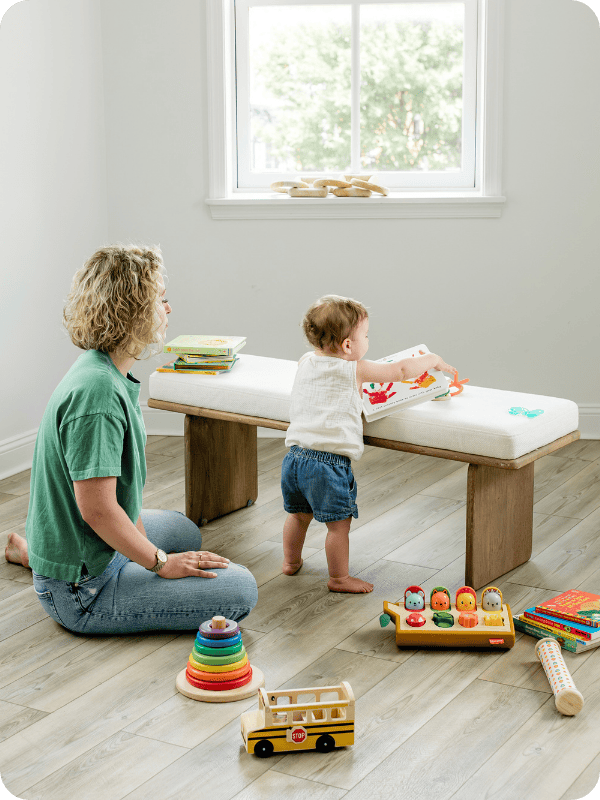
When do babies pull up to stand?
Developmentally, we expect to see babies pulling to stand by the end of 12 months. Some babies pull to stand much earlier, while others don’t. And that’s okay!
There are a few other gross motor skills that tend to develop on a similar timeline as pulling to stand. Some babies cruise side to side on furniture at the same time as learning to stand. Others figure out pulling to stand and are content to just stay put for a while! There’s a wide variety of normal when it comes to these markers in development.
If you’re not sure where your baby is at with milestones, we can help! Our free comprehensive Milestone Checklist helps you check and see your baby’s progress and where they might need more support.
If you find yourself worrying about your baby’s development, it’s always best to listen to your gut! Parents and caregivers are often told to “wait and see” how their child does with more time. But there are steps you can take now to offer extra support if your little one needs it. For instance, early intervention is free or low cost in most states, and you can self-refer if your pediatrician wants you to “wait and see.”
How to help baby pull to stand
There are many ways to encourage your baby to pull to stand. Before we dive into the best activities to support this development, let’s cover a few things to avoid.
In 2022, the AAP called for sit-in style baby walkers to be banned from manufacture and sale in the US. Although it still hasn’t happened in the United States, they have been banned in Canada. The AAP’s concern is that these walkers can result in serious injury, from pinched fingers to falls down steps.
Additionally—from a physical or occupational therapist’s point of view—sit-in walkers also don’t help babies learn to walk. Sit-in walkers can actually delay walking because babies start to rely on the outside support from the walker instead of using their muscles. Many babies will sit or hang on the “seat” and just use their legs to propel themselves around.
Another thing to avoid when helping littles learn to stand is holding their arms above their shoulders. When working on standing, pulling to stand, and (eventually) walking, we want your little one’s arms to stay at or below shoulder level. This encourages them to use their trunk and leg muscles and reduces the stress and reliance on their arms. Keeping their arms below shoulder level is also how they will learn to balance.
It takes a little more energy from you, but it’s best to get down on baby’s level when working on walking and standing. Think about it: do you ever walk with your hands above your head? Probably not!
Now that you know some things to avoid, here are our favorite activities to help your baby pull to stand!
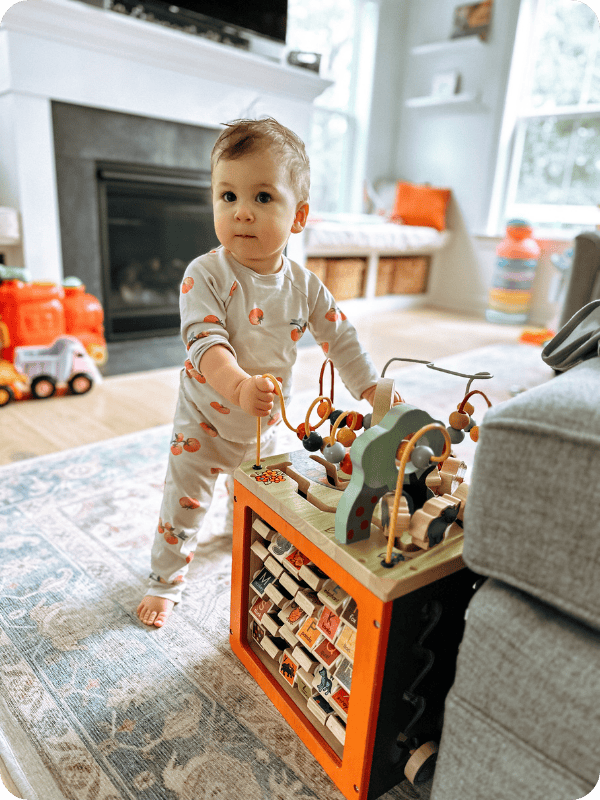
Kneeling at a low surface
Place a couch cushion (or two) on the floor and put your baby’s favorite toy on top. The goal is to get them to kneel in front of the cushion, using hands on the cushion for support as needed, to play with the toy. They can either get there from sitting by transitioning over either hip, or from all fours by walking their hands up onto the cushion one at a time.
Start small with a minute of play, then encourage your baby to shift weight back to sitting or hands and knees. Another way to do this is to take all the cushions off the couch and use this lower surface as your play surface. Then you can stack the cushions nearby and use it as another low surface. We want baby to play at a variety of different heights in order to strengthen their muscles through the full range.
Pulling to stand at furniture
Sit your baby on a low stool or couch cushion with feet flat on the floor facing a couch or ottoman. Put a ring stacker or puzzle board (these knob puzzles are great for this age) on the couch. Give baby a ring or puzzle piece.
Next, help them stand up by shifting their weight forward over their feet and using their hands to pull themselves up. Help them put the ring on or puzzle piece in, then lower back to sitting. Repeat as many times as your baby is interested.
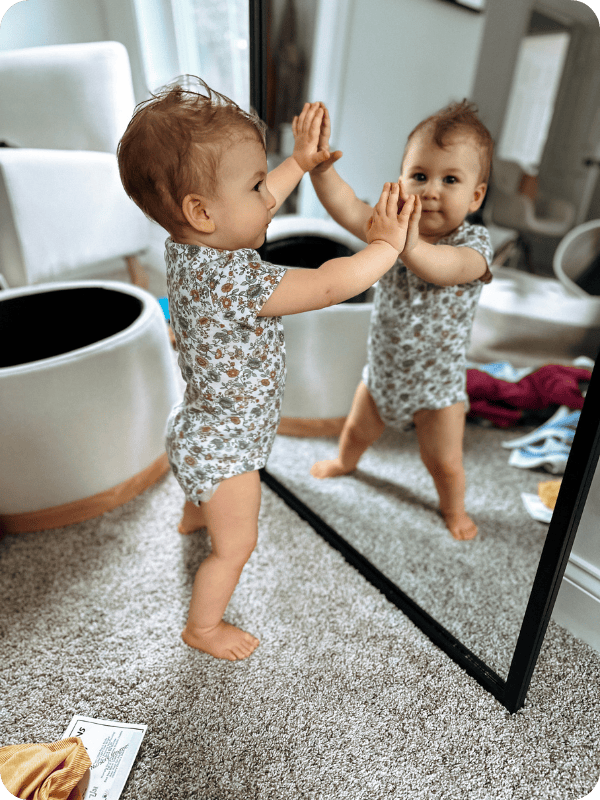
Pulling to stand and standing at vertical surfaces to play
Once your baby is comfortable standing while holding onto furniture, it’s time to work vertically.
Stick some spinners to the fridge, wall, glass door, or window at standing shoulder height. Stand baby up (or they may pull to stand on their own) to play! This is more of a challenge because there is nothing for baby to pull themselves up on or grasp onto while standing. They have to use more leg strength vs. relying on arms and trunk strength.
Squatting to pick up toys
Once your baby is more comfortable pulling to stand and standing with one or both hands for support, it’s time to work on going all the way up and down.
While your little one is standing beside the couch, “drop” something onto the floor next to them. Guide (or ask) them to pick it up and hand it to you, or put it back on the couch. You can also do this outside at the water table for a summer sensory activity! Learning to stand/squat/stand is essential for learning to stand up in the middle of the floor.
Cruising along and between furniture
Set up furniture so your baby has to take a step or two (or reach really far) to get from one place to the next. This is also a great time to put an activity table or cube to good use.
Encourage your baby to explore different sides on the table or cube by cruising around it and seeing how things work. Or stand baby at the couch and entice them to walk or reach over to the activity table to play. Cruising side-to-side in both directions is important because it works on weight shifting and single leg standing on each leg!
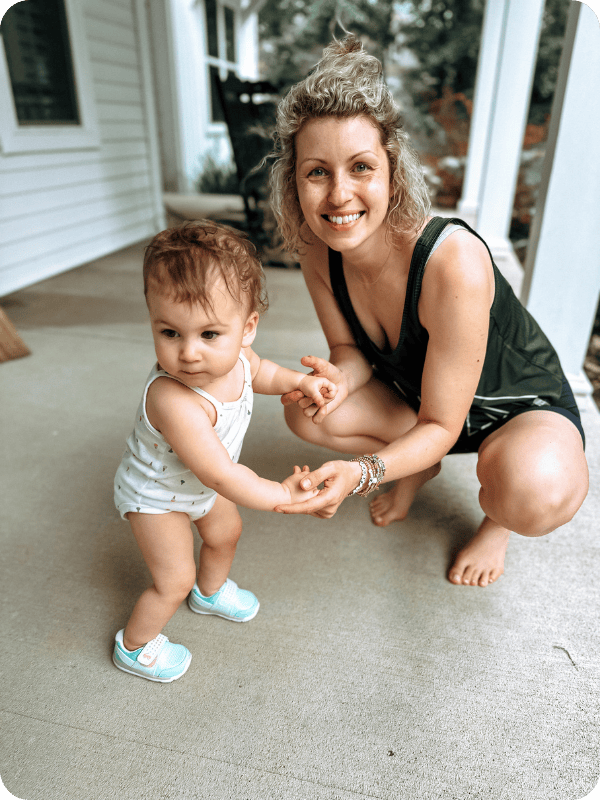
More ways to help baby pull to stand
Again, there are so many ways to help your baby pick up this skill! For some, it comes very naturally with little support. Other babies need an extra hand. Both ways are okay!
You might be wondering what, if anything, can replace a sit-in walker. There are plenty of great options! Some of our favorite toys that help build strength, coordination, and confidence for babies to stand include:
Activity Cube or Activity Table: Work on pulling to stand, cruising around to play with the different parts of the cube, and letting go with one or both hands to play while standing.
Push Walker: This push walker grows with your baby, converting from a seated toy to a push walker, then shopping cart or stroller! Push walkers are so versatile even before littles learn to walk.
Cardboard Blocks: Stack up the blocks to work on squat to stand movements. As baby grows, these can be used in so many ways! Toddlers can kick towers over to work on single leg balance, or you can make a path to walk through with a push toy or hand held assistance.
Activity Centers: Activity centers that don’t have wheels are safer alternatives to ones that move. This one also converts to an activity table for babies to cruise around once they outgrow standing in it! Many parents love these for times when they need to place baby somewhere safe so they can cook or shower. Remember to limit time spent in containers to 15 minutes or less.
Your baby doesn’t need fancy toys or expensive tools to learn how to stand upright or walk. Toys are fun, and great for helping encourage littles. But you are even better! Don’t forget the benefits of things you already have, like furniture and your own hands-on support.
More development support
Before you know it, your baby really will be running in circles around you. Standing up is one step closer! As your little one gets closer to walking, remember that you’re doing a great job.
You should be so proud!
For more support, check out our collection of resources! Whether you need support from our Weaning Handbook or need more than 100 age-appropriate ways to play with your little one, we have it!
OTHER POSTS YOU MAY LIKE:


MS, SLP
Founder of Eat Play Say, Speech-Language Pathologist, Feeding Specialist, Play Expert, Mom of 2
Jordyn Koveleski Gorman
SPECIALIZES IN: Infant and toddler speech-language, play, and feeding development, and curating a team that provides expert help that feels like a reassuring text from that one mom friend
EDUCATION: Jordyn received her BS in Speech-Language Pathology from Bloomsburg University and her MS in Speech-Language Pathology from Towson University
FAVE PARENTING FIRST: “The first true smile, it’s the sweetest!”

MS, CCC-SLP, CBS, IBCLC
Speech-Language Pathologist & Feeding Specialist, Certified Breastfeeding Specialist, International Board Certified Lactation Consultant
Jessica Nicholson Cocca
SPECIALIZES IN: Breast and bottle feeding, tongue ties, oral motor dysfunction, starting solids, infant and toddler speech, treating oral motor disorders
EDUCATION: Jessica received her BS in Communication Sciences and Disorders from Pennsylvania State University in 2015 and her MS in Speech-Language Pathology from Towson University in 2017
FAVE PARENTING FIRST: “Baby’s first wave! What a fun first communication gesture!”

MA, CCC-SLP, CLC
Speech-Language Pathologist, Certified Lactation Counselor
Jennifer McFarlin
SPECIALIZES IN: Breast and bottle feeding, tongue ties, starting solids, infant and toddler speech development
EDUCATION: She received her BS in Speech-Language Pathology from Ball State in 2014 and a MA in Speech-Language Pathology from Ball State in 2016.
FAVE PARENTING FIRST: “My favorite baby’s first is their first true smile that just warms your soul knowing they are smiling at you. My other favorite is their first word. I love watching their language explode!”

MS, CCC-SLP
Bilingual Speech-Language Pathologist
Nicole La Petina Kelly
SPECIALIZES IN: Bilingual development (Spanish-English), supporting multilingual families, infant and toddler speech
EDUCATION: She received her BA in Communication Sciences and Disorders and in Spanish from the University of Wisconsin-Madison in 2014 and her MS in Speech-Language Pathology with an English-Spanish Specialization from Marquette University in 2016.
FAVE PARENTING FIRST: “It’s the first slobbery kisses for me!”

RDN, LD
Licensed Registered Dietitian
Kimberly Vede
SPECIALIZES IN: Infant and pediatric nutrition including breastfeeding, formula feeding, and starting solids. She also specializes in prenatal and postpartum nutrition.
EDUCATION: She received her BSc in Biology in 2014 from Life University, and her BSc in Dietetics from Life University in 2019.
FAVE PARENTING FIRST: ”The first time they say ‘mama!’”


This checklist was created with input from a Speech-Language Pathologist, Occupational Therapist and Physical Therapist and has been downloaded over 20,000 times by parents worldwide. Learn the important milestones to pay attention to, and keep it in your digital back pocket during the baby + toddler years!
Comprehensive Milestone Checklist for gross motor, fine motor, and speech-language milestones for 0-36 months,
DOWNLOAD FOR FREE


