


Developmental Milestones for Babies
December 23, 2025
Jordyn Koveleski Gorman

Last Updated on January 12, 2026 by Jordyn Koveleski Gorman
What are developmental milestones?
There’s so much information swirling around the internet about developmental milestones for babies and toddlers. Sorting through it all is confusing and time-consuming, and parents literally don’t have time for all of that.
From tracking feedings to chasing toddlers through their “me do it!” era, parents are exhausted and probably need a nap more than the littles do (or is that just me?).
As a Speech-Language Pathologist and Feeding Specialist, who also had two kids in pediatric therapies, let me be the first to tell you this:
You don’t need to panic about meeting milestones.
When you notice a possible delay, it’s time to do something about it—but that doesn’t mean something scary is on the horizon!

Why is developmental milestone tracking so important?
Milestones can serve as a guide for parents to understand how most children develop in the first few years of life. It is important to point out two very different definitions. A “milestone” is what 90% of children are doing by a certain age. An “average” is what 50% of children are doing by a certain age. The goal is for children to at least hit the milestone by the expected age, as that is what 90% of children are doing at that same age.
Understanding the basics of development through milestones can help parents see areas where their littles might need more help. And if they do need help, the sooner intervention occurs, the more likely they are to make progress and potentially catch up.
This is a good time to point out that the data surrounding children who receive services for milestone delays is very encouraging. For example, a third of infants and toddlers who receive early intervention services will no longer need support by kindergarten. (1) But sadly, most children who need support don’t receive any professional intervention before age five. (2) This means that many children who could benefit from services are not receiving any help.
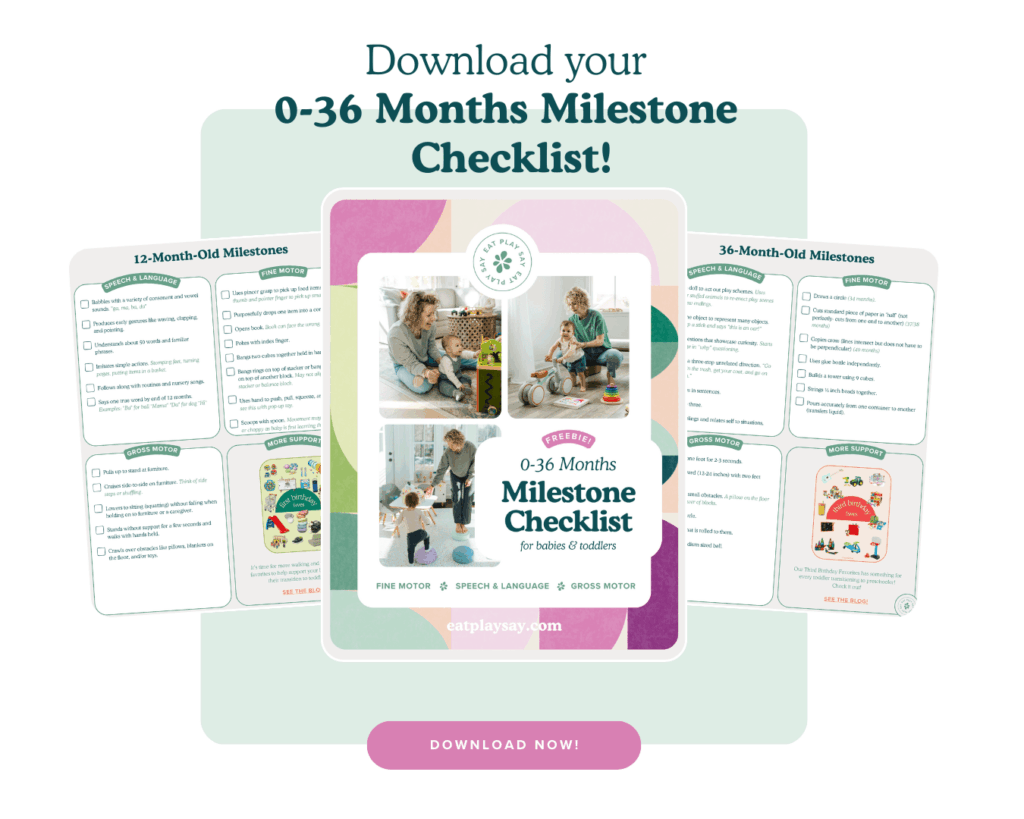
We have a Free Milestone Checklist for 0-36 Months to make sure parents aren’t missing any milestones. Download here!
Milestones aren’t meant to be scary. At their core, they’re an amazing tool to educate and empower parents. Many are ranges, such as babies usually start to coo between 2-4 months or begin crawling by 9-10 months. A baby’s first true word usually happens between 11-14 months, which is a pretty wide span of time. (3, 4) Knowing this can help ease the pressure and help you know when to get more help.
Milestones Month-By-Month
So, what are the most important milestones for babies and toddlers? We go much more in-depth in our Free Milestone Checklist, but here are our top few milestones across all areas of development:
Milestones for 3 Month Olds
At three months old, your baby should be:
- Bringing his/her hands together and to mouth
- Making eye contact
- Turning his/her head side to side and tracking toys
- Lifting his/her head for short periods during tummy time
- Rolling from his/her side to back
The world is expanding rapidly for infants as they exit the newborn stage and start to explore their surroundings more. For fun, easy, and simple play activities, be sure to check out this blog all about playing with your 3 month old!
Milestones for 6 Month Olds
At six months old, we expect babies to:
- Shout and vocalize to get attention
- Start to babble a variety of sounds (ba, ma, ga, da)
- Begin to interact with objects functionally
- Sit for short periods of time while supported
Six months is a big moment for littles—the world opens up to them as they learn to sit upright! There are so many new ways to play with infants once they begin to sit. You can find our best tips for activities with your six month old on our blog.
Milestones for 9 Month Olds
At nine months old, milestones we look for are:
- Sitting independently and reaching for objects
- Starting to crawl on their hands and knees
- Transferring toys and objects between both hands
- Communicating with vocalizations, eye contact, and some gestures
If you haven’t baby proofed, now’s the time. Littles get more mobile from this point onward, and helping them meet their milestones through play gets more engaging every day! For more support on playing with your nine month old, check out our blog on activities for your nine month old.
Milestones for 12 Month Olds
At twelve months, your baby should:
- Babble with a variety of consonant and vowel sounds (ga, ma, ba, da)
- Produce early gestures like waving, clapping, and pointing
- Use pincer grasp to pick up food items
- Pull up to stand at furniture
- Say one true word by the end of 12 months (“Ba” for ball, “Mama”)
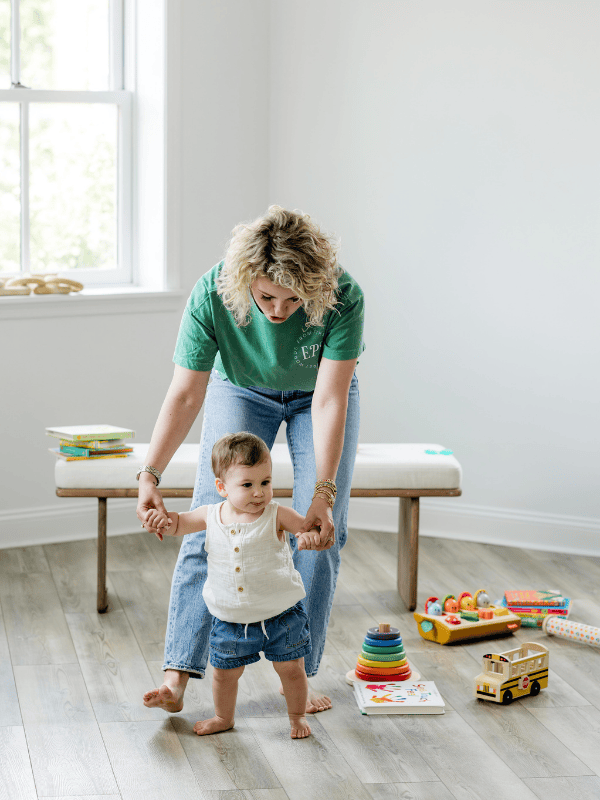
Happy birthday, baby! The transition to toddlerhood is fast approaching, and supporting your child as they explode with new skills can feel hard to keep up with…but you can do it. Our blog all about the best activities for 1 year olds can help!
Milestones for 15 Month Olds
At fifteen months old, your toddler should be:
- Saying 5-10 single words/word approximations
- Frequently imitating sounds during play
- Following basic one-step directions
- Pointing with index finger
- Stacking 2-3 objects (blocks)
Full-blown toddlerhood has arrived, and your little one is starting to have strong opinions and desires. Get out those wiggles and help them learn with our blog about top play activities for 15 month olds!
Milestones for 18 Month Olds
At 18 months, we expect to see milestones such as:
- Saying 10-50 words independently, with a variety of sounds like “b, p, m, n, t, d”
- Pointing to identify common vocabulary (including body parts)
- Carrying toys while walking
- Matching puzzle pieces
By this stage, littles have built a strong foundation of skills that they build upon every single day. They’re always learning and making new connections! For our top activities to do with your 18 month old, check out our blog.
How to Use a Milestone Checklist
When milestones are used as tools of empowerment, parents become better equipped to help their children grow, learn, and develop on their own unique journey. When we know better, we do better. Knowledge is power!
Tracking milestones doesn’t mean you have to get a degree in child development or pass a test at the pediatrician’s office. Instead of “wait and see,” we encourage a “check and see” approach.
Here are some simple steps you can take to support your little through their developmental milestones by month:
- “Check and see” where your child is at so you can best support them where they need extra help. Our milestone checklist is our most downloaded freebie and can help you do this!
- Work towards these milestones as they are approaching and offer extra support at home. Our Playbooks can help you do just that!
- If progress isn’t as quick as you’d like, it’s time to reach out for help with an early intervention evaluation.
Missing a milestone, or being delayed at reaching one, doesn’t mean that something is terribly wrong. For many babies and toddlers, a little extra support is all that’s needed.
Whether extra support looks like physical, occupational, speech, or feeding therapy, these interventions are tools to help littles thrive. Sometimes that support can even happen from the comfort of home. Early intervention evaluations are free in the United States, and you don’t have to have a pediatrician referral to be seen.
One more thing: it’s okay if your little one needs help sometimes. It’s important that parents have access to resources to help their children if they need extra support. You aren’t failing if your child needs a helping hand…and neither are they!
How do I help my baby meet milestones?
This is a most asked question on social media, and the answer doesn’t have to be complicated! Littles learn best through play, and when that play is purposeful, babies and toddlers can easily work towards their milestones.
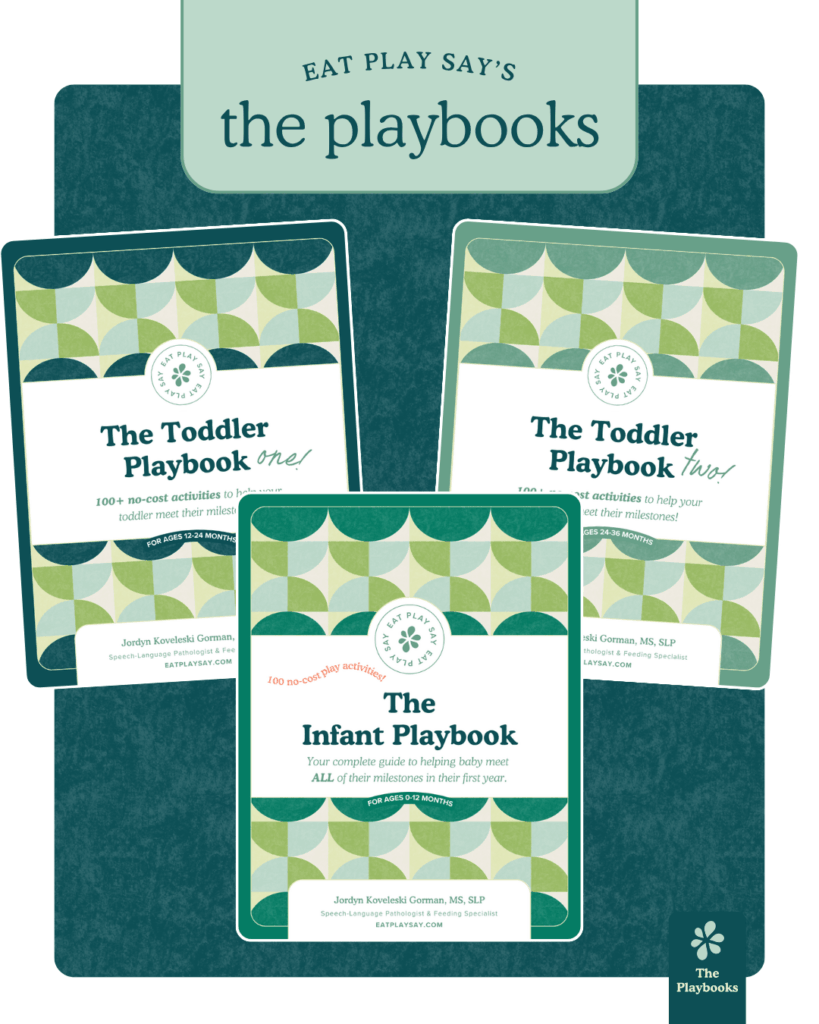
That’s why we created our Playbooks, which help your little one meet their milestones through play using only what you have at home. With more than 100 activities per ebook, the Playbooks break down ways to play for each age that support speech, fine motor and gross motor skill development—no specific toys or equipment needed!
To recap:
- Check and see your child’s progress on a milestone checklist, and then try strategies at home first to help them learn. Expose your little one to what they are missing and see if they can pick up on these new skills. If you haven’t exposed them to it, they likely won’t be able to do it yet!
- If you are still concerned after modeling and practicing at home, talk to a professional and/or self-refer to your local early intervention.
- Keep playing, practicing, and modeling for your child while waiting for an appointment!
Last but not least, remember that your child isn’t defined by milestones. Knowledge is power, and when we know better, we do better.
There is nothing wrong with needing help.
And you’re doing a great job.
Sources
- Hebbeler, Early Intervention for Infants and Toddlers with Disabilities and Their Families.
- Jennifer M. Zubler, Lisa D. Wiggins, Michelle M. Macias, Toni M. Whitaker, Judith S. Shaw, Jane K. Squires, Julie A. Pajek, Rebecca B. Wolf, Karnesha S. Slaughter, Amber S. Broughton, Krysta L. Gerndt, Bethany J. Mlodoch, Paul H. Lipkin; Evidence-Informed Milestones for Developmental Surveillance Tools. Pediatrics March 2022; 149 (3): e2021052138. 10.1542/peds.2021-052138
- Folio, M. R., Fewell, R. R. (2000). PDMS-2 Peabody Developmental Motor Scales Second Edition. Austin, TX: PRO-ED, Inc.
- Rossetti, L. (2006). Infant-Toddler Language Scale: A Measure of Communication and Interaction. Linguisystems.
Leave a Reply
OTHER POSTS YOU MAY LIKE:



MS, SLP
Founder of Eat Play Say, Speech-Language Pathologist, Feeding Specialist, Play Expert, Mom of 2
Jordyn Koveleski Gorman
SPECIALIZES IN: Infant and toddler speech-language, play, and feeding development, and curating a team that provides expert help that feels like a reassuring text from that one mom friend
EDUCATION: Jordyn received her BS in Speech-Language Pathology from Bloomsburg University and her MS in Speech-Language Pathology from Towson University
FAVE PARENTING FIRST: “The first true smile, it’s the sweetest!”

MS, CCC-SLP, CBS, IBCLC
Speech-Language Pathologist & Feeding Specialist, Certified Breastfeeding Specialist, International Board Certified Lactation Consultant
Jessica Nicholson Cocca
SPECIALIZES IN: Breast and bottle feeding, tongue ties, oral motor dysfunction, starting solids, infant and toddler speech, treating oral motor disorders
EDUCATION: Jessica received her BS in Communication Sciences and Disorders from Pennsylvania State University in 2015 and her MS in Speech-Language Pathology from Towson University in 2017
FAVE PARENTING FIRST: “Baby’s first wave! What a fun first communication gesture!”

MA, CCC-SLP, CLC
Speech-Language Pathologist, Certified Lactation Counselor
Jennifer McFarlin
SPECIALIZES IN: Breast and bottle feeding, tongue ties, starting solids, infant and toddler speech development
EDUCATION: She received her BS in Speech-Language Pathology from Ball State in 2014 and a MA in Speech-Language Pathology from Ball State in 2016.
FAVE PARENTING FIRST: “My favorite baby’s first is their first true smile that just warms your soul knowing they are smiling at you. My other favorite is their first word. I love watching their language explode!”

MS, CCC-SLP
Bilingual Speech-Language Pathologist
Nicole La Petina Kelly
SPECIALIZES IN: Bilingual development (Spanish-English), supporting multilingual families, infant and toddler speech
EDUCATION: She received her BA in Communication Sciences and Disorders and in Spanish from the University of Wisconsin-Madison in 2014 and her MS in Speech-Language Pathology with an English-Spanish Specialization from Marquette University in 2016.
FAVE PARENTING FIRST: “It’s the first slobbery kisses for me!”

RDN, LD
Licensed Registered Dietitian
Kimberly Vede
SPECIALIZES IN: Infant and pediatric nutrition including breastfeeding, formula feeding, and starting solids. She also specializes in prenatal and postpartum nutrition.
EDUCATION: She received her BSc in Biology in 2014 from Life University, and her BSc in Dietetics from Life University in 2019.
FAVE PARENTING FIRST: ”The first time they say ‘mama!’”


This checklist was created with input from a Speech-Language Pathologist, Occupational Therapist and Physical Therapist and has been downloaded over 20,000 times by parents worldwide. Learn the important milestones to pay attention to, and keep it in your digital back pocket during the baby + toddler years!
Comprehensive Milestone Checklist for gross motor, fine motor, and speech-language milestones for 0-36 months,
DOWNLOAD FOR FREE


