


Can You Overfeed a Breastfed Baby?
April 10, 2026
Jordyn Koveleski Gorman

Last Updated on April 28, 2026 by Jordyn Koveleski Gorman
From start to finish, no matter what the journey looks like, feeding an infant is a tough job. Whether feeding looks exactly the way you imagined or it’s like entering the twilight zone, you deserve to feel supported and empowered along the way.
As a speech-language pathologist and feeding specialist, I hear a lot of questions about how to know if a baby is getting enough to eat. Similarly, I hear the opposite—how to know if they’re getting too much. Especially for first time parents to a newborn, feeding cues can feel foreign and scary. There’s good news on the horizon though: you’re going to figure it out! Before you know it, questions like these will be in the rearview mirror.
Teaming up with our lactation consultants, we’ve combined our expertise to help answer one of the most common questions we hear about feeding infants. So, can you overfeed a breastfed baby? Let’s talk about it!

Can you overfeed a breastfed baby?
The answer: it depends.
There are so many pieces of feeding, and so many ways to approach it. Even within breastfeeding, there are multiple ways to feed!
For babies who are exclusively nursing at the breast, overfeeding is incredibly unlikely. Feeding directly from the breast is a dynamic, active process that requires baby to engage in order to receive milk. That means as baby slows down, so does the flow of milk. If baby stops suckling entirely but remains latched, the milk will also stop flowing. In other words, feeding at the breast is a process led by your baby.
Infants do not have the same social perceptions about food that older children and adults develop over time. For babies, feeding is about energy intake. (1) When infants are breastfed without bottle use, the control remains with baby, and they are able to stop a feed when they are full.
When breastfed babies are fed expressed milk—or formula—in a bottle, there are external influences that can contribute to overfeeding.
For starters, bottles continue to drip milk regardless of suckling on the nipple. Baby may be ready to finish feeding, but milk keeps coming anyway. Additionally, caregiver perception and encouragement to finish a bottle may lead to overfeeding. (2)
Breastmilk is more concentrated than formula, which means that a lower volume is needed compared to formula feeding. Confusion or lack of information about the amount of milk a breastfed baby needs can lead to overfeeding when using a bottle.
As a mom who knows how precious pumped milk is, there can also be a pressure to feed every last drop in the bottle for fear of wasting milk. We encourage parents to try and shift their mindset around “wasting milk” and instead focus on baby’s feeding cues. And remember, milk that has “expired” or is not used during a bottle feed can be repurposed for a milk bath. Just put it in the freezer and label it. Bring it out during baby’s next bath to nourish their skin and soothe any rashes.
Research indicates that the likelihood of overfeeding in infancy is higher with formula feeding. Factors such as incorrect preparation of bottles and caregiver influence can contribute to overfeeding formula. (3)
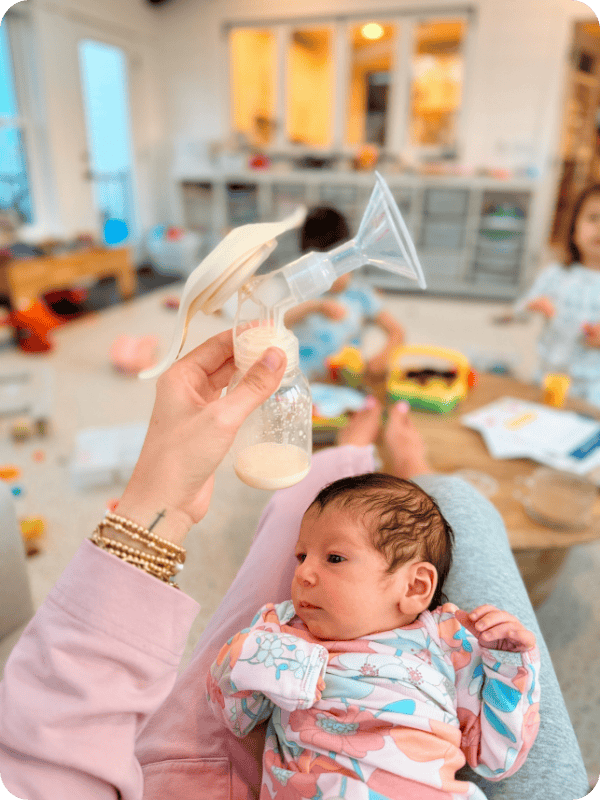
Signs of overfeeding a baby
Signs of overfeeding a baby include:
- Many wet diapers in one day. Your child’s pediatrician can tell you how many wet diapers your baby should have per day for their age.
- Loose, watery stools can be a sign that your baby’s digestive system can’t keep up.
- Spitting up during or after feedings, especially in large amounts, can signal overfeeding. Small quantities of spit up on occasion is normal, but frequent, large, or upsetting incidents of spitting up can point to another issue.
- Fussiness after feeds can indicate an upset stomach or tension in their abdomen, which can be caused from a variety of things, including overfeeding.
- Rapid or excessive weight gain can indicate feeding too much.
If you are concerned about any of the signs above, talk to your child’s pediatrician. Since the signs of overfeeding can be nonspecific, it’s important to talk to your healthcare provider for guidance.
How to avoid overfeeding baby
No matter the approach to feeding, the best way to avoid overfeeding your infant is the same. Understanding their hunger and fullness cues and responding accordingly helps prevent overfeeding. (2)
When nursing or bottle feeding, a baby may signal that they are done by simply unlatching or falling asleep. (4) Some other signs of fullness are less obvious.

Early signs that your baby is nearing fullness can include:
- Putting their hand to their face as they suckle
- Relaxed muscles
- Begins looking at their surroundings instead of focusing on breast, bottle, or caregiver
- Decreased activity level during feed
- Slowing or pausing suck/swallow pattern
- Turning head away (4)
Active signs that your baby is full and it’s time to stop feeding include:
- Pushes away from breast, nipple, or bottle
- Pulls or turns away abruptly
- Starts falling asleep
- Gaze aversion where baby looks as far away from the feeding source as possible
- Refusal to open mouth
- Biting
- Pounding their hands in refusal
- Shaking head or saying “no”
- Playing with nearby objects, bottle, or breast
- Spitting milk out
- Fussiness and whining
- Squirming or getting agitated (4)
Additionally, if your little one begins to arch their back away from the person feeding them, cries out, or vomits, feeding should end.
As you settle into life with your little one, you will quickly discover that their cues are unique to them, and you will recognize them well! Overfeeding is an understandable concern, but with the right knowledge, you can ensure your little one gets exactly what they need.
More feeding resources
Now that you’re equipped to recognize when your baby is full, you can hopefully breathe a little easier. But if feeding is still a source of overwhelm or you have more questions, you’ve come to the right place.
At Eat Play Say, we’re all about supporting caregivers through every stage of feeding littles. Whether you’re looking for more information about breast or bottle feeding, or maybe it’s time to start solids, we’ve got the resources. And if you’ve got toddlers to feed, you might need a boost there, too, and we understand.
For support that goes deeper, check out our most in-depth, expert-written Handbooks! From resources on feeding to 100+ developmentally appropriate play activities for littles, we have made sure to cover it all. Our team is also available for virtual consultations in a matter of days (rather than weeks or months!).
And remember, you’re doing an amazing job, and your baby is so lucky to have you!
Sources
- Crandall AK, Loch L, Gearhardt AN, Lumeng JC. The Regulation of Energy Intake in Infancy: A Narrative Review. Curr Obes Rep. 2025 Jul 25;14(1):60. doi: 10.1007/s13679-025-00653-9. PMID: 40707829; PMCID: PMC12289734.
- Srivastava, Anu, and Swati Jain. 2023. “Appetite Self-Regulation in Infancy – The Role of Direct Breastfeeding.”World Nutrition, March, 22–27. https://doi.org/10.26596/wn.202314122-27.22
- Appleton J, Russell CG, Laws R, Fowler C, Campbell K, Denney-Wilson E. Infant formula feeding practices associated with rapid weight gain: A systematic review. Matern Child Nutr. 2018 Jul;14(3):e12602. doi: 10.1111/mcn.12602. Epub 2018 Apr 14. PMID: 29655200; PMCID: PMC6866175.
- Hodges EA, Wasser HM, Colgan BK, Bentley ME. Development of Feeding Cues During Infancy and Toddlerhood. MCN Am J Matern Child Nurs. 2016 Jul/Aug;41(4):244-251. doi: 10.1097/NMC.0000000000000251. PMID: 27710994; PMCID: PMC5057392.
Leave a Reply
OTHER POSTS YOU MAY LIKE:




MS, SLP
Founder of Eat Play Say, Speech-Language Pathologist, Feeding Specialist, Play Expert, Mom of 3
Jordyn Koveleski Gorman
SPECIALIZES IN: Infant and toddler speech-language, play, and feeding development, and curating a team that provides expert help that feels like a reassuring text from that one mom friend
EDUCATION: Jordyn received her BS in Speech-Language Pathology from Bloomsburg University and her MS in Speech-Language Pathology from Towson University
FAVE PARENTING FIRST: “The first true smile, it’s the sweetest!”

MS, CCC-SLP, CBS, IBCLC
Speech-Language Pathologist & Feeding Specialist, Certified Breastfeeding Specialist, International Board Certified Lactation Consultant
Jessica Nicholson Cocca
SPECIALIZES IN: Breast and bottle feeding, tongue ties, oral motor dysfunction, starting solids, infant and toddler speech, treating oral motor disorders
EDUCATION: Jessica received her BS in Communication Sciences and Disorders from Pennsylvania State University in 2015 and her MS in Speech-Language Pathology from Towson University in 2017
FAVE PARENTING FIRST: “Baby’s first wave! What a fun first communication gesture!”

MA, CCC-SLP, CLC
Speech-Language Pathologist, Certified Lactation Counselor
Jennifer McFarlin
SPECIALIZES IN: Breast and bottle feeding, tongue ties, starting solids, infant and toddler speech development
EDUCATION: She received her BS in Speech-Language Pathology from Ball State in 2014 and a MA in Speech-Language Pathology from Ball State in 2016.
FAVE PARENTING FIRST: “My favorite baby’s first is their first true smile that just warms your soul knowing they are smiling at you. My other favorite is their first word. I love watching their language explode!”

MS, CCC-SLP
Bilingual Speech-Language Pathologist
Nicole La Petina Kelly
SPECIALIZES IN: Bilingual development (Spanish-English), supporting multilingual families, infant and toddler speech
EDUCATION: She received her BA in Communication Sciences and Disorders and in Spanish from the University of Wisconsin-Madison in 2014 and her MS in Speech-Language Pathology with an English-Spanish Specialization from Marquette University in 2016.
FAVE PARENTING FIRST: “It’s the first slobbery kisses for me!”

RDN, LD
Licensed Registered Dietitian
Kimberly Vede
SPECIALIZES IN: Infant and pediatric nutrition including breastfeeding, formula feeding, and starting solids. She also specializes in prenatal and postpartum nutrition.
EDUCATION: She received her BSc in Biology in 2014 from Life University, and her BSc in Dietetics from Life University in 2019.
FAVE PARENTING FIRST: ”The first time they say ‘mama!’”


This checklist was created with input from a Speech-Language Pathologist, Occupational Therapist and Physical Therapist and has been downloaded over 20,000 times by parents worldwide. Learn the important milestones to pay attention to, and keep it in your digital back pocket during the baby + toddler years!
Comprehensive Milestone Checklist for gross motor, fine motor, and speech-language milestones for 0-36 months,
DOWNLOAD FOR FREE


