


Activities for 1 Year Olds
January 12, 2026
Jordyn Koveleski Gorman

Last Updated on January 13, 2026 by Jordyn Koveleski Gorman
It happens so fast: you blink, and your tiny newborn has already had their first birthday. Every day is different with an infant. They develop rapidly in that first year of life! Some 12 month olds go full-blown toddler overnight, while others take a more relaxed approach to entering toddlerhood. With every system in a baby’s brain going full force, there are countless ways to play and help them learn through connection.
The foundations of critical thinking and executive functioning are built in early childhood, and social play is an important part of practicing these skills in safe, low-stakes environments. (1) Get excited, because every play session is a powerful building block for your toddler’s development!
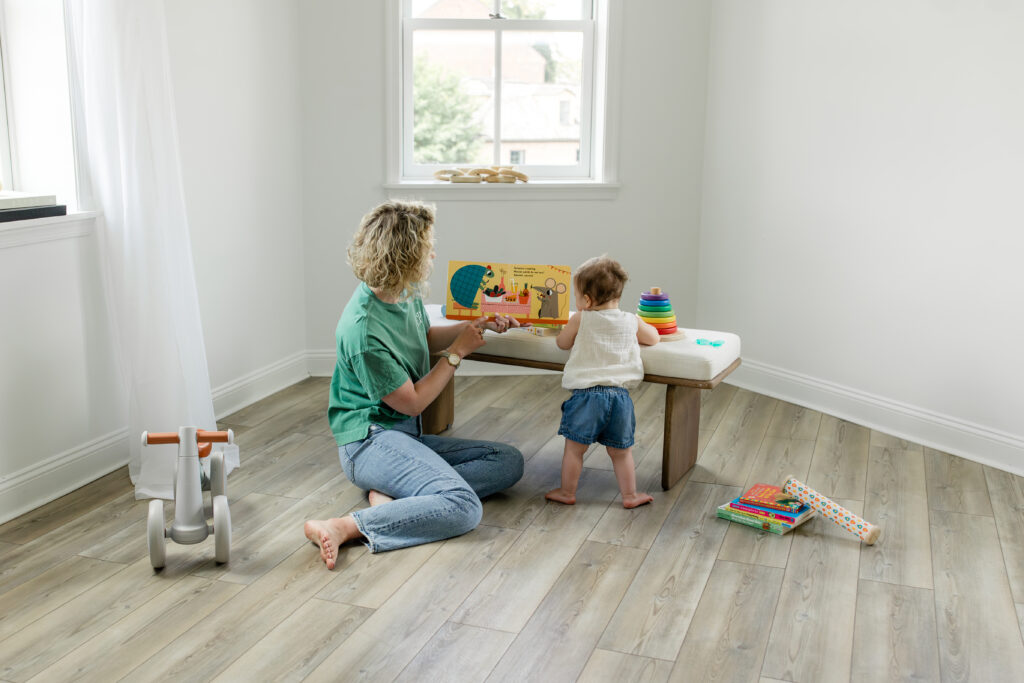
12 month milestones
Before we dive into activities, let’s do a little recap. What do we expect babies to be doing at one year old?
At twelve months, your baby should:
- Babble with a variety of consonant and vowel sounds (ga, ma, ba, da)
- Produce early gestures like waving, clapping, and pointing
- Use a pincer grasp to pick up food items
- Understand about 50 words and familiar phrases
- Pull up to stand at furniture
- Say one true word by the end of 12 months (“Ba” for ball, “Mama”)
- Imitate simple actions like stomping or putting items in a basket
- Bang two cubes together when held in their hands
- Open a book (it can face the wrong way)
- Stand without support for a few seconds and walk with hands held
These are just a few of the milestones we look for in 12 month olds. You can check and see where your baby is at and where they may need extra support by downloading our free milestone checklist for ages 0-36 months.
Developmental activities for 12 month olds
The good news is that you don’t have to buy your toddler a hundred new toys just because they turned from baby to toddler. Focusing on activities that help your little one reach all of their big milestones is important.
Remember, play is an important piece of healthy growth, and it’s the way that children learn best! In fact, studies have shown that play is an innate, vital part of early development across many species. (2)
Here are our top 5 activities for 12 month olds:
Walking: To help your 12 month old start to walk with support, take them around the house on a walk while holding their hands. The key here is to keep their hands at shoulder or waist level, not above their head! This helps them keep their balance.
First Words: To encourage your toddler to imitate more words and say them independently, head outside or gather random noisy things inside (toy car, kitchen utensil, or stuffed animal) and model noises the objects make. For example, cars go “vroom, vroom!” and leaves go “crunch crunch!”
Pinching: To encourage your toddler to use their pincer grasp consistently during play, “trap” some toys with painters tape on their high chair or the floor. Encourage them to use their thumb and index finger to peel the tape and free the toys. You may have to start the peel for them, and that’s okay!
Listening Skills: To support your 12 month old’s receptive language skills, play Simon Says—1 year old edition! Focus on gestures, animal noises, and verbs. Try phrases like, “Simon Says clap your hands! Clap!” or “Simon Says to oink like a piggy! Oink!” Make sure to look at your little one and pause so they have time to answer and imitate.
Fine Motor Skills: To help your little one learn how to stack objects, start by teaching them how to bang blocks together! First, bang one block on top of another slowly three times. On the third hit, release the block so that it stacks on top of the one below. Now let them try! They may simply bang blocks together or throw them across the room. That’s okay!
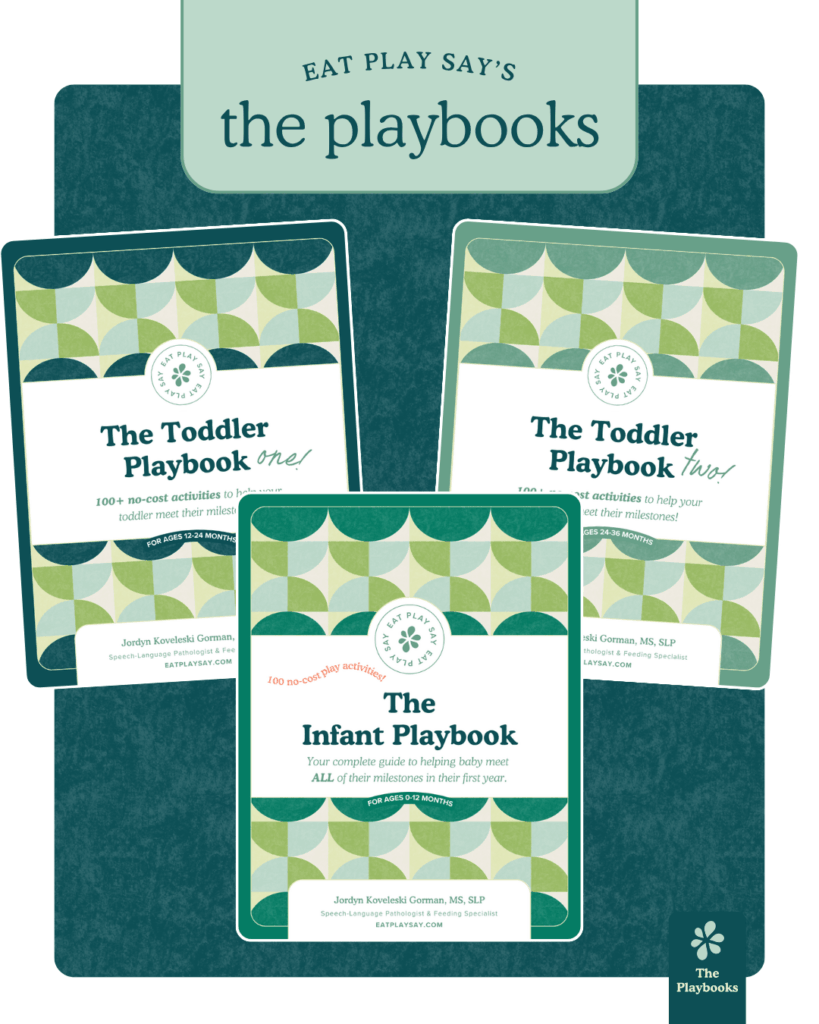
We have so many more milestone-focused play ideas just like this in our Toddler Playbook–One for 12-24 Months. Check it out for 100 more activities you can do at home!
Sensory activities for 1 year olds
Sensory play is all over social media, and there’s a good reason for it. Giving your little one the opportunity to think and make decisions for themselves through sensory play supports their budding imagination, creativity, and cognitive understanding. (3)
Don’t you remember how fun it was to make a mess as a kid?! Splashing in a puddle, digging little hands through a sandbox, and tasting everything those hands touch opens up the world for babies to explore and learn.
Our go-to sensory activities for 12 months olds include:
- Making your own sensory bin! The options are nearly limitless. Try out taste-safe sensory bins with oats, Cheerios, puffs, or water, and add a variety of toys for your baby to search for, dunk under the surface, and make silly noises with.
- If you’re up for a little mess, practice pre-writing skills without any crayons/pencils/markers! Using something spreadable (we prefer edible options like peanut butter, cool whip, yogurt, or pudding), add as much to a flat surface as you feel comfortable with, and let your little spread it everywhere! Once they’ve got the hang of it, you can model drawing squiggles and lines with your own finger.
Craft activities for 1 year olds
If it’s not already, your fridge is about to be full of your little one’s beautiful artwork. Crafts aren’t just for older toddlers or preschoolers—there are tons of quick, easy crafts you can do right now.
The best crafts for 12 month olds include:
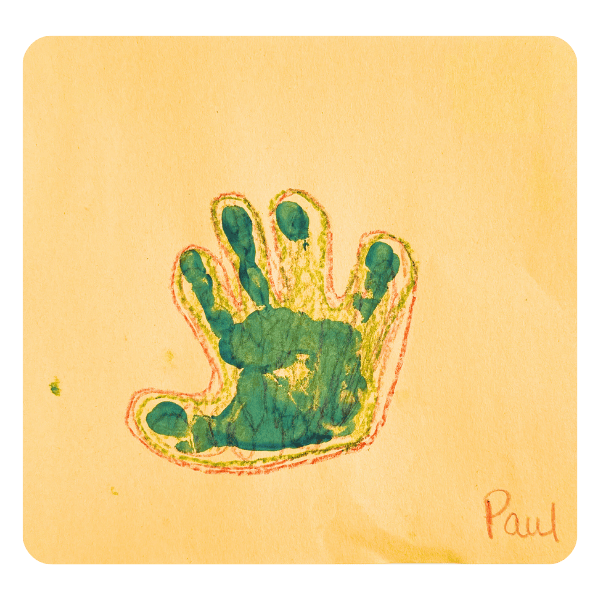
Handprint Leaf (you can adapt for every season!)
- Paint your little one’s hand with colored finger paint, then press it down on the paper to make a handprint.
- After it dries, use a brown crayon to draw lines on the hand to make it look like a leaf!
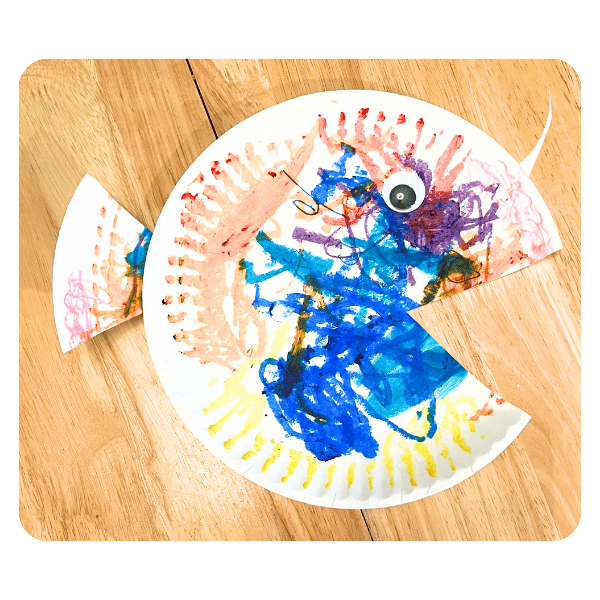
Paper Plate Fish
- Color and decorate the paper plate with markers, crayons, or paint.
- Cut a triangle out of the paper plate, similar to a pizza slice (this cut out will be the fish’s mouth).
- Glue the triangle to the opposite side of where you cut it out (gluing triangle point on the back of the paper plate so it is hidden). This will be the fish’s fin.
- Glue googly eyes onto the fish and take your fish friend for a “swim” around the house!
Need more craft ideas? We’ve got you covered for every season and (almost all) the holidays, too! Download our free craft guides here.
Gross motor activities for 1 year olds
This is the time when those gross motor skills really start to stack up. As your little one begins to explore the world with their feet planted on the ground, they’ll soon be running toward adventure!
Our favorite gross motor activities for 12 month olds are:
- For toddlers who are starting to cruise side-to-side and alongside furniture, you can help them get ready for solo steps! Stand your little up with their back to a wall or the couch and scoot away from them just a little bit. Hold out your hands and ask them to come your way! You can offer a finger to them for extra support as they get started.
- “Hide” Easter eggs or another similarly sized object around the room, being sure to place things slightly above their level, down low, and in between other things. This helps encourage littles to pull to stand, squat down, and turn around while walking. For extra support, your baby can push a shopping cart, walker, or hold onto your hand. An added bonus to this activity? Siblings will enjoy it too!
Fine motor activities for 1 year olds
From grasping small pieces of food on their plate to learning how to fit shapes through a sorter, your child is quickly developing their fine motor skills.
Our go-to fine motor activities for 12 month olds are:
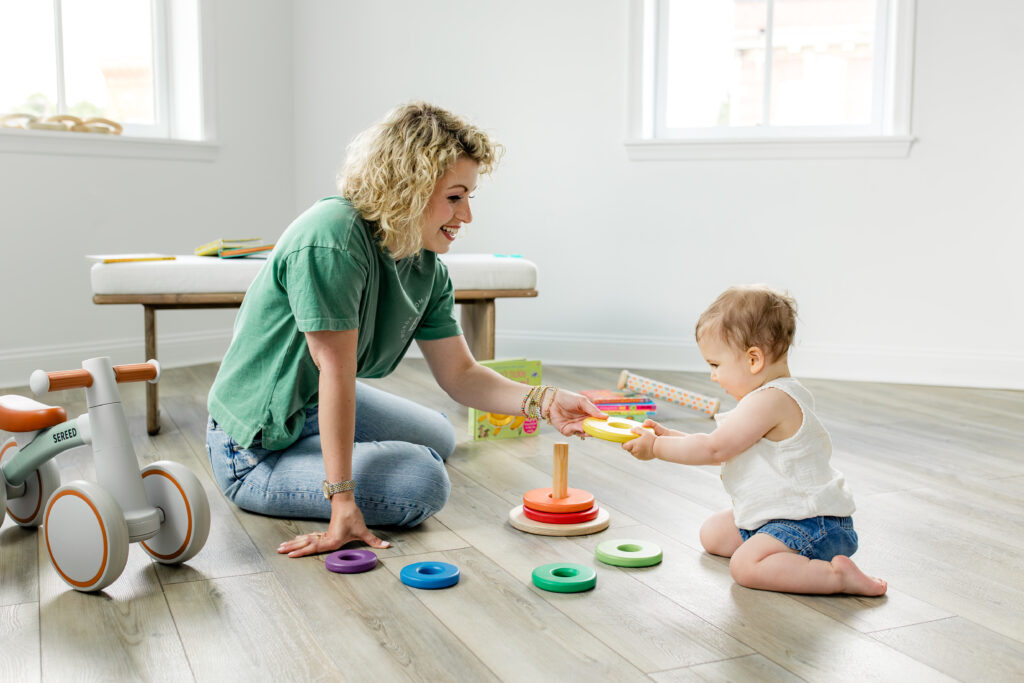
- Help your little one sort shapes! Using whatever shape sorter you have, cover all the shapes with your hands except for the circle. Have your baby practice putting the circle through the hole by themselves. After a few tries, go ahead and reveal the other shapes on the sorter and help your baby continue to find the circle by pointing at it. Over time, your little will be able to sort all the shapes—but for right now, the circle is perfect!
- Your toddler will start to understand that rings go on a stacker around this age…but getting them there is harder than it looks! They tend to bang the ring on top of the stacker, with their tiny hands gripping powerfully onto the ring. Model that banging motion for your child, and then show them how you let go onto the stacker. This activity usually requires some teamwork between the two of you, as you might also have to help them line it up. Fine motor skills are precise and challenging!
Want more play ideas?
It can feel overwhelming trying to find new, creative ways to play all the time. But it doesn’t have to be!
Remember that you’ve already built a solid foundation in the previous months of your baby’s life. There’s no need to reinvent the wheel every time they reach a new milestone or enter a new era, like toddlerhood.
You are doing great, and your child appreciates you so much!
If you liked the activities in this post, you will love our Playbooks—more than 100 age-appropriate, developmentally supportive ways to play with your child using only what you have at home!
Sources
- Center on the Developing Child at Harvard University (2011). Building the Brain’s “Air Traffic Control” System: How Early Experiences Shape the Development of Executive Function: Working Paper No. 11.
- Pellegrini, A. D., Dupuis, D., & Smith, P. K. (2007). Play in evolution and development. Developmental Review, 27(2), 261–276.
- Abidin, Anis & Ishak, Siti & Bakar, Ruhil & Abdul Rahman, Andrialis. (2022). Significance of Sensory Activities among Toddlers for Sensory Skills Development. Environment-Behaviour Proceedings Journal. 7. 15-27.
Leave a Reply
OTHER POSTS YOU MAY LIKE:



MS, SLP
Founder of Eat Play Say, Speech-Language Pathologist, Feeding Specialist, Play Expert, Mom of 3
Jordyn Koveleski Gorman
SPECIALIZES IN: Infant and toddler speech-language, play, and feeding development, and curating a team that provides expert help that feels like a reassuring text from that one mom friend
EDUCATION: Jordyn received her BS in Speech-Language Pathology from Bloomsburg University and her MS in Speech-Language Pathology from Towson University
FAVE PARENTING FIRST: “The first true smile, it’s the sweetest!”

MS, CCC-SLP, CBS, IBCLC
Speech-Language Pathologist & Feeding Specialist, Certified Breastfeeding Specialist, International Board Certified Lactation Consultant
Jessica Nicholson Cocca
SPECIALIZES IN: Breast and bottle feeding, tongue ties, oral motor dysfunction, starting solids, infant and toddler speech, treating oral motor disorders
EDUCATION: Jessica received her BS in Communication Sciences and Disorders from Pennsylvania State University in 2015 and her MS in Speech-Language Pathology from Towson University in 2017
FAVE PARENTING FIRST: “Baby’s first wave! What a fun first communication gesture!”

MA, CCC-SLP, CLC
Speech-Language Pathologist, Certified Lactation Counselor
Jennifer McFarlin
SPECIALIZES IN: Breast and bottle feeding, tongue ties, starting solids, infant and toddler speech development
EDUCATION: She received her BS in Speech-Language Pathology from Ball State in 2014 and a MA in Speech-Language Pathology from Ball State in 2016.
FAVE PARENTING FIRST: “My favorite baby’s first is their first true smile that just warms your soul knowing they are smiling at you. My other favorite is their first word. I love watching their language explode!”

MS, CCC-SLP
Bilingual Speech-Language Pathologist
Nicole La Petina Kelly
SPECIALIZES IN: Bilingual development (Spanish-English), supporting multilingual families, infant and toddler speech
EDUCATION: She received her BA in Communication Sciences and Disorders and in Spanish from the University of Wisconsin-Madison in 2014 and her MS in Speech-Language Pathology with an English-Spanish Specialization from Marquette University in 2016.
FAVE PARENTING FIRST: “It’s the first slobbery kisses for me!”

RDN, LD
Licensed Registered Dietitian
Kimberly Vede
SPECIALIZES IN: Infant and pediatric nutrition including breastfeeding, formula feeding, and starting solids. She also specializes in prenatal and postpartum nutrition.
EDUCATION: She received her BSc in Biology in 2014 from Life University, and her BSc in Dietetics from Life University in 2019.
FAVE PARENTING FIRST: ”The first time they say ‘mama!’”


This checklist was created with input from a Speech-Language Pathologist, Occupational Therapist and Physical Therapist and has been downloaded over 20,000 times by parents worldwide. Learn the important milestones to pay attention to, and keep it in your digital back pocket during the baby + toddler years!
Comprehensive Milestone Checklist for gross motor, fine motor, and speech-language milestones for 0-36 months,
DOWNLOAD FOR FREE


