


Newborn Hunger Cues
November 25, 2025
Jordyn Koveleski Gorman

Last Updated on May 15, 2026 by Jordyn Koveleski Gorman
You may assume that newborns simply start crying when they are hungry. But that’s not always true! Your baby often shows different signs, called hunger cues, which usually follow a pattern.
Newborn feeding cues are signs that your baby is hungry and would like to feed as soon as possible. As they get more hungry, the intensity of these signals might increase. They may get stronger and louder.
Let’s break down these newborn hunger cues, and I’ll teach you how you can follow your baby’s cues to feed them on demand!

Signs your newborn is hungry
Early Hunger Cues:
When you see these signs, it means your baby is starting to get hungry, and would like to be fed soon.
- Rooting: Baby turns their head from left to right as if they are looking for a nipple, especially when you are holding them or they are close to mother’s breast.
- Head Bobbing: Baby may turn their head side to side or even move it up and down, often with an open mouth as if they are searching anywhere for a nipple.
- Lip Smacking: Baby may lick their lips, stick their tongue out, or open and close their mouth to ‘prepare’ for feeding.
- Hands-to-Mouth*: Baby will bring their hands to their mouth, and start sucking on their thumb or closed fist. (Pictured above.)
- Increased Alertness: Baby may become more alert & active, and begin to move their eyes around.
- Squealing: Baby may start to make cooing and squealing noises while moving their body to signal that they are ready to eat.
These early feeding cues can sometimes be so subtle, and easy to miss. When you notice these signs, it’s best to feed your baby as soon as possible to prevent them from getting too upset.
*Bringing hands to mouth is usually a reliable hunger cue before 2-3 months. Around 6-8 weeks, as your baby gains more control over their hands, they may bring their hands to mouth intentionally for oral exploration. So, it’s no longer a reliable hunger cue. (1) This is the perfect time to introduce teethers!
Active Hunger Cues:
Your baby shows more obvious, repetitive behaviors as their hunger increases.
- Sucking on Hands: Baby may begin to suck hard on their hands, tongue, or anything near their mouth (e.g. clothes, toys).
- Body Squirming: Baby may start wriggling, getting restless or moving their head frantically. You might see them stirring in sleep or twisting their body. They may try to get in position for nursing, either by turning to their side or lying back.
- Fussiness: Baby may get more agitated, and begin to cry in short bursts. They may also hit you on the arm or chest repeatedly.
All these signs show that your baby is getting really hungry, and would like to be fed right away.
Keeping a schedule in mind is a great way to try and catch those hunger cues early. You can check out that entire blog post here!
Late Feeding Cues:
At this stage, your baby’s hunger has peaked, and they might be fairly upset or overwhelmed.
- Crying Hard: You’ll hear your baby is crying in a high-pitched, loud tone. The crying is rhythmic and consistent. After the first few weeks, you will likely distinguish this specific cry from others.
- Unable to be Soothed: Baby may not stop crying by any other means, like bouncing, rocking or patting their back.
- Back Arching: Baby’s body may be hyperextended due to distress. You’ll see their back might be arched and body movements are getting agitated.
- Turning Away: Baby may be moving their arms very quickly, and turning their head away from the nipple due to frustration and overstimulation.
You will likely need to calm them down before feeding. Hold your baby close to your chest, and rock or soothe gently.
It’s best to feed your baby before they start crying, so it’s easier to establish a good latch. We share more tips for proper latch on breast and bottle here if you need those!
False hunger cues in newborns
Newborns have several primitive reflexes and an immature nervous system. These may lead to false hunger cues in newborns, which are actually normal behaviors triggered by being tired or needing comfort.
For example, sucking on hands may not always be a sign of hunger, as sucking is soothing for newborns. They may open their mouth wide when their cheek is touched as part of their normal Gape Reflex. Similarly, fussing or crying shortly after a feed may indicate tiredness, rather than hunger.
These false hunger cues often appear in isolation, and don’t follow the usual feeding rhythm. Babies are also usually able to be soothed in other ways without offering a feed. You may want to look at a combination of at least some feeding cues mentioned above to determine if your newborn is really hungry or just tired.

Newborn sleep cues vs. hunger cues
Sometimes you may feel confused between signs of tiredness and hunger cues. It’s important that you differentiate both so you can feed the baby when they’re hungry, and put them down when they need rest.
When your newborn is tired, they may seem to lose interest in their surroundings, and often stare blank into space. You may also find them rubbing their eyes or pulling their ears. Slow body movements and yawning almost always mean your baby needs a nap!
If your baby is crying due to overstimulation, you may be able to soothe them by holding, rocking, or offering a pacifier. Taking them into a dark and quiet room can also help you decipher if they are overstimulated, overtired, or hungry. They will usually get quieter, and ready to settle if they are ready for sleep rather than a feed.
How to know when a newborn is full
Babies know how much milk they need to take, and their body cues show that once they have it.
When a newborn is full, they usually slow down their suck-swallow pattern, and begin to turn away from the nipple. You can also see their fists getting relaxed, and they are often calm and content.
If they no longer want to feed, they may pull off the breast or bottle and fall asleep. (2) All of these signs show that your baby has had enough milk.
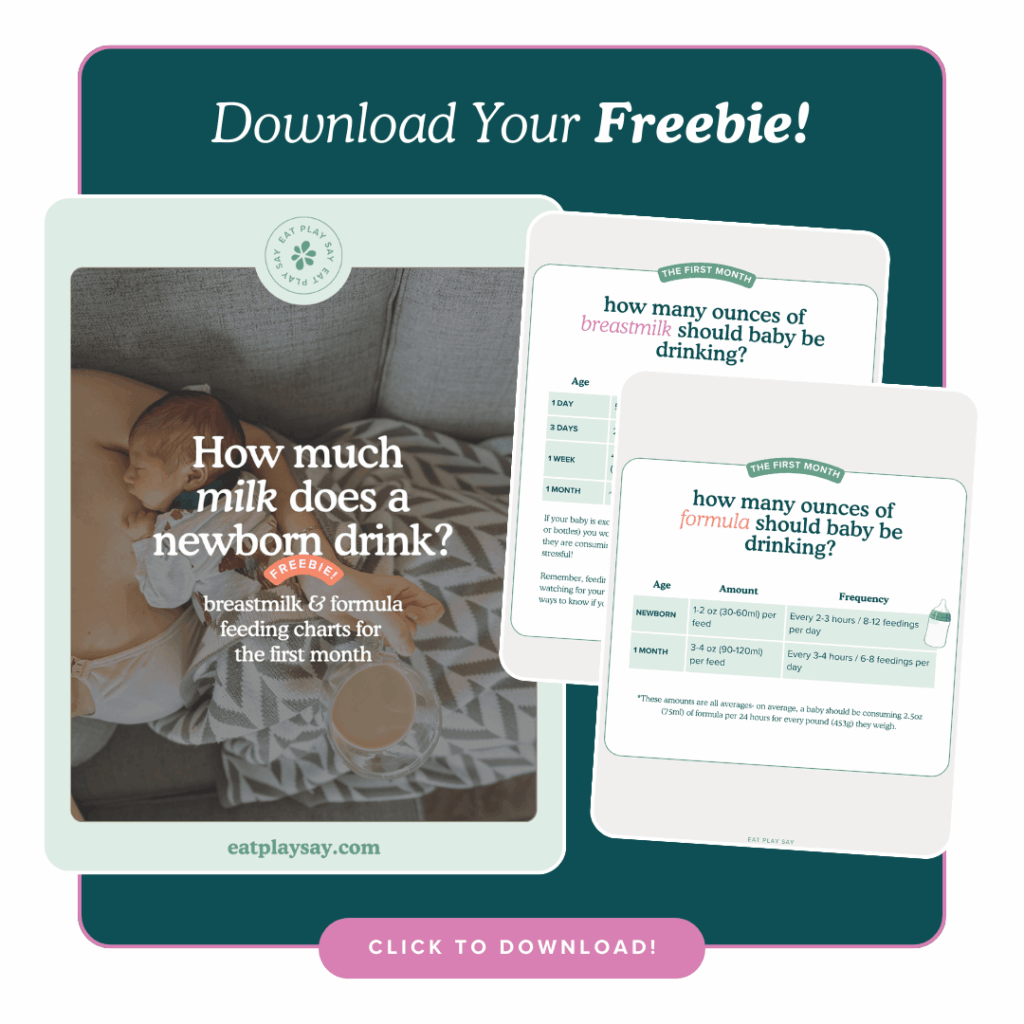
Download our Newborn Feeding freebie that details out how much and how often your baby should eat!
Why does my baby feed a lot?
Newborns clusterfeed a lot in the first few weeks. It’s totally normal, and doesn’t automatically mean a low milk supply! Clusterfeeding is defined as baby eating more frequently than every 2-3 hours. Sometimes it means they are feeding every hour for a period of time. While this is exhausting, it’s great for establishing a mother’s milk supply and it’s needed for those early growth spurts!
Your newborn usually needs to feed frequently in small amounts. They should be feeding at least 8-12 times in 24 hours, which equates to about ‘every 2-3 hours’. (3)
Following your baby’s hunger cues is more important than watching the clock. It may take some time, but you will know exactly when your baby needs to feed.
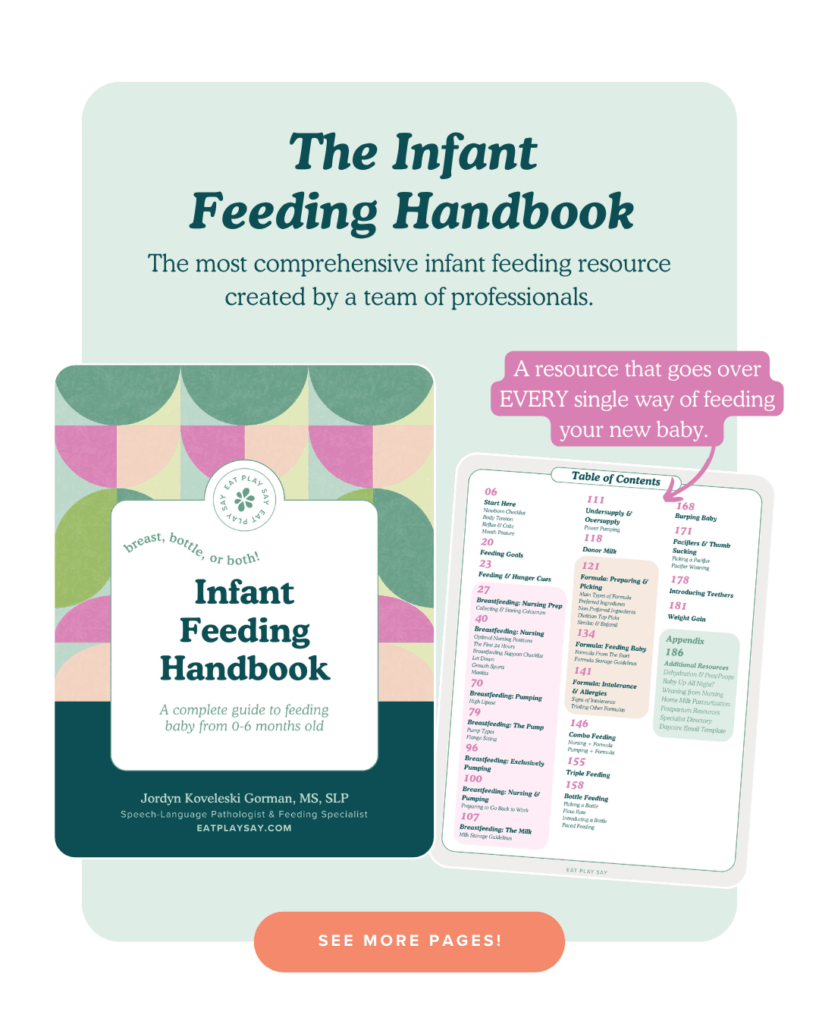
To learn everything you need to know about feeding your baby in the first six months, whether you’re breastfeeding, pumping, or formula feeding, check out our Infant Feeding Handbook!
Sources:
- Hetherington, M. M., & McNally, J. E. (2019). Reading appetite cues in infancy: A role for nutrition research and practice. In Appetite: Development, Dysregulation and Modelling (pp. 45-60).
- Hodges, E. A., Wasser, H. M., Colgan, B. K., & Bentley, M. E. (2016). Development of feeding cues during infancy and toddlerhood. MCN: The American Journal of Maternal/Child Nursing, 41(4), 244-251.
- Zimmerman, D., Whalen, B., & Alers, S. (2023). ABM Clinical Protocol #37: Physiologic Infant Care. Breastfeeding Medicine, 18(4), 223-231.
Leave a Reply
OTHER POSTS YOU MAY LIKE:




MS, SLP
Founder of Eat Play Say, Speech-Language Pathologist, Feeding Specialist, Play Expert, Mom of 3
Jordyn Koveleski Gorman
SPECIALIZES IN: Infant and toddler speech-language, play, and feeding development, and curating a team that provides expert help that feels like a reassuring text from that one mom friend
EDUCATION: Jordyn received her BS in Speech-Language Pathology from Bloomsburg University and her MS in Speech-Language Pathology from Towson University
FAVE PARENTING FIRST: “The first true smile, it’s the sweetest!”

MS, CCC-SLP, CBS, IBCLC
Speech-Language Pathologist & Feeding Specialist, Certified Breastfeeding Specialist, International Board Certified Lactation Consultant
Jessica Nicholson Cocca
SPECIALIZES IN: Breast and bottle feeding, tongue ties, oral motor dysfunction, starting solids, infant and toddler speech, treating oral motor disorders
EDUCATION: Jessica received her BS in Communication Sciences and Disorders from Pennsylvania State University in 2015 and her MS in Speech-Language Pathology from Towson University in 2017
FAVE PARENTING FIRST: “Baby’s first wave! What a fun first communication gesture!”

MA, CCC-SLP, CLC
Speech-Language Pathologist, Certified Lactation Counselor
Jennifer McFarlin
SPECIALIZES IN: Breast and bottle feeding, tongue ties, starting solids, infant and toddler speech development
EDUCATION: She received her BS in Speech-Language Pathology from Ball State in 2014 and a MA in Speech-Language Pathology from Ball State in 2016.
FAVE PARENTING FIRST: “My favorite baby’s first is their first true smile that just warms your soul knowing they are smiling at you. My other favorite is their first word. I love watching their language explode!”

MS, CCC-SLP
Bilingual Speech-Language Pathologist
Nicole La Petina Kelly
SPECIALIZES IN: Bilingual development (Spanish-English), supporting multilingual families, infant and toddler speech
EDUCATION: She received her BA in Communication Sciences and Disorders and in Spanish from the University of Wisconsin-Madison in 2014 and her MS in Speech-Language Pathology with an English-Spanish Specialization from Marquette University in 2016.
FAVE PARENTING FIRST: “It’s the first slobbery kisses for me!”

RDN, LD
Licensed Registered Dietitian
Kimberly Vede
SPECIALIZES IN: Infant and pediatric nutrition including breastfeeding, formula feeding, and starting solids. She also specializes in prenatal and postpartum nutrition.
EDUCATION: She received her BSc in Biology in 2014 from Life University, and her BSc in Dietetics from Life University in 2019.
FAVE PARENTING FIRST: ”The first time they say ‘mama!’”


This checklist was created with input from a Speech-Language Pathologist, Occupational Therapist and Physical Therapist and has been downloaded over 20,000 times by parents worldwide. Learn the important milestones to pay attention to, and keep it in your digital back pocket during the baby + toddler years!
Comprehensive Milestone Checklist for gross motor, fine motor, and speech-language milestones for 0-36 months,
DOWNLOAD FOR FREE


